Category Archives

36 Articles

Smart CSA Pricing That Makes Customers Want More (Farm-Tested Psychology)

Posted by darrell on
0
Business and Economic Impact
Smart CSA Pricing That Makes Customers Want More (Farm-Tested Psychology)

Price psychology shapes every purchasing decision your customers make, far beyond the simple exchange of dollars for produce. When farmers understand these psychological triggers, they transform their CSA pricing from a basic cost-plus calculation into a powerful marketing tool that drives both sales and customer satisfaction.

Consider how a $597 CSA share feels more carefully calculated and value-driven than a rounded $600 price point. Or how offering three distinct share sizes – small, medium, and premium – naturally guides customers toward your most profitable middle option through the decoy effect.

The most successful CSA farmers leverage these psychological principles daily: anchoring high-value items first to make standard shares appear more attractive, creating urgency through early-bird pricing, and building perceived value through transparent cost breakdowns. These aren’t just pricing tactics – they’re ways to communicate your farm’s worth while helping customers feel confident in their investment.

Whether you’re launching your first CSA season or fine-tuning an established program, understanding the psychology behind pricing decisions helps you create offers that resonate with customers while maintaining healthy profit margins. The key lies in aligning these proven psychological principles with your farm’s unique value proposition and your community’s needs.

The Psychology Behind CSA Share Pricing

Value Anchoring: Setting the Right Reference Point

Just like a well-tended garden needs strong roots, your CSA pricing strategy needs a solid foundation in value anchoring. By presenting a higher-priced option first, you create a reference point that makes your standard share prices feel more reasonable to potential members. For example, if you introduce a premium “Chef’s Box” at $45 per week before showing your regular share at $35, customers are more likely to view the regular share as a good value.

Many successful CSA farmers use the “good-better-best” approach. They might offer a basic share, a standard family share, and a premium share with add-ons like eggs or flowers. This strategy works because it gives customers options while anchoring the value of your produce at a sustainable price point.

Consider highlighting the retail value of individual items in your share. When members see that their $35 weekly box would cost $50+ at the farmers market, they better appreciate the value you’re providing. Remember to emphasize the quality, freshness, and unique varieties they can’t find elsewhere – these factors help justify and reinforce your pricing structure.

Side-by-side comparison of premium and basic CSA vegetable shares showing value difference
Split screen comparison showing premium vs standard CSA share contents

The Power of Price Bundling

Bundling farm-fresh products into different share sizes and combinations creates powerful psychological benefits for both farmers and customers. When CSA members can choose between various package options, they feel more in control of their purchasing decisions and perceive greater value. For example, offering a “Family Share,” “Couple’s Share,” and “Single Share” helps customers find the perfect fit for their needs while maximizing farm revenue.

Combining popular items with less familiar vegetables in thoughtfully designed bundles encourages culinary exploration and reduces food waste. Many successful farms also incorporate flexible CSA credit programs that allow members to customize their selections within certain parameters.

Consider creating themed bundles like “Salad Lover’s Box” or “Seasonal Soup Kit” to appeal to specific customer preferences. These specialized options often command premium prices while providing clear value propositions. Remember to highlight the cost savings of bundled shares compared to individual item pricing – this reinforces the perceived value and encourages longer-term commitment to your CSA program.

Seasonal Pricing Strategies That Work

Visual chart displaying CSA membership tiers and early registration savings
Infographic showing tiered CSA pricing structure with early bird discounts

Early Bird Incentives

Early bird incentives tap into powerful psychological triggers that motivate customers to commit sooner rather than later. By offering a thoughtful discount for early sign-ups, CSA farms can create a win-win situation that benefits both the farm and members. When members commit early, farms gain valuable planning advantages and improved cash flow through these advance payment solutions.

The key is structuring your early bird offer to create genuine urgency without appearing pushy. Consider offering a 10-15% discount for members who sign up at least 8-12 weeks before the season starts. This timing gives you ample planning runway while still feeling achievable for members.

Many successful CSA farms layer their early bird incentives, offering the best savings to the earliest commitments, then gradually reducing the discount as the season approaches. For example, you might offer:
– 15% off for sign-ups 12+ weeks early
– 10% off for sign-ups 8-11 weeks early
– 5% off for sign-ups 4-7 weeks early

This tiered approach maintains momentum throughout your pre-season period while rewarding your most enthusiastic supporters. Remember to clearly communicate deadlines and make the sign-up process simple. When members see genuine value in early commitment, they’re more likely to become loyal, long-term supporters of your farm.

Peak Season Pricing Adjustments

Every farmer knows that the ebb and flow of seasons brings both abundance and scarcity, and your pricing strategy should reflect these natural cycles. During peak harvest times, when tomatoes are bursting on the vine and zucchini seems endless, consider offering bulk discounts or special “preservation packs” that encourage customers to stock up and preserve the bounty.

Conversely, during lean periods like early spring or winter, when produce is more precious, implementing a slight price increase reflects the true value and effort required to grow off-season crops. Many successful CSA farmers have found that transparency about these seasonal adjustments helps customers understand and appreciate the pricing structure.

For example, the Peterson Family Farm in Vermont offers a 15% discount on bulk purchases during August’s tomato peak but maintains premium pricing for their coveted winter greens. They communicate these changes through their newsletter, explaining the reasoning behind price fluctuations and sharing preservation tips.

Remember that your core CSA members often understand these seasonal dynamics better than occasional market customers. Consider offering them special rates or first access to abundant crops, reinforcing their commitment to supporting your farm year-round. This approach not only manages inventory effectively but also strengthens community bonds and customer loyalty.

Implementing a flexible pricing system that responds to seasonal abundance helps prevent waste while maintaining profitability during challenging growing periods.

Building Customer Loyalty Through Smart Pricing

Member Rewards Programs

Member rewards programs are a powerful tool in your CSA pricing strategy toolkit, creating a win-win situation for both farmers and members. When thoughtfully designed, these programs tap into customers’ desire for exclusive benefits while supporting crucial member retention strategies.

Consider offering tiered membership levels that provide increasing benefits based on commitment length or share size. For example, “Gold Members” who commit to a full year might receive bonus items during peak harvest, priority access to limited products, or exclusive workshop invitations. This approach creates aspirational value while encouraging longer-term commitments.

Early-bird pricing offers another effective reward mechanism. Members who sign up before a specific date might receive a discount or additional produce credits, helping with early-season cash flow while making members feel savvy about their purchase decision.

Point systems can transform regular purchases into rewarding experiences. Members might earn points for consistent participation, referrals, or volunteering at farm events. These points could be redeemed for farm merchandise, additional produce, or special farm experiences.

Remember to make your rewards tangible and meaningful. Instead of generic discounts, offer benefits that connect members more deeply to your farm – like members-only harvest events or first access to seasonal specialties. This approach not only enhances perceived value but also strengthens the community bonds that make CSA programs special.

Farmer rewarding long-term CSA member with loyalty program benefits
Happy CSA member receiving their weekly share while farmer checks off loyalty points

Flexible Payment Plans

Offering flexible CSA payment models can significantly boost member satisfaction and retention rates. When members have options for how they pay, they’re more likely to commit to longer-term relationships with your farm. Many successful CSA farms offer a variety of payment schedules, from full upfront payments to monthly installments, each designed to accommodate different financial situations.

Consider implementing a tiered payment system where members who pay in full at the beginning of the season receive a meaningful discount, while those who prefer monthly payments maintain the standard rate. This approach rewards early commitment while remaining accessible to those who need payment flexibility.

Some farms have found success with bi-weekly payment options that align with their members’ paycheck schedules. Others offer sliding scale prices based on income levels, making fresh, organic produce accessible to more community members while allowing those who can pay more to support the farm’s mission.

Digital payment platforms have made it easier than ever to manage multiple payment schedules. Setting up automatic recurring payments reduces administrative work while providing convenience for members. Remember to clearly communicate payment deadlines and options, and consider offering early-bird specials to encourage early sign-ups and better cash flow planning for your farm operations.

Real Success Stories: Pricing Psychology in Action

Let’s explore how real farms have successfully implemented psychological pricing strategies to grow their businesses and better serve their communities.

The Green Valley Farm in Oregon transformed their CSA program by introducing tiered pricing. Owner Sarah Martinez noticed that offering three price points – $425, $495, and $595 for a seasonal share – actually increased overall participation. The middle tier became their most popular option, while the premium tier attracted customers who valued exclusive add-ons like farm-to-table dinners and cooking classes. This strategy led to a 40% increase in membership within one season.

Sweet Meadows Farm in Vermont experimented with anchor pricing by first presenting their premium “Farm Champion” share at $750, making their standard $495 share appear more attractive. Owner Tom Reynolds reports that this approach not only improved sales of the standard share but also resulted in unexpected interest in the premium option from customers who perceived its added value.

In Michigan, River Creek Gardens successfully implemented the power of number psychology. By changing their weekly share price from $30 to $29.95, they saw a 15% increase in new sign-ups. They also offered an early-bird special of $489 instead of $500 for full-season shares, which created a sense of urgency and resulted in 70% of their memberships being secured before the growing season began.

Perhaps the most innovative approach comes from Sunshine Organic Farm in California. They introduced a “pay-what-you-can” tier alongside their standard pricing, with suggested prices ranging from $400 to $600. This strategy not only made their produce accessible to more community members but also resulted in an average payment of $525 – higher than their previous fixed price of $475.

The Common Ground Farm Collective demonstrates the power of bundle pricing. By offering a “Summer Celebration Bundle” that combined their regular CSA share with additional u-pick flowers and herbs at $595 (valued at $700 separately), they created a perceived higher value that resonated with customers seeking a more complete farm experience.

These success stories share common threads: transparent communication about value, thoughtful price positioning, and a deep understanding of their target market’s preferences. Each farm adapted psychological pricing principles to their unique situation while maintaining authenticity and building stronger connections with their communities.

Implementing psychological pricing strategies in your CSA program doesn’t have to be complicated. By understanding and applying these key principles, you can create pricing structures that benefit both your farm and your customers. Remember that transparency builds trust – always communicate the value behind your pricing clearly to your members.

Start by analyzing your current pricing and identifying opportunities to incorporate psychology-based techniques. Consider testing anchor pricing by offering different share sizes, or implement the power of 9 endings where appropriate. However, maintain authenticity – your pricing should reflect the true value of your organic produce while remaining competitive in your local market.

Take small steps when implementing changes. Begin with one or two strategies and measure their effectiveness through customer feedback and retention rates. Pay attention to how your members respond to different pricing presentations and be ready to adjust your approach accordingly.

Don’t forget the power of storytelling in justifying your prices. Share the journey of your produce from seed to harvest, highlighting the care and sustainable practices that go into growing each crop. This narrative helps customers understand and appreciate the value they’re receiving.

Most importantly, keep your pricing strategy aligned with your farm’s values and your community’s needs. When done thoughtfully, psychological pricing can help create a win-win situation where customers feel good about their purchase while supporting sustainable local agriculture.

Remember to regularly review and refine your pricing strategy as your farm grows and market conditions change. Success comes from finding the right balance between profitability and customer satisfaction.

How YC SAFE Agreements Are Transforming Small Farm Funding

Posted by darrell on
0
Business and Economic Impact
How YC SAFE Agreements Are Transforming Small Farm Funding

The YC SAFE (Simple Agreement for Future Equity) has revolutionized how early-stage startups secure funding, offering a streamlined alternative to traditional convertible notes. Created by Y Combinator in 2013, this standardized investment tool has become the gold standard for seed-stage fundraising, allowing founders to defer complex equity discussions while quickly securing essential capital.

Unlike traditional financing methods, SAFE agreements eliminate interest rates and maturity dates, creating a clearer path forward for both investors and entrepreneurs. The agreement’s beauty lies in its simplicity: investors provide capital now in exchange for the right to purchase equity during a future priced round, typically when the company raises a larger investment.

For farm owners and agricultural enterprises exploring flexible funding options, SAFE agreements present a compelling opportunity to access capital without immediately diluting ownership or taking on debt. The straightforward terms and standardized structure make it particularly attractive for agriculture-focused startups seeking to scale their operations while maintaining operational control during crucial growth phases.

This modern financing instrument bridges the gap between traditional agricultural lending and conventional startup funding, offering a practical solution for innovative farming enterprises looking to grow sustainably.

Why SAFE Agreements Matter for CSA Farms

Traditional Farm Funding vs. SAFE Agreements

Traditional farm funding often relies on bank loans, which can be challenging for small-scale farmers to secure due to strict collateral requirements and rigid repayment schedules. These conventional methods may not align well with the seasonal nature of farming income or the unique needs of Community Supported Agriculture (CSA) operations that support local farmers.

SAFE agreements offer a more flexible alternative, allowing farmers to receive immediate funding without the pressure of monthly payments or the need to give up significant control of their operation. Unlike traditional loans, SAFE agreements convert to equity only when specific conditions are met, such as a future funding round or revenue milestone.

For farmers, this means they can focus on growing their operation without the immediate burden of debt service. The investor shares in the farm’s success through future equity, creating a more aligned partnership. This model particularly benefits seasonal operations, as it doesn’t require regular payments during low-income periods, making it an attractive option for growing CSA programs and sustainable farming initiatives.

Visual comparison between traditional farm lending and SAFE agreement financing methods
Split screen comparison showing traditional bank loan process vs SAFE agreement process

Key Advantages for Small Farmers

SAFE agreements offer unique advantages for small-scale farmers looking to grow their CSA operations. Unlike traditional loans, these agreements don’t burden farmers with immediate debt repayment obligations, allowing them to focus on crop cultivation and business development. Farmers maintain full operational control while receiving the capital needed for essential investments like greenhouse construction, irrigation systems, or equipment upgrades.

For seasonal operations, the flexibility of SAFE agreements aligns perfectly with agricultural cash flow patterns. Farmers can receive funding during planting seasons when expenses are highest, without worrying about monthly payments during slower periods. This structure helps preserve working capital for critical farming activities.

The simplified paperwork and straightforward terms make SAFE agreements particularly attractive for busy farmers who don’t have time for complex financial negotiations. Additionally, these agreements often come with valuable mentorship opportunities and connections to networks of sustainable agriculture supporters.

Small farmers also appreciate that SAFE agreements can be customized to their specific needs, with terms that respect the unique challenges of agricultural businesses and local food systems. This flexibility helps create a more sustainable funding model for growing CSA operations.

Understanding SAFE Agreement Basics

Diagram illustrating the main elements and structure of a SAFE agreement for farms
Infographic showing key components of a SAFE agreement with farm-themed icons

Essential Terms and Components

A SAFE (Simple Agreement for Future Equity) agreement consists of several key components that farm owners should understand before implementation. The core elements include the investment amount, which is the initial funding provided, and the valuation cap, which sets the maximum company value for converting the investment into equity. These work alongside modern payment solutions to create a flexible funding structure.

The discount rate is another crucial element, typically ranging from 10-20%, which gives investors a reduced price when converting their investment to equity compared to future investors. The most favored nation (MFN) provision ensures investors receive the best terms offered to any subsequent SAFE holders.

The trigger events specify when the SAFE converts to equity, usually during a priced equity round or exit event. The pro-rata rights determine whether investors can participate in future funding rounds to maintain their ownership percentage.

For CSA farms, understanding the post-money valuation structure is essential, as it clearly defines how ownership will be calculated upon conversion. The dissolution rights outline what happens to the investment if the farm ceases operations, typically giving investors rights to any remaining assets after other obligations are met.

These components work together to create a balanced agreement that protects both the farm’s interests and the investors’ capital while providing the flexibility needed for agricultural growth.

Valuation Caps and Conversion Events

In a SAFE agreement, the valuation cap sets the maximum price at which your investment will convert to equity, protecting your stake from potential dilution if the company’s value skyrockets. Think of it as a friendly handshake that ensures early supporters get a fair deal when the big moment arrives.

Conversion events are the triggers that transform your SAFE investment into actual company ownership. The most common trigger is when the farm or agricultural business raises a “priced round” of financing, typically from larger investors or venture capital firms. At this point, your investment converts to equity shares based on either the valuation cap or the discount rate, whichever gives you the better deal.

Another important conversion event is an acquisition or merger. If another company buys the farm business, your SAFE typically converts just before the sale, making you a shareholder in time to benefit from the transaction. Some SAFEs also include provisions for conversion during initial public offerings (IPOs), though this is less common in the farming sector.

For sustainable agriculture ventures, these terms are particularly important because they balance the need for patient capital with fair returns for early supporters who believe in regenerative farming practices. The valuation cap and conversion terms should reflect both the farm’s growth potential and the meaningful impact it aims to create in the local food system.

Implementing SAFE Agreements in Your CSA

Getting Started with SAFE

Starting your journey with a SAFE agreement begins with understanding the basic requirements and preparing essential documentation. First, you’ll need to determine your farm’s valuation and the amount of funding you’re seeking. This helps establish the foundation for your economic impact and growth potential.

Begin by consulting with a legal advisor who understands agricultural businesses and startup financing. They can help you customize the SAFE template to fit your CSA’s specific needs while maintaining its core benefits. You’ll need to prepare financial projections, including revenue forecasts and growth plans, to share with potential investors.

Next, identify your target investors. These might include community members, local food advocates, or impact investors interested in sustainable agriculture. Create a clear presentation that outlines your farm’s mission, operational model, and how the SAFE investment will support your growth.

Before finalizing any agreements, ensure you have:
– A completed SAFE template
– Clear terms for conversion scenarios
– Written valuation cap
– Investment amount specifications
– Rights and obligations documentation

Remember to maintain open communication with your investors throughout the process. Many successful CSAs have found that transparency builds trust and leads to stronger long-term relationships with their investment community.

Farmer and investors discussing SAFE agreement terms at a farmhouse table
Small farm owner reviewing SAFE agreement documents with investors

Common Pitfalls to Avoid

When navigating YC SAFE agreements, several common pitfalls can catch farmers and CSA operators off guard. First, failing to fully understand the valuation cap and its implications for future fundraising rounds can lead to unexpected dilution of ownership. Many farmers rush into signing without properly calculating how different scenarios might affect their equity position.

Another frequent mistake is not clearly documenting all terms and expectations, especially regarding conversion triggers and rights. Some farmers assume verbal agreements or handshake deals will suffice, but this can lead to complications down the road. It’s essential to have everything in writing and reviewed by a legal professional familiar with agricultural financing.

Be cautious about accepting investment terms that might limit your operational flexibility. Some SAFE agreements may include restrictive covenants that could affect your ability to make crucial farming decisions or pursue additional funding sources when needed.

Watch out for misalignment between investor expectations and your farm’s natural growth timeline. Agriculture operates on seasonal cycles, and returns may take longer to materialize compared to traditional startups. Make sure investors understand and accept this reality before finalizing any agreements.

Lastly, don’t overlook the importance of maintaining clear communication channels with investors throughout the process. Regular updates about farm operations and financial performance help build trust and prevent misunderstandings that could complicate future negotiations.

SAFE agreements represent a game-changing opportunity for Community Supported Agriculture ventures seeking flexible financing solutions. By combining the innovative approach of Y Combinator’s investment model with the unique needs of small-scale farming operations, these agreements offer a path forward that benefits both farmers and investors.

The success stories we’ve seen from farms implementing SAFE agreements demonstrate their potential to revolutionize CSA financing. Farmers appreciate the straightforward terms and delayed valuation aspects, while investors are drawn to the potential for supporting sustainable agriculture while maintaining financial upside.

For CSA operators considering funding options, SAFE agreements provide a middle ground between traditional loans and complex equity arrangements. They offer the flexibility needed to weather seasonal fluctuations and the simplicity required for small-scale operations. The standardized format reduces legal costs and negotiations, making them particularly attractive for farmers who want to focus on growing food rather than paperwork.

Looking ahead, we expect to see increased adoption of SAFE agreements in the CSA community. As more farmers share their positive experiences and investors recognize the value of supporting local food systems, these agreements could become a standard tool for sustainable agriculture financing. The combination of financial innovation and agricultural wisdom creates a promising foundation for the future of community-supported farming.

Remember, while SAFE agreements aren’t perfect for every situation, they represent an important addition to the farming finance toolkit, especially for operations committed to organic practices and community engagement.

Smart SaaS Solutions That Make CSA Management Actually Simple

Posted by darrell on
0
Business and Economic Impact
Smart SaaS Solutions That Make CSA Management Actually Simple

Transform your CSA farm’s subscription management with modern SaaS solutions that streamline operations and enhance customer satisfaction. Today’s digital platforms offer agricultural businesses powerful tools to automate payment processing, manage member communications, and track produce distributions – all while maintaining the personal touch that makes CSA programs special.

For farm operators juggling multiple subscription tiers and seasonal offerings, SaaS platforms provide the flexibility to create customized membership plans, from weekly vegetable boxes to monthly fruit shares. These systems seamlessly integrate with existing farm management software, allowing you to sync harvest schedules with delivery routes and maintain real-time inventory control.

The shift toward digital subscription management isn’t just about convenience; it’s about growing your farm’s business sustainably. Modern SaaS solutions offer detailed analytics, helping you understand member preferences, reduce waste, and optimize crop planning while building stronger connections with your community through automated yet personalized communications.

Why Traditional CSA Payment Methods Fall Short

Traditional CSA payment methods often rely on seasonal or monthly cash payments, paper checks, or basic electronic transfers, creating challenges for both farmers and members. Many farms struggle with tracking payments, managing member records, and maintaining consistent cash flow throughout the growing season.

Members face their own set of hurdles, including the inconvenience of remembering payment due dates and having to use outdated payment methods. Some find it difficult to make large upfront payments at the start of the season, while others struggle with the inflexibility of fixed payment schedules that don’t align with their personal budgets.

The manual nature of traditional payment systems also leads to administrative headaches. Farmers spend valuable time processing payments, sending payment reminders, and reconciling accounts – time that could be better spent in the fields or connecting with their community. Additionally, paper-based systems make it challenging to maintain accurate records and can lead to payment tracking errors.

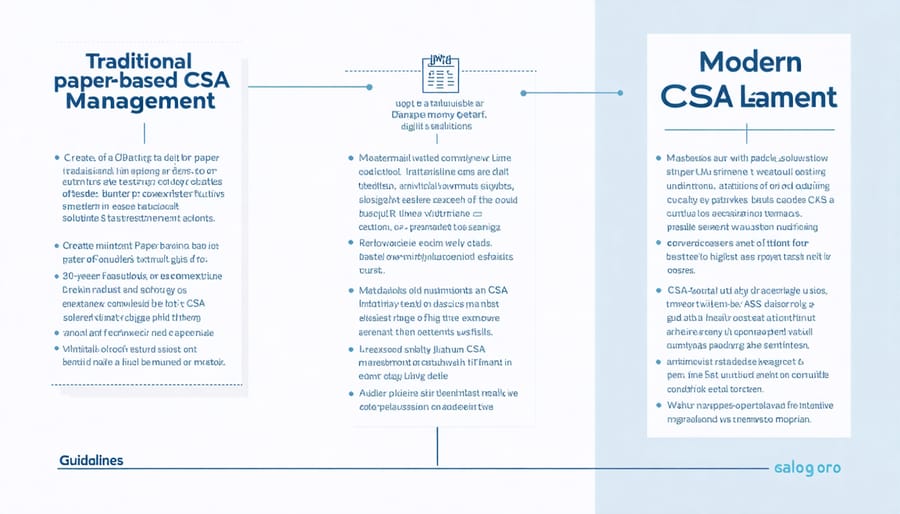
Fortunately, modern payment solutions are transforming how CSA farms handle subscriptions and payments. These tools offer features like automated billing, flexible payment plans, and real-time tracking that benefit both farmers and members while fostering stronger, more sustainable CSA programs.

Comparison between old paper-based CSA management and modern digital management system
Split-screen comparison showing traditional paper-based CSA management vs modern digital solutions

Modern SaaS Solutions for CSA Subscription Management

User interface of a CSA management software showing member tracking, payment processing, and inventory management
Dashboard interface mockup showing key CSA management features

Member Management Features

Modern SaaS subscription platforms offer robust features to help CSA farms effectively manage their member base and streamline operations. These systems typically include member portals where subscribers can update their preferences, access delivery schedules, and manage their accounts independently. Communication tools enable farmers to send automated notifications about harvest updates, pickup reminders, and special announcements, helping to maintain member loyalty through consistent engagement.

Share tracking capabilities allow farms to monitor vegetable allocations, track seasonal distributions, and manage different share sizes efficiently. Many platforms also include customizable reporting features that provide insights into member participation rates, payment histories, and share preferences. This data helps farmers make informed decisions about crop planning and member satisfaction.

Additional features often include waitlist management, automated renewal processes, and flexible payment scheduling options. Some platforms even offer recipe sharing capabilities and member feedback systems, creating a more interactive and engaging experience for CSA participants while reducing administrative workload for farm staff.

Payment Processing Options

Modern SaaS platforms offer CSA farms diverse ways to handle payments, making it easier than ever to manage member subscriptions efficiently. These platforms typically support multiple payment methods, including credit cards, ACH transfers, and digital wallets, allowing farms to provide flexible payment options that work for all members.

Most subscription management systems integrate seamlessly with popular payment processors like Stripe, Square, and PayPal, enabling secure transactions and automated billing. This automation reduces administrative work while ensuring consistent cash flow for farm operations. Many platforms also offer features like pro-rated billing for mid-season joiners, automatic renewal processing, and the ability to handle seasonal payment adjustments.

For farms offering tiered memberships or add-on products, these systems can manage multiple pricing levels and recurring billing cycles. Members can often self-manage their payment information through secure portals, updating credit card details or changing payment methods as needed.

Important features to look for include:
– Automatic payment retry for failed transactions
– Custom billing cycles (weekly, monthly, or seasonal)
– Multi-currency support for farms serving different regions
– Secure payment data storage
– Real-time transaction reporting
– Integration with accounting software

These platforms also help farms maintain compliance with payment security standards while providing detailed transaction histories and financial reports. This transparency helps both farmers and members track their financial relationships effectively, building trust and reducing payment-related communication needs.

Choosing the Right Subscription Model

Seasonal vs. Year-Round Models

When it comes to CSA farm subscriptions, timing is everything. Many farms operate with two distinct subscription models: seasonal and year-round offerings. Seasonal subscriptions typically align with your growing season, running from spring through fall in most regions. This model works particularly well for farms in areas with distinct growing seasons and allows you to focus your resources during peak production times.

Year-round subscriptions, on the other hand, require more planning but can provide steady income throughout all seasons. These models often incorporate storage crops, greenhouse production, and partnerships with other local producers to maintain consistent variety during winter months. Some successful farms combine both approaches, offering premium pricing for year-round commitments while maintaining flexibility with seasonal options.

To implement these models effectively, consider using modern subscription management software that can handle both recurring and fixed-term memberships. These platforms can automate payment processing, manage member communications, and help you track inventory across different subscription timeframes.

Many CSA farmers find success in offering early-bird discounts for seasonal subscriptions and loyalty rewards for year-round members. This approach helps secure early-season capital while building a committed customer base. Remember to clearly communicate the differences between your subscription options, including delivery schedules, produce variety expectations, and pricing structures to help members choose the best fit for their needs.

Flexible Share Options

Customizable share options are essential for modern CSA programs, allowing farmers to meet diverse customer needs while maintaining operational efficiency. Start by offering basic size variations like individual, family, and large family shares, then consider adding specialized options such as fruit-only shares or meal-kit style boxes.

Many SaaS platforms now support flexible customization features that let members modify their boxes week-to-week. You can set up systems allowing subscribers to swap items, add extras, or pause deliveries when needed. This flexibility helps reduce waste and increases customer satisfaction, as members can adjust their shares based on their changing needs.

Consider implementing a points-based system where subscribers can allocate their share value across different products. This works particularly well for farms with diverse offerings beyond vegetables, such as eggs, honey, or value-added products. The software can track these selections and automatically generate picking lists for your team.

To manage this effectively, establish clear deadlines for customization requests and set minimum order values. Your system should automatically close customization windows and send reminder emails to members. Many platforms also offer waitlist management features for popular add-on items.

Remember to balance flexibility with your farm’s capacity. While customization is valuable, too many options can complicate operations. Start with a few well-chosen customization features and expand based on member feedback and your ability to fulfill requests efficiently.

Farmer using digital tools to manage CSA operations in an agricultural setting
Farmer using tablet to manage CSA subscriptions while standing in field

Implementation Success Stories

Green Acres Farm in Vermont revolutionized their CSA program by implementing Harvie, a specialized SaaS platform for farms. Within their first season, they increased member retention by 40% and reduced administrative work by 15 hours per week. The platform’s automated payment processing and customizable delivery schedules allowed them to focus more on farming and less on paperwork.

Fresh Fields Family Farm in California partnered with Farmigo to streamline their subscription management. Their success story highlights how they grew from 50 to 200 members in just one year, thanks to the platform’s user-friendly interface and flexible subscription options. Members particularly appreciated the ability to customize their weekly boxes and manage their subscriptions through a mobile app.

Root & Branch Organics in Colorado implemented Local Food Marketplace, transforming their traditional CSA into a hybrid model. The software enabled them to offer both standard shares and à la carte purchasing options. This flexibility resulted in a 60% increase in customer satisfaction and helped them attract younger, tech-savvy customers who preferred digital management of their subscriptions.

These farms reported that the initial investment in SaaS solutions paid for itself within the first season through reduced administrative costs, decreased food waste, and increased member satisfaction. The key to their success was choosing platforms that aligned with their specific needs and taking time to properly train both staff and members on the new systems.

SaaS subscription models have revolutionized the way CSA farms manage their operations, offering a win-win solution for both farmers and their members. By adopting these digital platforms, farmers can spend less time on administrative tasks and more time nurturing their crops and connecting with their community. The automated payment processing, member management, and communication tools streamline daily operations, reducing errors and improving overall efficiency.

These modern solutions also enhance the member experience through user-friendly interfaces, flexible payment options, and convenient subscription management. Members appreciate the ability to customize their shares, pause deliveries when needed, and communicate directly with their farmers through integrated messaging systems.

For CSA operators, the switch to SaaS platforms often leads to increased member retention, better cash flow management, and valuable data insights that help inform farming decisions. The scalability of these systems means farms can grow their membership base without being overwhelmed by administrative burden.

Most importantly, these digital tools help preserve the intimate farmer-member relationship that makes CSA programs special, while modernizing the experience for today’s tech-savvy consumers.

How CSA Credit Programs Make Farm-Fresh Food More Accessible

Posted by darrell on
0
Business and Economic Impact
How CSA Credit Programs Make Farm-Fresh Food More Accessible

Transform your local food purchasing experience with the innovative 4 Cs Credit system, a flexible payment model revolutionizing how CSA payments support local farmers while ensuring sustainable food access for communities. This credit-based approach allows members to pre-purchase “credits” worth various amounts of produce, creating a win-win scenario where farmers receive reliable upfront funding and consumers enjoy the freedom to customize their weekly harvest selections. Unlike traditional CSA models with fixed boxes, the 4 Cs system (Choose, Collect, Credit, Connect) empowers members to control their food choices while maintaining the direct farmer-to-consumer relationship that makes local agriculture thrive. Whether you’re a seasoned CSA participant or new to supporting local farms, this innovative payment structure offers the perfect blend of flexibility and commitment to sustainable food systems.

Understanding the 4 Cs Credit System

How Credit Points Work

Credit points in CSA programs offer a flexible way for members to manage their farm share payments. Each credit point typically represents a dollar value that can be used towards purchasing produce throughout the season. Members can load their accounts with points at the beginning of the season or opt for regular top-ups using modern payment solutions.

When selecting produce, members simply deduct points based on current market values. For example, a basket of tomatoes might cost 10 points, while a bunch of herbs could be 5 points. This system allows members to customize their selections while helping farmers track inventory and plan harvests more effectively.

Unused points usually roll over to the next week or month, depending on the farm’s policy. Some CSAs offer bonus points for early-season commitments or bulk purchases, creating additional value for members who support their local farmers.

Visual diagram of CSA credit system showing how food items correlate to point values
Infographic showing credit point system with vegetables and fruit icons connected to point values

Flexibility and Benefits

The 4 Cs credit system offers remarkable flexibility for both members and farmers throughout the growing season. Unlike traditional CSA models, members can choose exactly what produce they want each week, ensuring they get items their families will actually use and enjoy. This credit-based approach allows you to skip weeks when you’re on vacation without losing value, and you can even purchase extra items when hosting special events or planning to preserve the harvest.

For families with changing schedules or dietary preferences, the ability to customize weekly selections is invaluable. You might opt for extra tomatoes during canning season or load up on winter squash for holiday cooking. Some farms even allow credits to roll over to the following season, providing added value and peace of mind. Many members appreciate being able to share credits with friends or family when they have excess, creating a more sustainable and community-oriented food system.

Implementing 4 Cs Credit in Your CSA Membership

Family choosing vegetables from CSA shares while farmer manages digital credit system
Happy family selecting fresh produce at a CSA pickup point while farmer checks their credit balance on a tablet

Managing Your Credits

Keeping track of your CSA credits doesn’t have to be complicated. Start by creating a simple spreadsheet or using a dedicated mobile app to monitor your credit balance throughout the season. Many CSA members find it helpful to set weekly reminders to check their balance and plan their pickups accordingly.

Make the most of your credits by staying informed about seasonal availability. When certain crops are abundant, consider using extra credits to stock up for preservation through freezing or canning. If you’re running low on credits, prioritize high-value items like specialty vegetables or fruits that tend to be more expensive at regular markets.

Some helpful strategies include sharing credits with a neighbor when you’re away, requesting credit rollover options during slower weeks, and communicating with your farmer about upcoming harvest schedules. Many CSA programs offer online portals where you can view your balance and upcoming harvests, making it easier to plan your credit usage.

Remember to document any special arrangements or credit adjustments made with your farmer for future reference. This helps prevent misunderstandings and ensures you’re maximizing the value of your CSA investment.

Seasonal Planning

Effective seasonal planning is crucial for maximizing the value of your 4 Cs credit throughout the growing season. Start by mapping out your farm’s production schedule, identifying peak harvest periods and potential gaps in produce availability. This foresight allows members to strategically use their credits when abundance is highest, often leading to better value for their investment.

Consider implementing a weighted credit system where certain items or seasons offer bonus value. For example, during the height of tomato season, members might get a 10% credit bonus when purchasing bulk quantities for preservation. This approach has proven successful in maintaining long-term CSA membership while helping farms manage surplus effectively.

Many successful farms also offer early-season planning sessions where members can work with farmers to align their credit usage with personal needs and seasonal availability. This collaborative approach helps members maximize their credit value while ensuring farms can plan their growing seasons more effectively, creating a win-win situation for everyone involved.

Success Stories and Real-World Examples

Meet Sarah from Green Valley Farm, who transformed her small family operation using the 4 Cs credit system. Within just two growing seasons, she built a loyal community of 75 members who appreciated the flexibility of credits. “Our members love being able to skip weeks when they’re on vacation and double up on produce when hosting family gatherings,” Sarah shares.

The Thompson family, long-time CSA members, found the credit system perfect for their busy lifestyle. “With three kids in sports, some weeks we needed more vegetables than others. The credit system lets us adjust our pickups to match our schedule,” explains Lisa Thompson.

Rising Sun Farm in Colorado implemented the credit system after members requested more flexibility. Owner Mike Chen reports a 40% increase in member retention and a 25% growth in new sign-ups. Their innovative approach allows members to use credits for both regular produce boxes and special items like honey and eggs.

Another success story comes from Urban Roots Community Farm, which serves a diverse metropolitan area. They’ve used the credit system to accommodate varying household sizes and dietary preferences. “Some members save credits for preservation-ready bulk purchases in late summer, while others maintain steady weekly pickups,” notes farm manager Diana Rodriguez.

These real-world examples demonstrate how the 4 Cs credit system benefits both farmers and members, creating sustainable relationships that support local agriculture while meeting modern families’ needs for flexibility and choice.

The 4 Cs credit system offers a win-win solution for both farmers and CSA members, providing flexibility, financial stability, and a stronger sense of community connection. By adopting this innovative payment model, farms can better manage their cash flow while members enjoy greater choice in how they participate in their local food system. Success stories from farms across the country demonstrate how this system has helped build more resilient and sustainable agricultural communities.

Whether you’re a farmer looking to modernize your CSA program or a member seeking more flexible payment options, the 4 Cs credit approach offers a practical solution that adapts to modern needs while preserving the core values of community-supported agriculture. Consider implementing this system to strengthen your farm-community relationships and create a more sustainable future for local agriculture. The combination of choice, convenience, and community support makes the 4 Cs credit system a valuable tool for evolving CSA programs.

Smart Ways to Cut Your CSA Farm’s Delivery Costs (Without Compromising Quality)

Posted by darrell on
0
Business and Economic Impact
Smart Ways to Cut Your CSA Farm’s Delivery Costs (Without Compromising Quality)

Managing logistical costs can make or break your farm sustainability, with transportation and distribution often consuming up to 40% of operational expenses. Smart route optimization reduces fuel costs by 25-30%, while strategic delivery hub placement cuts last-mile expenses significantly. Local food aggregation partnerships among small farms decrease individual delivery burdens, creating economies of scale that benefit everyone involved.

Modern tracking systems and delivery analytics reveal hidden cost-saving opportunities, transforming data into actionable insights for better resource allocation. By implementing efficient cold chain management and minimizing product loss during transit, farms can protect their margins while maintaining produce quality. These practical solutions not only boost profitability but also strengthen relationships with CSA members through reliable, cost-effective delivery services.

The key to managing logistics isn’t just about cutting costs—it’s about building resilient systems that scale with your operation while keeping quality and customer satisfaction at the forefront.

Why Transportation Costs Matter for Your CSA

Farm workers loading colorful produce boxes into a delivery van
Delivery van loaded with CSA produce boxes being packed at a farm

The Hidden Costs of CSA Delivery

While CSA farms often focus on growing great produce, transportation costs can significantly impact the bottom line. Fuel expenses typically account for 15-20% of delivery costs, varying with route efficiency and delivery radius. Vehicle maintenance, including regular servicing, tire replacements, and unexpected repairs, can add another 10-15% to operational expenses.

Labor costs for delivery drivers and route planners are often overlooked but crucial components. These can represent 30-40% of delivery expenses, especially when considering time spent organizing routes and maintaining member satisfaction through reliable delivery schedules.

Additional hidden costs include vehicle insurance, parking fees, and specialized equipment like coolers or insulated boxes to maintain produce freshness. These seemingly minor expenses can add up to 10-15% of total delivery costs. Weather-related delays and traffic conditions may also increase fuel consumption and labor hours, creating unexpected budget variations throughout the season.

Smart route planning and investing in fuel-efficient vehicles can help minimize these costs while maintaining service quality. Some CSAs have found success in establishing central pickup points to reduce individual delivery stops.

How Logistics Affect Your Farm’s Bottom Line

For most small-scale farms, logistics can account for 20-30% of total operating costs, making it one of the biggest factors affecting profitability. These expenses include transportation, storage, packaging materials, and labor hours spent on distribution activities. When you break it down, fuel costs alone typically represent 8-12% of a farm’s monthly expenses.

Take Sarah’s Garden, a thriving organic farm in Vermont, for example. By analyzing their logistics costs, they discovered that delivery routes were eating up nearly 25% of their revenue. After optimizing their delivery schedule and consolidating drop-off points, they reduced these costs to 18%, resulting in a significant boost to their bottom line.

The impact of logistics on pricing is equally important. For every dollar spent on transportation and handling, farmers typically need to add $1.50-$2.00 to their product prices to maintain healthy profit margins. This means efficient logistics aren’t just about saving money – they’re about staying competitive in the market while ensuring fair prices for customers.

Smart logistics management can be the difference between a farm that struggles and one that thrives. By tracking these costs carefully and making strategic adjustments, you can significantly improve your farm’s financial health.

Practical Solutions for Efficient Delivery

Route Planning Strategies That Work

Planning efficient delivery routes is like solving a puzzle that can significantly impact your bottom line. Start by grouping your deliveries by geographical zones and time windows to minimize backtracking and fuel consumption. Many successful CSA farmers use mapping software or apps to optimize their routes, saving both time and fuel costs.

Consider using the “hub and spoke” method, where you establish central pickup points in different neighborhoods. This approach lets you serve multiple customers in one stop while building community connections. For example, local coffee shops or community centers often make excellent pickup hubs.

Factor in variables like traffic patterns, delivery time preferences, and seasonal road conditions when planning routes. Keep detailed records of delivery times and distances to identify opportunities for improvement. Some farmers find success by offering incentives to customers who choose pickup locations that fit efficiently into existing routes.

Remember to build flexibility into your schedule for unexpected delays or last-minute changes. Having a backup plan for vehicle breakdowns or weather-related issues helps maintain reliable service while keeping costs predictable.

Digital map showing efficient CSA delivery routes with marked stops
Map visualization showing optimized delivery routes with multiple drop-off points

Drop-off Points vs. Home Delivery

Drop-off points and home delivery each offer unique benefits and cost considerations for CSA operations. Drop-off points, where multiple members collect their shares from a central location, can significantly reduce delivery costs by consolidating multiple deliveries into one stop. This model typically saves 30-40% in fuel and labor costs compared to individual home deliveries.

However, home delivery provides a premium service that many members are willing to pay extra for, especially busy families and urban professionals. While it increases operational costs through additional fuel usage and delivery time, farms can offset these expenses by implementing delivery fees or minimum order requirements.

Many successful CSAs use a hybrid approach, offering both options to cater to different member preferences. For example, some farms provide free pickup at central locations while charging an additional fee for home delivery. This flexibility allows farms to maintain profitability while meeting diverse customer needs.

When choosing between these models, consider factors like member density in delivery areas, staff availability, and vehicle costs. Some farms partner with local businesses or community centers to create convenient drop-off points, building valuable community connections while keeping costs manageable.

Farmer in field using digital tablet showing delivery management software
Farmer using tablet to manage delivery logistics with route planning app

Technology Tools for Better Logistics

In today’s digital age, there’s no need to break the bank when it comes to managing your CSA’s logistics. Several affordable tech solutions can help streamline your operations and reduce costs significantly.

Route planning apps like RouteXL and Circuit offer free or low-cost options to optimize delivery routes, saving both time and fuel. These user-friendly tools can handle multiple stops and adjust routes based on traffic conditions, helping you serve more members efficiently.

For delivery management, consider using simple spreadsheet templates or basic delivery management systems like Local Food Marketplace. These tools help track customer preferences, delivery schedules, and product inventory without requiring extensive technical knowledge.

Many CSA farmers have found success using messaging apps like WhatsApp or Signal to create delivery groups, making it easy to communicate last-minute changes or delivery updates to members. These free tools can replace costly communication systems while maintaining personal connections with your community.

Cloud-based management platforms like Harvie or Small Farm Central offer comprehensive solutions specifically designed for CSA farms. While these might require a modest investment, they often pay for themselves by reducing administrative time and improving member satisfaction.

For those just starting, even basic tools like Google Maps and Calendar can make a significant difference in organizing deliveries and planning routes. The key is to start with what you need most and gradually add more tools as your operation grows.

Effectively managing logistical costs is crucial for the long-term success and sustainability of any CSA operation. By implementing the strategies discussed throughout this article, farmers can significantly reduce their operational expenses while maintaining high-quality service to their members. Start by analyzing your current processes and identifying areas where efficiency can be improved. Consider adopting route optimization software, investing in proper storage solutions, and exploring partnerships with other local producers.

Remember that small changes can lead to substantial savings over time. Whether it’s consolidating delivery routes, implementing a more efficient packaging system, or reducing food waste through better inventory management, every optimization contributes to your bottom line. Don’t hesitate to involve your CSA members in cost-saving initiatives – many will appreciate transparency and may even offer valuable suggestions.

Success stories from farms like Green Valley CSA and River Road Farm demonstrate that systematic cost reduction is achievable without compromising product quality or member satisfaction. Take action today by choosing one or two strategies to implement immediately, then gradually incorporate others as your systems evolve. Your commitment to efficiency will not only benefit your farm’s financial health but also contribute to a more sustainable local food system.

Turn Your CSA’s Economic Impact into Growth: Smart Tools That Show Your True Value

Posted by darrell on
0
Business and Economic Impact
Turn Your CSA’s Economic Impact into Growth: Smart Tools That Show Your True Value

Transform your farm’s economic story into compelling data using today’s most effective economic impact studies and analysis tools. Calculate your direct community impact through IMPLAN software, tracking local job creation, supplier relationships, and worker spending patterns. Measure indirect benefits by documenting farmers’ market sales multipliers, regional food distribution networks, and agritourism revenue streams. Quantify your farm’s ecosystem services value using the InVEST toolkit to showcase environmental contributions alongside financial metrics.

These accessible tools help small-scale farmers demonstrate their true worth beyond simple revenue figures, speaking directly to community stakeholders and grant makers. Modern impact analysis transforms complex economic relationships into clear, actionable insights that strengthen funding applications and community partnerships. Whether you’re launching a new CSA or expanding existing operations, these measurement tools illuminate your farm’s role in building a resilient local economy.

Economic Impact Tools That Work for Small Farms

IMPLAN: Making Complex Data Simple

IMPLAN (Impact Analysis for Planning) makes understanding your farm’s economic impact as simple as harvesting ripe tomatoes. This user-friendly software transforms complex economic data into clear, meaningful insights that show how your CSA farm contributes to the local economy.

Think of IMPLAN as a digital map that traces every dollar spent at your farm as it flows through the community. When you buy seeds from local suppliers, hire workers, or sell produce at farmers’ markets, IMPLAN captures these transactions and shows their ripple effects. For example, your farm workers might spend their wages at local restaurants, creating additional economic activity.

For CSA farmers, IMPLAN can demonstrate your farm’s value beyond just produce sales. It calculates direct impacts (like your farm’s revenue), indirect impacts (such as business with local suppliers), and induced impacts (spending by your employees in the community). This data helps when applying for grants, securing loans, or showing community stakeholders the real value of supporting local agriculture.

Many successful CSA farms use IMPLAN to tell their economic story effectively, making it easier to gain community support and grow their operations.

IMPLAN software dashboard displaying economic impact analysis charts and graphs
Computer screen showing IMPLAN software interface with economic data visualization

Local Food Economics Toolkit

The USDA’s Local Food Economics Toolkit is a game-changing resource for farmers and food system organizers looking to measure their economic impact on local communities. This user-friendly toolkit combines data collection methods, analysis frameworks, and real-world case studies to help you tell your farm’s economic story effectively.

The toolkit offers step-by-step guidance for measuring various impacts, including job creation, income generation, and multiplier effects in your local economy. What makes it particularly valuable is its flexibility – whether you’re running a small CSA or managing a regional food hub, you can adapt the tools to fit your needs.

Local farmers like Sarah Martinez in Vermont have used the toolkit to demonstrate their farm’s $2.3 million annual economic contribution to their county, helping secure community support and local government backing. The toolkit includes customizable spreadsheets, survey templates, and clear instructions for calculating both direct sales impacts and ripple effects throughout the community.

Best of all, it’s completely free and available online, making it accessible to farmers of all scales and experience levels.

Real Numbers That Tell Your Story

Direct Sales Impact Tracking

When measuring your farm’s economic impact, tracking direct sales is like following the ripples in a pond – it all starts with that first splash! For CSA farms, direct sales tracking involves carefully monitoring revenue from CSA memberships, farmers’ market sales, and on-farm purchases.

Start by maintaining detailed records of all transactions, including the number of CSA shares sold, weekly market earnings, and direct-to-consumer purchases. Many farmers find success using simple spreadsheet templates or user-friendly point-of-sale systems designed specifically for small farms.

Consider tracking these key metrics:
– Total revenue from each sales channel
– Number of customers served
– Average purchase value
– Seasonal sales patterns
– Product-specific performance

Sarah Johnson, a successful CSA farmer in Vermont, shares: “By tracking our direct sales carefully, we discovered that offering half-shares brought in 40% more members and increased our overall revenue by 25%.”

Remember to document both monetary and non-monetary transactions, such as work-share arrangements or produce donations to local food banks. This comprehensive approach helps paint a complete picture of your farm’s direct economic contributions to the community.

For best results, review your sales data monthly and analyze trends seasonally. This regular assessment helps identify opportunities for growth and allows you to make informed decisions about crop planning and pricing strategies.

Circular diagram illustrating how CSA dollars circulate through different local businesses and services
Infographic showing money flow from CSA farm through local economy

Community Multiplier Effects

When CSA members invest in local farms, their dollars create a ripple effect that helps transform local economies in powerful ways. This multiplier effect occurs as money circulates through various local businesses and service providers, creating additional economic value with each transaction.

For example, when CSA farmers receive payment from members, they typically spend a significant portion locally – purchasing seeds from nearby suppliers, hiring local farm workers, or buying equipment from area dealers. These businesses, in turn, use that income to pay their employees and make their own local purchases, continuing the cycle.

Studies show that every dollar spent at a CSA farm generates between $1.80 and $2.40 in local economic activity. This is significantly higher than money spent at conventional grocery stores, where much of the revenue leaves the community through corporate supply chains.

To measure these effects, farmers can use simple tracking tools like spending logs and local vendor lists. More comprehensive analysis might include surveying local businesses about their farm-related income or partnering with local economic development offices to conduct detailed impact studies.

By understanding and documenting these multiplier effects, CSA farms can better demonstrate their vital role in building resilient local economies and securing community support for their operations.

Putting Your Data to Work

Building Community Support

Economic impact data serves as a powerful tool for building strong community relationships and fostering local support for your CSA farm. When you can clearly demonstrate how CSA payments support local farmers and benefit the broader community, you create compelling reasons for stakeholders to invest in your success.

Start by sharing your economic impact findings with local business associations, community organizations, and government officials. Present data showing job creation, local spending patterns, and multiplier effects in easy-to-understand formats like infographics or short reports. These materials can help potential partners visualize their role in strengthening the local food economy.

Consider organizing community events where you can present your farm’s economic impact alongside tastings of your produce. This combination of data and direct experience helps people connect emotionally with your mission while understanding its practical benefits. Partner with local schools and colleges to create educational programs that highlight sustainable agriculture’s economic advantages.

Remember to regularly update your impact measurements and share success stories through social media and newsletters. When community members see concrete evidence of their support making a difference, they’re more likely to become long-term advocates for your farm.

CSA farmer showing economic impact charts to local business leaders and government officials
Farmer presenting economic impact data to community stakeholders

Securing Financial Resources

Economic impact data can be a powerful tool for securing financial resources for your farm. When applying for grants, loans, or other funding opportunities, having concrete numbers that demonstrate your farm’s positive impact on the local economy can significantly strengthen your case. Start by organizing your economic data into clear, compelling narratives that highlight job creation, local spending, and community benefits.

Many grant-making organizations and financial institutions look favorably upon businesses that can quantify their community impact. Include specific metrics like the number of local jobs supported, total annual local purchases, and the multiplier effect of your farm’s spending in the local economy. Consider creating a simple one-page impact summary that showcases these key figures.

Success story: Sweet Meadows Farm secured a $50,000 grant by demonstrating how their CSA program generated $175,000 in annual economic activity within their county. They highlighted their partnerships with local businesses, employment of seasonal workers, and educational programs for school children.

Remember to tailor your economic impact presentation to each funding source’s specific interests. Some may prioritize job creation, while others focus on environmental benefits or food security. Keep your data current and verify all figures to maintain credibility with potential funders.

Economic impact analysis tools are invaluable assets for CSA farms and local food producers looking to demonstrate their value to the community. By implementing these tools effectively, you can showcase your farm’s contribution to the local economy, strengthen relationships with stakeholders, and make data-driven decisions that benefit both your operation and the community.

Remember that you don’t need to be an economist to start measuring your impact. Begin with simple metrics like tracking local spending and job creation, then gradually incorporate more sophisticated tools as your comfort level grows. Consider partnering with local universities or agricultural extension offices for guidance and support in your analysis efforts.

Take action today by selecting one or two tools that align with your farm’s goals and capacity. Whether you’re seeking grant funding, building community support, or planning for expansion, understanding and communicating your economic impact can open new doors for your agricultural enterprise. Your farm’s success story isn’t just about growing food – it’s about growing a stronger, more resilient local economy.

Together, we can build a more sustainable and economically vibrant food system, one analysis at a time.

CSA Farm Success: Market Penetration vs Development (Real Strategies That Work)

Posted by darrell on
0
Business and Economic Impact
CSA Farm Success: Market Penetration vs Development (Real Strategies That Work)

Growing a CSA farm demands strategic choices between deepening existing customer relationships and expanding into untapped territories. Market penetration focuses on selling more shares to current customers and maximizing referrals within your established community, while market development involves reaching entirely new customer segments or geographical areas. Both strategies offer distinct advantages for CSA operators, but choosing the right path requires careful evaluation of your farm’s resources, operational capacity, and long-term vision.

For established CSA farms, increasing market penetration might mean offering premium shares to loyal members or introducing value-added products to boost revenue from existing customers. Meanwhile, market development could involve expanding delivery zones, partnering with workplace wellness programs, or targeting new demographics through tailored share options.

The key to success lies not in choosing one strategy exclusively, but in finding the right balance that aligns with your farm’s growth stage, available resources, and community needs. Smart CSA operators often combine elements of both approaches, using current customer insights to guide expansion while strengthening their core market presence.

Comparison of two CSA market stalls showing different levels of market penetration
Split screen showing a densely packed farmers market stall (left) versus a sparsely attended one (right), illustrating market penetration potential

Market Penetration: Deepening Your Local Roots

Maximizing Existing Customer Base

When it comes to growing your CSA farm business, making the most of your existing customer base is often more cost-effective than seeking new markets. The key is to focus on strategies that keep CSA members coming back while encouraging them to increase their share sizes.

Start by creating strong relationships with your current members through regular communication. Share weekly newsletters featuring farm updates, cooking tips, and storage advice for their produce. Consider hosting member-only events like farm tours, harvest festivals, or cooking demonstrations that deepen their connection to your farm.

Implement a referral program that rewards existing members for bringing in new subscribers. This not only helps grow your membership but also strengthens loyalty among current members. Offer early-bird discounts for next season’s shares and consider flexible payment plans to make renewal more attractive.

To increase share sizes, introduce add-on options like eggs, honey, or flowers. Many members appreciate the convenience of getting more products from a trusted source. Create different share sizes to accommodate varying household needs, and make it easy for members to upgrade mid-season if they find they want more produce.

Remember to regularly collect feedback through surveys and casual conversations. This helps you understand what your members value most and allows you to adjust your offerings accordingly, ensuring high retention rates and sustained growth.

Converting Local Food Enthusiasts

Converting casual food enthusiasts into loyal CSA members requires a deep understanding of what drives their purchasing decisions. Start by engaging with your existing customer base through weekly farmers’ market conversations and social media interactions. Share compelling stories about your farming practices, seasonal crop varieties, and the positive environmental impact of supporting local agriculture.

Create educational content that highlights the benefits of CSA membership over occasional market purchases. Host farm tours and cooking demonstrations that showcase the versatility of your produce and build personal connections. Consider offering “trial” CSA boxes during peak seasons to give potential members a taste of the experience without a long-term commitment.

Leverage the power of word-of-mouth marketing by implementing a referral program that rewards existing members for bringing in new subscribers. Use customer testimonials and success stories to demonstrate the value of CSA membership, focusing on aspects like improved cooking skills, healthier eating habits, and connection to the farming community.

Partner with local wellness professionals, cooking instructors, and nutritionists to create value-added programming exclusively for CSA members. This might include seasonal recipe collections, meal planning workshops, or preservation classes that help members make the most of their weekly shares.

Remember, converting local food enthusiasts isn’t just about selling produce – it’s about cultivating a community of supporters who share your vision for sustainable, local agriculture.

Market Development: Growing Beyond Your Borders

Reaching New Demographics

Reaching new demographics offers CSA farms exciting opportunities to expand their community impact and transform local economies. Consider targeting young families by offering kid-friendly farm events and educational programs that make organic farming accessible and fun. Many CSAs have found success connecting with health-conscious professionals through workplace delivery programs and wellness partnerships with local gyms and yoga studios.

Senior communities represent another untapped market segment, particularly those interested in fresh, nutritious produce and social connection. Consider offering smaller share sizes and convenient delivery options to accommodate their needs. Cultural communities may also present growth opportunities – explore adding heritage vegetables and traditional crops that appeal to specific ethnic groups in your area.

Local restaurants and small-scale food artisans can become valuable partners, especially those emphasizing farm-to-table dining. Consider creating special restaurant shares or collaborative events that showcase your produce in creative ways. Educational institutions, from elementary schools to universities, often seek partnerships for their dining services and nutrition programs.

Remember to tailor your communication and offerings to each demographic’s specific needs and values. Young families might prioritize convenience and education, while restaurants focus on consistency and quality. Start small with pilot programs to test new demographic segments before scaling up successful initiatives.

Geographic Expansion Tactics

When expanding your CSA’s geographic reach, start by mapping potential service areas that align with your delivery capabilities. Consider establishing satellite pickup locations in community hubs like local businesses, churches, or community centers. These partnerships can create win-win situations, bringing foot traffic to partner locations while providing convenient access points for your members.

Look for areas with demographics similar to your current successful markets – communities that value locally grown produce and sustainable agriculture tend to cluster. Natural food stores, yoga studios, and farmers’ markets can indicate neighborhoods receptive to CSA programs.

Many successful CSAs have found success with the hub-and-spoke model, where a central farm location serves as the main distribution point, with strategic pickup locations radiating outward. This approach allows for efficient route planning and helps maintain produce freshness during transport.

Consider testing new areas with pop-up markets or seasonal offerings before committing to year-round service. This lets you gauge interest and build relationships gradually. Some farms partner with existing CSAs in adjacent areas to share delivery routes and reduce logistics costs.

Remember to factor in drive times, fuel costs, and storage needs when planning expansion routes. Start with areas closest to your current operation and expand gradually to maintain quality control and member satisfaction. Building strong relationships with local community leaders can help facilitate smooth entry into new neighborhoods.

Geographic map showing CSA farm expansion into new service areas
Map visualization showing a CSA’s service area expanding from core location to new neighborhoods with delivery routes and pickup points
Diverse group of CSA members collecting their shares at a busy distribution point
Success story photo of thriving CSA farm with diverse customer base at pickup location

Real Success Stories: CSA Farms That Got It Right

Local Market Dominance

Green Valley Organics, a small CSA farm in Vermont, exemplifies the power of effective market penetration strategy. When faced with increasing competition from larger organic retailers, owner Sarah Mitchell chose to focus on deepening her presence in her existing local market rather than expanding geographically.

Sarah implemented several targeted initiatives to increase market share. She introduced a flexible payment plan for CSA memberships, making organic produce more accessible to budget-conscious families. The farm also developed strong partnerships with local restaurants and schools, providing fresh, seasonal produce while educating the community about sustainable farming practices.

To enhance customer loyalty, Green Valley Organics launched a mobile app for members to customize their weekly produce boxes and access recipe suggestions. They also started hosting monthly farm-to-table events, cooking demonstrations, and educational workshops, transforming their farm into a community hub for sustainable living.

The results were remarkable. Within two years, Green Valley Organics doubled their CSA membership, increased revenue by 75%, and achieved a 90% customer retention rate. Their success demonstrates how focusing on existing market opportunities through innovative solutions and community engagement can lead to substantial growth without geographic expansion.

The key takeaway from Green Valley’s experience is that sometimes the most effective growth strategy is to dig deeper rather than wider, nurturing existing relationships and maximizing local market potential.

Smart Expansion

Green Valley Organics, a small CSA farm in Vermont, exemplifies successful market development strategy in action. Starting with just 50 local subscribers in Burlington, the farm recognized untapped potential in neighboring communities that lacked access to fresh, organic produce.

Instead of solely focusing on increasing their Burlington customer base, they expanded their delivery routes to include three additional towns within a 30-mile radius. They also adapted their offering to meet the unique needs of these new markets. For example, they introduced workplace CSA pickup points for corporate professionals and partnered with local schools to provide educational farm tours.

The results were remarkable. Within two years, Green Valley Organics grew from 50 to 300 subscribers across four communities. They achieved this by:

– Conducting thorough market research to identify areas with high demand for organic produce
– Building relationships with community leaders and local businesses
– Creating targeted marketing campaigns highlighting their sustainable farming practices
– Developing flexible subscription options to accommodate different household sizes
– Establishing efficient delivery systems for each new location

This strategic expansion not only increased their revenue but also strengthened their brand reputation as a regional leader in sustainable agriculture. Their success demonstrates how careful market development can help small farms grow sustainably while maintaining their core values and quality standards.

Choosing between market penetration and market development for your CSA ultimately depends on your farm’s current position and growth goals. If you have a strong existing customer base but aren’t operating at full capacity, market penetration might be your best path forward. This strategy allows you to deepen relationships with current members and maximize your presence in familiar territory before taking on new challenges.

On the other hand, if you’ve saturated your local market or see untapped potential in nearby communities, market development could offer exciting growth opportunities. This approach requires more resources and planning but can lead to sustainable long-term growth through diversification.

Consider starting with market penetration if you’re a newer CSA or still building momentum in your current market. Once you’ve established a solid foundation and efficient operations, you can explore market development as a natural next step. Remember, success stories from both strategies show that either path can work – the key is choosing the one that aligns with your farm’s resources, capabilities, and vision for the future.

Many successful CSAs actually implement a hybrid approach, focusing primarily on one strategy while incorporating elements of the other to maintain flexibility and adaptability in our ever-changing local food landscape.

Keep Your CSA Members Coming Back: Proven Strategies That Build Lasting Relationships

Posted by darrell on
0
Business and Economic Impact
Keep Your CSA Members Coming Back: Proven Strategies That Build Lasting Relationships

Transform membership retention rates by implementing proven member retention strategies that create lasting connections. Build personalized communication channels through monthly newsletters, feedback surveys, and direct messaging platforms to maintain consistent engagement. Create exclusive member experiences by offering special events, behind-the-scenes tours, and members-only workshops that showcase your organization’s unique value. Develop a structured onboarding process that clearly outlines membership benefits, establishes expectations, and provides immediate access to resources. Nurture community bonds by facilitating peer-to-peer connections through social media groups, mentorship programs, and regular meetups. These foundational practices transform casual participants into long-term, committed members who actively contribute to your organization’s growth and success.

Creating an Exceptional CSA Experience

Quality and Variety That Keeps Members Excited

Maintaining member excitement throughout the season starts with delivering consistently high-quality produce that exceeds expectations. Develop rigorous quality control processes, from harvest timing to proper storage and handling, ensuring members receive fresh, vibrant produce every time. Consider implementing a multi-step inspection process before distribution, checking for optimal ripeness, appearance, and freshness.

Variety is equally crucial for keeping members engaged. Plan your crop rotation to include both reliable favorites and exciting specialty items that members might not find elsewhere. Introduce unique heirloom varieties or lesser-known vegetables alongside familiar staples. For example, pair traditional tomatoes with exotic varieties like Purple Cherokee or Green Zebra to spark curiosity and conversation.

Create anticipation by sharing upcoming harvest schedules and featuring “crop of the week” highlights in your communications. Include preparation tips and recipe suggestions for less familiar items to help members make the most of their shares. Consider offering “choice boxes” occasionally, where members can select preferences from available options.

Keep detailed records of member feedback about specific varieties and adjust your growing plans accordingly. This data-driven approach helps optimize your crop selection while maintaining an element of discovery. Remember that quality and variety work together – even the most unusual vegetable won’t excite members if it’s not at its peak freshness and flavor.

Finally, consider implementing a satisfaction guarantee, demonstrating your commitment to quality and building trust with your membership base.

Fresh organic vegetables and fruits beautifully arranged in wooden CSA share boxes
Diverse array of colorful seasonal produce arranged in CSA boxes

Communication That Builds Connection

Regular, meaningful communication forms the backbone of strong membership relationships. Start by establishing a consistent newsletter schedule that members can rely on. Whether weekly or monthly, include a mix of farm updates, upcoming harvest information, and practical tips for storing and preparing produce. Share authentic stories about your farm’s journey, challenges, and victories to help members feel connected to their food’s origin.

Personal engagement goes beyond mass communications. Consider implementing a text messaging system for time-sensitive updates about harvest days or weather-related changes. Create opportunities for two-way dialogue through member surveys and feedback sessions, showing that you value their input and are committed to improving their experience.

Social media can serve as a daily touchpoint, offering behind-the-scenes glimpses of farm life through photos and short videos. Use these platforms to celebrate the seasons, showcase your farming practices, and build anticipation for upcoming harvests.

Remember to segment your communications based on member preferences and engagement levels. New members might appreciate more educational content, while long-time supporters might enjoy more in-depth farming insights. Always maintain a warm, conversational tone that reflects your farm’s personality while keeping messages clear and actionable.

Make sure every communication adds value. Whether it’s sharing recipes featuring current harvest items, offering preservation tips, or providing updates on sustainable farming practices, each interaction should reinforce the benefits of membership and strengthen the connection between farm and table.

Building Community Around Your CSA

CSA members enjoying a community harvest celebration with activities and farm tours
Families participating in a farm harvest festival event

Farm Events That Foster Loyalty

Hosting exclusive member events creates memorable experiences that strengthen the connection between your farm and CSA members. Consider organizing seasonal harvest festivals where members can participate in traditional farming activities like apple picking or pumpkin harvesting. These hands-on experiences help members understand the community impact of local food while creating lasting memories.

Schedule educational workshops that teach valuable skills like preservation techniques, composting, or cooking with seasonal ingredients. These sessions not only provide practical value but also help members make the most of their CSA shares. Farm-to-table dinners featuring your produce create an intimate atmosphere where members can connect with fellow subscribers and your farming team.

Consider hosting family-friendly events like farm scavenger hunts or seasonal celebrations that welcome children to experience farm life. Photography days during peak growing seasons give members beautiful opportunities to document their farm connection while sharing their experiences on social media.

Keep events varied throughout the year to maintain engagement during all seasons. Winter planning sessions where members can provide input on crop selection make them feel invested in the upcoming growing season. Remember to capture these moments through photos and videos to share with your broader community, inspiring others to join your farm family.

Educational Opportunities That Add Value

Educational opportunities serve as powerful incentives for members to stay engaged and invested in your organization. Hands-on cooking classes showcase creative ways to prepare seasonal produce, helping members make the most of their weekly shares while building essential culinary skills. Farm workshops offer invaluable insights into organic growing practices, composting techniques, and seasonal planning, creating a deeper connection between members and their food source.

Consider offering specialized learning experiences like seed-saving workshops, food preservation classes, or children’s gardening programs. These educational events not only add practical value but also foster a sense of community among members who share similar interests. Host expert-led sessions on topics like sustainable living, herbal medicine, or backyard chicken keeping to diversify your educational offerings.

Document these learning experiences through photos and participant testimonials, sharing them in newsletters and social media to showcase the added value of membership. Create take-home materials or digital resources that members can reference later, extending the impact of each educational event. Remember to gather feedback after each session to continuously improve and tailor future offerings to member interests.

By providing these enriching learning opportunities, you transform simple membership into an ongoing journey of growth and discovery, giving members compelling reasons to maintain their connection with your organization.

Smart Systems for Member Satisfaction

Flexible Payment and Pickup Options

Making it easy for members to pay and collect their shares is crucial for long-term retention. Successful CSA payment structures offer multiple options to accommodate different budgets and lifestyles. Consider implementing both upfront seasonal payments and monthly installment plans, with early-bird discounts to encourage early commitments.

Digital payment methods like automatic bank transfers, credit cards, and mobile payment apps make transactions seamless for tech-savvy members. For those preferring traditional methods, continue accepting checks and cash. Some farms find success with sliding scale payments or work-trade arrangements, making fresh produce accessible to more community members.

Flexible pickup windows are equally important. Offer multiple collection times throughout the week, including early morning and evening slots for working members. Consider establishing satellite pickup locations in convenient areas like community centers or partner businesses. For busy members, coordinate with local delivery services or implement a buddy system where members can alternate pickup duties.

Don’t forget to accommodate vacation schedules by allowing members to temporarily redirect their shares to friends or food banks. Some farms offer makeup boxes for missed pickups or allow members to double up the following week. Clear communication about these options through a user-friendly online system helps members feel supported and valued, increasing their likelihood of returning season after season.

Screenshot of user-friendly CSA membership portal showing pickup schedules and payment options
Mobile app interface showing CSA member dashboard

Feedback Systems That Drive Improvement

Effective feedback systems are the cornerstone of continuous improvement in member satisfaction and retention. Start by implementing regular surveys that go beyond basic satisfaction metrics to uncover specific areas where your organization can enhance the member experience. Consider using a mix of quarterly digital surveys and annual in-depth questionnaires to gather both quick insights and detailed feedback.

Create multiple channels for members to share their thoughts, including suggestion boxes at pickup locations, feedback forms on your website, and direct conversations during farm events. Many successful CSAs host monthly “feedback circles” where members can share their experiences in a casual, supportive environment.

When you receive feedback, acknowledge it promptly and communicate your action plan clearly. For example, if members express interest in more recipe variety, respond by creating a weekly recipe newsletter featuring creative ways to use seasonal produce. Track feedback patterns to identify recurring themes and prioritize improvements accordingly.

Remember to close the feedback loop by sharing how member input has shaped positive changes. This could be through your newsletter, social media updates, or during member meetings. When members see their suggestions implemented, they feel valued and invested in your organization’s success.

Consider establishing a member advisory board that meets quarterly to provide structured input on major decisions and strategic planning. This deeper level of engagement helps create advocates within your membership while ensuring decisions align with member needs.

Maintaining strong membership retention is vital for the long-term success of any CSA or farming organization. By implementing the strategies discussed throughout this article, you can create a thriving community that benefits both farmers and members alike. Remember that successful retention starts with delivering exceptional value through high-quality produce and engaging experiences, while building genuine connections within your community.

Regular communication, educational opportunities, and special events help create lasting bonds between members and your farm. When combined with efficient operational systems, flexible payment options, and responsive customer service, these elements form the foundation of a sustainable membership program.

The rewards of strong member retention extend far beyond financial stability. Loyal members become advocates for your farm, naturally attracting new participants through word-of-mouth recommendations. Their consistent support allows you to plan crop rotations more effectively and invest in farm improvements with confidence. Perhaps most importantly, retained members contribute to the rich community atmosphere that makes CSA programs so special.

Consider implementing these strategies gradually, measuring their effectiveness, and adjusting based on member feedback. Remember that building lasting relationships takes time and dedication, but the effort invested in member retention pays dividends through a more resilient and vibrant farming community. By focusing on member satisfaction and community building, you’re not just running a farm – you’re nurturing a sustainable food system that will thrive for years to come.

How Local Farms Transform Raw Materials into Economic Growth

Posted by darrell on
0
Business and Economic Impact
How Local Farms Transform Raw Materials into Economic Growth

Transform local agriculture by mastering the four fundamental factors of production that drive successful farming operations. From fertile soil to innovative farming techniques, these essential ingredients for farm success shape the foundation of sustainable food production. Small-scale farmers and agricultural entrepreneurs harness these elements daily: converting unused land into thriving market gardens, optimizing labor through smart scheduling and volunteer programs, leveraging equipment and infrastructure investments, and implementing creative business strategies that connect fresh produce with eager consumers. Understanding how these production factors interact within local food systems reveals practical opportunities for both aspiring farmers and established growers to enhance their agricultural ventures while strengthening community food security.

Land: The Foundation of Local Agriculture

Sustainable Land Management

Sustainable land management practices are essential for maintaining long-term agricultural productivity and increasing land value. Smart farmers know that healthy soil is the foundation of successful farming, and they implement various techniques to preserve and enhance it. Crop rotation stands out as a time-tested method, where different crops are planted in sequence to maintain soil fertility and prevent nutrient depletion.

For example, Cedar Grove Farm in Vermont rotates corn with nitrogen-fixing legumes, which naturally replenish soil nutrients and reduce the need for synthetic fertilizers. This practice has helped them increase their land’s value by 15% over five years while maintaining consistent crop yields.

Conservation methods like no-till farming and cover cropping protect topsoil from erosion and improve soil structure. These practices also boost organic matter content, enhancing the land’s water retention capacity and reducing irrigation needs. Many successful farms complement these methods with composting and natural mulching, creating a sustainable cycle that builds soil health year after year.

The result? Healthier crops, lower input costs, and steadily appreciating land values that benefit both current operations and future generations.

Bird's eye view of a local farm with varied crop fields, irrigation systems, and soil conservation features
Aerial view of a diversified small farm showing crop rotation patterns and sustainable land management practices

Economic Benefits of Small-Scale Farming

Small-scale farming creates ripple effects that boost local economies in surprising ways. When farmers efficiently use small plots of land for organic produce, nearby property values often see a noticeable increase. Communities with thriving small farms tend to attract young professionals and families seeking fresh, locally-grown food and a connection to their food source.

Take Sarah’s story from Vermont: her two-acre organic farm not only provides income through direct sales but has helped transform her neighborhood into a desirable “farm-to-table” community. Local restaurants now feature her produce, creating additional jobs and drawing food tourists to the area. Property values in her vicinity have increased by 15% since she started farming five years ago.

Small farms also contribute to community development through farmers’ markets, food co-ops, and educational programs. These venues become social hubs, encouraging local spending and entrepreneurship. Studies show that every dollar spent at a small farm generates an additional $2.50 in local economic activity through employment, supply purchases, and increased foot traffic to nearby businesses.

By maximizing land use through intensive growing methods, small-scale farmers help preserve green spaces while creating sustainable economic growth for their communities.

Labor: The Human Element of Local Production

Farmers and agricultural workers learning to operate specialized farming equipment during a training session
Group of diverse farm workers receiving training on modern agricultural equipment

Job Creation and Skill Development

Local agriculture creates diverse employment opportunities while fostering valuable skill development in communities. From farm managers and field workers to market coordinators and value-added product specialists, each role contributes to a thriving agricultural ecosystem. Successful farms often partner with local schools and organizations to offer apprenticeships and training programs, helping cultivate the next generation of farmers and agricultural professionals.

Many organic farms provide hands-on learning experiences through seasonal internships, where participants gain practical skills in sustainable farming methods, crop planning, and business management. These programs not only create jobs but also ensure the preservation and transfer of traditional farming knowledge while incorporating modern sustainable practices.

The ripple effect extends beyond direct farm employment. Local food systems create positions in farmers’ markets, food processing, distribution, and agritourism. Additionally, the growth of farm-to-table restaurants and specialty food businesses generates opportunities for chefs, food artisans, and entrepreneurs who focus on locally sourced ingredients. This agricultural ecosystem helps build resilient local economies while providing meaningful work that connects people to their food system.

Community Engagement and Knowledge Transfer

Farm education programs and volunteer initiatives play a vital role in how CSA farms transform local economies through knowledge sharing and community building. These programs serve as practical training grounds where experienced farmers mentor newcomers in sustainable agricultural practices, creating a ripple effect of expertise throughout the community.

Local farms frequently host workshops covering essential topics like soil management, crop rotation, and organic pest control. These hands-on learning opportunities not only educate future farmers but also help consumers understand the value of locally grown produce. Volunteer programs allow community members to contribute their time while gaining practical experience in farming operations.

Many farms partner with schools and universities to offer internship programs, providing students with real-world experience in agricultural economics and sustainable farming practices. These partnerships often lead to innovation in farming techniques and create pathways for young people to enter the agricultural sector. The exchange of knowledge between experienced farmers and enthusiastic learners ensures the continuation of sustainable farming practices for future generations.

Capital: Investment in Local Food Systems

Equipment and Infrastructure

Modern farming success relies heavily on well-maintained equipment and robust infrastructure. Essential machinery includes tractors for plowing and harvesting, irrigation systems for efficient water management, and specialized tools for planting and crop maintenance. A local organic farm might invest in smaller-scale equipment like walk-behind tractors and precision seeders, which are perfect for intensive growing methods.

Storage facilities play a crucial role in preserving harvest quality. Climate-controlled storage units help maintain optimal temperature and humidity levels for different crops, while root cellars provide natural cooling for root vegetables and winter squash. Many successful farms also incorporate solar-powered cold storage units, combining sustainability with practical preservation needs.

Distribution networks connect farms to their markets through various channels. These include refrigerated delivery vehicles, packaging facilities, and strategic partnerships with local food hubs. Some innovative farms are embracing modern technology by implementing online ordering systems and establishing efficient delivery routes to serve their CSA members and restaurant clients.

Smart infrastructure planning helps reduce waste and improve operational efficiency. For example, strategically placed wash stations, packing sheds, and loading docks can significantly streamline the harvest-to-market process.

Financial Resources and Community Investment

Financial resources in local agriculture come from diverse sources, including traditional bank loans, USDA grants, crowdfunding campaigns, and community-supported agriculture (CSA) memberships. These funding streams act as vital capital inputs that enable farmers to purchase equipment, seeds, and necessary infrastructure.

When local farms receive financial support, it creates a powerful ripple effect throughout the community. For instance, when a small organic farm secures a $50,000 grant, they might purchase equipment from local suppliers, hire additional workers from the community, and increase their production capacity. This increased activity generates more local spending, tax revenue, and job opportunities.

Many successful farms combine multiple funding sources creatively. The Growing Roots Farm in Vermont started with a modest community investment of $15,000 and transformed it into a thriving operation that now supports 200 CSA members and provides produce to local restaurants. Their success demonstrates how initial capital investment, when combined with smart resource management, can multiply its impact through increased production and expanded market reach.

The key is viewing financial resources not just as money, but as a tool for building sustainable agricultural systems that benefit the entire community.

Entrepreneurship: Innovation in Local Agriculture

Value-Added Products

Local farmers are increasingly discovering innovative ways to transform their raw agricultural products into premium value-added items, significantly boosting their income potential. For example, apple orchards are creating artisanal cider, preserves, and dried fruit snacks from their harvest. Small dairy farmers are crafting specialty cheeses, yogurt, and ice cream, turning basic milk production into luxury dairy products that command higher prices at farmers’ markets.

Berry farmers are particularly successful in this arena, producing homemade jams, jellies, and fruit-infused vinegars. Some even partner with local bakeries to create farm-fresh pies and pastries. Herb growers are packaging dried herbs, creating custom tea blends, and producing essential oils from their crops.

Creative vegetable farmers are making pickled products, specialty sauces, and farm-fresh salsas. Others are offering value-added convenience by preparing pre-washed, cut, and packaged vegetables for busy families. These transformed products not only provide higher profit margins but also help farmers maintain steady income during off-seasons while reducing crop waste and creating distinctive brand identities in their local markets.

Colorful display of homemade jams, preserves, and other processed farm products at a local market
Farmer’s market stall displaying value-added products made from local farm produce

Direct Marketing Strategies

Local farmers are increasingly adopting innovative direct marketing strategies to connect with consumers and maximize their returns. CSA programs have become a cornerstone of sustainable farming, allowing producers to receive upfront payments while providing members with regular shares of fresh, seasonal produce. This model helps farmers better manage their cash flow and reduce market uncertainties.

Farmers markets serve as vibrant community hubs where producers can sell directly to consumers, eliminating middlemen and capturing full retail value for their products. These markets also provide valuable opportunities for farmers to build lasting relationships with customers and gather feedback about their products.

Local distribution networks have evolved to include restaurant partnerships, food co-ops, and online marketplaces. Many farmers now offer home delivery services or coordinate neighborhood pickup points, making fresh produce more accessible to busy families. Some innovative producers have even created farm-to-door subscription boxes, combining the convenience of delivery services with the personal touch of direct farmer relationships.

These direct marketing channels not only improve profit margins but also strengthen local food systems and create more resilient agricultural communities.

Local agriculture represents a powerful intersection of traditional economic factors and modern sustainability needs. Through efficient use of land, labor, capital, and entrepreneurship, local farms are proving to be vital economic engines in their communities. Success stories from small-scale farmers demonstrate how smart resource management can lead to profitable enterprises while supporting local food security.

The future of local agriculture looks promising, with increasing consumer demand for fresh, locally sourced produce creating new opportunities for growth. innovative farming techniques and direct-to-consumer sales models are helping farmers maximize their productivity while maintaining sustainable practices. This trend not only strengthens local economies but also creates jobs, preserves agricultural land, and reduces transportation costs associated with food distribution.

As we look ahead, the continued development of local food systems will likely play an increasingly important role in our economic landscape. By understanding and effectively managing the factors of production, local farmers can build resilient businesses that benefit both their communities and the environment. The success of these enterprises proves that sustainable agriculture can be both economically viable and environmentally responsible.

Simplify Your CSA Farm Payments: Modern Solutions That Work

Posted by darrell on
0
Business and Economic Impact
Simplify Your CSA Farm Payments: Modern Solutions That Work

Streamline your CSA farm’s payment processing with modern digital solutions that respect both your farm’s cash flow and your members’ convenience. Today’s Community Supported Agriculture programs thrive on flexible payment systems that transform traditional upfront seasonal payments into manageable monthly installments. Whether you’re managing a small urban farm or an established rural operation, implementing the right payment structure builds trust, increases member retention, and ensures steady revenue throughout the growing season.

Smart CSA operators now offer multiple payment channels – from traditional checks to mobile payments and automated recurring billing – creating an inclusive system that accommodates diverse member preferences. This strategic approach to payment management not only reduces administrative burden but also opens doors to younger, tech-savvy members while maintaining accessibility for traditional supporters who prefer conventional payment methods.

By modernizing your CSA payment system, you’re investing in your farm’s future while making local, sustainable agriculture more accessible to your entire community.

Traditional vs. Modern CSA Payment Methods

Comparison illustration of cash payment and digital payment methods for CSA memberships
Split screen showing traditional cash payment vs modern payment apps

Single Season Payments

Single-season payments are the traditional approach many CSA members choose to support local farmers while securing their share of fresh, seasonal produce. With this payment method, members pay the full amount upfront, typically before the growing season begins. This lump-sum arrangement offers several advantages for both farmers and members.

For farmers, receiving the full payment early provides crucial capital for seeds, equipment, and seasonal preparations. It allows them to better plan their crops and invest in necessary resources without taking on additional debt. Members benefit from the simplicity of a one-time payment and often receive a discount compared to monthly payment plans.

Many farms offer early-bird specials for those who commit early with single-season payments, making it an attractive option for budget-conscious members who can manage the upfront cost. This payment structure helps create a strong bond between farmers and their community while ensuring sustainable farm operations throughout the growing season.

Flexible Payment Plans

We understand that every farm and family has unique financial circumstances, which is why we offer flexible payment plans to make fresh, local produce accessible to everyone. Our most popular option is the monthly installment plan, where members can spread their CSA share cost across the growing season. For those who prefer a longer payment window, we offer quarterly payments that align with harvest schedules.

Early-bird members can take advantage of our pre-season payment discount, while those needing more flexibility can opt for our bi-weekly payment schedule. We’ve also introduced a sliding scale payment system to accommodate different income levels, ensuring everyone can access fresh, organic produce.

For farms considering implementing payment plans, we recommend starting with 2-3 simple options and adjusting based on member feedback. Many of our partner farms have found success with automated payment processing, making it easier to manage installments while maintaining consistent cash flow throughout the season.

Digital Payment Solutions for CSA Farms

Farmer accepting mobile payment from customer at farm stand using tablet device
Farmer using tablet to process digital payment from CSA member

Online Payment Platforms

Today’s CSA farms have access to numerous user-friendly digital payment platforms that make transactions smooth and convenient for both farmers and members. Popular options include Square, PayPal, and Stripe, which offer secure payment processing and easy-to-use interfaces. These platforms typically charge a small percentage fee per transaction but provide valuable features like automated recurring payments and digital receipts.

Many CSA farmers find success with specialized farm management platforms like Harvie and Small Farm Central, which integrate payment processing with member management and communication tools. These platforms often include features specifically designed for CSA operations, such as flexible payment schedules and customizable share options.

Mobile payment apps like Venmo and Cash App are gaining popularity among smaller CSA operations due to their convenience and widespread adoption. Some farms also utilize farm-specific apps that combine payment processing with inventory management and delivery scheduling.

For farms serving diverse communities, it’s important to offer multiple payment options. Consider platforms that accept EBT/SNAP benefits and various payment methods to ensure your CSA remains accessible to all members.

Mobile Payment Integration

In today’s fast-paced world, farmers are embracing mobile payment solutions to make CSA memberships more convenient for their customers. Popular options like Square, Venmo, and PayPal have become essential tools for modern farm operations, allowing members to pay quickly and securely using their smartphones.

Many farmers have found success by offering a mix of payment methods, with mobile options being particularly popular among younger members. Sarah Johnson, an organic farmer in Vermont, shares that after implementing mobile payments, her CSA signup rate increased by 30% among millennials.

Mobile payment platforms typically charge a small processing fee (usually 2.5-3% per transaction), but the convenience often outweighs the cost. These systems also provide valuable features like automated receipts, payment tracking, and detailed transaction histories, making bookkeeping easier for farm managers.

To get started, farmers can simply download their preferred payment app, link their bank account, and share their payment information with members. Many platforms also offer QR codes that can be displayed at pickup locations, making it even easier for members to process their payments.

Making CSA Payments Work for Everyone

Income-Based Payment Options

Making CSA memberships accessible to all income levels helps transform local economies while building stronger, more inclusive communities. Many CSA farms now offer flexible payment options based on household income, ensuring fresh, organic produce is available to everyone.

Sliding scale payment models typically offer three to four price tiers. Higher-income members can choose to pay full price or even contribute extra to support the program, while lower-income households access the same share at a reduced rate. This approach creates a sustainable system where community members support one another.

Some farms partner with local organizations to subsidize shares for families in need or accept SNAP/EBT benefits. Payment plans can be customized with weekly, bi-weekly, or monthly installments to accommodate different budgeting needs. Work-trade arrangements are another popular option, where members contribute labor hours in exchange for a share discount.

To implement income-based pricing, farms should:
– Clearly communicate pricing tiers and qualification criteria
– Maintain confidentiality about members’ payment levels
– Offer simple application processes
– Keep documentation requirements minimal
– Provide multiple payment methods
– Consider partnering with local food security organizations

This inclusive approach not only makes healthy food more accessible but also strengthens community bonds and ensures the farm’s long-term sustainability.

Customer scanning EBT card at farmers market payment terminal with fresh produce in background
Person using EBT card at farmers market terminal

SNAP and EBT Integration

Integrating SNAP (Supplemental Nutrition Assistance Program) and EBT (Electronic Benefits Transfer) payments into your CSA program opens doors for more community members to access fresh, local produce while expanding your customer base. Many farmers markets and CSAs now accept these government assistance programs, making healthy food more accessible to all income levels.

To begin accepting SNAP/EBT payments, you’ll need to apply for authorization through the USDA Food and Nutrition Service. Once approved, you’ll receive a free point-of-sale device to process EBT transactions. This integration typically requires minimal setup costs and can significantly increase your program’s reach within the community.

Some states offer additional incentive programs, like “Double Up Food Bucks” or similar initiatives, which match SNAP benefits spent on local produce. These programs can make your CSA shares more affordable for SNAP recipients while ensuring you receive full payment for your products.

Remember to clearly communicate your SNAP/EBT acceptance in your marketing materials and consider offering flexible payment plans that work with monthly benefit distributions. Many successful CSAs have found that accepting SNAP/EBT not only supports food equity but also helps build a more diverse and resilient customer base.

For technical support and resources on implementing SNAP/EBT payments, reach out to your local agricultural extension office or farmers market association. They often provide guidance on best practices and compliance requirements.

Setting Up Your CSA Payment System

Choosing the Right Platform

When selecting a payment platform for your CSA program, consider both your farm’s needs and your members’ preferences. Many successful farms use a combination of traditional and modern payment methods to accommodate diverse member preferences.

Popular options include Square, PayPal, and Harvie, which offer user-friendly interfaces and robust feature sets specifically designed for farm businesses. These platforms typically charge processing fees between 2.5-3% per transaction but provide valuable features like automated recurring payments and detailed reporting.

For smaller operations, simpler solutions like Venmo or bank transfers might suffice. Consider platforms that integrate with your existing farm management software to streamline bookkeeping and reduce administrative work.

Key factors to evaluate include:
– Processing fees and monthly costs
– Ease of use for both you and your members
– Mobile payment capabilities
– Integration with accounting software
– Customer support quality
– Security features

Remember that some members, particularly older ones, may prefer traditional payment methods like checks. Maintaining flexibility in payment options helps ensure your CSA remains accessible to all community members while modernizing your operations.

Member Communication Strategies

Clear communication about payment processes helps keep CSA members coming back season after season. Start by creating a welcome packet that clearly outlines payment options, schedules, and policies. Use simple, straightforward language and provide visual examples when possible.

Send regular payment reminders through multiple channels, such as email, text messages, and social media, depending on member preferences. Consider creating short video tutorials demonstrating how to use your online payment system, especially for less tech-savvy members.

Host pre-season meetings to walk through payment procedures and address questions in person. This builds trust and ensures everyone understands the process. Maintain an FAQ section on your website covering common payment questions, and consider offering payment plan options to make your CSA more accessible to diverse income levels.

Remember to be responsive to payment-related inquiries and maintain a friendly, solution-oriented approach when addressing concerns. Regular feedback surveys can help identify areas where your payment communication could improve.

CSA payments have evolved significantly, adapting to meet the needs of both farmers and members in our digital age. While traditional methods like cash and checks remain viable options, the shift toward digital payments has made CSA programs more accessible and manageable for everyone involved. This modernization has opened doors for smaller farms to reach broader audiences and for members to participate with greater convenience.

Looking ahead, we can expect to see even more innovative payment solutions emerging, including subscription-based models and mobile payment integration. These advancements will continue to strengthen the bond between farmers and their communities while making local, organic produce more accessible to diverse populations. As CSA programs continue to grow, flexible and inclusive payment options will remain crucial in supporting sustainable agriculture and fostering strong farm-to-table relationships.