Modern funeral practices are shifting toward ceremonies that reflect individual lives rather than following rigid traditions. Families increasingly seek alternatives that blend emotional expression with environmental consciousness, turning to elements like meaningful poetry recitations and biodegradable burial methods. Short poems for scattering ashes offer structured moments of reflection, while tree burial pods transform grief into growth. These personalized approaches raise important questions about how memorial choices can honor both the deceased and the values they held throughout their lives.
Why Personalization Matters in Modern Farewell Ceremonies
The evolution of funeral services reflects a broader cultural shift away from standardized rituals toward ceremonies that honor individual lives authentically.
Modern families increasingly reject one-size-fits-all approaches, seeking instead to celebrate what made their loved ones unique. Personalization transforms funerals from generic observances into meaningful tributes that capture specific personalities, passions, and values.
This customization extends beyond memorial service elements to final disposition choices. Traditional burials and cremations no longer satisfy everyone’s wishes for how they return to nature or leave their mark.
Incorporating personal poetry readings or choosing eco-conscious options like tree burial pods demonstrates how individualization now permeates every aspect of farewell planning. These personalized elements provide genuine comfort to grieving families, creating memories that reflect their loved one’s authentic spirit rather than conforming to impersonal conventions.
Using Short Poems for Scattering Ashes to Express Love and Remembrance
Among the most intimate personalization choices families make, selecting words to accompany ash scattering ceremonies carries profound emotional weight. Short poems provide structured yet meaningful expressions when emotions overwhelm spontaneous speech.
These verses capture relationships, memories, and final wishes in condensed form, making them ideal for outdoor settings where brevity suits the moment. Families often choose poems reflecting the deceased’s connection to nature, favorite locations, or personal philosophies. Maritime verses accompany ocean scatterings, while woodland imagery complements forest releases.
Some select classical poetry; others commission custom pieces incorporating specific details about their loved one. The recitation itself creates ceremonial structure, marking the shift from physical presence to memory.
Words spoken aloud unite mourners in shared remembrance, transforming ash scattering from solitary act into communal tribute honoring the departed.
Selecting Words and Readings That Reflect a Life Well Lived
When families gather to celebrate a life’s journey, the readings they select serve as verbal portraits capturing essential truths about the person who has died. These carefully chosen words should mirror individual passions, values, and character traits that defined their existence.
A nature enthusiast might be honored through passages describing forests, oceans, or wildlife. Someone devoted to service could be remembered with humanitarian writings. Literary lovers deserve excerpts from beloved authors, while spiritual individuals benefit from sacred texts reflecting their faith traditions.
Personal writings, journal entries, letters, or original poetry, offer intimate glimpses into authentic perspectives. Combining professional literature with the deceased’s own words creates powerful tributes.
Selections need not be somber. Humorous anecdotes, adventure stories, or uplifting verses celebrating joy align perfectly with vibrant personalities, ensuring ceremonies genuinely represent lives fully lived.
How a Tree Burial Pod Supports Symbolic and Nature-Based Memorials
Tree burial pods transform death into regeneration by encasing remains within biodegradable vessels designed to nourish saplings planted above them. This method creates living memorials that grow stronger over time, replacing traditional stone markers with forests that breathe and evolve.
Families select tree species meaningful to the deceased, perhaps an oak symbolizing strength or a cherry representing beauty and impermanence. The pod’s organic materials gradually decompose, releasing nutrients that sustain root development and growth cycles.
These nature-based memorials align with ecological values while offering tangible connection points for mourners. Visiting a thriving tree provides comfort through visible transformation, demonstrating how endings feed new beginnings.
The practice reduces environmental impact compared to conventional burials, eliminating embalming chemicals and non-biodegradable materials while contributing to reforestation efforts and carbon sequestration.
Planning a Meaningful Ceremony That Honors Personal Values
How does one design a farewell ceremony that authentically reflects a person’s beliefs, passions, and lived experiences? The process begins with gathering insights from loved ones about what mattered most to the deceased.
Consider their relationship with nature, spiritual beliefs, favorite places, and cherished activities. Incorporate meaningful elements that represent their values. An environmentalist might prefer a tree burial pod ceremony in a forest setting. A poet’s service could feature readings of their work or beloved verses. Musicians may want instrumental performances rather than traditional hymns.
Select a location that held significance, a garden they tended, a hiking trail they loved, or a quiet woodland grove. Invite participants who shared meaningful connections. Choose rituals that feel genuine rather than obligatory, creating an authentic tribute to their unique life.
Involving Family and Friends in the Farewell Process
Active participation transforms a farewell ceremony from a passive observance into a shared act of remembrance and healing. Family members can read selected poems that reflect the deceased’s personality, values, or favorite literary works. Friends might share personal stories that illuminate cherished memories and character traits.
Practical involvement deepens connection to the ceremony. Participants can help plant the tree burial pod together, symbolizing collective nurturing of new life. Others may create visual tributes, compile photo displays, or contribute written reflections to a memorial book.
Assigning specific roles guarantees everyone feels included. Children can draw pictures or select flowers. Musicians may perform meaningful songs.
This collaborative approach acknowledges grief as a communal experience while honoring individual relationships with the deceased.
Creating a Lasting Legacy Through Thoughtful Memorial Choices
Beyond the ceremony itself, memorial choices shape how a person’s memory endures for generations. Tree burial pods offer an environmentally conscious alternative that transforms remains into nourishment for living trees, creating tangible symbols of life’s continuity.
These biodegradable vessels allow families to visit meaningful spaces where nature flourishes rather than static gravesites.
Selecting memorial poems adds intellectual and emotional depth to legacies. Verses chosen for headstones, plaques, or digital memorials communicate values and philosophies that defined the deceased.
Whether classical literature or contemporary works, these words provide comfort and connection for future generations seeking understanding of their ancestors.
Combining ecological burial methods with carefully curated poetry creates multidimensional tributes. Physical trees represent growth and renewal while selected verses preserve wisdom and personality, ensuring memories remain vibrant and accessible.
Manufacturing operations at CSA farms—from washing and packing produce to refrigeration and delivery—account for a surprising portion of your farm’s carbon emissions, often rivaling field production itself. The good news? Small, strategic changes in how you process, package, store, and distribute your harvest can dramatically slash your environmental impact while cutting operational costs.
Switch to energy-efficient cold storage by upgrading to variable-speed compressors and LED lighting in coolers, which can reduce refrigeration energy use by 30-40%. Install motion sensors and programmable thermostats to avoid cooling empty spaces overnight. One Vermont CSA reduced their cold storage emissions by half simply by adding insulated curtains between storage zones.
Replace diesel delivery vehicles with electric or biodiesel alternatives for your distribution routes. Even hybrid vehicles cut fuel emissions by 25-35% compared to conventional trucks. Map efficient delivery routes using route optimization software to minimize miles driven—many farms discover they can eliminate an entire delivery day per week.
Eliminate single-use plastics in your packing shed by transitioning to reusable clamshells, compostable bags, or encouraging members to return containers. Processing waste represents hidden emissions through both production and decomposition. Massachusetts farmer Sarah Chen reduced packaging waste by 80% through a deposit-return system for plastic berry containers, saving $3,000 annually while building member loyalty.
Audit your equipment energy use with a simple plug-in meter to identify the biggest culprits. Walk-in coolers, washing equipment, and packaging machines often run inefficiently, wasting both energy and money. Understanding where emissions originate empowers you to prioritize changes that deliver maximum impact with minimal investment.
Understanding Carbon Emissions in CSA Operations
The Hidden Carbon Costs of Farm Processing
While growing organic vegetables captures most of our attention, the behind-the-scenes activities after harvest can quietly rack up significant energy costs. Let’s look at where carbon emissions hide in your post-harvest operations.
Washing stations are essential for delivering clean, market-ready produce, but they’re energy-intensive. Most CSA farms use electric pressure washers and water pumps that run for hours daily during peak season. The water itself needs heating in cooler months, adding another energy layer. A medium-sized operation might use 50-100 gallons of water daily just for root vegetables.
Cold storage represents another major energy draw. Keeping leafy greens crisp and berries fresh requires constant refrigeration. Walk-in coolers typically run 24/7 during growing season, consuming 15-20 kWh daily. That’s roughly equivalent to powering two average homes.
Packing operations also contribute, though less obviously. Electric scales, labeling equipment, and lighting in processing areas all add up. Even small conveniences like electric fans for worker comfort during summer packing sessions increase your carbon footprint.
The good news? Understanding these hidden costs is your first step toward meaningful reduction. Many farmers find that post-harvest processing accounts for 30-40% of their total on-farm energy use, making it a prime target for efficiency improvements and renewable energy solutions.
Packaging and Distribution Realities
Packaging choices significantly impact your farm’s carbon footprint. Biodegradable containers made from materials like mushroom mycelium or recycled paper reduce emissions by up to 70% compared to conventional plastic clamshells. Many CSA farms are switching to reusable bin systems where members return containers weekly, eliminating single-use packaging entirely.
Your delivery model matters too. Route optimization software can cut fuel consumption by 20-30%, while transitioning to electric delivery vehicles further reduces emissions. Consider partnering with neighboring farms to consolidate deliveries and maximize vehicle capacity. Some successful operations have switched to member pickup hubs at community centers or farmers markets, dramatically reducing vehicle miles traveled.
The pickup model itself offers unique advantages for supply chain carbon reduction. Members coming to your farm or designated pickup points eliminate individual delivery trips. One Vermont CSA calculated that their pickup system prevented 15,000 miles of delivery driving annually.
Start small by auditing your current packaging waste and delivery routes. Calculate the carbon costs of each component, then prioritize changes with the biggest impact. Members typically embrace these shifts when you share the environmental benefits they’re helping achieve together.
Energy-Smart Infrastructure Solutions
Solar Power for Processing and Storage
Making the switch to solar power for farms is transforming how CSA operations handle their post-harvest processing and storage needs. Many farms are discovering that solar panels can effectively power coolers, washing stations, and packing areas while dramatically cutting carbon emissions and energy costs.
Take Green Valley CSA in Ontario, for example. They installed a 10-kilowatt solar array for $18,000 and now power their walk-in cooler, pressure washer, and packing shed lights entirely off-grid. Within four years, they recouped their investment through eliminated electricity bills that previously ran $350 monthly. Better yet, their cooler maintains consistent temperatures without drawing from fossil fuel sources, keeping produce fresh while reducing their carbon footprint by approximately 8 tons annually.
The cost-benefit calculations work particularly well for processing equipment that runs during peak sunshine hours. Washing stations, sorting tables with overhead lighting, and vacuum sealers can operate directly on solar power when harvest activities naturally occur. Even farms in cloudier regions see significant returns, especially with modern panel efficiency and available government rebates that can cover 25-40 percent of installation costs.
Battery storage systems add flexibility, allowing farms to run evening packing operations or maintain overnight cooler temperatures using stored solar energy. While batteries increase upfront costs by roughly 30 percent, they maximize energy independence and provide backup power during outages, protecting valuable harvests from spoilage.
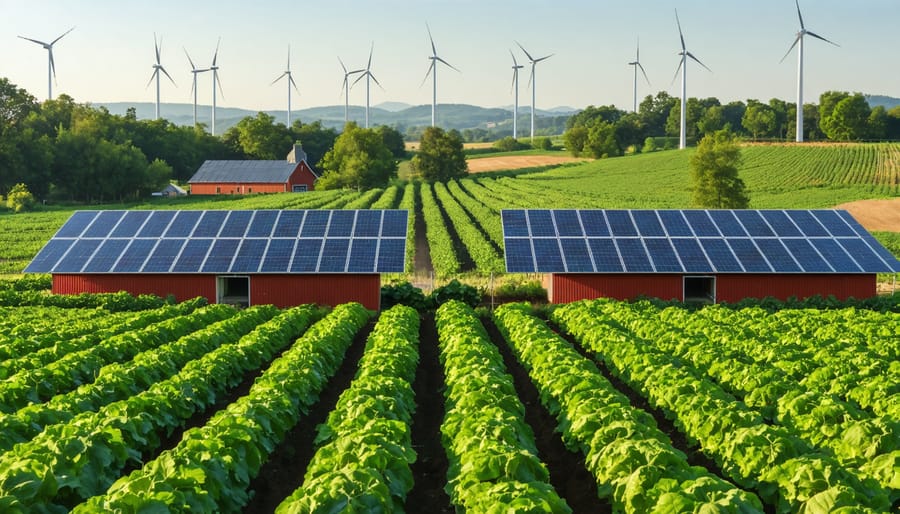
Solar panels power essential CSA farm operations like washing stations and cold storage, reducing energy costs while cutting carbon emissions.
Energy-Efficient Cold Storage Upgrades
Your cold storage facility represents one of the biggest energy draws on your CSA farm, but smart upgrades can dramatically reduce both electricity consumption and carbon emissions. Start by examining your insulation—older facilities often have gaps or degraded materials that force cooling systems to work overtime. Adding spray foam insulation or upgrading door seals can cut energy use by up to 30%.
Consider replacing outdated refrigeration units with ENERGY STAR certified models that use natural refrigerants like propane or ammonia instead of synthetic options with high global warming potential. These newer systems operate more efficiently while being kinder to the environment.
Smart temperature management makes a substantial difference too. Install programmable thermostats that adjust cooling based on actual storage needs rather than running at full capacity constantly. Motion-sensor LED lighting eliminates unnecessary energy waste, and installing clear plastic strip curtains in doorways prevents cold air escape during loading.
One Vermont CSA farmer reduced cold storage energy costs by 40% after upgrading insulation and switching to a variable-speed compressor system. The investment paid for itself within three years through lower electricity bills, proving that efficiency improvements benefit both your bottom line and the planet.
LED Lighting and Small Efficiency Wins
Sometimes the biggest impact comes from the smallest changes. Switching to LED lighting in your processing facility, cold storage, or packing areas can cut energy use by up to 75% compared to traditional bulbs. These upgrades pay for themselves quickly through lower electricity bills while reducing your carbon emissions significantly.
Beyond lighting, simple maintenance habits make a real difference. Regularly cleaning equipment filters, checking door seals on coolers, and maintaining proper tire pressure on farm vehicles might seem minor, but they prevent energy waste. One organic farm in Vermont reduced their cooling costs by 20% just by sealing air leaks and upgrading their refrigeration unit’s gaskets.
Don’t overlook motion sensors for lights in storage areas or programmable thermostats for climate control. These affordable tools ensure you’re only using energy when actually needed. The beauty of these efficiency wins is that they require minimal investment while delivering immediate results, making them perfect starting points for any CSA operation looking to lighten their environmental impact.
Rethinking Packaging for Lower Impact
Reusable Container Programs That Work
Successful CSA farms have discovered that reusable container programs significantly cut packaging waste while building stronger member relationships. The key lies in making returns effortless for participants.
Green Valley Farm in Vermont achieves an impressive 95% return rate by placing clearly labeled collection bins at multiple pickup locations. Members simply drop off their previous week’s containers when collecting fresh produce. The farm designates a volunteer “bin monitor” at each site to quickly rinse and stack returns, keeping the process smooth and sanitary.
Twin Oaks CSA in Oregon tackled the logistics challenge by implementing a simple deposit system. Members pay a refundable $20 deposit on their first delivery, which covers the cost of containers and motivates returns. They offer flexible options too, allowing members to keep containers for up to three weeks before returning them, accommodating different household schedules.
Communication proves essential for program success. Meadowbrook Farm sends friendly monthly reminders through their newsletter, highlighting how many pounds of cardboard waste members have collectively prevented. They’ve found that sharing these tangible environmental wins keeps participation high.
The investment pays off quickly. Most farms report breaking even on reusable containers within the first season, then enjoying ongoing savings while reducing their carbon footprint. Starting small with one pickup location helps iron out any logistical wrinkles before expanding the program farm-wide.
Reusable container systems eliminate single-use packaging waste while maintaining produce quality for CSA members.
Choosing Sustainable Packaging Materials
Packaging choices significantly impact your farm’s carbon footprint, but the good news is that sustainable alternatives are more accessible than ever. By switching to sustainable packaging materials, you can dramatically reduce emissions while keeping your produce fresh and appealing.
Compostable bags made from plant-based materials like cornstarch or cellulose break down naturally, returning nutrients to the soil instead of lingering in landfills for decades. These work wonderfully for leafy greens and herbs. Paper alternatives, particularly those made from recycled content, offer excellent breathability for root vegetables and mushrooms while maintaining a significantly lower carbon footprint than plastic.
Consider minimal packaging approaches that eliminate unnecessary layers. Reusable containers for regular members create a closed-loop system, cutting packaging waste to nearly zero. Some farms successfully use wax-coated paper wraps for items like cheese and baked goods, providing protection without plastic.
One Ontario CSA operator reduced packaging emissions by 60 percent simply by transitioning to paper bags and encouraging members to return egg cartons and berry containers. She now saves money on packaging costs while members appreciate the environmental commitment. Start by identifying which items truly need packaging and experiment with eco-friendly options for those necessities. Your members will notice and value the effort.
Smarter Distribution Methods
Central Pickup Points and Route Optimization
Rethinking how you deliver your CSA boxes can dramatically cut transportation emissions while making life easier for your members. Central pickup points are game-changers for reducing your carbon footprint. Instead of driving to individual homes scattered across town, establish convenient hubs where multiple members can collect their shares. Think community centers, local businesses, farmers markets, or even member volunteers who offer their driveways.
The math is compelling: delivering to five pickup locations serving 100 members generates far fewer emissions than 100 individual stops. One Colorado CSA reduced their delivery miles by 60% after switching to a hub system, saving fuel costs and driver time.
Route optimization software takes this further by calculating the most efficient path between stops. Free tools like Google Maps or dedicated apps such as Route4Me help you avoid backtracking and unnecessary mileage. For smaller operations, simple planning works too. Group deliveries geographically and schedule them on the same day to minimize trips.
Encourage members to carpool to pickup points or coordinate neighborhood collections where one person grabs boxes for several households. Some farms even offer small discounts for members who choose central pickups over home delivery, creating a win-win that rewards sustainable choices while streamlining your operations.
Electric and Alternative Fuel Vehicles
For CSA farms looking to green their delivery routes, transitioning to eco-friendly delivery vehicles represents one of the most impactful carbon reduction strategies. Electric vehicles (EVs) are increasingly practical for farm-to-customer deliveries, especially for routes under 150 miles. While upfront costs range from $30,000 to $50,000 for electric vans, federal and state incentives can offset 20-40% of this investment. Operating costs typically drop by 60% compared to gas vehicles, with electricity costing about $0.03 per mile versus $0.15 for gasoline.
Many farms find success starting with one electric vehicle for urban delivery routes where charging infrastructure is readily available. Charging stations can be installed at the farm for $500-2,000, with overnight charging providing a full day’s range. For farms not ready for EVs, biodiesel blends offer an intermediate solution. Converted diesel vehicles can run on B20 (20% biodiesel) with minimal modifications, reducing emissions by 15-20% while supporting local biodiesel producers.
Consider your delivery radius, vehicle availability in your area, and access to charging stations when planning your transition. Start small, track your savings, and expand as infrastructure improves.
Electric vehicles are becoming practical options for CSA farms looking to reduce transportation emissions on delivery routes.
Success Story: A CSA Farm That Cut Emissions by Half
Meet Green Valley CSA in Vermont, a mid-sized operation that went from sustainability talk to measurable action. Owner Maria Chen faced a common challenge: her farm was growing organic vegetables, but the post-harvest operations were generating emissions she couldn’t ignore. In 2021, she decided to tackle the problem head-on.
The numbers told a sobering story. Green Valley’s baseline carbon audit revealed their walk-in coolers, packaging materials, and delivery routes were responsible for 8.2 tons of CO2 annually. Maria knew change was needed, but like many small farm operators, she worried about the upfront costs.
She started with the lowest-hanging fruit. By switching to compostable packaging made from mushroom mycelium and recycled paper, she cut packaging emissions by 35 percent in the first season. The switch cost an extra $800 annually, but members appreciated the eco-friendly approach and several shared positive feedback on social media.
Next came the bigger investment. Maria installed solar panels on her packing shed roof, which now powers the refrigeration units during peak sun hours. This required a $12,000 investment, but state incentives covered 40 percent. The solar system reduced her electricity-related emissions by 60 percent.
The delivery routes got a creative overhaul too. Instead of driving to individual drop-off points, Maria established neighborhood pickup hubs where members could collect their shares within walking distance. This simple change cut delivery emissions by half.
The biggest challenge? Getting members on board with the hub system initially. Some preferred home delivery convenience. Maria addressed concerns through transparent communication, explaining the environmental impact and offering a small discount for hub pickups.
After 18 months, Green Valley reduced total emissions by 52 percent. The lesson Maria shares with other farmers: start small, track your progress, and involve your community in the journey. Sustainability improvements don’t require perfection, just consistent steps forward.
Getting Started: Your Carbon Reduction Action Plan
Ready to tackle carbon emissions on your CSA farm? Let’s break this down into manageable steps that work for your unique operation.
Start by mapping your current carbon footprint. Walk through your entire operation and identify your main emission sources. Focus on your processing area, refrigeration systems, packaging materials, and distribution vehicles. Don’t worry about getting exact measurements right away. Simply list where you’re using electricity, fuel, and materials. This initial audit takes most farmers about 2-3 hours and reveals surprising opportunities.
Next, prioritize your improvements based on three factors: impact, cost, and ease of implementation. Quick wins might include switching to LED lighting in your processing facility or optimizing delivery routes. These changes often pay for themselves within months. Medium-term projects could involve upgrading to energy-efficient refrigeration or implementing sustainable farm features like solar panels. Long-term goals might include transitioning your vehicle fleet or redesigning your entire packaging system.
Create a realistic timeline with specific milestones. Maybe this season you’ll tackle packaging waste, next season you’ll focus on transportation, and the following year you’ll address energy systems. Breaking it down prevents overwhelm and allows you to spread costs over time.
Track your progress using simple metrics like fuel consumption, electricity bills, and packaging material purchases. These numbers tell the story of your improvement journey and help you communicate your commitment to members.
Remember, every farm’s path looks different. A small urban CSA might prioritize bicycle deliveries, while a larger rural operation could focus on renewable energy. Start where you are, use what you have, and celebrate each step forward.
Reducing your carbon footprint in CSA operations creates a beautiful alignment between environmental stewardship and practical business benefits. Many farmers discover that carbon-cutting measures actually strengthen their bottom line through reduced energy costs, less packaging waste, and improved efficiency. When you share these sustainability efforts with your members, you’re reinforcing the very values that drew them to community-supported agriculture in the first place. Your commitment to reducing emissions becomes another reason for members to feel proud of their CSA choice and stay connected to your farm year after year.
The good news? You don’t need to overhaul your entire operation overnight. Start with one manageable change that fits your farm’s unique situation. Maybe it’s switching to renewable energy for your cooler, transitioning to reusable harvest containers, or optimizing your delivery routes. Each small step contributes to meaningful impact while keeping the transition realistic and sustainable for your operation. Remember, your journey toward carbon reduction mirrors the same values you practice in the field: working with nature’s rhythms, building healthy systems gradually, and nurturing long-term resilience. The planet benefits, your community benefits, and your farm thrives.
Beneath our feet lies a hidden universe more diverse than a tropical rainforest – the soil microbiome, a dynamic network of billions of microscopic organisms that form the living foundation of our food system. These invisible allies – bacteria, fungi, protozoa, and other microorganisms – work tirelessly to transform organic matter into nutrients, protect plants from disease, and build the rich, resilient soil structure that sustains our farms and gardens.
For farmers and gardeners alike, understanding and nurturing this underground ecosystem isn’t just fascinating science – it’s the key to growing healthier, more abundant crops while reducing the need for synthetic inputs. By partnering with these microscopic workers, we can create self-sustaining growing systems that naturally suppress pests, cycle nutrients efficiently, and build long-term soil fertility.
Recent research reveals that a single teaspoon of healthy soil contains more microorganisms than there are people on Earth, each playing a crucial role in plant health and soil function. From nitrogen-fixing bacteria that feed our crops to beneficial fungi that extend plant root systems by up to 1000 times, these tiny organisms form the backbone of organic growing practices.
Let’s explore how we can work with nature’s smallest farmers to build thriving, productive growing spaces from the ground up.
The Living Universe Beneath Your Feet
Microscopic photo of diverse soil bacteria and fungi showing the intricate network of microorganisms
Meet Your Microscopic Farm Partners
Your soil is teeming with billions of microscopic allies, each playing a crucial role in creating healthy, productive farmland. Think of these tiny organisms as your underground farming team! Bacteria, the workhorses of your soil, break down organic matter and make nutrients available to plants. Some special bacteria, called nitrogen-fixers, actually pull nitrogen from the air and transform it into a form your plants can use.
Fungi are the soil’s master engineers, creating vast underground networks that connect plants and distribute resources. Mycorrhizal fungi form partnerships with plant roots, essentially extending their reach and helping them access water and nutrients they couldn’t get on their own.
Don’t forget about the protozoa and nematodes! These tiny creatures help regulate bacterial populations and release nutrients through their feeding activities. Even earthworms, while not microscopic, work alongside these smaller organisms, creating channels for air and water while distributing beneficial microbes throughout the soil.
Together, these microorganisms create the living foundation of your farm’s ecosystem, turning organic matter into plant food and building soil structure that resists erosion and holds water effectively.
The Soil Food Web at Work
Think of the soil food web as nature’s underground networking system, where billions of microorganisms work together to support plant growth. These tiny helpers create a bustling marketplace of nutrients, with bacteria and fungi acting as the primary traders. They break down organic matter into forms that plants can easily absorb, while also providing numerous local ecosystem benefits.
Beneficial fungi form remarkable partnerships with plant roots through mycorrhizal networks, essentially extending the plant’s reach for nutrients and water. These fungal threads can connect multiple plants, creating a collaborative community where resources are shared. Meanwhile, bacteria cluster around root zones, converting nitrogen from the air into plant-friendly compounds and producing natural growth hormones that strengthen plant health.
Other soil organisms like protozoa and nematodes join this underground dance, feeding on bacteria and releasing nutrients in plant-available forms. This natural cycle creates a self-sustaining system where plants receive a steady supply of nutrients without the need for synthetic fertilizers. The result is healthier plants with stronger immune systems and better resistance to pests and diseases.
Simple Ways to Boost Your Soil’s Microbial Life
Cover Cropping for Microbe Success
Cover crops are nature’s microbe magnet, creating the perfect environment for beneficial soil organisms to thrive. These crops, planted during off-seasons or between main crop rotations, do more than just prevent soil erosion – they’re like five-star hotels for your soil’s microscopic helpers!
When cover crops grow, their roots release sugary substances called exudates that feed beneficial bacteria and fungi. Different cover crop varieties support different types of microorganisms. For example, legumes like clover and vetch form special partnerships with nitrogen-fixing bacteria, while deep-rooted crops like daikon radish create highways for fungi to travel through the soil.
The living roots provide constant nourishment to microbes, while the plant matter above ground eventually becomes organic material that feeds different groups of decomposing organisms. This creates a wonderful cycle of life in your soil!
Many farmers have found success using a mix of cover crops. Sarah Johnson, an organic farmer in Vermont, combines rye grass, crimson clover, and buckwheat in her rotation. “Since implementing cover crops three years ago, I’ve noticed my soil is more spongy and alive,” she shares. “My vegetables are healthier, and I use less water and fertilizer.”
To get started with cover cropping, try planting a simple mix of grasses and legumes after your main harvest. Your soil microbes will thank you with better soil structure and nutrient cycling.
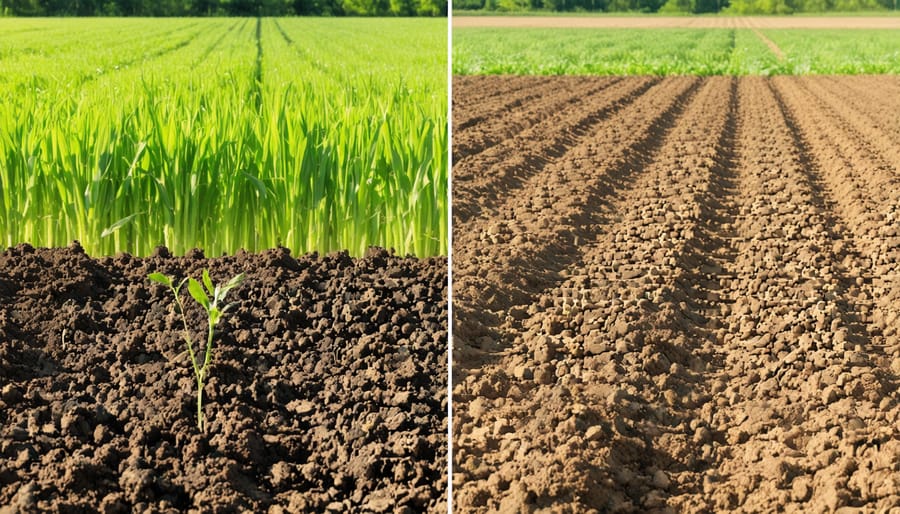
Split image showing cover crop implementation with root systems visible below ground
Compost: Your Microbe Multiplication Tool
Compost is nature’s most powerful tool for boosting your soil’s microbial community. Think of it as a microbe multiplication station, where beneficial bacteria and fungi thrive and multiply before joining your soil’s ecosystem. By implementing effective composting methods, you’re essentially creating a five-star hotel for beneficial microorganisms.
When you add well-made compost to your soil, you’re not just providing nutrients – you’re introducing millions of helpful microbes that will continue to work for you long after application. These microscopic workers break down organic matter, create soil structure, and make nutrients more available to your plants.
The key to successful composting lies in maintaining the right balance of materials. Mix “greens” (nitrogen-rich materials like kitchen scraps and fresh grass clippings) with “browns” (carbon-rich materials like dried leaves and straw) in roughly equal proportions. Keep your pile moderately moist – think wrung-out sponge – and turn it occasionally to provide oxygen to your microbial allies.
For best results, apply finished compost as a top dressing in spring or fall, or mix it into your planting holes. Even a thin layer can significantly boost your soil’s microbial activity. Remember, every handful of good compost contains more beneficial microorganisms than there are people on Earth!
No-Till Methods That Protect Your Microbe Partners
Protecting your soil’s microscopic allies starts with minimal disruption. No-till farming, one of the most effective sustainable farming practices, keeps soil structure intact while preserving the intricate networks that beneficial microbes create underground.
Think of soil as a bustling underground city. Every time we till, we’re essentially demolishing these microbial highways and homes. Instead, use methods like sheet mulching and surface composting to add nutrients without disturbing the soil ecosystem. Simply layer organic materials on top and let your microbe partners do the work of breaking them down.
For larger operations, consider investing in no-till seed drills or maintaining permanent bed systems. These approaches allow you to plant new crops while keeping soil disturbance to a minimum. Cover crops are another fantastic tool – their roots create natural pathways for water and nutrients while feeding your microbiome.
When you do need to work the soil, use gentle tools like broadforks that lift and loosen without turning. This maintains vertical channels created by earthworms and root systems, which are crucial highways for microbe movement and nutrient transport.
Remember, every time you avoid disrupting your soil, you’re giving your microscopic teammates a chance to thrive and build a stronger, more resilient growing environment.
Real Results: CSA Success Stories
From Struggling Soil to Thriving Crops
When Sarah Chen took over Wildflower Valley CSA in 2018, the soil told a story of struggle. Years of intensive farming had left the ground compact, with low organic matter and minimal microbial activity. “The soil was practically lifeless,” Sarah recalls. “Our first season’s yields were disappointing, and we knew something had to change.”
Sarah began implementing a comprehensive soil restoration program focused on nurturing the soil microbiome. She introduced cover cropping, minimal tillage, and regular applications of compost tea. The farm also established permanent beds and implemented crop rotation to minimize soil disturbance.
The transformation over three years was remarkable. Soil tests revealed a dramatic increase in organic matter, from 2% to 6%. The once-hardened ground became loose and crumbly, teeming with earthworms and beneficial microorganisms. This biodiversity improvement translated directly to crop performance.
“Today, our vegetables are more nutrient-dense and flavorful,” Sarah explains. “We’re harvesting 40% more produce from the same acreage, and our crops show better resistance to pests and diseases.” The farm’s success has inspired neighboring growers to adopt similar practices, creating a ripple effect throughout the local farming community.
The most visible sign of success? The rich, dark soil that crumbles perfectly in your hands – nature’s signature of a thriving microbiome.
Before and after photos of a CSA farm field showing visible soil structure improvement
Measuring Your Microbiome Success
Tracking your soil’s microbiome health doesn’t require a laboratory – there are several simple indicators you can monitor right in your garden. Start by examining soil structure: healthy soil should crumble easily and have a pleasant, earthy aroma. Look for earthworms – their presence indicates good biological activity.
A quick soil test involves burying a clean cotton underwear in your garden for two months. The more decomposed it becomes, the more active your soil microbes are. Another reliable method is the “soil jar test” – mix soil with water in a clear jar, shake, and let it settle. Distinct layers will form, showing your soil composition and organic matter content.
Watch your plants for signs of improvement. Healthy soil produces robust plants with deep root systems and resistance to disease. Document your observations through photos and notes, paying attention to leaf color, plant vigor, and crop yields.
Monitor water retention by observing how your soil handles both drought and heavy rain. Well-structured soil with active microbes should drain excess water while retaining moisture for dry periods.
Keep track of your organic matter inputs and note changes in soil color – darker soil usually indicates higher organic matter content. Remember, meaningful improvements in soil health typically take 2-3 growing seasons to become evident, so maintain consistent records for accurate comparison.
Getting Started Today
Ready to nurture your soil’s microbiome? Here are simple yet effective steps you can start implementing today to boost your soil’s microbial health and productivity.
Begin by conducting a baseline soil test to understand your starting point. This will help you track improvements as you implement microbiome-friendly practices. Many local extension offices offer affordable testing services.
Start incorporating organic matter gradually:
– Add quality compost (about 1-2 inches) to your growing areas
– Use cover crops between growing seasons
– Apply mulch to protect soil life
– Leave crop residues in place when possible
Minimize soil disturbance by:
– Reducing tilling or switching to no-till methods
– Using permanent beds
– Creating dedicated walking paths
– Avoiding working wet soil
Feed your microbes with diverse organic inputs:
– Brew and apply compost tea monthly
– Use diverse plant species in your rotation
– Include flowering plants to support beneficial insects
– Apply natural amendments like kelp meal or fish emulsion
Monitor progress through simple observations:
– Look for earthworm activity
– Check soil structure and aggregation
– Notice plant health improvements
– Document increased water retention
Start small by selecting one area to implement these practices. Many successful farmers began with test plots before scaling up. Within months, you’ll likely notice improved soil structure, better water retention, and healthier plants – all signs of a thriving soil microbiome.
Remember, building healthy soil is a journey, not a race. Each small step contributes to creating a robust, self-sustaining ecosystem that will benefit your garden or farm for years to come.
The incredible world of soil microbiomes offers endless possibilities for creating thriving, sustainable gardens and farms. By nurturing these microscopic communities, we can build healthier soils that produce more nutritious food while reducing our environmental impact. Remember that every handful of healthy soil contains billions of beneficial organisms working together to support plant growth and ecosystem health.
Whether you’re tending a small backyard garden or managing acres of farmland, implementing microbiome-friendly practices is both achievable and rewarding. Start small by incorporating cover crops, reducing tillage, and adding organic matter to your soil. As you witness the positive changes – from improved soil structure to more vigorous plants – you’ll be inspired to explore more advanced techniques.
The success stories we’ve shared demonstrate that working with soil microbiomes isn’t just about following scientific principles – it’s about reconnecting with nature’s wisdom and becoming better stewards of our land. By adopting these practices, you’re not only improving your own growing space but contributing to a larger movement toward sustainable agriculture.
Take the first step today by observing your soil’s condition and choosing one practice to implement this growing season. Remember, healthy soil leads to healthy plants, which ultimately means healthier communities and a healthier planet. Your journey toward building a thriving soil microbiome is an investment in our collective future.
Revolutionizing local food distribution in Dallas, CSA transportation services bridge the crucial gap between farm-fresh produce and urban consumers. From Oak Cliff to Plano, innovative logistics solutions are transforming how small-scale farmers deliver their harvests to thousands of Dallas-Fort Worth subscribers. Local CSA programs now leverage temperature-controlled vans, coordinated delivery routes, and real-time tracking systems to ensure produce maintains peak freshness during transit across the metroplex’s diverse neighborhoods.
Smart scheduling algorithms optimize delivery windows around Dallas’s notorious traffic patterns, while strategic hub-and-spoke distribution centers in key locations like Richardson and Arlington maximize efficiency for both farmers and subscribers. This sophisticated approach to local food transportation has enabled Dallas CSA programs to grow from serving hundreds to thousands of families while maintaining the personal connection between growers and consumers that makes the CSA model unique.
Through these advanced yet sustainable delivery solutions, Dallas’s CSA community continues to strengthen the local food ecosystem, one carefully planned route at a time.
Current CSA Transportation Challenges in Dallas
Distance and Time Management
Managing transportation logistics in the sprawling Dallas-Fort Worth metroplex presents unique challenges for CSA operations. The region’s vast geographical spread, from McKinney to Arlington and Fort Worth to Mesquite, requires careful route planning to ensure fresh produce reaches members efficiently. Most successful CSA programs in Dallas organize their delivery routes into zones, typically serving specific neighborhoods on designated days to optimize travel time and maintain produce freshness.
Traffic patterns play a crucial role in delivery scheduling, with many CSA operators choosing early morning or late evening distribution to avoid peak congestion periods. During summer months, when temperatures regularly exceed 95°F, timing becomes even more critical to preserve produce quality. Many local CSA programs have adapted by using insulated vehicles and implementing strict delivery windows.
To maximize efficiency, some Dallas CSA operators have established central pickup points in strategic locations throughout the metroplex, reducing overall travel time while maintaining produce freshness and quality.
Temperature Control Issues
Managing produce freshness in Dallas’s notorious summer heat presents unique challenges for CSA transportation. With temperatures regularly soaring above 100°F, maintaining optimal conditions requires careful planning and innovative sustainable produce packaging solutions. Local CSA operators use a combination of early morning deliveries, insulated containers, and strategically placed ice packs to protect temperature-sensitive items.
Many successful Dallas CSAs have adopted mobile cooling units and temperature-monitored delivery vehicles to ensure produce stays fresh from farm to doorstep. These systems maintain consistent temperatures between 35-45°F for delicate greens and berries, while allowing slightly warmer conditions for heat-tolerant vegetables.
Smart routing helps minimize exposure time, with drivers following carefully planned routes that prioritize quick dropoffs during the coolest parts of the day. Some CSAs even offer members the option of picking up their shares from climate-controlled collection points, ensuring maximum freshness regardless of delivery timing.
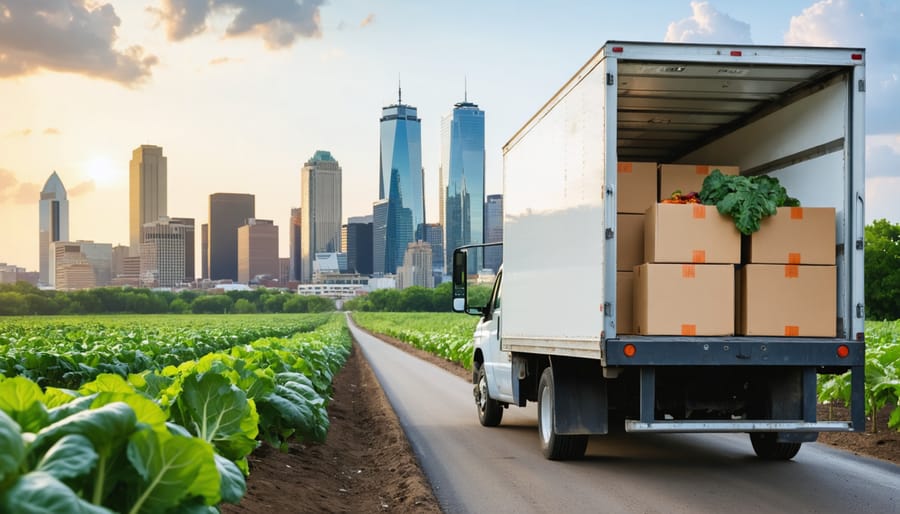
Refrigerated delivery van with fresh produce boxes being loaded at a local Dallas farm
Innovative Distribution Models
Hub-and-Spoke Distribution
CSA programs in Dallas have embraced an efficient hub-and-spoke distribution model that makes fresh, local produce more accessible to members across the metroplex. This system centers around strategically placed pickup locations that serve as community hubs, reducing transportation costs and environmental impact while building stronger neighborhood connections.
Central hubs typically include farmers’ markets, community centers, and partner businesses that serve as primary collection points for weekly harvests. From these locations, produce is distributed to smaller neighborhood pods, making pickup convenient for members who might otherwise face long commutes to reach the farm directly.
These neighborhood pods often form in areas with high member concentration, such as Oak Cliff, Preston Hollow, and Lake Highlands. Local hosts—usually enthusiastic CSA members themselves—volunteer their porches, garages, or small businesses as mini distribution points. This arrangement typically serves 10-15 families within walking or short driving distance.
The hub-and-spoke system has proven particularly successful during Texas’s hot summers, as it minimizes the time produce spends in transit. Many Dallas CSAs have enhanced this model with temperature-controlled storage at hub locations and coordinated pickup windows to ensure optimal freshness. Some programs even offer flexible pickup times through secure storage lockers, accommodating members with varying schedules while maintaining produce quality.
This distribution approach has helped Dallas CSAs reduce their carbon footprint while creating vibrant local food communities throughout the metroplex.
Map visualization showing a hub-and-spoke distribution network across Dallas neighborhoods
Mobile CSA Markets
Mobile CSA markets are revolutionizing the way Dallas residents access fresh, local produce through innovative eco-friendly food distribution methods. These food truck-style operations bring the farm directly to urban communities, making fresh produce more accessible to busy professionals and families throughout the metroplex.
These mobile markets operate like traditional food trucks but are specifically designed to transport and display fresh produce. Custom-built refrigeration units maintain optimal temperatures for delicate vegetables and fruits, while fold-out display stands create an inviting farmers’ market atmosphere at each stop. Many trucks feature solar-powered cooling systems and LED lighting to minimize their environmental impact.
Dallas CSA operators typically establish regular weekly routes, visiting corporate campuses, residential communities, and popular gathering spots throughout the city. Members can pick up their shares at predetermined locations and times, eliminating the need to drive to distant farm sites. Some mobile markets even offer additional items like fresh eggs, honey, and artisanal bread from local producers.
The flexibility of mobile markets helps CSA programs adapt to Dallas’s unique urban sprawl while building stronger connections between farmers and consumers. This distribution method has proven particularly successful in food desert areas, where access to fresh produce is limited.
Technology-Driven Solutions
Route Optimization Tools
Modern CSA farms in Dallas are leveraging technology to streamline their delivery operations through innovative supply chain optimization tools. Popular solutions include Route4Me and Circuit, which help farmers map out the most efficient delivery routes while considering factors like traffic patterns and delivery time windows. These user-friendly platforms allow farms to reduce fuel consumption and ensure fresh produce reaches members promptly.
Local farmers particularly appreciate features like real-time driver tracking and automated customer notifications, which help maintain transparency with CSA members. Many Dallas CSA operators use mobile apps that integrate with these routing tools, allowing drivers to access turn-by-turn directions and capture delivery confirmation photos.
Some farms have reported cutting their delivery times by up to 30% after implementing these digital solutions. The tools also help manage multiple drop-off locations effectively, a crucial feature for farms serving Dallas’s sprawling metropolitan area. By optimizing delivery routes, CSAs can maintain produce freshness while reducing their environmental impact and operating costs.
Mobile device displaying CSA delivery route optimization app with real-time tracking
Real-Time Tracking Systems
CSA Transportation Dallas leverages cutting-edge tracking technology to ensure smooth delivery operations and enhanced customer satisfaction. Each delivery vehicle is equipped with GPS tracking devices that provide real-time location updates, estimated arrival times, and route optimization. Members can access this information through a user-friendly mobile app or web portal, allowing them to track their farm-fresh deliveries with precision.
The system sends automated notifications when deliveries are en route, keeping members informed and eliminating uncertainty about delivery timing. For farmers and coordinators, the tracking platform offers valuable insights into delivery efficiency, route performance, and driver activity. This data helps optimize delivery routes and reduce fuel consumption, supporting both operational efficiency and environmental sustainability.
Weather alerts and traffic updates are integrated into the tracking system, enabling drivers to adjust their routes dynamically and ensure produce stays fresh during transport. The communication platform also allows for direct messaging between members and drivers, facilitating smooth coordination for special delivery instructions or last-minute changes.
This technology has significantly improved the reliability and transparency of CSA deliveries across the Dallas metroplex, making fresh, local produce more accessible to urban communities.
Success Stories
Green Acres Farm in South Dallas revolutionized their CSA delivery system by partnering with local food co-ops, creating efficient distribution hubs throughout the metroplex. Their innovative approach reduced delivery times by 40% while serving 200+ weekly subscribers. By establishing strategic pickup points at community centers and farmers’ markets, they’ve made fresh, organic produce accessible to more neighborhoods.
Oak Creek Gardens found success through their member-volunteer transport program. Members who help with deliveries receive extra produce and reduced subscription fees. This community-driven solution not only solved their transportation challenges but strengthened relationships between farmers and subscribers.
Pure Prairie Organics implemented a successful zone-based delivery system, dividing Dallas into four delivery regions with specific delivery days. Their mobile app lets subscribers track deliveries in real-time and adjust pickup locations when needed. This tech-savvy approach reduced missed deliveries by 85% and increased customer satisfaction.
The Trinity Valley Collective, a group of three small farms, pooled their resources to share refrigerated delivery vans and coordination staff. This cooperation allowed them to expand their reach while keeping costs manageable. Their combined CSA now serves over 500 families across Dallas-Fort Worth, proving that collaboration can lead to greater success for small-scale farmers.
These success stories demonstrate how Dallas CSAs are finding creative solutions to transportation challenges while building stronger food communities.
As Dallas continues to embrace sustainable food systems, CSA transportation services are evolving to meet growing demands. The combination of eco-friendly delivery methods, innovative scheduling solutions, and partnership networks has made fresh, local produce more accessible than ever to Dallas residents. Local CSA programs are increasingly adopting technology to streamline operations, while maintaining the personal touch that makes community-supported agriculture special. Looking ahead, we can expect to see more electric delivery vehicles, expanded route optimization systems, and stronger collaborations between farms and local businesses. These developments promise to make CSA participation even more convenient for Dallas families while supporting local farmers and reducing environmental impact. The future of CSA transportation in Dallas looks bright, paving the way for a more sustainable and connected local food system.
Transform your farm into a self-sustaining ecosystem by implementing circular farming practices that maximize resource efficiency and minimize waste. Like nature’s own cycles, circular farming systems create closed loops where outputs from one process become valuable inputs for another, delivering powerful environmental benefits of CSA farming. Composting crop residues feeds soil microorganisms, while integrated livestock provides natural fertilizer and pest control. Strategic crop rotation and companion planting build soil health naturally, reducing the need for external inputs. By mimicking natural ecosystems, circular farming transforms traditional linear production into regenerative cycles that build fertility, conserve water, and strengthen local food security – all while cutting costs and boosting farm resilience.
The Magic Loop: How Circular Farming Works
Nature’s Perfect Circle
Nature has perfected the art of recycling over billions of years, creating seamless cycles where nothing goes to waste. In natural ecosystems, fallen leaves decompose to nourish soil, which feeds plants that sustain animals, whose waste and eventual remains continue the cycle. Circular farming systems deliberately mirror these natural patterns.
Just as a forest floor transforms dead matter into rich humus, circular farms convert agricultural “waste” into valuable resources. Crop residues become compost or animal feed, while animal manure enriches the soil for future plantings. Water cycles through irrigation systems, getting filtered naturally by soil and plants before being reused.
This interconnected approach creates a resilient system where each element supports the others, just like in nature. By observing and replicating these natural cycles, farmers can create sustainable operations that maintain soil health, conserve water, and reduce external inputs while maximizing productivity.
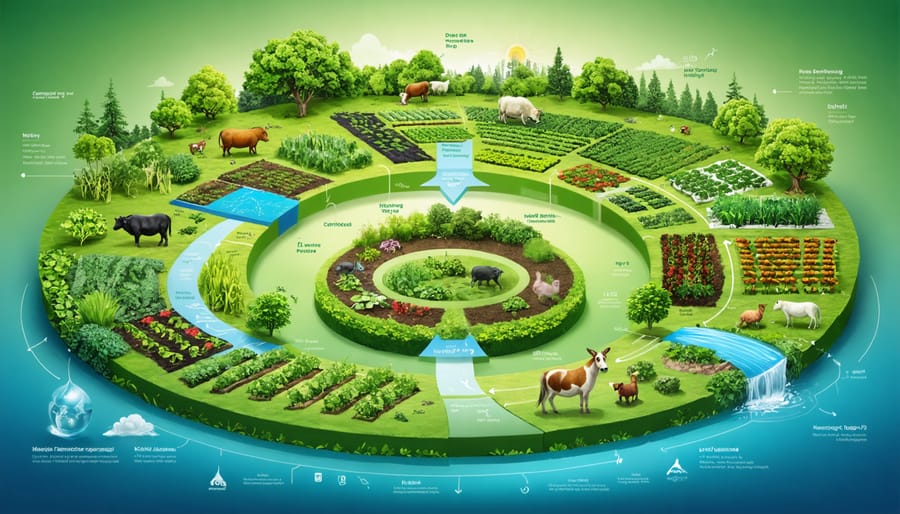
Infographic showing the interconnected cycles of a circular farming system, including composting, water recycling, and animal integration
From Waste to Resource
In circular farming, waste becomes a valuable resource, creating a sustainable loop that benefits both the environment and farm productivity. Crop residues transform into nutrient-rich compost, while animal manure powers biogas digesters for energy production. Even food processing byproducts find new life as animal feed or soil amendments.
Innovative farmers are discovering creative ways to repurpose materials that were once considered waste. Coffee grounds become mushroom growing medium, while fruit pulp transforms into natural dyes or animal treats. Vegetable trimmings feed chickens, whose manure then enriches garden beds, completing a perfect cycle of nutrients.
Water recycling systems capture and filter runoff for irrigation, while greenhouse condensation provides clean water for sensitive crops. Some farms even partner with local restaurants to collect food scraps, creating premium compost that builds healthy soil. These waste-to-resource practices not only reduce environmental impact but also improve farm economics by cutting input costs and creating new revenue streams.
Building Your Farm’s Circular System
Composting Systems
Creating effective composting systems is essential for circular farming success. The process begins with selecting an ideal location that’s easily accessible and has good drainage. Most successful systems use a three-bin method: one for fresh materials, one for actively decomposing matter, and one for finished compost.
Start by layering green materials (kitchen scraps, fresh grass clippings, and plant waste) with brown materials (dry leaves, straw, and cardboard) in a roughly 3:1 brown-to-green ratio. Maintain moisture levels similar to a wrung-out sponge and turn the pile every few weeks to ensure proper aeration.
Consider adding beneficial materials like aged manure, coffee grounds, and eggshells to enhance nutrient content. Many farmers also incorporate earthworms to speed up decomposition and improve compost quality.
Monitor temperature using a compost thermometer – a healthy pile should reach 130-150°F in its active phase. When the compost looks dark and crumbly with an earthy smell, it’s ready to enrich your soil and complete the circular farming cycle.
Active composting system on a CSA farm showing layers of organic matter, with visible steam rising
Water Conservation Loops
Water recycling plays a crucial role in circular farming systems, where every drop counts. By implementing smart water conservation methods, farmers can significantly reduce their environmental impact while maintaining healthy crop yields. Popular techniques include drip irrigation systems, which deliver water directly to plant roots, and rainwater harvesting through collection tanks and swales.
Many successful CSA farms use greywater systems to recycle household water for irrigation, while others incorporate constructed wetlands that naturally filter and purify water for reuse. Smart soil management practices, like adding organic matter and using mulch, help retain moisture and reduce water needs.
Monitoring systems and soil moisture sensors enable farmers to water only when necessary, preventing waste and ensuring optimal plant health. These water-saving strategies not only conserve precious resources but also lead to reduced operational costs and more resilient farming systems.
Animal Integration
Integrating livestock into circular farming systems creates a harmonious cycle where animals contribute to and benefit from the farm’s ecosystem. Chickens, for example, can follow grazing cattle to scratch through manure, eating insect larvae while spreading nutrients across pastures. Pigs excel at turning food scraps and agricultural byproducts into valuable fertilizer while helping to till soil in rotation areas.
Sheep and goats serve as natural weed control specialists, maintaining pastures and clearing unwanted vegetation. Their manure enriches soil fertility, while rotational grazing helps prevent overgrazing and promotes healthy pasture regeneration. Rabbits provide rich fertilizer for gardens while consuming excess vegetation and crop residues.
To successfully integrate animals, create designated rotation schedules that allow livestock to contribute to different areas of your farm throughout the seasons. This approach maximizes benefits while preventing soil compaction or overgrazing. Remember to provide adequate shelter, water sources, and protection from predators in each rotation area.
Real Success Stories
Small-scale CSA farm showcasing integrated systems with chickens grazing between crop rows and rainwater collection system
Small-Scale Success
Green Acres CSA in Vermont showcases how circular farming systems can thrive on just five acres. Farmers Sarah and Mike Thompson transformed their small plot into a model of sustainability through careful planning and innovative resource management.
Their system starts with diverse vegetable production, feeding 50 local families through their CSA program. Kitchen scraps and produce waste from their weekly deliveries return to the farm as compost. They maintain a small flock of chickens that process this organic matter while providing eggs for CSA members. The chickens also help with pest control and soil fertility in rotation through their growing areas.
The Thompsons collect rainwater from their barn roof to irrigate their greenhouse, where they extend their growing season and start seedlings. Cover crops protect their soil during winter months, while their beehives support pollination and produce honey as an additional CSA offering.
“Our small size actually makes it easier to close the loop,” says Sarah. “We can monitor every resource carefully and make adjustments quickly when needed.” Their success proves that circular farming principles can work effectively at any scale.
Scaling Up Circular Practices
Green Valley Farm, a 50-acre CSA operation in Vermont, demonstrates how circular farming practices can work effectively at scale. Under the leadership of Sarah Chen, the farm has transformed from a traditional operation into a model of circular agriculture over the past decade.
The farm integrates multiple sustainable systems, including a composting facility that processes food waste from 200 local households and three restaurants. This generates enough rich compost to fertilize their entire vegetable production area. Their chicken flock of 500 birds rotates through harvested fields, managing pest populations while producing eggs for CSA members.
A series of interconnected ponds captures rainwater and irrigation runoff, which is filtered through constructed wetlands before being reused. The farm’s greenhouse operations are powered by solar panels, while excess biomass from crop residues feeds an on-site biodigester that provides supplemental energy.
Green Valley’s success has inspired neighboring farms to adopt similar practices, creating a regional network of circular farming operations that share resources and knowledge. Their annual workshops attract hundreds of farmers eager to learn about scaling up circular practices.
Getting Started Today
First Steps
Transitioning to circular farming begins with a thorough assessment of your current resources and waste streams. Start by mapping out all inputs and outputs on your farm, including water usage, organic matter, and energy consumption. This visual representation helps identify opportunities for creating closed loops.
Next, implement a comprehensive composting system to transform farm waste into valuable nutrients. Begin collecting kitchen scraps, crop residues, and animal manure if available. Quality compost forms the foundation of soil health in circular systems.
Consider integrating complementary crops and animals that support each other. For example, chickens can help with pest control and provide natural fertilizer, while their scratching behavior aids in soil aeration.
Water management is crucial – install rainwater harvesting systems and explore ways to reuse greywater. Start small with a single rain barrel, then expand as you gain confidence.
Remember, transitioning to circular farming is a journey. Focus on one area at a time, document your progress, and adjust your approach based on what works best for your specific situation.
Common Challenges and Solutions
While circular farming systems offer numerous benefits, farmers often face several key challenges during implementation. Initial setup costs can be significant, particularly when investing in infrastructure for composting and water recycling systems. Many farmers also struggle with managing the complex nutrient cycles and maintaining proper balance in their integrated systems.
Time management presents another hurdle, as circular systems require careful monitoring and coordination between different components. Weather unpredictability can impact closed-loop systems, especially in regions with extreme climate variations.
However, solutions exist for each challenge. Start small and scale gradually to manage costs. Join farmer networks to share knowledge and resources. Implement simple monitoring systems to track nutrient flows. Consider protective structures like hoop houses to minimize weather impacts. Many successful circular farms began with just one or two integrated elements before expanding their systems.
Remember that challenges are learning opportunities. Document your experiences and adjust your approach based on what works best for your specific situation.
Circular farming systems represent a powerful solution for creating a more sustainable and resilient agricultural future. By closing resource loops, minimizing waste, and maximizing efficiency, these systems offer multiple benefits for farmers, communities, and the environment. From reduced operational costs and improved soil health to decreased environmental impact and enhanced food security, the advantages of circular farming are clear and compelling.
Success stories from farmers who have implemented these practices show that circular farming isn’t just an idealistic concept – it’s a practical and profitable approach to agriculture. Whether you’re managing a small garden plot or a large-scale farm, incorporating circular principles can lead to meaningful improvements in your operation’s sustainability and productivity.
The transition to circular farming doesn’t have to happen overnight. Start small by implementing one or two practices, such as composting or water recycling, and gradually expand your circular systems as you become more comfortable with the approach. Remember, every step toward circularity contributes to a more sustainable food system and a healthier planet for future generations. By embracing these practices today, we can help create a more regenerative and resilient agricultural landscape for tomorrow.
Transform your business or lifestyle with proven sustainability initiatives that deliver measurable environmental impact. Leading organizations worldwide have successfully implemented water recycling systems that reduce consumption by 40%, installed solar panels that slash energy costs by 60%, and created zero-waste programs diverting 90% of materials from landfills. From Fortune 500 companies to small local farms, sustainable practices aren’t just preserving resources – they’re driving innovation and boosting bottom lines.
Consider how Seattle’s Pike Place Market composts 1,000 tons of food waste annually, converting it into rich soil for local farms, while Tesla’s Nevada Gigafactory operates entirely on renewable energy, proving that sustainability scales from community projects to industrial operations. These real-world examples demonstrate how environmental stewardship creates ripple effects across communities, economies, and ecosystems.
Whether you’re a business leader, community organizer, or household decision-maker, implementing sustainability efforts offers immediate benefits and long-term rewards for both planet and profit.
Smart Water Management Solutions That Work
Drip Irrigation Success Stories
Jordan and Sarah Miller’s 15-acre vegetable farm in California’s Central Valley serves as a shining example of drip irrigation success. After switching from traditional sprinkler systems, they reduced their water usage by 60% while increasing crop yields by 25%. Their precision irrigation system delivers water directly to plant roots, minimizing waste and preventing weed growth between rows.
In Arizona, Desert Springs Farm transformed their water management practices by implementing a solar-powered drip system. Owner Maria Rodriguez reports saving 800,000 gallons of water annually while producing the same amount of crops. The system’s moisture sensors ensure optimal water delivery, and the farm’s success has inspired five neighboring properties to adopt similar practices.
Small-scale success stories include the Green Thumb Community Garden in Oregon, where 50 plot holders collectively reduced water consumption by 40% after installing a shared drip irrigation network. The garden now serves as a learning center for sustainable water management, hosting monthly workshops for local growers interested in efficient irrigation techniques.
Modern drip irrigation system in action on a vegetable farm
Rainwater Harvesting Systems
Rainwater harvesting systems have become a cornerstone of sustainable agriculture, offering farmers and homeowners a smart solution for water conservation. These systems typically include gutters, downspouts, and storage tanks that collect rainfall from rooftops and other surfaces. Many successful farms have implemented simple yet effective setups using food-grade plastic tanks connected to greenhouse roofs, capable of storing thousands of gallons of water for dry seasons.
For example, Green Valley Farm in Oregon reduced their water bills by 40% after installing a 5,000-gallon collection system. They use this stored rainwater for irrigation, livestock, and greenhouse operations. The system pays for itself within two to three growing seasons through reduced utility costs.
Beyond storage tanks, some farmers are incorporating swales and retention ponds into their landscape design. These natural collection methods help replenish groundwater and create moisture-rich growing areas. Simple filters and first-flush diverters ensure the collected water remains clean and suitable for agricultural use.
DIY enthusiasts can start small with rain barrels under downspouts, gradually expanding their system as needs grow. This scalable approach makes rainwater harvesting accessible to both small garden plots and larger farming operations.
Waste Reduction Practices That Save Money
Large-scale composting operation at a sustainable farm
Composting Innovation
Modern composting initiatives are revolutionizing how we handle organic waste, going far beyond traditional backyard bins. Innovative farmers are implementing effective composting methods that transform agricultural waste into valuable resources. These include in-vessel composting systems that speed up decomposition and vermiculture setups that use worms to create nutrient-rich castings.
Many farms now use smart sensors to monitor moisture levels and temperature in their compost piles, ensuring optimal conditions for breakdown. Some have even introduced solar-powered aeration systems that maintain proper oxygen levels while reducing the need for manual turning.
Community-scale composting programs are gaining traction, with some farms partnering with local restaurants and markets to process food waste. This collaboration not only diverts waste from landfills but also creates high-quality soil amendments for organic farming. The resulting compost helps improve soil structure, retain water, and boost crop yields naturally, completing a sustainable cycle of waste reduction and soil enrichment.
Package-Free Distribution
Innovative farms are revolutionizing produce distribution by embracing package-free solutions that drastically reduce waste. Many local farms now offer “bring-your-own-container” programs, where customers can fill reusable bags or boxes with fresh produce directly from harvest bins. Some farms have introduced creative solutions like returnable wooden crates or mesh bags that customers can exchange on their next visit.
Community Supported Agriculture (CSA) programs have taken this concept further by delivering produce in reusable bins that members return weekly. Farms like Green Valley Organics save thousands of plastic bags annually by using cloth produce bags and encouraging customers to bring their own containers to farmers’ markets.
Several farms have partnered with local grocery stores to create “loose produce” sections, where fruits and vegetables are displayed without packaging, allowing customers to select exactly what they need. This approach not only eliminates unnecessary packaging but also helps reduce food waste by enabling customers to purchase precise quantities.
Some farms even offer bulk dispensing systems for items like grains, nuts, and dried fruits, completely eliminating the need for pre-packaged portions. These initiatives have shown that package-free distribution isn’t just environmentally friendly – it’s also cost-effective and popular with customers.
Soil Health Revolution
Cover Cropping Success
Cover cropping has become a game-changer for many sustainable farms across the country. Take Sarah’s Heritage Farm in Vermont, where implementing winter rye and crimson clover rotation helped increase soil organic matter by 2.5% in just two growing seasons. The cover crops not only prevented erosion but also naturally suppressed weeds, reducing the need for mechanical cultivation.
In California’s Central Valley, the Martinez Family Farm saw remarkable success with their mustard and vetch cover crop system. Their water retention improved by 30%, while beneficial insect populations doubled, leading to better natural pest control. They also noticed significantly improved tomato yields in fields following their cover crop rotation.
Green Acres Farm in Iowa combines cereal rye with hairy vetch, planting in fall after corn harvest. This practice has cut their nitrogen fertilizer needs by 40% and provides excellent protection against soil erosion during winter months. The farm saves approximately $75 per acre annually on input costs while building healthier soil.
These success stories demonstrate how cover cropping can simultaneously improve soil health, reduce costs, and enhance crop productivity when implemented thoughtfully.
Natural Fertilization Methods
Natural fertilization methods offer sustainable alternatives that nourish soil while protecting the environment. Compost is a cornerstone of organic fertilization, created by recycling kitchen scraps, yard waste, and agricultural byproducts into nutrient-rich soil amendments. Many farmers successfully use cover crops like clover and alfalfa, which naturally fix nitrogen in the soil while preventing erosion.
Green manure, created by turning these cover crops back into the soil, provides essential nutrients and improves soil structure. Vermicomposting, using earthworms to break down organic matter, produces highly effective fertilizer rich in beneficial microorganisms. Local farmer Sarah Chen shares, “Since switching to vermicompost, my vegetable yields have increased by 30%, and soil health has dramatically improved.”
Other natural methods include using bone meal for phosphorus, seaweed extracts for micronutrients, and aged animal manure for balanced nutrition. These alternatives not only reduce dependency on synthetic fertilizers but also build long-term soil fertility. Remember to test your soil regularly to understand its specific needs and adjust your natural fertilization strategy accordingly.
Energy-Smart Farming
Solar-Powered Solutions
Innovative farmers across the country are harnessing the sun’s power to create more sustainable operations. Solar power in agriculture has evolved from simple panel installations to sophisticated systems that power entire farm operations.
Take Fresh Earth Farm in California, where solar panels mounted on barn roofs power irrigation systems, cold storage units, and processing facilities. This setup not only reduces their carbon footprint but saves them $15,000 annually in energy costs. In Vermont, Blue Mountain Organics installed a ground-mounted solar array that doubles as shade protection for grazing sheep, maximizing land use while generating clean energy.
Solar solutions aren’t limited to large operations. Small-scale farmers are using portable solar panels to power electric fencing, water pumps, and greenhouse ventilation systems. Some innovative growers even use solar dehydrators for preserving herbs and vegetables, eliminating the need for electric dryers.
These real-world examples show how solar technology can be both environmentally responsible and economically smart, helping farms reduce operational costs while contributing to a more sustainable future.
Solar panels installed on a barn roof with agricultural fields in background
Wind Energy Integration
Modern farms are increasingly turning to wind energy as a sustainable power solution, with impressive results for both the environment and their bottom line. Many farmers are installing wind turbines that generate clean electricity for their operations while reducing dependency on the grid. For example, the Peterson Family Farm in Iowa powers their entire dairy operation through two medium-sized turbines, saving over $45,000 annually on electricity costs.
Some farmers are taking it a step further by participating in wind farm cooperatives, where multiple properties host larger turbines and share the energy benefits. These arrangements provide steady income through power company partnerships while maintaining regular farming operations. The Rising Sun Collective in Minnesota demonstrates this dual-purpose approach, using their land for both crop production and wind energy generation.
Small-scale solutions are also gaining popularity, with portable turbines powering irrigation systems and greenhouse climate control. These systems are particularly effective for farms in windy regions, where consistent air movement can be harnessed for practical daily operations. The initial investment in wind energy typically pays for itself within 5-7 years through reduced utility costs and potential energy credits.
The sustainability efforts we’ve explored demonstrate that small changes can lead to significant environmental impact when implemented consistently. From water conservation techniques to renewable energy adoption, these examples show how farms and businesses are successfully balancing ecological responsibility with economic viability. What’s particularly encouraging is that many of these initiatives have resulted in cost savings while reducing environmental footprints, proving that sustainability can benefit both the planet and the bottom line.
These success stories serve as inspiration and practical blueprints for others looking to embrace more sustainable practices. Whether you’re a small-scale farmer, business owner, or individual looking to make a difference, there’s an entry point for everyone. Start small by implementing one or two practices that align with your goals and capabilities, then gradually expand your efforts as you see results.
Remember, sustainability isn’t just about environmental protection—it’s about creating resilient systems that can thrive long into the future. By adopting these proven practices and continuously innovating, we can all contribute to a more sustainable world for generations to come. The time to act is now, and every effort, no matter how small, counts toward our collective goal of a greener future.
Transform your farm or homestead into a beacon of sustainability with eco-friendly building practices that slash energy costs while protecting our planet. Modern agricultural structures now blend time-tested natural materials with cutting-edge green technology, creating buildings that work in harmony with the environment. From solar-powered barn ventilation to rainwater harvesting systems, these innovative approaches are revolutionizing how we construct agricultural spaces.
Smart farmers are discovering that eco-friendly buildings don’t just benefit the environment – they significantly reduce operational costs. Natural lighting, superior insulation, and renewable materials like reclaimed wood and rammed earth create structures that maintain ideal temperatures year-round while minimizing energy consumption. These buildings often pay for themselves through reduced utility bills and increased operational efficiency.
The future of farming demands buildings that produce more than they consume. Whether you’re planning a new greenhouse, converting an existing barn, or designing a processing facility, eco-friendly building techniques offer practical solutions that benefit both your bottom line and the environment.
Natural and Sustainable Building Materials
Local and Recycled Materials
Using local and recycled materials in construction not only reduces environmental impact but also creates unique, character-rich buildings that tell a story. Salvaged wood from old barns, reclaimed bricks, and repurposed metal roofing can significantly lower building costs while preserving valuable resources. Many farmers have found success incorporating materials from their own land, such as stone from field clearing or timber from sustainable woodlots.
Local sourcing keeps transportation costs down and supports regional businesses. Consider working with nearby sawmills for custom-cut lumber, quarries for stone, and salvage yards for unique architectural elements. Many communities also have material exchanges where contractors and homeowners can find or list unused building supplies.
Creative reuse options include converting shipping containers into storage spaces, using old windows for greenhouse construction, and repurposing concrete rubble for foundation work. When sourcing materials locally, build relationships with area contractors who can alert you when quality materials become available from demolition projects.
Remember to inspect all reclaimed materials thoroughly for structural integrity and ensure they meet local building codes before incorporation into your project.
Bio-Based Building Components
Bio-based building materials are revolutionizing sustainable construction by transforming agricultural byproducts into durable building components. Straw bales, once considered mere farm waste, now serve as excellent insulation material, offering superior thermal properties while sequestering carbon. These bales can create walls with R-values between R-30 and R-50, significantly reducing energy costs.
Bamboo has emerged as a sustainable alternative to traditional timber, growing up to 3 feet per day and reaching maturity in just 3-5 years. Its tensile strength rivals steel, making it ideal for flooring, wall panels, and structural supports.
Hemp-based materials are gaining popularity through products like hempcrete, which combines hemp hurds with lime binder. This lightweight material offers excellent insulation, moisture regulation, and fire resistance while being carbon-negative during production.
Other innovative options include mycelium-based insulation, which uses mushroom roots to create naturally fire-resistant panels, and agricultural waste composites that transform rice hulls and corn stalks into sturdy building materials. These alternatives not only support local farming communities but also create healthier, more sustainable building environments.
A sustainable farm building constructed with straw bales and reclaimed wood
Energy-Efficient Design Elements
Passive Solar Design
Harnessing the power of the sun through thoughtful building design is one of the most cost-effective ways to reduce energy consumption on your farm. By incorporating passive solar principles, you can create structures that naturally maintain comfortable temperatures and reduce lighting costs throughout the year.
Strategic window placement is key to maximizing natural light and heat gain. South-facing windows capture maximum sunlight during winter months, while properly sized overhangs prevent overheating in summer. Thermal mass materials like concrete floors or stone walls absorb heat during the day and release it slowly at night, helping regulate indoor temperatures.
Building orientation plays a crucial role too. Positioning structures to take advantage of prevailing winds can enhance natural ventilation, while careful placement of trees and vegetation provides natural shade during hot seasons. These design elements work together with renewable energy in agriculture systems to create highly efficient farm buildings.
Consider incorporating clerestory windows or skylights in barns and storage areas to reduce artificial lighting needs during daylight hours. For greenhouse structures, implementing thermal curtains and strategic ventilation can help maintain optimal growing conditions while minimizing energy use.
Diagram showing passive solar design principles in a farm structure
Natural Ventilation Systems
Natural ventilation systems harness the power of wind and thermal buoyancy to maintain healthy air quality in buildings without relying on mechanical systems. By strategically placing windows, vents, and other openings, these systems create a natural flow of air that helps regulate temperature and remove stale air.
Cross-ventilation is one of the most effective techniques, achieved by positioning windows on opposite walls to allow air to flow through the building. Stack ventilation takes advantage of warm air’s natural tendency to rise, using high openings or roof vents to release hot air while drawing in cooler air through lower openings.
For agricultural buildings, natural ventilation is particularly beneficial. Well-designed ridge vents in barn roofs help remove excess heat and moisture, while adjustable side panels allow farmers to control airflow based on weather conditions and livestock needs. Solar chimneys can enhance this effect by using the sun’s heat to create stronger upward air movement.
These passive systems not only reduce energy costs but also create healthier environments for both people and animals. When combined with proper building orientation and shade elements, natural ventilation can significantly decrease the need for artificial cooling and ventilation systems.
Water Conservation Features
Rainwater Harvesting
Rainwater harvesting is one of the most effective sustainable water practices you can implement in your eco-friendly building design. By installing gutters, downspouts, and collection tanks, you can capture rainfall for various agricultural uses, from irrigation to livestock watering. A well-designed system typically includes first-flush diverters to remove initial contaminated runoff, mesh filters to keep debris out, and storage tanks sized according to your farm’s needs and local rainfall patterns.
Underground cisterns or above-ground tanks can store thousands of gallons of water, providing a reliable source during dry spells. For maximum efficiency, consider integrating your harvesting system with drip irrigation or other water-conserving distribution methods. Many farmers find that rainwater harvesting not only reduces their water bills but also provides better quality water for their crops, as rainwater is naturally soft and free from added chemicals.
Integrated rainwater harvesting system on a farm building
Greywater Systems
Greywater systems offer an innovative solution for farms looking to conserve water and reduce environmental impact. These systems capture and filter water from sinks, showers, and washing machines, making it safe for irrigation and other non-potable uses. For farm buildings, implementing a greywater system can significantly reduce water consumption while providing a reliable source for crop irrigation and cleaning equipment.
A basic greywater setup includes collection pipes, a filtration system, and storage tanks. Many farmers have found success using constructed wetlands or biofilters, which naturally clean the water using plants and beneficial bacteria. This filtered water can then be used for various farm tasks, from washing down barn floors to irrigating non-food crops.
When designing your farm’s greywater system, consider factors like soil type, slope, and local regulations. Simple systems can be relatively inexpensive to install and maintain, offering an excellent return on investment through reduced water bills and increased sustainability.
Cost-Effective Implementation
Phased Construction Approaches
Breaking down an eco-friendly building project into phases makes the process more manageable and allows for better budget control. Start with the foundation and basic structure using sustainable materials like reclaimed wood or recycled steel. This initial phase should include proper site planning to maximize natural lighting and ventilation.
The second phase typically focuses on the building envelope, incorporating energy-efficient windows, sustainable insulation materials, and green roofing options. Consider installing a living roof during this stage to support local biodiversity and improve temperature regulation.
Next, implement renewable energy systems and water conservation features. This might include solar panels, rainwater harvesting systems, or greywater recycling setups. These installations can be spread across multiple sub-phases to distribute costs.
The final phase involves interior finishing and landscaping. Choose low-VOC paints, sustainable flooring options, and energy-efficient appliances. Complete the project with drought-resistant landscaping and permeable pathways that complement your farming operation.
Remember to schedule construction during appropriate farming seasons to minimize disruption to agricultural activities. This phased approach allows farmers to continue operations while gradually building their eco-friendly structures.
Available Grants and Incentives
Farmers and agricultural businesses looking to implement sustainable farm features can access various financial support options. The Environmental Farm Plan (EFP) offers grants covering up to 50% of eco-friendly building costs, including solar panel installations and energy-efficient greenhouse systems. The Canadian Agricultural Partnership (CAP) provides funding for sustainable infrastructure improvements, with specific programs varying by province.
Local conservation authorities often offer incentives for implementing water-saving features and sustainable waste management systems. First-time farmers can explore the Young Farmer Loan program, which offers reduced interest rates for eco-friendly building projects. Additionally, many provinces provide tax credits for implementing renewable energy systems and using sustainable building materials.
Remember to check with your local agricultural office, as grant availability and application deadlines vary throughout the year. Some agricultural cooperatives also offer member-specific funding programs for sustainable building initiatives, making eco-friendly construction more accessible for farming communities.
Embracing eco-friendly building practices isn’t just good for the environment – it’s a smart investment in our future. From reduced energy costs and improved air quality to enhanced property values and decreased carbon footprints, the benefits of sustainable construction are clear and compelling. Farmers and agricultural businesses have a unique opportunity to lead by example, implementing green building techniques that complement their sustainable farming practices.
By choosing renewable materials, maximizing natural lighting, installing energy-efficient systems, and incorporating water conservation measures, we can create structures that work in harmony with nature while supporting productive agricultural operations. These choices not only benefit individual farms but contribute to the broader movement toward environmental stewardship.
Whether you’re planning a new barn, greenhouse, or storage facility, consider taking the first step toward sustainable building practices today. Start small with simple improvements or go all-in with a comprehensive green building plan. Every eco-friendly choice makes a difference, creating a healthier environment for current and future generations of farmers and their communities.
Transform your composting practice with the Johnson-Su bioreactor, a groundbreaking method that produces fungal-rich compost perfect for regenerative farming. Developed by Dr. David Johnson and his wife Hui-Chun Su at New Mexico State University, this static aerobic composting system creates a powerful soil amendment that dramatically boosts crop yields while sequestering carbon. Unlike traditional composting methods, the Johnson-Su approach requires no turning and operates at lower temperatures, fostering beneficial fungi and microorganisms that build soil health.
For small-scale organic farmers and CSA operations, this method offers a practical, low-cost solution to enhance soil fertility naturally. The resulting compost extract can be applied as a soil drench or foliar spray, delivering essential microbes directly to your crops. Research shows that Johnson-Su compost significantly improves plant vigor, disease resistance, and nutrient density in vegetables – exactly what CSA members value most in their produce.
Whether you’re managing a market garden or scaling up your organic operation, this innovative composting approach aligns perfectly with regenerative agriculture principles while demanding minimal labor and equipment investment.
What Makes Johnson-Su Composting Special?
The Science Behind the Magic
The magic of the Johnson-Su composting method lies in its ability to supercharge your garden’s growth by creating the perfect environment for beneficial microorganisms. The bioreactor’s unique design maintains consistent moisture levels and oxygen flow, creating ideal conditions for fungal growth and bacterial diversity.
Unlike traditional composting methods, the Johnson-Su approach doesn’t require turning, which allows fungal networks to develop undisturbed. These fungal communities, particularly mycorrhizal fungi, form intricate webs throughout the compost, breaking down complex organic materials into nutrients plants can easily absorb.
The method’s sustained moisture levels of 65-70% and regulated temperature between 21-32°C (70-90°F) create a thriving ecosystem for beneficial microbes. These conditions encourage the proliferation of actinobacteria, which produce natural antibiotics and growth-promoting compounds that help plants resist diseases and enhance their nutrient uptake.
The resulting compost is incredibly rich in diverse microbial life, containing billions of beneficial organisms per gram. This microscopic army works symbiotically with plant roots, improving soil structure and creating a self-sustaining cycle of soil health.
Why It’s Perfect for CSA Farms
The Johnson-Su composting method is tailor-made for CSA farms, offering several advantages that align perfectly with small-scale organic operations. For starters, it requires minimal equipment and labor once set up, allowing farmers to focus on other essential tasks during the busy growing season. The resulting biologically-rich compost is ideal for building healthy soil across multiple growing areas, which is crucial for CSA farms that typically grow diverse crops throughout the year.
The static nature of these compost bioreactors means they can be placed strategically around the farm, reducing transportation needs and making it easier to apply the finished product. Plus, the method’s focus on fungal-dominant compost particularly benefits perennial crops and fruit trees – common features in many CSA operations. The low-cost setup and minimal maintenance requirements make it an economically sustainable choice for small farms operating on tight margins.
Completed Johnson-Su bioreactor with visible aeration pipes and moisture monitoring system
Building Your Johnson-Su Bioreactor
Materials You’ll Need
To create your Johnson-Su bioreactor, you’ll need these basic materials, most of which are affordable and easily sourced:
Primary Structure:
– 5-foot length of 4-foot diameter concrete form tube
– 2 wooden pallets (one for base, one for cover)
– Hardware cloth or wire mesh (½-inch openings)
– Zip ties or wire for securing mesh
– PVC pipe (½-inch diameter) for aeration tubes
– Electric drill with ⅜-inch bit
Optional but Recommended:
– Landscape fabric or shade cloth for covering
– Thermometer for monitoring temperature
– Moisture meter
– Garden hose with spray nozzle
Cost-Saving Alternatives:
Instead of a concrete form tube, you can use cattle panels formed into a cylinder. Replace new pallets with reclaimed ones from local businesses. Old window screens can substitute for hardware cloth, while recycled irrigation tubing works well for aeration.
Additional Tools:
– Wheelbarrow for material transport
– Garden fork or shovel
– Heavy-duty scissors or wire cutters
– Work gloves
– Safety goggles
Most materials cost under $200 total, making this an affordable composting solution for small-scale farmers and gardeners.
Assembly Steps
Start by selecting a flat, well-draining area for your bioreactor. Create a circular base approximately 6 feet in diameter using concrete blocks or wooden boards. Install a sturdy center pole (at least 6 feet tall) in the middle, ensuring it’s perfectly vertical and securely anchored.
Roll out hardware cloth (1/4-inch mesh) to form a cylinder around the center pole, maintaining a 5-foot diameter. Secure the hardware cloth with wire ties or strong clips. Cover this structure with landscape fabric, leaving the top open. The fabric should overlap at the seam and be secured firmly to prevent gaps.
Create air holes by pushing 1/2-inch PVC pipes through the fabric and mesh at regular intervals, about 12 inches apart. These pipes should extend from the outer edge to near the center pole. Cut the pipes flush with the outer wall once installed.
Install a simple irrigation system at the top using a soaker hose arranged in a spiral pattern. This ensures even moisture distribution throughout the pile. Finally, add a protective cover or tarp over the top that can be easily removed for adding materials and monitoring the process.
Remember to leave enough space around your bioreactor for easy access during material loading and monitoring.
Making Perfect Compost
Choosing Your Ingredients
The success of your Johnson-Su compost largely depends on the careful selection of your starting materials. Aim for a balanced mix of carbon-rich (browns) and nitrogen-rich (greens) materials. Browns should include items like fallen leaves, straw, cardboard, and wood chips, while greens can consist of grass clippings, food scraps, and fresh plant material.
For optimal results, chop materials into smaller pieces (1-3 inches) to increase surface area and speed up decomposition. Avoid treated wood products, diseased plants, or materials contaminated with chemicals, as these can affect your chances of achieving organic compost certification.
Moisture content is crucial – materials should feel as damp as a wrung-out sponge. If using dry materials like straw or leaves, pre-moisten them before adding to your pile. Include about 10% soil or finished compost to introduce beneficial microorganisms. For best results, gather all materials before starting, ensuring you have enough to fill your bioreactor in one go, which typically requires about 3-4 cubic yards of mixed materials.
Cross-section diagram showing layers of materials inside an active Johnson-Su bioreactor
Monitoring and Maintenance
Successful Johnson-Su composting requires consistent monitoring and maintenance to achieve optimal results. The most critical factor is moisture content – the pile should feel like a wrung-out sponge, moist but not waterlogged. Check moisture levels weekly by squeezing a handful of material; if water drips out, it’s too wet. If it feels dry and crumbly, add water using a gentle spray.
Temperature monitoring is equally important. Use a compost thermometer to track the pile’s core temperature, which should stay between 130-150°F (54-66°C) during the active phase. While the Johnson-Su method doesn’t require turning, you’ll need to maintain proper aeration through the bioreactor’s pipe system. Check that air holes remain unblocked and clear any debris regularly.
Watch for settling of materials as decomposition occurs. As the pile naturally compresses, add fresh organic matter to maintain the desired height. The process typically takes about 12 months, during which you should notice gradual changes in texture and appearance. The material should become darker and more uniform over time.
Keep detailed records of temperature readings, moisture adjustments, and any additions to the pile. This documentation helps you understand the composting progression and make improvements for future batches. If you notice unpleasant odors, which shouldn’t occur in a properly maintained pile, check moisture levels and aeration immediately.
Applying Your Super-Charged Compost
Once your Johnson-Su compost reaches its mature state, you’ll have a powerful soil amendment that can revolutionize your CSA operations. This biologically rich compost is particularly effective when applied as a liquid extract or tea, making it perfect for both small and large-scale applications.
For direct soil application, spread a thin layer (about 1/4 inch) of the finished compost over your growing areas before planting. This approach maximizes the environmental impact of CSA farming by improving soil structure and reducing the need for chemical fertilizers.
Create a compost extract by mixing one part mature compost with five parts water. This solution can be applied through standard irrigation systems or used as a foliar spray. For best results, apply the extract during early morning or late afternoon when plants are most receptive to nutrient uptake.
When using the compost for seed starting, mix a small amount (about 10%) with your potting soil. This gives seedlings a strong start by introducing beneficial microorganisms right from the beginning.
Remember, a little goes a long way with Johnson-Su compost. Its high concentration of beneficial microorganisms means you’ll need less material compared to traditional composts, making it incredibly cost-effective for CSA operations. Store any unused compost in a cool, shaded area to maintain its biological activity until needed.
Farmer applying finished Johnson-Su compost to vegetable beds using a sprayer system
The Johnson-Su composting method offers a powerful, accessible way to enhance soil health and boost crop productivity while supporting sustainable farming practices. By following the simple steps outlined in this guide, you can create nutrient-rich, fungal-dominant compost that dramatically improves soil structure and plant health. Remember, patience is key – while the 12-month process might seem long, the resulting biologically active compost is worth the wait.
Whether you’re a small-scale farmer or home gardener, this method requires minimal equipment and maintenance, making it an ideal choice for anyone committed to organic growing practices. Start small, monitor your progress, and don’t hesitate to adjust the process to suit your specific needs. By implementing the Johnson-Su method, you’re not just making compost – you’re contributing to a healthier, more sustainable food system while reducing waste and building soil fertility for future generations.
The National Agroforestry Center (NAC) stands at the forefront of revolutionizing American agriculture by blending traditional farming with sustainable forestry practices. Established as a partnership between the U.S. Forest Service and Natural Resources Conservation Service, NAC empowers farmers, ranchers, and landowners to create resilient agricultural landscapes that benefit both people and the environment. Through innovative research, practical training programs, and hands-on technical assistance, NAC helps transform conventional farmland into dynamic ecosystems where trees, crops, and livestock work together in harmony. This integrated approach not only enhances soil health and biodiversity but also creates additional income streams for farmers while combating climate change. Whether you’re a seasoned farmer looking to diversify your operation or a newcomer interested in sustainable agriculture, NAC provides the expertise, resources, and support needed to successfully implement agroforestry practices across America’s working lands.
Essential Resources for CSA Farmers
Technical Support and Training
The National Agroforestry Center offers comprehensive support through hands-on workshops, online courses, and personalized consultations. Their expert team guides farmers and landowners through every step of implementing agroforestry practices, from initial planning to long-term maintenance.
Regular training sessions cover essential topics like tree species selection, spacing optimization, and integrating livestock with forest farming. These programs are designed to accommodate both beginners and experienced practitioners, with flexible learning options including virtual webinars and on-site demonstrations at partner farms.
The center’s technical assistance program pairs participants with experienced agroforestry specialists who provide customized advice for specific land conditions and goals. They also maintain an extensive resource library featuring practical guides, case studies, and research findings that farmers can access anytime.
For hands-on learners, the center organizes field days where participants can observe successful agroforestry systems in action and network with other practitioners. These events often feature farmer-to-farmer learning opportunities, creating valuable connections within the agroforestry community.
Special workshops focusing on grant writing and business planning help farmers access funding opportunities and develop sustainable business models for their agroforestry ventures.
National Agroforestry Center specialist providing hands-on training to farmers in the field
Research and Development Tools
The National Agroforestry Center offers a wealth of practical tools and resources to help farmers succeed in their agroforestry ventures. Their online database includes detailed soil mapping tools, climate modeling software, and tree-crop compatibility guides that take the guesswork out of planning your agroforestry system.
Farmers can access free design templates for various agroforestry layouts, including alley cropping and silvopasture arrangements. The center’s mobile apps help track plant growth, monitor soil health, and schedule maintenance tasks throughout the growing season.
For research purposes, the center maintains an extensive collection of case studies, scientific publications, and field trial data. Their specialized measurement tools, like the crown density analyzer and soil moisture sensors, help farmers collect accurate data about their operations.
The center also provides practical field guides, worksheets, and calculators that help farmers estimate costs, project yields, and plan for long-term sustainability. These user-friendly resources are regularly updated based on the latest research findings and farmer feedback, ensuring they remain relevant and practical for real-world applications.
Implementing Agroforestry in Your CSA Operation
Aerial view of a well-designed agroforestry system showing rows of trees integrated with vegetable crops
Tree-Crop Integration Strategies
The National Agroforestry Center promotes several effective strategies for combining trees with traditional crops, enhancing biodiversity in CSA farming while maximizing land use. One popular method is alley cropping, where rows of trees or shrubs are planted with wide spacing between them, creating natural alleys for growing vegetables, grains, or herbs. This approach provides shade management and wind protection while allowing sufficient sunlight for crop growth.
Silvopasture combines trees with livestock grazing areas and forage production. Farmers can plant fruit or nut trees that provide additional income while offering shelter for animals. The trees’ deep roots help prevent soil erosion and improve water retention, benefiting the entire system.
Riparian forest buffers are particularly effective along waterways, where trees and shrubs protect water quality while providing habitat for beneficial insects and birds. These buffers can include profitable species like elderberries or hazelnuts, turning potential problem areas into productive zones.
Forest farming involves growing shade-tolerant crops like mushrooms, medicinal herbs, and ornamental plants under an existing tree canopy. This method is perfect for farmers looking to diversify their income streams while maintaining woodland areas.
These integration strategies can be mixed and matched based on specific farm needs, climate conditions, and market opportunities, creating resilient agricultural systems that benefit both farmers and the environment.
Sustainable Income Opportunities
Agroforestry opens up multiple revenue streams that go beyond traditional farming, creating a more resilient and sustainable income model. By integrating trees and shrubs with crops and livestock, farmers can tap into diverse market opportunities throughout the year. Just like the environmental benefits of CSA farming, these income opportunities help create a more sustainable future for agriculture.
Forest-based products like nuts, fruits, and maple syrup provide seasonal income boosts, while timber and specialty woods offer long-term investment returns. Many farmers have found success selling medicinal herbs and mushrooms grown in the forest understory, catering to the growing natural wellness market. Some even generate additional revenue through agritourism, offering educational tours and workshops about their agroforestry systems.
Consider Sarah’s story from Minnesota, who transformed her conventional farm into an agroforestry system. She now earns income from hazelnuts, elderberries, and shiitake mushrooms, while her pasture-raised chickens benefit from the natural shelter. Her diverse product line has attracted local restaurants and health food stores, creating stable year-round income streams.
The beauty of agroforestry lies in its flexibility – farmers can start small and gradually expand their operations based on market demand and available resources. Many successful practitioners combine direct-to-consumer sales with wholesale partnerships, creating a robust business model that supports their families while nurturing the land.
Success Stories from CSA Farms
Small-Scale Success
Green Valley Farm, a small 15-acre CSA operation in Vermont, stands as a shining example of successful agroforestry implementation. Owner Sarah Martinez transformed her conventional vegetable farm into a thriving food forest system over just five years, with guidance from the National Agroforestry Center.
Martinez strategically integrated fruit and nut trees along field borders, creating windbreaks that protect her vegetable crops while providing additional income streams. She planted pawpaw, persimmon, and hazelnut trees, which now contribute to her CSA shares and farmers’ market offerings.
The farm’s most innovative feature is its silvopasture system, where pastured chickens roam beneath young apple and pear trees. This arrangement provides natural pest control, fertilization, and multiple harvest opportunities from the same plot of land.
Since implementing these changes, Green Valley Farm has seen a 40% increase in overall productivity and a 30% reduction in irrigation needs. The farm now serves 120 CSA members, up from 75 before the transition, and has become a local hub for agroforestry education.
“The diversity we’ve created doesn’t just benefit our bottom line,” says Martinez. “It’s created a more resilient system that better handles climate extremes while supporting local wildlife.”
Before and after comparison of a CSA farm’s transformation through agroforestry implementation
Scaling Up with Agroforestry
Green Valley Farm’s journey from a traditional CSA to a thriving agroforestry operation showcases the potential of scaling up sustainable farming practices. Owner Sarah Martinez transformed her 50-acre property by strategically incorporating fruit and nut trees alongside vegetable rows, creating a dynamic food forest that produces year-round.
The farm now features alternating rows of apple, pear, and pecan trees with seasonal vegetables growing in between. This thoughtful design maximizes space while providing natural shade and wind protection for sensitive crops. The tree rows also serve as habitat corridors for beneficial insects and birds, reducing pest management costs by 40%.
Martinez credits the National Agroforestry Center’s technical assistance program for helping develop her implementation plan. “Their expertise helped us avoid common pitfalls and optimize our layout for both immediate production and long-term sustainability,” she explains.
The results speak for themselves: Green Valley Farm now serves 200 CSA members, offers value-added products like fruit preserves and nuts, and has become a model for sustainable agriculture in their region. Their success demonstrates how agroforestry principles can be adapted to enhance existing CSA operations while building resilience and diversifying income streams.
Getting Started with NAC Resources
Getting started with the National Agroforestry Center (NAC) is straightforward and rewarding for anyone interested in integrating trees with crops or livestock. Begin by visiting the NAC’s official website and registering for their free newsletter, which delivers seasonal updates and practical tips directly to your inbox.
To access NAC’s extensive resource library, create a free account on their portal. This gives you immediate access to downloadable guides, research papers, and case studies about successful agroforestry implementations. Their technical guides are particularly valuable for newcomers, offering step-by-step instructions for various sustainable agriculture initiatives.
Don’t miss their webinar series, typically held monthly, where experts share insights and answer questions live. These sessions are recorded and archived for later viewing. For hands-on support, connect with your regional NAC coordinator, who can help assess your land’s potential and develop a customized agroforestry plan.
Take advantage of NAC’s cost-share programs, which can help offset initial implementation costs. Remember to join their online community forum, where you can connect with other farmers, share experiences, and get practical advice from those who’ve successfully integrated agroforestry practices into their operations.
For in-person learning, check their events calendar for workshops and field days in your area, where you can see agroforestry systems in action and network with experienced practitioners.
The National Agroforestry Center offers a wealth of opportunities for farmers, landowners, and environmental enthusiasts to create more sustainable and productive agricultural systems. By combining trees with crops and livestock, agroforestry practices enhance soil health, increase biodiversity, and provide additional income streams through diversified products. Whether you’re a seasoned farmer or just starting out, the Center’s resources, technical assistance, and educational programs can help you implement these earth-friendly practices on your land. Take the first step today by exploring their educational materials, connecting with local experts, or attending a workshop. Together, we can build a more resilient and sustainable future for agriculture while protecting our natural resources for generations to come.
Transform public transportation into a cornerstone of urban sustainability by revolutionizing how cities move their citizens while drastically reducing carbon emissions. Modern transit systems serve as powerful catalysts for environmental protection, economic growth, and social equity – connecting communities while cutting greenhouse gas emissions by up to 45% compared to private vehicle use.
Cities worldwide are reimagining their transportation networks through electric buses, expanded light rail, and integrated mobility hubs. These innovations not only shrink environmental footprints but also create more livable communities with cleaner air, less congestion, and improved accessibility for all residents. From Stockholm’s biogas-powered fleet to Singapore’s award-winning mass rapid transit, sustainable public transportation is proving that environmental responsibility and operational efficiency can work in perfect harmony.
The future of urban mobility depends on building resilient, sustainable transit systems that serve both people and planet. By investing in clean public transportation today, we lay the foundation for healthier, more connected communities tomorrow.
Why Public Transportation Matters for CSA Success
Reducing Carbon Footprint
Public transportation plays a crucial role in slashing their carbon footprint through significant reductions in individual vehicle emissions. When commuters choose buses and trains over personal cars, they collectively contribute to decreased greenhouse gas emissions per passenger mile. A single bus can replace approximately 30 individual vehicles on the road, resulting in an estimated 85% reduction in carbon dioxide emissions per passenger.
Cities that have successfully implemented comprehensive public transit systems have reported remarkable environmental benefits. For example, Portland’s transit system prevents more than 70,000 tons of carbon emissions annually. This reduction is equivalent to the environmental impact of planting over 3 million trees.
The shift to electric and hybrid buses further enhances these benefits, with some cities reporting up to 95% fewer emissions compared to traditional diesel buses. When combined with renewable energy sources for powering trains and electric buses, public transportation systems can achieve near-zero emission operations.
Split comparison showing carbon emissions between individual car pickup vs. public transit distribution
Improving Access to Fresh Local Food
Public transportation plays a vital role in connecting communities to fresh, local food through CSA (Community Supported Agriculture) programs. Many transit agencies now collaborate with local farms to establish pickup points near major bus and train stations, making it easier for subscribers to collect their weekly produce shares during their regular commute.
For example, several cities have implemented “Farm Stop” programs where CSA members can pick up their fresh produce boxes at designated transit hubs. This arrangement benefits both farmers and consumers – farmers can efficiently distribute their produce to multiple locations, while subscribers can access fresh, local food without additional car trips.
The system particularly helps urban residents who rely on public transportation to access healthy food options. Some transit authorities even offer special “market routes” on weekends, connecting city dwellers to farmers’ markets and CSA distribution points. This integration of food distribution with public transit networks reduces carbon emissions while supporting local agriculture and improving food accessibility for all community members.
Successful Public Transit Models for CSAs
Urban Hub-and-Spoke Systems
Urban hub-and-spoke systems have revolutionized eco-friendly food distribution by creating efficient networks that connect local farms to city centers. Cities like Toronto have successfully implemented these systems, establishing central distribution hubs in strategic locations that serve multiple neighborhood pickup points.
For example, The Stop Community Food Centre in Toronto operates a hub that connects five local farms with twelve neighborhood collection points, reducing delivery vehicle miles by 60% compared to individual farm deliveries. Similarly, Vancouver’s Local Food Plus program coordinates multiple CSA operations through three main hubs, serving over 2,000 families while cutting transportation emissions by 40%.
These systems work by consolidating produce from various farms at central warehouses, often located near major transit routes. From there, smaller, fuel-efficient vehicles make short-distance deliveries to neighborhood pickup spots like community centers, schools, and local businesses. This approach not only reduces carbon emissions but also creates opportunities for farmers to reach more customers without increasing their delivery burden.
The success of these systems relies on careful planning and coordination. Mobile apps help optimize delivery routes and notify customers about pickup times, while shared cold storage facilities at hub locations ensure produce stays fresh. This model has proven particularly effective in dense urban areas, where traditional farm-to-door delivery would be logistically challenging and environmentally costly.
Map-style illustration showing urban CSA distribution points connected to transit lines
Rural Transit Solutions
Rural communities face unique challenges in implementing sustainable public transportation, but innovative solutions are emerging to meet these needs. Demand-responsive transit systems, where smaller vehicles operate on flexible routes based on passenger requests, have proven successful in many rural areas. These systems use mobile apps and smart scheduling to optimize routes and reduce empty vehicle runs.
Several communities have introduced hybrid solutions combining traditional fixed routes with on-demand services. For example, the Green Rider program in Vermont uses fuel-efficient minibuses that run regular routes during peak hours while offering door-to-door service during off-peak times. This approach maximizes vehicle utilization while serving dispersed populations effectively.
Shared mobility options like vanpools and community car-sharing programs are gaining traction in rural areas. These services often partner with local employers or community organizations to ensure sustainable ridership levels. The Rural Rides initiative in Maine demonstrates how volunteer drivers using electric vehicles can supplement public transit, creating an environmentally conscious transportation network.
Technology plays a crucial role in making rural transit more efficient. GPS tracking, real-time scheduling apps, and automated dispatch systems help coordinate services across large geographic areas. Some regions have implemented solar-powered bus stops with digital displays showing arrival times and allowing passengers to request pickups.
By combining these approaches with electric or hybrid vehicles, rural communities can create sustainable transportation systems that serve their residents while minimizing environmental impact. The key is tailoring solutions to local needs while maintaining operational efficiency.
Implementation Strategies for Your CSA
People collecting CSA boxes at a transit-adjacent pickup point
Planning Transit-Friendly Pickup Locations
When selecting pickup locations for your CSA program, prioritizing transit accessibility can significantly boost member participation while reducing environmental impact. Look for spots within a 5-10 minute walk of major bus stops, train stations, or transit hubs. Popular options include community centers, libraries, and local businesses that offer extended hours and covered waiting areas.
Consider establishing multiple distribution points across different transit lines to accommodate members coming from various directions. Work with local transit authorities to identify high-traffic areas and peak commuting times when planning your pickup schedule. This information helps you choose locations that align with members’ daily routines.
Safety and convenience are crucial factors. Ensure the location has adequate lighting, clear signage, and weather protection. If possible, select spots with bike racks and pedestrian-friendly infrastructure. Some successful CSAs partner with coffee shops or natural food stores near transit stops, creating mutually beneficial relationships while providing members with a comfortable pickup experience.
Remember to gather feedback from your members about location accessibility. Consider conducting a simple survey to understand their commuting patterns and preferred pickup times. This data can help you optimize your distribution network and potentially identify new transit-friendly locations as your CSA grows.
For urban areas, look into establishing pickup points at transit-oriented developments or mixed-use buildings that naturally attract foot traffic. These locations often provide excellent visibility for your CSA while serving members who rely on public transportation.
Partnering with Local Transit Authorities
Building strong partnerships with local transit authorities is essential for creating sustainable public transportation systems that benefit both the community and the environment. Start by reaching out to your local transit agency’s community engagement team to schedule initial discussions about potential collaboration opportunities.
Consider proposing joint sustainability initiatives, such as implementing electric bus pilot programs or creating dedicated bus lanes to improve service efficiency. These partnerships can lead to shared resources, knowledge exchange, and more effective implementation of green transportation solutions.
Regular communication is key to maintaining productive relationships. Establish monthly or quarterly meetings to discuss progress, challenges, and new opportunities. Share data and feedback from your community to help transit authorities better understand local needs and adjust services accordingly.
Look for ways to create win-win situations. For example, offering transit authorities space for electric vehicle charging stations on your property in exchange for improved route coverage or increased service frequency. Consider developing joint grant applications for sustainable transportation projects, as partnerships often strengthen funding proposals.
Don’t forget to celebrate successes together. Organize community events showcasing sustainable transportation achievements, which can help build public support and awareness. Document case studies of successful collaborations to inspire other communities and demonstrate the value of these partnerships.
Remember that building trust takes time. Start with smaller projects and gradually expand your collaboration as you demonstrate reliability and shared commitment to sustainability goals.
As we’ve explored throughout this article, sustainable public transportation is not just an environmental imperative but a practical solution for creating more livable communities. By embracing electric buses, implementing smart routing systems, and expanding bike-sharing programs, cities can significantly reduce their carbon footprint while improving accessibility for all residents.
The success stories we’ve shared demonstrate that sustainable transit solutions are both achievable and economically viable. From small towns to major metropolitan areas, communities are proving that green transportation initiatives can thrive with proper planning and community support.
To move forward, we must prioritize public engagement, secure adequate funding, and maintain strong partnerships between transit authorities and environmental organizations. Every step toward sustainable transportation, no matter how small, contributes to a healthier planet and more connected communities.
By supporting and using sustainable public transportation options in our daily lives, we each play a vital role in creating a more sustainable future. The journey toward greener transit systems may be gradual, but the destination is worth every effort we make today.

 darrell on