Daily Archives

2 Articles

How Carbon Credits Could Transform Your Local CSA Farm

Posted by darrell on
0
Business and Economic Impact
How Carbon Credits Could Transform Your Local CSA Farm

Your CSA farm already sequesters carbon, nurtures pollinators, and filters water through your daily farming practices—now you can get paid for it. Ecosystem services market consortiums connect farmers like you with companies and organizations willing to pay for measurable environmental benefits your land provides, creating a revenue stream that rewards stewardship rather than just yield.

Think of these consortiums as agricultural cooperatives for the carbon age. Instead of pooling grain or milk, farmers combine their conservation efforts—cover cropping, hedgerow maintenance, reduced tillage—to meet the scale requirements that individual operations can’t achieve alone. A single 50-acre CSA might sequester 20 tons of carbon annually, but a consortium of twenty farms collectively offers 400 tons, making verification costs worthwhile and attracting serious buyers.

The mechanics are straightforward: you document existing sustainable practices, implement additional conservation measures, have third-party verifiers measure results, and receive payments through the consortium that handles contracts and reporting. Early adopters report earning $15-40 per acre annually while improving soil health and biodiversity—benefits that compound over time.

For consumers, these markets represent something bigger than carbon accounting. When your CSA participates in ecosystem services payments, your weekly vegetable box supports a farm that’s financially incentivized to prioritize environmental health alongside food production. The carrots taste the same, but the system behind them becomes more resilient and economically sustainable for the farmers who grow them.

What Is an Ecosystem Services Market Consortium?

The Basics of Carbon Markets for Farmers

Carbon markets might sound complicated, but they’re actually a straightforward way for farmers to earn income while fighting climate change. Think of it as getting paid for the environmental good your farm naturally does.

Here’s how it works: When you practice sustainable farming methods like cover cropping, reduced tillage, or composting, you’re helping your soil capture and store carbon from the atmosphere. This process, called carbon sequestration, turns your fields into carbon sinks. Instead of carbon floating around as greenhouse gas, it gets locked into the ground where it actually improves soil health and crop productivity.

Similar to CSA payment models that reward farmers upfront for their season’s work, carbon markets compensate growers for the environmental benefits their practices create. Companies and organizations looking to offset their carbon emissions purchase credits generated by farms that store carbon in their soil.

The verification process ensures credibility. Third-party organizations measure how much carbon your farm actually sequesters using soil samples and field assessments. They issue carbon credits based on these measurements, typically representing one ton of carbon dioxide stored per credit.

Payment structures vary by program. Some pay farmers upfront for committing to carbon-friendly practices over several years, while others pay annually based on verified results. Credits typically range from fifteen to thirty dollars per ton, though prices fluctuate based on market demand.

Many CSA farmers already use practices that qualify for carbon credits without realizing it. By entering carbon markets, you’re simply monetizing the sustainable methods you’re already passionate about. It’s an additional revenue stream that rewards your commitment to environmental stewardship while keeping your operation financially resilient.

Farmer's hands holding dark composted soil with earthworms and organic matter
Healthy soil rich in organic matter is the foundation of carbon sequestration on CSA farms participating in ecosystem services markets.

Beyond Carbon: Other Ecosystem Services That Pay

While carbon sequestration gets most of the headlines, CSA farms provide a treasure trove of other environmental benefits that consortiums are helping farmers turn into revenue. Think of your local farm as nature’s multitasker, quietly working to clean water, support pollinators, and provide habitat for wildlife while growing your weekly vegetables.

Water quality improvement is a big one. When farms use cover crops, reduced tillage, and organic practices, they prevent nutrient runoff into local waterways. Some consortiums now connect farmers with municipalities or watershed groups willing to pay for these clean water services, creating payment programs that recognize farms as natural water filters.

Biodiversity and pollinator habitat represent another income opportunity. By maintaining hedgerows, wildflower strips, and diverse crop rotations, CSA farms create essential homes for bees, butterflies, and beneficial insects. Conservation organizations and even corporations seeking to offset their environmental impact are increasingly willing to pay farms for documented biodiversity improvements.

Here’s where consortiums shine: they bundle these various ecosystem services together, making it easier for farmers to access multiple payment programs simultaneously. Rather than navigating separate applications for water quality credits, pollinator habitat incentives, and carbon payments, farmers work with one organization that handles the complexity. This approach recognizes what experienced farmers already know: sustainable practices deliver multiple benefits at once, and the financial rewards should reflect that interconnected reality.

Why CSA Farms Are Perfect for Ecosystem Services Markets

Organic Practices That Capture Carbon

Community-supported agriculture farms naturally employ several powerful practices that pull carbon dioxide from the atmosphere and store it in the soil. These climate-resilient farming practices not only combat climate change but also improve soil health and crop productivity.

Composting stands as one of the most effective carbon-capturing methods. When farmers transform crop residues, food scraps, and plant materials into nutrient-rich compost, they’re creating a stable form of carbon that enriches the soil rather than escaping into the atmosphere. Many CSA operations maintain active compost systems that process tons of organic matter annually, building soil carbon levels year after year.

Reduced tillage techniques keep carbon locked underground. Unlike conventional plowing that exposes soil and releases stored carbon, minimal tillage preserves soil structure and the beneficial microorganisms that help store carbon. Some CSA farmers have adopted no-till practices entirely, using specialized equipment or mulching techniques to prepare beds without disturbing the carbon-rich layers below.

Crop rotation naturally builds soil health while sequestering carbon. By alternating plant families throughout the growing season, farmers encourage diverse root systems that deposit carbon at different soil depths. Legumes like beans and peas even fix atmospheric nitrogen while their roots pump carbon into the ground.

Perennial plantings offer long-term carbon storage solutions. Unlike annual crops that require replanting each year, perennials like asparagus, rhubarb, berry bushes, and orchard trees develop extensive root systems that continuously store carbon. Many CSA farms dedicate portions of their land to these permanent plantings, creating carbon sinks that deepen with each passing season while providing members with diverse, delicious harvests.

Diverse CSA farm field showing cover crops, vegetable rows, and pollinator-friendly flower borders
CSA farms using regenerative practices like cover cropping and pollinator habitats are ideally positioned to generate multiple ecosystem service credits beyond carbon alone.
CSA farmer holding crate of freshly harvested vegetables in farm field
CSA farmers across the country are discovering new revenue opportunities through ecosystem services market consortiums while maintaining their commitment to sustainable local food production.

Real Farmers, Real Results: Success Stories

When Green Valley Farm in Vermont joined the Northeast Ecosystem Services Consortium in 2021, farmer Maria Chen was cautiously optimistic. Her 40-acre CSA operation had always prioritized soil health and biodiversity, but she wondered if these practices could actually generate additional income. Two years later, the results speak for themselves.

Through the consortium, Maria enrolled in both carbon sequestration and pollinator habitat programs. By documenting her cover cropping, reduced tillage, and hedgerow maintenance, she earned an extra $8,400 in her first year alone. “The consortium handled all the complicated verification and paperwork,” she explains. “I just kept doing what I was already doing, but with better record-keeping.”

The biggest challenge? Learning the documentation requirements. Maria spent about three hours monthly tracking specific practices and taking soil samples. However, the consortium provided templates and hosted monthly Q&A sessions that made the process manageable. Her advice for others: “Start small. Pick one program, get comfortable with it, then expand.”

Over in Oregon, Twin Oaks Community Farm took a different approach. Farmers Jake and Lisa Rodriguez focused exclusively on water quality credits, working through the Pacific Agriculture Consortium. Their 25-acre vegetable operation implemented expanded riparian buffers and constructed wetlands that filter runoff before it reaches nearby streams. These improvements generated $6,200 in ecosystem service payments during their first eighteen months.

“The upfront costs were our biggest hurdle,” Jake shares. The wetland construction required $3,000 in materials and equipment rental. Fortunately, the consortium connected them with cost-share grants that covered 70 percent of expenses. They broke even within the first year and now view the payments as reliable supplemental income that helps during slower sales months.

Lisa emphasizes the importance of choosing the right consortium partner. “Interview them like you would any business partner. Ask about payment timelines, verification requirements, and what support they provide.” She also recommends connecting with other farmers already in the program to get honest feedback about their experiences.

Both farms agree that ecosystem service markets aren’t get-rich-quick schemes, but they do provide meaningful financial recognition for stewardship practices that benefit everyone. As Maria puts it, “We’re finally getting paid for the invisible work we’ve always done.”

How to Get Your CSA Farm Involved

What Consortiums Look for in Member Farms

Ecosystem services market consortiums seek member farms that demonstrate genuine commitment to sustainable practices and can meet specific verification standards. Understanding these criteria helps farmers determine if joining aligns with their operations and the essential ingredients for farm success.

Farm size requirements vary considerably between consortiums. While some focus on larger operations exceeding 100 acres, many programs welcome smaller farms, recognizing that even modest acreage can deliver measurable environmental benefits. Community-supported agriculture farms often fit perfectly within these frameworks since they already prioritize sustainable methods.

Practice requirements typically include implementing conservation techniques like cover cropping, reduced tillage, diverse crop rotations, and efficient water management. Consortiums want evidence of practices that sequester carbon, improve soil health, enhance biodiversity, or protect water quality. The good news? Many CSA farms already employ these methods as part of their organic or regenerative approach.

Documentation needs can seem daunting initially but become routine over time. Expect to maintain detailed records of field activities, input applications, crop yields, and conservation practices. Most consortiums provide templates and support to simplify this process. Some require third-party verification or soil testing to establish baseline measurements and track progress.

Successful applicant farms demonstrate willingness to learn, adapt practices based on data, and participate in ongoing monitoring. Financial stability matters too, as programs often involve multi-year commitments. Consortiums value farmers who view environmental stewardship not as a burden but as an integral part of their agricultural mission.

What This Means for CSA Members and Consumers

For CSA members, participating in farms that engage with ecosystem services markets means your weekly produce box contributes to something bigger than fresh vegetables. When you support a CSA enrolled in carbon credit programs, you’re directly funding farming practices that capture carbon, improve soil health, and protect local waterways. Think of it as climate action that tastes delicious.

You might wonder if carbon market participation will affect your share prices. The good news is that revenue from ecosystem services can actually help stabilize costs. Many farmers use carbon credit income to offset operational expenses, invest in infrastructure like hoop houses or irrigation systems, or maintain affordable share prices despite rising production costs. Some CSAs even pass savings directly to members or expand share offerings.

The added value extends beyond your produce box. Members of carbon market-participating CSAs receive the assurance that their food dollars support verified environmental outcomes. You’re not just hoping your farm is sustainable—you’re backing practices with measurable climate benefits. This transparency strengthens the economic impact of CSA farms by attracting environmentally conscious members who value accountability.

Consider Sarah from Vermont, whose CSA membership now includes quarterly reports showing how much carbon her farm sequestered that season. “It helps me understand the real impact of my local food choices,” she shares. “I’m not just eating well—I’m part of a solution.”

For consumers evaluating CSA options, farms participating in ecosystem services markets demonstrate financial innovation and environmental commitment. They’re building resilient businesses while nurturing healthier landscapes, making your membership investment work harder for both community food security and planetary health.

Challenges and Honest Considerations

While ecosystem services markets offer exciting opportunities for CSA farmers, it’s important to approach them with clear expectations. The reality is that these programs come with challenges that won’t work for everyone.

The paperwork can feel overwhelming, especially if you’re already juggling farm operations, CSA box packing, and farmer’s market schedules. You’ll need to document baseline conditions, track practice changes, and submit regular reports. For small farms under five acres, the administrative burden sometimes outweighs the financial benefits. Consider starting with simpler programs that have streamlined applications before diving into complex carbon credit schemes.

Verification costs present another hurdle. Third-party auditors typically charge between $500 to $2,000 annually to confirm your sustainable practices. These fees can eat into payments, particularly during your first year when you’re still learning the system. Some consortiums offer cost-sharing arrangements or group verification options that spread expenses across multiple farms, making participation more affordable.

Market volatility is real. Carbon credit prices fluctuate based on policy changes, corporate demand, and overall market conditions. What pays $25 per credit this year might drop to $15 next year. Think of ecosystem service payments as supplemental income rather than guaranteed revenue you can budget around.

Here’s the good news: many farmers find success by starting small. Join a consortium that handles most administrative tasks for you. Partner with neighboring farms to share verification costs. Focus on practices you’re already implementing or planning to adopt anyway, like cover cropping or hedgerow planting, so you’re getting paid for improvements that benefit your farm regardless of payment fluctuations.

Sarah Martinez, who runs a three-acre CSA in Oregon, suggests keeping meticulous records from day one. “I spend thirty minutes weekly photographing and noting changes. When verification time comes, I’m prepared rather than scrambling,” she shares. This simple habit transformed her experience from stressful to manageable, proving that organization makes all the difference.

Ecosystem services markets represent an exciting frontier for CSA farms looking to diversify income while deepening their environmental impact. The opportunity to earn revenue for practices many sustainable farmers already embrace—like building healthy soil, protecting waterways, and sequestering carbon—feels like a natural evolution for community-supported agriculture. These markets can provide financial stability during challenging growing seasons and reward the long-term thinking that defines regenerative farming.

However, it’s important to approach these programs with realistic expectations. Participating requires time, documentation, and often upfront investments in verification processes. Not every farm will qualify immediately, and payment structures vary widely between programs. Start small by researching consortiums operating in your region and attending informational workshops to understand requirements. Many successful farmers recommend beginning with one program, learning the ropes, and expanding participation as you become comfortable with the processes.

For those ready to explore this path, consider reaching out to your local USDA office or cooperative extension for guidance on available programs. Organizations like the Ecosystem Services Market Consortium offer valuable resources and connection points. Talk with fellow farmers already enrolled in these markets to learn from their experiences—both the successes and challenges they’ve encountered.

The intersection of sustainable agriculture and environmental markets continues to evolve, creating opportunities for farms committed to stewardship. By taking informed, measured steps forward, CSA operations can position themselves at the forefront of this growing movement while staying true to their core mission of nourishing communities and nurturing the land.

How Smart Technology Transforms Your Urban CSA Garden into a Thriving Food System

Posted by darrell on
0
Technology and Innovation
How Smart Technology Transforms Your Urban CSA Garden into a Thriving Food System

Map your growing space by measuring every sunny spot—balconies, windowsills, rooftops, and shared yards—then calculate hours of direct sunlight each location receives daily. This data-driven approach helps you match crops to microclimates, ensuring tomatoes claim your south-facing balcony while shade-tolerant lettuce thrives under partial cover.

Design vertical growing systems using wall-mounted planters, trellises, and tiered shelving to multiply your productive area without expanding your footprint. A 4×8 foot balcony can yield over 100 pounds of produce annually when you grow upward rather than outward, stacking herbs, greens, and vining crops in carefully planned layers.

Schedule succession plantings every two weeks using a simple calendar system that tracks planting dates, expected harvest windows, and crop rotation patterns. This planning method prevents feast-or-famine cycles and keeps fresh vegetables flowing from spring through fall, maximizing every container’s productivity throughout the growing season.

Connect with urban Community Supported Agriculture programs that provide proven growing blueprints and seasonal crop plans tailored to city conditions. These partnerships offer structured guidance for beginners while creating food security through coordinated neighborhood efforts. Urban farmers who adopt integrated planning methods report harvesting 3-5 times more produce than those using random, unplanned approaches.

Transform scattered containers into productive mini-farms by treating your urban space as a complete agricultural system where every element—from water collection to companion planting—works together intentionally.

What Integrated Urban Planning Means for Your Garden

The CSA Connection: From Farm to Urban Plot

Traditional Community Supported Agriculture models are experiencing an exciting urban evolution. Instead of simply delivering produce from distant farms, modern CSA programs are embracing integrated urban planning to create interconnected food networks right in the heart of cities. This transformation turns urban members from passive consumers into active participants in local food production.

Urban CSA farms now work closely with city planners to establish micro-farms on vacant lots, rooftop gardens, and underutilized green spaces. These small-scale operations serve as demonstration sites and educational hubs, showing residents how professional farming techniques can scale down for home gardens. Members learn directly from farmers during work shares, then apply those same principles to their backyard plots or balcony containers.

The real magic happens when home gardens become recognized extensions of the larger CSA system. Some programs now offer seed sharing initiatives, where members receive the same heirloom varieties grown at the main farm. Others coordinate neighborhood growing clusters, where several households focus on different crops and share their harvests, mimicking the diversity of a traditional CSA box.

Sarah Martinez, a CSA member in Portland, transformed her 400-square-foot backyard into a productive plot after working weekend shifts at her local urban farm. “I grew enough tomatoes and herbs last season to supply three neighboring families,” she shares. “We’re essentially creating our own micro-CSA network, and it started with what I learned through the main farm’s integrated planning workshops.”

This model proves that urban agriculture isn’t just about individual gardens but rather coordinated systems that strengthen community food security together.

Why Your Backyard Matters to City Food Security

Your backyard might seem like just a small patch of green space, but when connected through smart planning systems, it becomes part of something much bigger. Individual urban gardens collectively create a network of local food production that strengthens community resilience during supply chain disruptions and reduces reliance on distant food sources.

Think of integrated planning as connecting the dots between your tomato plants and your neighbor’s herb garden, then linking those to community plots and local CSA farms. When cities implement coordinated urban agriculture solutions, they create systems where resources like compost, seeds, and knowledge flow efficiently between growers.

The impact is real. In Detroit, networked urban gardens now produce over 400,000 pounds of food annually, demonstrating how individual efforts add up. Your backyard contributions matter because they diversify what your neighborhood grows, reduce food miles, and create living examples that inspire others to start growing.

Smart planning systems help track what each garden produces, identify gaps in local food availability, and coordinate seasonal growing schedules. This transforms scattered individual efforts into a cohesive food security strategy that benefits everyone in your community.

Technology That Makes Urban Growing Smarter, Not Harder
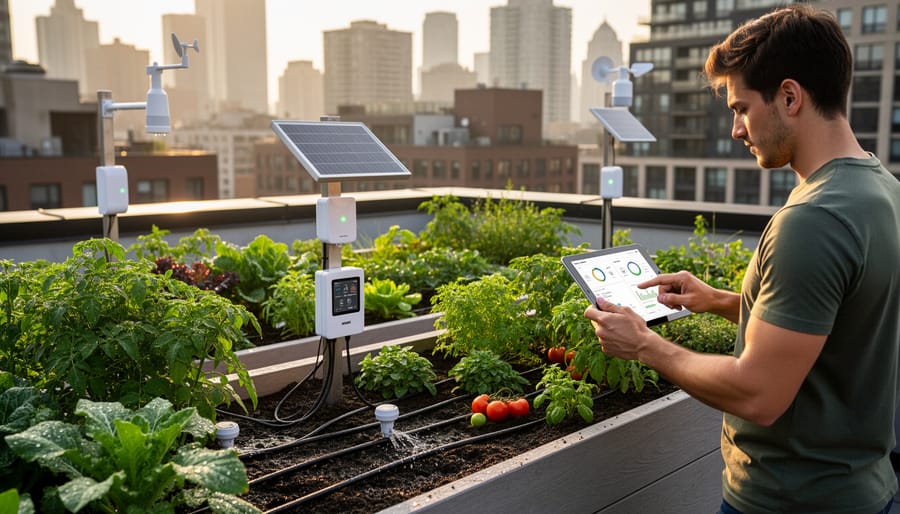
Aerial view of urban rooftop garden with raised beds and soil moisture sensors
Smart sensors integrated into urban rooftop gardens help maximize yields in limited city spaces while optimizing water and resource use.

Sensors and Automation: Your Garden’s Digital Assistant

Urban gardening doesn’t require constant vigilance when you have the right digital tools working alongside you. Modern sensors and automation systems act as your garden’s tireless assistant, monitoring conditions and responding to your plants’ needs even when you’re at work or away.

Soil moisture sensors are the perfect entry point for beginners. These affordable devices measure water levels in your soil and send alerts to your phone when plants need watering. Basic models start around $20-30, while smart sensors with Bluetooth connectivity range from $50-100. They eliminate guesswork and prevent both overwatering and drought stress, crucial for apartment balconies where you can’t easily check soil daily.

Compact weather stations designed for urban settings track temperature, humidity, rainfall, and sunlight. These mini stations help you understand your microclimate—essential information since rooftop conditions differ dramatically from ground-level patios. Expect to invest $75-150 for reliable models that sync with smartphone apps.

Automated watering systems transform how city dwellers maintain gardens. Simple drip irrigation kits with timers cost $30-60 and work perfectly for balcony container gardens. More sophisticated systems ($150-300) integrate with moisture sensors and weather data, adjusting watering schedules automatically. This technology proves invaluable during summer vacations or busy work weeks.

Maria, a Toronto CSA member, installed a basic moisture sensor system in her vertical garden last spring. “I was drowning my tomatoes and under-watering my peppers,” she shares. “Now my phone tells me exactly what each section needs. My harvest doubled, and I’m spending less time worrying.”

The beauty of these systems is scalability. Start with one moisture sensor, then expand as you gain confidence. As IoT technology transforms commercial farming, similar tools become increasingly accessible and affordable for home gardeners seeking efficiency in limited urban spaces.

Apps That Connect Growers and Build Community

Technology is bringing urban growers together in exciting new ways, making it easier than ever to share knowledge, coordinate harvests, and build thriving digital communities around local food production.

Apps like Crop Swap and ShareHarvest connect neighbors who want to exchange surplus produce, seeds, and gardening supplies. These platforms help reduce food waste while strengthening community bonds. Simply post what you have available, browse nearby offerings, and arrange pickups with fellow growers in your area.

For CSA members, coordination apps like Harvie and Local Line streamline communication between farms and shareholders. Members can customize their weekly shares, swap items they don’t want, and even pick up extra produce when available. The real-time updates keep everyone informed about harvest schedules and farm happenings.

Knowledge-sharing platforms such as GrowIt! and PlantSnap function as social networks specifically for gardeners. Upload photos of your urban garden, identify unfamiliar plants, troubleshoot pest problems, and get advice from experienced growers worldwide. These apps create supportive spaces where beginners feel comfortable asking questions and experts enjoy sharing their wisdom.

Many urban farms now use apps like Growing Gardens to manage volunteer schedules, workshop registrations, and community events. Members receive notifications about planting days, harvest festivals, and educational sessions, making participation effortless.

These digital tools transform isolated backyard efforts into collaborative movements, proving that even in dense cities, growers can cultivate both vegetables and meaningful connections with their neighbors.
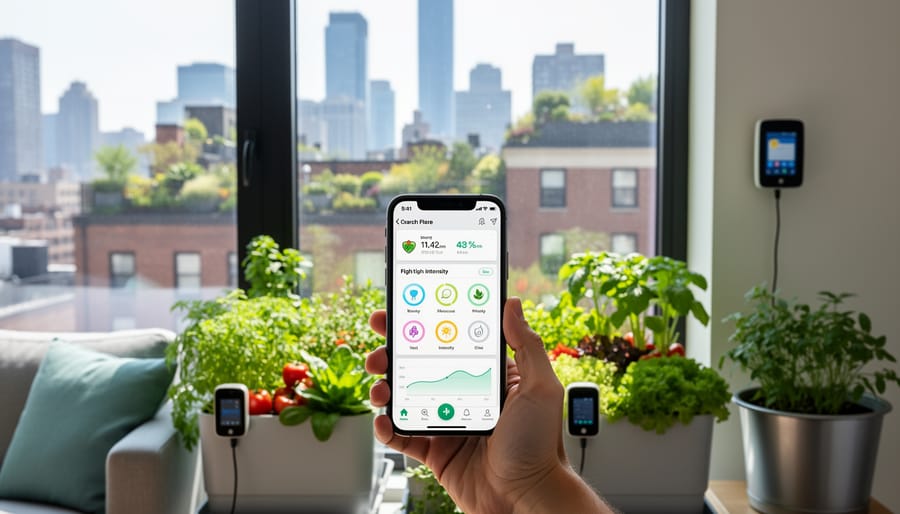
Person checking garden monitoring app on smartphone next to vertical hydroponic growing system
Mobile apps connect urban growers to real-time garden data and community networks, making high-tech food production accessible to apartment dwellers.

Vertical and Indoor Systems: Growing Beyond Ground Level

When ground space is scarce, thinking vertically transforms your urban growing potential. Hydroponic tower systems stack growing pockets upward, allowing you to cultivate dozens of plants in the footprint of a single houseplant. These innovative structures use nutrient-rich water instead of soil, making them perfect for balconies and patios where weight matters.

Indoor growing has evolved dramatically with LED grow light technology. These energy-efficient lights mimic natural sunlight, enabling year-round harvests regardless of weather or season. Modern LED systems use specific light spectrums to boost plant growth while consuming 40-60% less energy than traditional grow lights. You can now grow fresh lettuce, herbs, and even tomatoes right in your kitchen or spare bedroom.

Smart indoor systems take the guesswork out of urban farming. Automated controllers monitor moisture levels, adjust lighting schedules, and alert you when plants need attention. Some systems connect to smartphone apps, letting you tend your garden remotely during busy workdays.

Take Maria from Chicago, who transformed her studio apartment’s unused corner into a thriving vertical garden. Using a simple tower system and LED lights, she grows enough salad greens and herbs to supply her weekly meals and share with neighbors. She reports saving over $50 monthly on produce while enjoying fresher, pesticide-free food.

Starting small is key. Begin with a countertop herb garden to learn the basics, then expand as your confidence grows. The beauty of vertical and indoor systems is their scalability—you control exactly how much space and effort you invest.
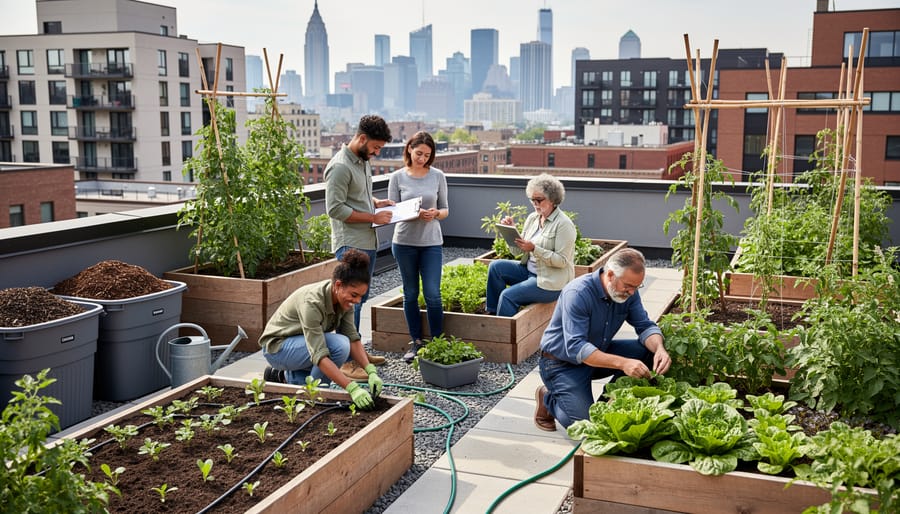
Group of urban gardeners working together and sharing harvest in city backyard garden
Urban CSA members collaborate in shared growing spaces, combining traditional community-supported agriculture with modern city gardening techniques.

Real Success: Urban Growers Making It Work

The best proof that integrated urban planning works? Real people growing real food in real cities. Let’s meet some urban growers who’ve cracked the code.

Sarah Chen transformed her Brooklyn apartment building’s rooftop into a thriving CSA that now feeds 25 neighborhood families. She started with just three raised beds and a simple drip irrigation system controlled by her smartphone. By mapping sun exposure throughout the day and using vertical growing structures, Sarah maximized every square foot. Her secret weapon? A combination of automated watering scheduled around weather forecasts and a detailed planting calendar that ensures continuous harvests from April through November. What began as a personal experiment now generates enough produce to supply weekly shares while building community among her neighbors.

In Detroit, Marcus Williams turned his backyard and two vacant side lots into an urban farm that supplies three local restaurants. His integrated approach combines solar-powered irrigation, companion planting strategies, and a simple spreadsheet system that tracks what to plant when. Marcus emphasizes that you don’t need expensive technology to succeed. His planning notebook and basic weather app help him stay ahead of planting deadlines and pest problems. The key, he says, is consistency and observation.

Even balcony gardeners are seeing remarkable results. Lima Rodriguez feeds her family of four with vegetables grown entirely on her Chicago apartment balcony. She uses container gardens with self-watering systems and follows a succession planting schedule she learned from online gardening communities. By growing vertically and choosing high-yield varieties like cherry tomatoes, peppers, and leafy greens, Lima harvests something fresh almost daily during the growing season.

These growers share common threads: they all started small, learned from mistakes, and used simple planning tools to track what worked. They prove that integrated urban planning isn’t about having the perfect setup or expensive equipment. It’s about understanding your space, using available resources wisely, and staying committed to the process. Whether you have a rooftop, backyard, or just a sunny balcony, their stories show that thoughtful planning makes urban food production not just possible, but genuinely rewarding.

Getting Started: Your First Steps Toward an Integrated Garden

Assess Your Space and Resources

Before diving into urban agriculture, take time to understand what you’re working with. Start by observing your available space throughout the day. Which areas receive at least six hours of direct sunlight? These prime spots are perfect for fruiting plants like tomatoes and peppers, while shadier corners work well for leafy greens.

Next, evaluate your water situation. Is there easy access to a hose or outdoor faucet? Consider installing rain barrels to harvest free water while reducing your environmental footprint. One urban farmer in Chicago saved 40% on her water bill by collecting rainwater from her roof.

Measure your actual growing space, whether it’s a balcony, rooftop, or small yard. Don’t let limited square footage discourage you. Vertical gardens, container systems, and intensive planting methods can transform even tiny areas into productive gardens.

Finally, establish a realistic budget. Factor in initial setup costs for containers, soil, seeds, and any technology like drip irrigation systems or grow lights. Remember that many investments, like quality containers and automated watering systems, pay dividends through years of use. Start small if needed—you can always expand as you gain experience and confidence in your urban growing journey.

Start Small, Scale Smart

You don’t need to transform your entire urban garden overnight. The most successful city growers start with one or two simple technologies and expand as they learn what works in their specific environment. Begin by choosing a single system that addresses your biggest challenge. If watering is your struggle, try a basic drip irrigation timer before investing in a smart controller. If space is tight, test one vertical growing structure before covering every wall.

Consider running small experiments. Set up moisture sensors in half your containers while watering the others manually, then compare plant health and water usage over a month. This hands-on approach teaches you what your plants actually need rather than guessing. Maria, a Brooklyn balcony gardener, started with just three self-watering containers. After seeing her tomato yields double, she gradually expanded to 15 containers with a rainwater collection system.

Track what you observe in a simple notebook or phone app. Note which plants thrive, when pests appear, and how much you harvest. These insights become invaluable when deciding where to invest time and resources next. Remember, urban farming is about progress, not perfection. Each growing season offers new lessons that help you refine your approach and scale thoughtfully.

Overcoming Common Urban Growing Challenges

Urban gardening comes with its fair share of hurdles, but integrated planning paired with smart technology turns these obstacles into opportunities. Let’s explore how modern solutions tackle the common urban farming challenges that city growers face.

Limited space ranks as the biggest concern for urban farmers. Vertical growing systems, including tower gardens and wall-mounted planters, maximize every square foot available. Many urban CSAs now use tiered shelving with grow lights to transform small warehouses into productive farms. By mapping your space digitally using garden planning apps, you can optimize layouts and calculate exactly how many plants fit in your area.

Contaminated soil presents another significant barrier in cities where industrial history left behind harmful residues. Raised beds with purchased organic soil provide a clean growing medium, while container gardening eliminates ground contact entirely. Some urban farmers use soil testing kits to assess contamination levels before planting, then choose appropriate growing methods based on results.

Unpredictable microclimates make urban growing tricky. Tall buildings create wind tunnels and shade patterns that shift throughout the day. Temperature variations between sunny pavement and shaded areas can differ by 15 degrees. Weather monitoring stations and smartphone apps help you track these variations, allowing you to position heat-loving tomatoes in warm spots while placing leafy greens in cooler zones.

Water management also challenges city growers. Integrated drip irrigation systems with timers ensure consistent moisture without waste, while rainwater collection barrels turn rooftops into water sources. These technologies, combined with moisture sensors that alert you via smartphone, prevent both drought stress and overwatering, helping your urban garden thrive despite city conditions.

The beauty of integrated urban planning is that it transforms what seems impossible into something genuinely achievable. By combining thoughtful space design with accessible technology like soil sensors, vertical growing systems, and simple planning apps, city dwellers can create thriving food gardens right where they live. You don’t need a sprawling farm or expensive equipment to participate in CSA programs or grow your own fresh produce.

The success stories we’ve explored prove that anyone can start small and scale up gradually. Whether you’re joining a community garden with shared technology resources or setting up a modest balcony garden with a few smart tools, taking that first step matters most. Connect with your local CSA programs to learn what’s possible in your neighborhood and discover what resources already exist in your community.

Technology has democratized urban agriculture, making it accessible to beginners and experienced gardeners alike. Start by assessing your available space, research one or two tech tools that match your budget, and begin growing something simple. Your urban garden journey doesn’t have to be perfect from day one. The important thing is to begin, learn as you grow, and enjoy the fresh, organic produce you’ve cultivated yourself while contributing to a more sustainable food system in your city.