

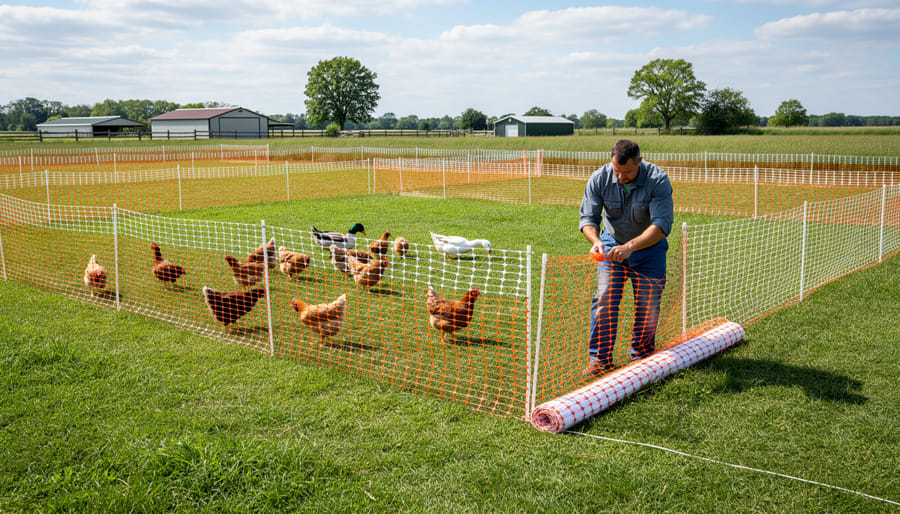
Divide your pasture into 4-8 smaller paddocks using temporary electric netting, moving your chickens or sheep every 3-5 days to fresh grass while giving grazed areas 21-30 days to recover. This simple rhythm prevents overgrazing, builds soil fertility naturally, and transforms even a quarter-acre plot into productive grazing space alongside your vegetable beds.
Start with mobile infrastructure that grows with your operation. A basic setup costs $800-1,200 for premier electric netting, a solar charger, and portable water tanks. Position your first paddock adjacent to high-value crops like tomatoes or squash, where chickens excel at pest control and fertilization during their off-season months.
Map your rotation by walking your land with string flags, marking paddock divisions that accommodate natural features like trees, slopes, and irrigation lines. Calculate 50-100 square feet per chicken or 200-400 square feet per sheep, adjusting density based on forage quality and season. Small CSA farms typically succeed with 15-30 laying hens or 3-6 sheep integrated into 2-5 acres.
Track your grazing days using a simple calendar or phone app, noting when animals enter and exit each paddock. This data reveals patterns in grass recovery, optimal stocking rates, and seasonal adjustments. After three rotation cycles, you’ll notice darker soil, thicker grass stands, and reduced feed costs as your system matures into a regenerative powerhouse that enhances both animal welfare and vegetable production.
Why Small CSA Farms Are Perfect for Rotational Grazing
The Soil Health Connection Your Vegetables Will Thank You For
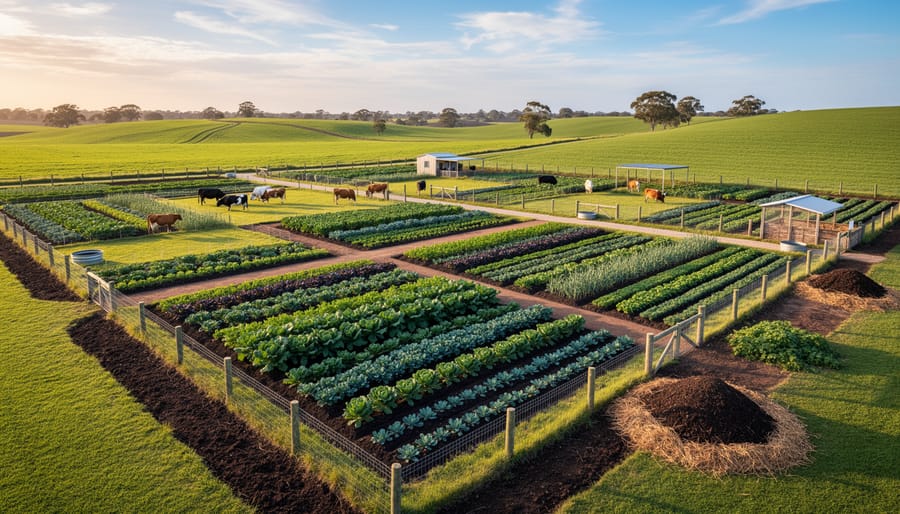
Here’s what happens when your livestock become soil-building partners: as animals graze through designated paddocks, their hooves break up compacted soil surfaces, creating tiny pockets for water and air to penetrate deeper. This natural tilling action improves soil structure without machinery, and the results show up beautifully in your vegetable beds.
The magic really happens through what animals leave behind. Each grazing rotation deposits nutrient-rich manure directly onto future growing areas, adding organic matter that feeds soil microbes and builds long-term fertility. Unlike synthetic fertilizers that only provide quick nutrients, this biological approach creates a living soil ecosystem that sustains itself over time.
Sarah Martinez, a CSA farmer in Vermont, discovered this connection firsthand. “After three years of rotating chickens through our fallow beds, our soil tests showed dramatic improvements in organic matter and nitrogen levels,” she shares. “We’ve cut our fertilizer costs by 60% while growing better vegetables than ever before.”
The timing matters too. By planning your rotational grazing patterns with next season’s vegetable beds in mind, you’re essentially pre-fertilizing your growing areas naturally. Animals graze cover crops in fall, deposit nutrients through winter, and by spring, you have rich, biologically active soil ready for planting. These land healing strategies work particularly well on small-scale operations where integration between animals and vegetables creates powerful synergies. The animals feed themselves while building your garden’s future productivity—a perfect closed-loop system.
Diversifying Income While Building Your Land
Rotational grazing creates a perfect opportunity to diversify your CSA income beyond vegetables. Many small farms find that adding animal products like fresh eggs, pasture-raised chicken, and lamb to their weekly shares significantly boosts revenue while delighting members who appreciate the convenience of one-stop farm shopping.
The beauty of this approach lies in how the animals earn their keep twice over. Your laying hens can follow cattle or sheep through paddocks, spreading manure and eating pest larvae while producing premium eggs. Meat chickens thrive in mobile tractors that you move daily across recently grazed areas, fertilizing the soil while converting pasture into protein. Sheep or goats work wonders on overgrown areas and can integrate beautifully with silvopasture systems if you have wooded sections.
Start small with a flock of 20-30 laying hens to test member interest. Survey your CSA members about their protein preferences before investing in larger livestock. Many farmers report that animal products command premium prices and create stronger member loyalty, as families come to rely on their weekly farm protein alongside vegetables. This diversity also smooths out seasonal income fluctuations that vegetable-only operations face.
Designing Your Rotational Grazing System: Start Small, Think Smart
Choosing the Right Animals for Your Farm Size and Goals
Selecting the right animals for your small CSA farm depends on your acreage, infrastructure, and production goals. Each species offers unique benefits and challenges worth considering.
Chickens are the gateway animal for most CSA operations, requiring minimal investment in fencing. A simple electric poultry netting system works well, costing around $200-300 for a portable setup. They need about 1 gallon of water per 10 birds daily and excel at pest control in vegetable beds after harvest. Processing can happen on-farm in most states for direct sales, making them ideal for small-scale operations. Sarah Chen of Green Valley Farm integrates 50 laying hens into her 3-acre CSA, rotating them through garden beds to manage insects and fertilize simultaneously.
Sheep fit beautifully into small operations, typically requiring 4-6 animals per acre in rotational systems. They need more robust fencing than chickens, usually five-strand electric or woven wire, but their grazing patterns complement vegetable production nicely. Water requirements run about 1-2 gallons per sheep daily. Processing logistics prove trickier since you’ll likely need to transport to a USDA facility, but their compact size makes them manageable.
Goats require the most secure fencing since they’re notorious escape artists. Plan for 6-8 goats per acre and consider their browsing behavior, which works wonderfully for clearing overgrown areas but requires vigilance near vegetable crops. Water needs mirror sheep at 1-2 gallons daily.
Cattle demand the most infrastructure and space, needing at least 2-3 acres for a small herd in rotation. Unless you have existing pasture and sturdy perimeter fencing, start with smaller livestock first. However, their manure builds soil fertility rapidly, and many CSA members appreciate beef shares alongside vegetables.
Paddock Layout That Works With Your Vegetable Beds
Designing paddocks around your existing vegetable beds requires thoughtful planning, but it’s simpler than you might think. Start by mapping your growing areas and identifying the spaces between and around them that animals can graze. These transitional zones, pathways, and fallow sections become your grazing paddocks.
Here’s a straightforward formula to calculate paddock size: divide your total grazing area by the number of days you want grass to recover. For most small farms, grass needs 21-35 days of rest during the growing season. If you have one acre available for grazing and want a 28-day recovery period, you’ll need about 14 paddocks at roughly 3,000 square feet each.
For stocking density, use this simple calculation: a sheep or goat needs approximately 50-75 square feet for a one-day graze, while chickens in portable coops need about 10 square feet per bird daily. Sarah Chen, who runs a 3-acre CSA in Vermont, rotates 12 sheep through paddocks between her raised bed sections. She moves them every two days, giving each paddock a month to recover while fertilizing pathways that would otherwise need mowing.
Consider integrating trees with grazing in your border areas to add shade and biodiversity. Mark your paddock boundaries with temporary electric netting, which costs about 50 cents per linear foot and can be easily reconfigured as your vegetable layout changes seasonally.
The key is starting small. Begin with 4-6 paddocks and adjust based on how quickly your grass recovers and how your animals perform. You’ll quickly develop an intuitive sense of timing that matches your farm’s unique rhythm.
Fencing Solutions That Won’t Break the Bank
Good news: you don’t need thousands of dollars in permanent fencing to start rotational grazing on your CSA farm. Temporary, moveable fencing offers flexibility and affordability that’s perfect for small-scale operations.
Electronet fencing is a popular choice for beginners, especially with sheep, goats, or poultry. These pre-woven nets with built-in support posts cost around $150-250 for a 164-foot roll. They’re self-supporting, easy to move, and highly visible to both animals and people. The biggest advantage? You can set up a new paddock in under 10 minutes once you get the hang of it.
For cattle and larger animals, polywire or polytape with step-in posts provides excellent value. A basic setup costs roughly $100-150 for 1,300 feet of polywire and 20 step-in posts. Polytape is more visible than wire, making it ideal if your animals are new to electric fencing. Budget an additional $200-300 for a quality solar energizer that’ll power your system reliably.
Here’s a money-saving tip from experienced graziers: start small with one or two paddocks, then expand as you learn your animals’ behavior and your land’s quirks. Test your fence regularly with a voltage tester (around $20) to ensure it’s working properly. Most escape attempts happen because the fence lost its charge, not because animals are testing boundaries.
Remember, even a modest investment in moveable fencing pays for itself quickly through improved pasture health and reduced feed costs.
The Movement Schedule: Timing Is Everything
Reading Your Pasture (No Degree Required)
You don’t need a degree in agronomy to know when it’s time to move your animals. With a few simple observation skills, you’ll quickly become fluent in reading your pasture’s signals.
Start with the easiest indicator: grass height. For most small-scale operations, move animals when grass reaches 8-10 inches tall and relocate them before it drops below 3-4 inches. This sweet spot ensures plants have enough leaf surface to photosynthesize efficiently while preventing overgrazing damage. Think of it as harvesting at peak ripeness, just like you would with vegetables.
Watch for the three-leaf stage as your green light. Most pasture grasses recover best when they’ve regrown to three full leaves after grazing. This indicates the plant has replenished its root reserves and is ready for another grazing cycle. Count the leaves on several plants across your paddock for a quick assessment.
Red flags for overgrazing are surprisingly obvious once you know what to look for. Bare soil patches, animals grazing plants down to nubbins, and the appearance of weedy species all signal you’ve waited too long to move. You might also notice animals spending excessive time searching for preferred plants rather than grazing contentedly.
Sarah Mitchell, who runs a two-acre CSA in Vermont, keeps it simple: “I walk the paddock daily with my coffee. If I see mostly stems and my chickens are pecking at dirt instead of grass, it’s time to move.” Trust your observations, adjust based on what you see, and your instincts will sharpen quickly.

Creating a Rotation Calendar That Fits Your CSA Season
Planning your rotation calendar starts with understanding your CSA’s rhythm. Map out your harvest days and market schedules first, as these anchor points determine when animals need to be moved to fresh paddocks. Most small-scale CSA farmers find success moving animals early in the morning before harvest begins or in the late afternoon after market prep wraps up.
Consider seasonal grass growth when setting move frequency. During spring’s explosive growth (May-June), you might rotate sheep or chickens every 1-2 days to keep up with the forage. Summer’s slower growth extends this to 3-4 days per paddock, while fall may stretch to 5-7 days as grass production slows.
Here’s a sample weekly schedule that works beautifully for a vegetable-focused CSA:
Monday: Move animals after morning chores (7-8 AM)
Tuesday-Wednesday: Regular animal checks only
Thursday: Afternoon move (4-5 PM) before Friday harvest prep
Friday: CSA harvest day, no animal moves
Saturday: Farmers market prep and delivery
Sunday: Light move if needed, farm rest day
Sarah Chen from Green Valley Farm shares her success: “I sync my chicken tractor moves with my harvest schedule. Thursday afternoons work perfectly because Friday mornings are crazy with CSA packing. The chickens get fresh ground, and I’m not scrambling during peak harvest time.”
Track paddock conditions in a simple notebook or phone app, noting recovery times and adjusting your calendar monthly as seasons shift. This flexibility keeps both your animals and vegetables thriving without overwhelming your schedule.
Integrating Grazing With Your Vegetable Production
Using Animals as Cover Crop Terminators
One of the most satisfying aspects of rotational grazing is watching your animals do double duty as living tillers. Instead of mowing down cover crops and working them into the soil with machinery, you can move chickens, sheep, or cattle onto plots planted with ryegrass, clover, or winter rye. The animals graze the biomass down to a manageable level while simultaneously depositing nitrogen-rich manure exactly where your next vegetable crop will grow.
Timing is everything here. Plan to move animals onto cover crop areas about two to three weeks before you intend to plant. This gives the manure time to begin breaking down and allows any remaining plant material to decompose slightly. Chickens work particularly well for this task on smaller plots, with a mobile coop providing flexibility to target specific beds. At Spring Valley Farm in Oregon, farmer Marcus Chen uses a flock of 30 chickens to terminate cover crops across his half-acre vegetable garden, saving both fuel costs and soil compaction while building fertility. The result? Soil that’s primed for planting with minimal equipment needed, plus eggs as a bonus product for your CSA members.
Post-Harvest Cleanup Crews
One of the most satisfying aspects of rotational grazing is putting animals to work as your post-harvest cleanup crew. After you’ve harvested your vegetable beds, chickens and sheep can move through those spaces to handle the mess you’d otherwise clear by hand.
Chickens excel at this job, scratching through finished beds to devour crop residues, weed seeds, and pest larvae hiding in the soil. A flock of 15-20 laying hens can clear a 30-foot bed in just a few days while depositing nitrogen-rich manure that will feed your next planting. They’re particularly effective at reducing pest populations since they hunt for insects, slugs, and grubs with remarkable enthusiasm.
Sheep offer different advantages, especially for larger CSA operations. They’ll mow down cover crops, eat tougher plant material, and compact the soil less than cattle would. Their manure breaks down quickly and adds valuable organic matter to tired beds.
The key is timing your rotations carefully. Move animals onto beds after you’ve harvested but before you need to prepare for the next crop. Use portable electric netting to contain them in specific areas, preventing them from wandering into active growing spaces. Most small-scale CSA farmers find that 3-5 days per bed provides thorough cleanup without over-fertilizing.
Sarah Chen, who runs a two-acre CSA in Vermont, shares this tip: “My chickens follow right behind every harvest. They’ve reduced my pest pressure by at least 60 percent, and I’ve cut my fertilizer costs in half. It’s like having a maintenance crew that pays me in eggs.”

Real Farm Success: Sarah’s 3-Acre Integration
When Sarah Martinez started her CSA farm in Vermont, she worked three acres alone, spending long days managing vegetable beds while watching soil fertility decline each season. Five years ago, she introduced rotational grazing with 25 laying hens and 8 Katahdin sheep, transforming both her farm’s productivity and her quality of life.
Sarah divided her three acres into six paddocks using portable electric netting, keeping two acres in vegetable rotation and dedicating one acre to permanent pasture and cover crops. Each paddock measures roughly half an acre, allowing her animals to move every 3-5 days during the growing season. “The sheep graze down cover crops in early spring, fertilizing future vegetable beds, while the chickens follow two days later, spreading manure and controlling pests,” Sarah explains.
Her initial investment totaled $2,400, including $800 for electric netting, $600 for a mobile chicken coop, $400 for waterers and feeders, and $600 for the animals themselves. Within two years, egg sales alone covered her setup costs, generating $3,200 annually at local markets. The sheep provide additional income through breeding stock sales and occasional lamb harvests.
The seasonal workflow integrates seamlessly with vegetable production. In early spring, sheep graze winter-killed cover crops on designated sections, trampling residue and adding fertility. Sarah transplants vegetables three weeks after animals leave, allowing time for manure to stabilize. During peak summer, chickens rotate through harvested garlic and early pea beds, cleaning up debris while her sheep maintain pathways and hedgerows. Come fall, both species tackle cover crop cocktails before winter dormancy.
Challenges emerged quickly. Sarah initially underestimated water needs, hauling 15 gallons daily until she installed a permanent waterline with multiple hookup points. Predator pressure required upgraded fencing and a livestock guardian dog, adding $1,200 to expenses. “Learning animal behavior took time,” she admits. “Sheep can be stubborn about moving, and timing moves around vegetable harvest required careful planning.”
Her biggest lesson? Start smaller than you think. “I wished I’d begun with 12 hens only, mastering the system before adding sheep,” Sarah reflects. Today, her soil organic matter has increased from 3.2% to 5.8%, and CSA members rave about optional egg and meat shares, creating a truly integrated, profitable operation.
Common Mistakes to Avoid (So You Don’t Learn the Hard Way)
Even the most well-intentioned grazing plans can go sideways without some foresight. Let’s talk about the mistakes that trip up many beginners, so you can sidestep them entirely.
Overstocking is probably the biggest culprit. It’s tempting to squeeze in extra animals, but too many mouths in too small a space defeats the whole purpose. Your paddocks get hammered, recovery time vanishes, and you’re left with mud and stress. Start conservative with your stocking density. A good rule of thumb for beginners is to aim for about 80 percent of what calculators suggest, then adjust upward once you see how your land responds through a full season.
Moving too slowly or too fast creates its own headaches. Leave animals in one spot too long, and they’ll overgraze their favorites while trampling everything else. Move them too quickly, and they won’t consume enough forage, wasting your pasture’s potential. Watch your grass height closely. Most pasture species do best when grazed down to about 3-4 inches, then given time to bounce back to 8-10 inches before the animals return.
Inadequate water systems will sabotage everything. Hauling water by hand gets old fast, and animals won’t thrive if they’re thirsty. Invest in a good portable watering system from the start, whether that’s a gravity-fed tank on a sled or a simple IBC tote with quick-connects. Your future self will thank you.
Predator problems catch many CSA farmers off guard when they first add livestock. Electric netting works wonders for poultry, but only if you keep it charged and vegetation-free. Consider getting a livestock guardian dog if predation becomes persistent.
Fence failures often happen at the worst possible moments. Test your charger weekly, walk your perimeter regularly, and keep a repair kit handy. One Ontario CSA farmer shared that his breakthrough came when he started treating fence maintenance like crop maintenance, scheduling it into his weekly routine rather than waiting for emergencies.
Getting Started: Your First Season Action Plan
Winter planning sets the foundation for success. Begin three to four months before your planned start date by mapping your available pasture space on paper. Walk the land and identify water access points, natural shade, and existing fence lines. This quiet season is perfect for reading books, watching tutorials, and connecting with local graziers who can share practical wisdom from their own experiences.
As spring approaches, invest in your essential infrastructure. For a starter operation on 1-2 acres, budget approximately $800-1,200 for basic supplies: a solar-powered fence charger ($150-250), 1,000 feet of polywire or polytape ($75-100), 15-20 step-in posts ($60-80), a gate handle ($15), and a voltage tester ($25). Add temporary water containers like 100-gallon stock tanks ($100-150) and basic hoof care supplies ($50). Larger operations spanning 5-10 acres should expect $2,000-3,500 in startup costs for more robust fencing materials and additional water infrastructure.
Begin with a small, manageable number of animals. Two to four sheep or a couple of goats allow you to learn the rhythm of moves without feeling overwhelmed. Set up three to five paddocks initially, planning to move animals every 2-3 days. This gives you time to observe, adjust, and build confidence.
Your first moves will feel clumsy, and that’s completely normal. Keep a simple notebook tracking which paddocks you grazed, rest periods, and what you notice about regrowth. These observations become invaluable as you refine your system and develop profitable small farm systems.
Connect with your regional grazing network or extension office. Many areas offer farm tours, workshops, or mentorship programs where experienced graziers welcome newcomers with open advice. Consider joining online communities where you can ask questions and share your learning journey.
By mid-season, evaluate what’s working. Are paddock sizes appropriate? Is rest time adequate? Do animals have enough forage? Adjust your rotation speed and paddock dimensions based on real results, not just theory. Remember that every farm’s conditions differ, so your system should evolve uniquely to match your land, climate, and goals. The first season is about learning through doing, building skills that will serve you for years to come.
Rotational grazing isn’t just a farming technique—it’s a pathway to building a truly resilient and profitable small farm while actively healing the land beneath your feet. Whether you’re managing a compact CSA operation or dreaming of starting one, this regenerative practice offers real benefits: healthier soil, reduced feed costs, happier animals, and vegetables that practically grow themselves in nutrient-rich pastures.
The beauty of rotational grazing lies in its flexibility. You don’t need to transform your entire operation overnight. Start with one species—perhaps chickens in mobile coops following your bed rotations—and observe how your soil responds. As you gain confidence and see results, you can gradually introduce sheep, goats, or other animals that complement your vegetable production goals.
Remember Sarah’s story? She began with just six chickens and now runs a thriving integrated farm. Every farmer who’s embraced rotational grazing started exactly where you are now, with questions and curiosity.
By implementing rotational grazing, you’re joining a growing movement of farmers who recognize that agriculture can regenerate rather than deplete. Your small farm has the power to sequester carbon, build topsoil, and produce nourishing food—all while becoming more profitable. That’s something worth celebrating.
