
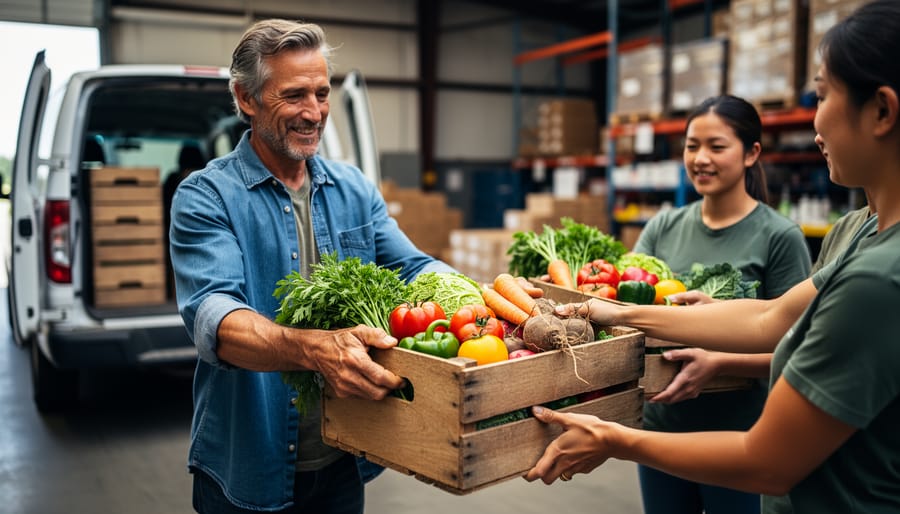
Yes, food donations are tax deductible, and as a farmer or CSA operator, you may qualify for enhanced deductions that go beyond the standard write-offs most donors receive. The IRS allows you to deduct up to 15% of your taxable income when donating food to qualified charitable organizations, and in many cases, you can claim deductions based on the fair market value of your produce rather than just your production costs.
The process starts with understanding your protection under the Bill Emerson Good Samaritan Food Donation Act, which shields you from liability when donating food in good faith to nonprofit organizations. This federal protection means you can confidently donate surplus crops, slightly imperfect produce, or end-of-season harvests without fear of legal repercussions if someone claims the food caused harm.
For CSA farmers, this creates a meaningful opportunity to reduce food waste while lowering your tax burden. Calculate your potential deduction by documenting the fair market value of donated items—essentially what you would charge customers at your farm stand or through your CSA shares. Keep detailed records including dates, quantities, descriptions of produce donated, and acknowledgment letters from receiving organizations.
The enhanced deduction provision particularly benefits farmers operating as C corporations, allowing deductions of up to 25% of taxable income. Many small-scale and CSA farmers successfully partner with local food banks, homeless shelters, and community kitchens, creating relationships that serve their communities while providing substantial tax benefits. Documentation requirements are straightforward, making this an accessible strategy for farms of any size.
Understanding Food Donation Tax Deductions for CSA Farms
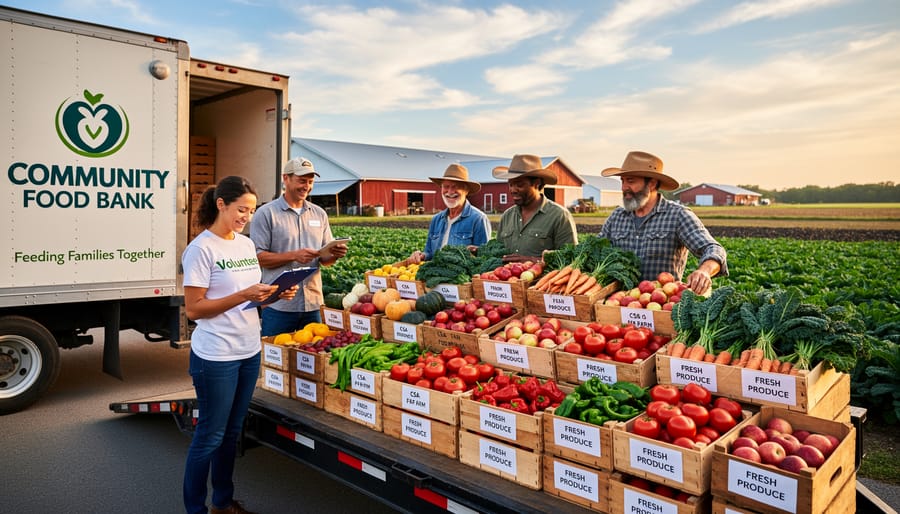
What Makes a Food Donation Tax Deductible?
Good news for generous farmers and food donors: yes, food donations are generally tax deductible when you follow IRS guidelines! Understanding what qualifies can help your farm maximize tax benefits while supporting your community.
For donations to count, you must give to qualified tax-exempt organizations. These include food banks, soup kitchens, homeless shelters, and 501(c)(3) nonprofit organizations that serve people in need. Religious organizations with feeding programs and community meal services also qualify. The key is ensuring your recipient has proper tax-exempt status, which you can verify through the IRS Tax Exempt Organization Search tool.
The food itself must meet certain standards. Fresh produce from organic CSA operations, excess harvest, or slightly imperfect items that don’t meet retail standards but remain wholesome all qualify. The IRS requires donated food to be suitable for human consumption at the time of donation. You can’t claim rotten or unsafe produce, but cosmetically imperfect vegetables and surplus yields work perfectly.
For CSA farms, the basic requirement is maintaining proper documentation. You’ll need written acknowledgment from recipient organizations for donations over 250 dollars, describing what you gave and when. Keep detailed records of quantities, fair market values, and dates. Many successful farmers share that simple spreadsheets tracking weekly donations make tax time straightforward.
Remember, the organization receiving your donation cannot provide goods or services in return for your deduction to remain valid. Pure generosity gets rewarded!
The Enhanced Deduction for CSA Farmers
Here’s some great news if you’re a CSA farmer looking to donate your harvest: you may qualify for an enhanced tax deduction that goes beyond what typical donors receive. While most individuals can only deduct the cost basis of donated food (essentially what they paid for it), qualifying farmers can deduct up to 50% of the fair market value of their donated products.
This enhanced deduction recognizes the unique position of agricultural producers who grow food for income. For a CSA farmer who donates fresh tomatoes worth $500 at market price, with a growing cost of $150, the regular deduction would be limited to that $150. However, under the enhanced deduction, you could potentially deduct $250, calculated as the cost basis plus half the appreciation in value.
To qualify, you must donate to eligible organizations like food banks or soup kitchens that serve those in need. The donated items must be wholesome food inventory that would otherwise be sold in your regular CSA operation. This provision helps bridge the gap between farm surplus and community hunger while rewarding farmers for their generosity. Keep detailed records of your costs, market values, and recipient organization information to support your enhanced deduction claim at tax time.
Navigating Food Donation Liability Protection
The Good Samaritan Act: Your Safety Net
One of the biggest concerns for CSA farmers considering food donations is liability. What if someone gets sick from donated produce? The good news is that federal law has your back. The Bill Emerson Good Samaritan Food Donation Act, passed in 1996, protects food donors from civil and criminal liability when donating to nonprofit organizations in good faith.
This protection applies to both direct donations and gleaning programs, covering you whether you’re donating surplus kale to a food bank or inviting volunteers to harvest excess tomatoes from your fields. The law shields you from lawsuits as long as the food donated appears wholesome and safe at the time of donation, even if it’s past its peak freshness.
There’s an important exception: the protection doesn’t apply in cases of gross negligence or intentional misconduct. Simply put, don’t donate food you know is contaminated or unsafe. But that slightly bruised apple or the perfectly edible carrots that don’t meet your CSA box aesthetic standards? Those are completely protected.
Many farmers who’ve embraced donation programs share that this legal protection removed their primary hesitation. It transforms what once felt risky into a safe, rewarding practice that reduces waste while serving your community.
What About Food Safety Standards?
Good news: the Bill Emerson Good Samaritan Food Donation Act protects you from liability when donating food in good faith. This federal law shields farmers and food donors from civil and criminal prosecution, provided the food meets basic safety standards at donation time.
For CSA farmers, this means following the same food safety standards you already practice. Keep donated produce properly stored, handle it with clean hands and equipment, and avoid donating anything you wouldn’t feel comfortable serving your own family. Simple practices like washing produce, maintaining proper temperatures, and documenting donation dates go a long way.
Many farmers worry about FSMA compliance requirements, but the same protocols protecting your CSA members also protect your donations. Document your safety procedures, and you’re covered both legally and for tax purposes.
How to Calculate Your Tax Deduction
Cost Basis Method for Most CSA Farms
Most small CSA farms will use the cost basis method, which is straightforward and perfectly suited to farming operations. Here’s the good news: you can deduct the actual expenses you invested in growing the donated food.
This includes your costs for seeds, seedlings, soil amendments, compost, fertilizer, water, and other growing inputs. You’ll also factor in calculating labor costs if you paid employees to help grow, harvest, or prepare the donated produce. Don’t forget to include fuel for tractors, irrigation system expenses, and even a proportional share of land use costs.
For example, if you donated 50 pounds of tomatoes and your total cost to grow them was $75 in seeds, compost, and labor, that’s your deductible amount. Keep detailed records of all these expenses throughout the growing season, which also helps with overall tax compliance for CSA farms.
The beauty of this method is its simplicity. You’re already tracking these expenses for farm management purposes, making tax time much easier when donation season arrives.
Fair Market Value Method (For Qualifying Farms)
Here’s the exciting part: if your CSA operation has grown into a qualified farm business, you might be eligible for significantly higher deductions using the fair market value method. Instead of deducting just your cost basis, you could deduct the full retail value of your donated produce.
To qualify for this enhanced deduction, your farm must meet specific IRS criteria. You need to be a C corporation or, more commonly for CSA farms, a qualified farmer with ordinary income from your farming business. The donated food must go to qualified charitable organizations that serve people who are ill, needy, or infants, and the charity must use the food solely for these purposes.
The deduction can reach up to 15% of your net farm income for sole proprietors and partnerships, or 25% for C corporations. For example, if you donate $5,000 worth of tomatoes and lettuce that cost you $2,000 to grow, you could potentially deduct the full $5,000 rather than just your $2,000 cost basis.
This method requires careful documentation and working with a tax professional familiar with agricultural businesses. Many successful CSA farmers have found these enhanced deductions make their donation programs not only community-minded but financially sustainable too.
Essential Documentation and Record-Keeping
Required Forms and Receipts
Proper documentation transforms your generous food donations into valuable tax deductions. When donating surplus produce from your farm or garden, you’ll need to keep detailed records to satisfy IRS requirements.
For donations exceeding $250, you must obtain a written acknowledgment from the recipient organization. This letter should include the organization’s name, donation date, description of items donated, and a statement confirming whether you received any goods or services in return. Request this acknowledgment promptly after each donation, as many food banks and community organizations are happy to provide them.
If your total noncash donations exceed $500 for the year, you’ll need to complete IRS Form 8283 and attach it to your tax return. This form requires information about each recipient organization, donation dates, and how you acquired the donated items. For food you grew yourself, note the date you harvested it.
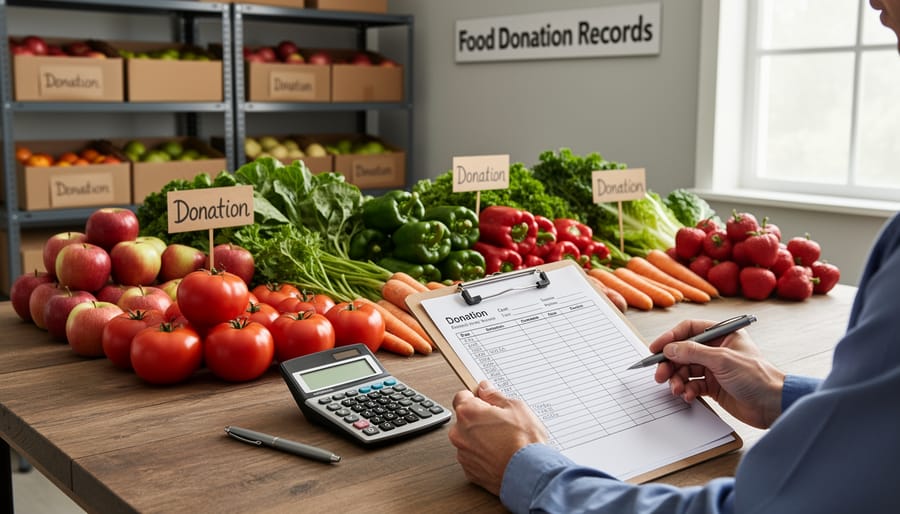
Keep your own records too. Document what you donated, estimated fair market values (based on local farmers market prices), dates, and recipient details. Photographs of your donations can provide helpful backup documentation. One Pennsylvania farm couple maintains a simple spreadsheet tracking their weekly food bank contributions, making tax time much easier while supporting their community throughout the growing season.
Simple Record-Keeping Systems for Busy Farmers
Good news: you don’t need fancy software or complicated spreadsheets to track your donations. A simple three-ring binder or smartphone app works perfectly for busy farmers juggling multiple tasks.
Consider keeping a donation log at your packing shed or cooler. Each time you set aside produce for donation, jot down the date, item, quantity, and estimated value based on your regular CSA prices. Many farmers find success using their phone’s notes app or a free spreadsheet on their tablet that syncs across devices.
Take quick photos of donations before delivery. These visual records supplement your written logs and provide excellent backup documentation if questions arise later. Some farmers create a dedicated folder on their phone labeled “Donation Records” for easy year-end access.
For a streamlined approach, batch your record-keeping. Instead of logging individual carrots or tomatoes, note “10 pounds mixed produce” with a total value. The IRS accepts reasonable estimates for perishable goods.
Meet Sarah from Willow Creek Farm who uses a simple pocket notebook she keeps in her harvest tote. “I spend maybe five minutes per donation,” she shares. “When tax season arrives, I just total the pages and hand everything to my accountant.”
The key is consistency, not perfection. Choose one method that fits naturally into your existing workflow and stick with it throughout the growing season.
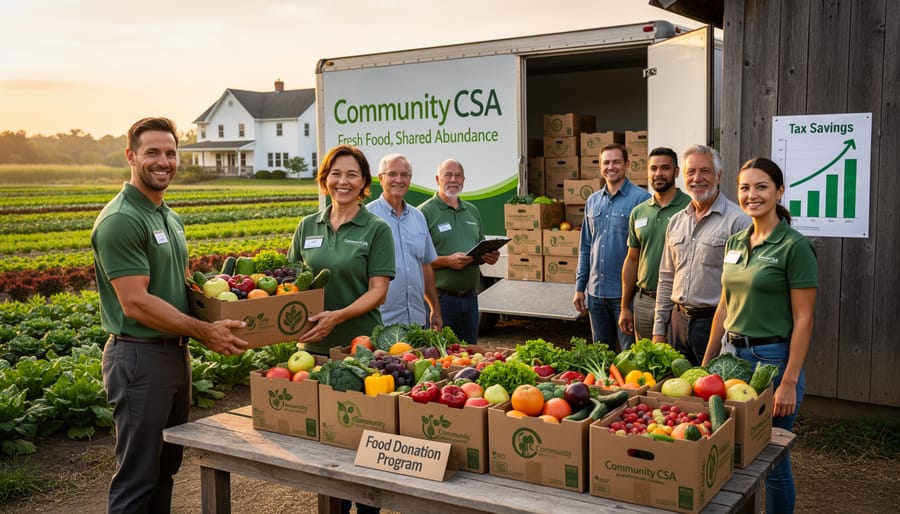
Real-World Benefits: A CSA Farmer’s Success Story
Meet Sarah Chen, who runs Green Valley CSA in Vermont, where she grows organic vegetables for 120 member families. Three years ago, Sarah faced a common challenge: perfectly good produce that didn’t meet her members’ aesthetic expectations or exceeded weekly harvest needs. Rather than composting 15-20% of her harvest, she decided to establish a donation program with her local food bank.
The results transformed both her farm’s bottom line and her community. In her first year, Sarah donated 3,200 pounds of organic produce valued at $9,600. Because she qualified for the enhanced deduction as a farmer donating to a qualified organization, she could deduct the full fair market value rather than just her production costs. This resulted in tax savings of approximately $2,880, effectively recovering about 30% of her potential lost revenue.
“I was amazed at how straightforward the process was,” Sarah explains. “I kept simple records of what I donated each week, got quarterly receipts from the food bank, and my accountant handled the rest during tax season.”
Beyond the financial benefits, the program created unexpected positive ripples. Local media covered her donations, attracting fifteen new CSA members who specifically mentioned her community involvement. Sarah also connected with the food bank’s nutrition educator, who now visits her farm for seasonal workshops, strengthening relationships between CSA members and the broader community.
The program reduced her composting needs, saved disposal time, and gave purpose to crops affected by minor cosmetic issues. Most importantly, Sarah’s donations provided fresh organic vegetables to over 200 families facing food insecurity, demonstrating how smart tax planning can multiply good outcomes for everyone involved.
Common Mistakes CSA Farmers Make (And How to Avoid Them)
Even experienced CSA farmers sometimes stumble when it comes to claiming food donation deductions. One of the most common mistakes is failing to obtain proper documentation from recipient organizations. Without a written acknowledgment from the food bank or nonprofit that includes your farm’s name, the date, and a description of what you donated, the IRS may disallow your deduction entirely. Always request receipts immediately, even for smaller donations throughout the season.
Another frequent error involves overvaluing donated produce. While it’s tempting to use retail prices, remember that the IRS expects fair market value based on wholesale pricing for similar quality items. Keep records of what you typically sell your produce for at farmers markets or through your CSA shares to establish reasonable valuations. Consider checking local wholesale market reports to support your pricing.
Many farmers also miss out on enhanced deductions by not understanding eligibility requirements. If your farm operates as a C corporation or you meet specific gross receipts thresholds, you might qualify for deductions up to twice your cost basis. Review your business structure annually with a tax professional who understands agricultural operations.
Lastly, don’t mix personal and business motivations without proper documentation. If you’re donating excess produce that didn’t meet CSA quality standards, maintain detailed records showing the food was still wholesome and marketable. One successful organic farmer in Vermont keeps a simple log with photos, which has proven invaluable during tax preparation and provides peace of mind.
Getting Started: Your Action Plan for Food Donations
Ready to transform your surplus harvest into tax savings while feeding your community? Here’s your straightforward action plan to launch a compliant food donation program.
Start by identifying qualified recipient organizations in your area. Food banks, soup kitchens, homeless shelters, and churches with feeding programs typically hold 501(c)(3) status, making them eligible recipients. Call your local food bank first—they often coordinate with smaller pantries and can become your primary distribution partner. Many have established pickup routes and refrigerated trucks, making logistics surprisingly simple.
Next, establish your documentation system before making your first donation. Create a simple log sheet with columns for date, recipient organization, description of items donated, quantity, and fair market value. Keep it on a clipboard near your packing area so recording becomes routine. Take photos of donated items occasionally to support your records.
Connect with a tax professional familiar with agricultural businesses. They’ll help you determine whether you qualify for the enhanced deduction (available to farmers with gross receipts under $500,000) and ensure you’re calculating values correctly. This initial investment in professional guidance pays dividends during tax season.
Consider Sarah, a Vermont CSA farmer who started small by donating excess lettuce to her town’s food pantry. She kept a simple notebook, documented everything, and saved nearly $2,000 in taxes her first year while feeding 50 families weekly. “I wish I’d started sooner,” she says.
Begin with one reliable recipient organization and one donation per week. As you refine your process, you can expand. The key is building habits that make documentation second nature, turning your generous impulses into systematic community support with financial benefits.
Donating surplus food from your CSA farm creates a beautiful win-win situation. You’re not only reducing waste and supporting neighbors facing food insecurity, but you’re also unlocking valuable tax deductions that can strengthen your farm’s financial health. As we’ve explored, the enhanced deduction available to farmers can significantly boost your bottom line while making a real difference in your community.
Remember, navigating tax law can feel overwhelming, especially when you’re juggling planting schedules, harvest logistics, and customer communications. That’s why consulting with a qualified tax professional who understands agricultural operations is essential. They’ll help you maximize your deductions while ensuring compliance with IRS requirements.
Food donations align perfectly with the core values of sustainable agriculture: nothing wasted, everyone fed, communities strengthened. Many successful CSA farmers have discovered that donation programs actually enhance their reputation and customer loyalty. When your members see their farm actively supporting local food banks, it reinforces their commitment to your mission.
This season, take that first step. Reach out to a nearby food bank, start documenting your donations, and discover how rewarding it feels to turn surplus into support. Your community is waiting, and your farm will thrive in ways you might not expect.
