Category Archives

9 Articles

Why Your CSA Farm Needs Certified Scales (And What Happens If You Don’t)

Posted by darrell on
0
Policy, Law & Certification
Why Your CSA Farm Needs Certified Scales (And What Happens If You Don’t)

Register your farm scale with the California Division of Measurement Standards before your first CSA harvest—most counties require certification for any device used to determine the price of produce sold by weight. Download the device registration form from your county’s agriculture department website, pay the nominal fee (typically $50-150 annually), and schedule your initial inspection at least 30 days before you plan to weigh products for customers.

Purchase a commercial-grade scale certified for legal trade, identifiable by the NTEP (National Type Evaluation Program) seal or Certificate of Conformance number on the device. Avoid bathroom scales, kitchen scales, or unmarked equipment, as inspectors will reject these during certification. Place your scale on a stable, level surface away from wind and vibration, and test it weekly using certified test weights to maintain accuracy between official inspections.

Keep detailed records of all scale calibrations, inspection certificates, and any adjustments made to your measuring equipment. California law requires these documents remain accessible during farmers market sales and CSA pickups, protecting both your farm and your members. Most county sealers conduct annual re-inspections, so mark your calendar and ensure your scale remains in compliance—a simple practice that builds trust with CSA members who appreciate transparent, legally compliant farming operations.

Understanding these requirements transforms what seems like bureaucratic red tape into a straightforward process that legitimizes your farm business and reassures customers they’re receiving honest value for their investment in local, sustainable agriculture.

What Weights and Measures Compliance Actually Means for CSA Farms

If you’re running a CSA farm in California, you’re probably familiar with various regulations already, like sales tax compliance. But weights and measures laws often catch new farmers by surprise. Here’s what you need to know.

California’s weights and measures regulations exist to ensure fairness in commercial transactions. When you sell produce by weight, whether to CSA members or at farmers markets, you’re legally required to use certified scales and follow specific practices. These rules apply to farms of all sizes, from backyard operations to large commercial growers.

County Sealers of Weights and Measures are the local officials who enforce these regulations in your area. Think of them as your go-to resource rather than just enforcers. Most County Sealers genuinely want to help small farms succeed and understand the unique challenges you face. They conduct annual inspections, test your scales for accuracy, and provide guidance on compliance.

Why do CSA farms fall under these requirements? The moment you engage in commercial transactions involving weight-based pricing, you’re subject to weights and measures laws. This includes selling produce shares, operating farm stands, or participating in farmers markets. The key trigger is the commercial exchange of goods by weight, not the size of your operation.

The good news? Compliance doesn’t have to be complicated or expensive. Most County Sealers offer affordable annual certification services, typically ranging from thirty to one hundred dollars depending on your equipment. They’ll test your scales, apply certification seals, and ensure you’re meeting legal standards. Many farmers report that once they understand the process, maintaining compliance becomes a simple part of their annual routine alongside other farm management tasks.

Commercial certified scale weighing fresh produce on farm stand table
Certified scales are essential equipment for CSA farms selling produce by weight at farmers markets and farm stands.

When Your CSA Farm Needs Certified Scales

Weight-Based Pricing and Share Distributions

When you’re selling produce by the pound at farmers markets or through direct sales, California law requires you to use certified scales. This means your scale must be inspected and approved by your local county weights and measures office. The certification process is straightforward: contact your county office to schedule an inspection, pay a modest fee (typically between $25-$75), and receive your official certification seal. These scales need recertification annually to ensure accuracy and protect both you and your customers.

Here’s where it gets interesting for CSA farmers: share distributions operate in a gray area. If you’re providing predetermined boxes or bags as part of a subscription model where members pay upfront for a season’s worth of produce, you’re generally not required to use certified scales. The key distinction is that members are buying a share of the harvest, not purchasing produce by weight. However, if you offer add-ons or extra items priced by the pound, those transactions do require certified scales.

Many successful CSA farmers keep a certified scale on hand anyway. It builds trust with members, helps with harvest planning, and gives you flexibility if you decide to sell at farmers markets. Consider it an investment in transparency and professional operation of your farm business.

Farmer weighing fresh carrots on commercial scale at farm
Weight-based sales at CSA farms require properly certified and maintained scales to ensure accuracy and legal compliance.

Farmers Market and Direct Sales

When you’re selling your fresh harvest at farmers market sales venues or from your farm stand, California’s Division of Measurement Standards requires your scales to meet the same certification standards as retail stores. This means you’ll need a Type Approved scale with a valid Certificate of Approval, even if you’re only selling a few times per month.

The good news? Many portable battery-operated scales designed for farmers markets already come Type Approved. Look for a National Type Evaluation Program certificate number on the device. Your scale must display weights clearly to both you and your customers, and it needs annual inspection by your county’s weights and measures department.

Here’s a practical tip from successful market vendors: invest in a quality digital scale with a large display that’s easy to read in outdoor lighting conditions. Keep your most recent inspection certificate handy at your booth, as inspectors can make surprise visits during market hours.

Remember, accurate weighing builds trust with your customers and protects your farming business from potential fines. Many counties offer dedicated farmers market inspection days to make compliance easier for small-scale growers. Contact your local agricultural commissioner’s office to schedule your inspection and join their support programs for sustainable farming operations.

Getting Your Scales Certified in California

Getting your scales certified might sound intimidating, but it’s actually a straightforward process that protects both you and your customers. Think of it as getting a health inspection for your farm stand—just with numbers instead of lettuce.

Your first step is locating your County Sealer of Weights and Measures. Every California county has one, and they’re genuinely there to help you succeed. A quick online search for “weights and measures” plus your county name will pull up contact information. Many sealers now offer online appointment scheduling, making the process even easier. Don’t hesitate to call them with questions before your inspection—most are friendly folks who appreciate farmers taking compliance seriously.

When inspection day arrives, the sealer will test your scales using certified test weights to ensure accuracy. They’ll check that your equipment meets California’s tolerance standards, which typically allow for minimal variance. For a 10-pound measurement, your scale needs to be accurate within about 0.1 ounces. If your scale passes, you’ll receive a certification sticker valid for one year. If it doesn’t pass initially, the sealer will explain what adjustments are needed—often it’s something simple like recalibration.

Fees vary by county but generally range from 25 to 75 dollars per scale annually. Some counties charge based on scale capacity, while others have flat rates. It’s a small investment considering the trust it builds with your CSA members. One organic farmer in Sonoma County shared that displaying her certification sticker actually increased customer confidence and led to more word-of-mouth referrals.

Annual recertification is required in California, so mark your calendar each year. Pro tip: schedule your inspection during your slower season to avoid any disruption to peak harvest times.

To make the process smoother, keep your scales clean and level, store them properly when not in use, and avoid placing them on uneven surfaces. Test them periodically with known weights—like a bag of flour—to catch potential drift early. Many farmers keep a simple log of their own accuracy checks, which demonstrates good faith effort during inspections.

Remember, certification isn’t about catching you doing something wrong—it’s about ensuring fairness in the marketplace and protecting the integrity of sustainable farming practices.

Choosing the Right Scales for Your CSA Operation

Selecting the right scale for your CSA operation doesn’t have to break the bank, but it does require meeting California’s legal standards. The good news? You have several options that balance compliance with affordability.

For most small to medium CSA operations, a legal-for-trade bench scale is your best bet. These scales must carry a Certificate of Conformance (CoC) number, which indicates they’ve been approved by the National Type Evaluation Program. Look for this number on the scale itself or in the product documentation before purchasing. Prices typically range from $200 to $800 for models suitable for weighing produce.

When shopping for scales, prioritize these features: a capacity of at least 30 to 60 pounds to accommodate larger orders, readability in 0.01-pound increments for accuracy, and a platform large enough for boxes or bags. Stainless steel platforms are worth the investment since they’re easy to clean and resist corrosion from moisture. Battery operation provides flexibility for farmers market setups, while AC adapters work well for on-farm sales.

Popular brands among CSA farmers include Avery Weigh-Tronix, Ohaus, and Brecknell, all of which offer legal-for-trade models. Sarah Chen, who runs a thriving CSA in Sonoma County, shares this tip: “I started with a basic $300 bench scale, and it’s served me perfectly for five years. Don’t feel pressured to buy top-of-the-line equipment when you’re starting out.”

Remember to factor in the annual certification fee, usually around $50 to $100, when budgeting for your scale investment. This small ongoing cost ensures your measurements remain accurate and legally compliant, protecting both you and your customers.

Common Mistakes CSA Farmers Make (And How to Avoid Them)

Nobody starts their CSA journey planning to run into compliance issues, but even well-intentioned farmers sometimes stumble with weights and measures requirements. The good news? Most mistakes are easily preventable once you know what to watch for.

One of the most common pitfalls happens when farmers purchase a scale at a big-box store or online marketplace without checking certification status. Sarah, who runs a thriving CSA in Sonoma County, learned this the hard way during her first year. “I bought what I thought was a professional scale, only to discover during an inspection that it wasn’t certified for commercial use in California,” she recalls. Now she always verifies that scales carry the appropriate Certificate of Approval sticker before making purchases.

Another frequent issue involves scale maintenance. Scales can drift out of calibration over time, especially with regular use and seasonal temperature changes. Setting a quarterly reminder to check calibration and scheduling annual professional inspections keeps you ahead of potential problems. Think of it like maintaining your tractor – preventive care beats emergency repairs.

Pricing signage causes confusion too. Some farmers display only the price per box without clarifying the weight or unit cost, which can lead to misunderstandings with both customers and inspectors. Clear signage showing “5 lbs for $15” or “$3 per pound” eliminates ambiguity and builds trust with your members.

Unit conversion mistakes also crop up occasionally, particularly when farmers work with recipes or planting guides using different measurement systems. A simple conversion chart posted near your packing station prevents errors when customers request specific weights.

Remember, regulatory compliance isn’t about catching farmers doing something wrong – it’s about protecting consumers and creating fair marketplaces. Viewing these requirements as part of your commitment to transparency and quality service helps maintain the integrity that makes CSA farming so special.

Success Story: How Green Valley Farm Simplified Their Compliance

When Maria Rodriguez launched Green Valley Farm CSA in Sonoma County three years ago, she felt overwhelmed by California’s weights and measures requirements. Like many small-scale farmers, she worried that compliance would eat into her limited time and budget.

“I was selling produce at farmers markets and running my CSA boxes, but I wasn’t sure if my home scale was legal,” Maria recalls. “The regulations seemed complicated, and I didn’t want to risk fines or lose customer trust.”

Maria decided to tackle compliance head-on. She contacted her local County Agricultural Commissioner’s office and discovered the process was more straightforward than expected. Within two weeks, she had her scale tested and certified for just $50. The inspector even provided helpful tips on proper weighing procedures.

The results surprised her. “Customers noticed the certification sticker on my scale immediately,” Maria explains. “It boosted their confidence, and I actually saw an increase in sales.” She also discovered that accurate weighing helped reduce waste and improved her profit margins by ensuring consistent portions.

Today, Maria maintains her certification annually and has invested in a second certified scale for her packing area. She estimates the entire compliance process takes less than four hours per year, including record-keeping.

“It seemed daunting at first, but getting certified was one of the best business decisions I made,” she says. “My customers trust me, and I sleep better knowing everything is above board.”

CSA farmer preparing vegetable share box with certified scale on work table
Successful CSA operations build customer trust through transparent weighing practices and proper compliance with weights and measures regulations.

Here’s the good news: staying compliant with California’s weights and measures requirements doesn’t have to be complicated or overwhelming. Think of it as an investment in your farm’s future rather than just another regulatory hurdle. When you consistently use certified scales and follow proper measuring practices, you’re doing more than checking boxes—you’re building a foundation of trust with your customers that can set your CSA apart.

Accurate weights and measures show your members that you respect their investment and take your business seriously. This transparency strengthens the connection between you and the people who depend on your farm for fresh, healthy food. Plus, proper compliance protects you legally, giving you peace of mind as your operation grows.

Your next steps are straightforward: locate your nearest County Sealer of Weights and Measures office, schedule an inspection for your scales, and establish a simple system for regular checks. Many successful CSA farmers report that once they’ve set up their initial practices, maintaining compliance becomes second nature.

Remember, every accurate measure you provide contributes to the integrity of local food systems across California. You’re not just following regulations—you’re helping to create a marketplace where honesty and quality thrive, benefiting farmers and eaters alike.

What USDA Organic Standards Really Mean for Your CSA Farm

Posted by darrell on
0
Policy, Law & Certification
What USDA Organic Standards Really Mean for Your CSA Farm

Understanding USDA organic certification transforms your CSA operation from a local endeavor into a nationally recognized source of verified organic produce. The certification process requires documenting every aspect of your farming practices, from seed selection to harvest methods, but this rigor builds consumer trust that translates directly into member retention and premium pricing.

Review the National Organic Program standards focusing on three core requirements: maintaining soil health through approved amendments and crop rotation, using only substances on the National List of allowed materials, and keeping detailed records that trace every input back to its certified organic source. Your farm needs a three-year transition period where you follow all organic practices before crops can be certified, though you can market transitional produce during this time.

Create a comprehensive Organic System Plan that maps your fields, lists all inputs with their organic certifications, details your pest management strategies using cultural and biological controls, and outlines buffer zones separating your operation from conventional neighbors. This living document becomes your roadmap for compliance and your proof during annual inspections.

Calculate certification costs against potential benefits by comparing annual fees ranging from $400 to $2,000 plus inspector travel expenses against the 20-30% price premium most certified CSAs command and increased member confidence. Many farmers report that certification simplified their marketing message and opened doors to wholesale accounts requiring USDA verification.

Connect with certified CSA farmers in your region who navigate these same challenges successfully. Their experiences reveal practical solutions for record-keeping systems, approved pest control timing, and maintaining certification while experimenting with new crops that keep members excited about their weekly shares.

Breaking Down USDA Organic Standards: The Foundation

Farmer's hands holding dark organic soil with visible earthworms and organic matter
Healthy soil rich in organic matter forms the foundation of USDA organic certification standards.

The Three Pillars of Organic Certification

At the heart of USDA organic certification lie three essential pillars that guide every aspect of organic farming. Understanding these foundations will help you appreciate what goes into maintaining certified organic status on your local CSA farm.

The first pillar focuses on soil health and fertility management. Organic farmers must build and maintain healthy soil using natural methods like composting, cover cropping, and crop rotation. Instead of synthetic fertilizers, they rely on organic matter, beneficial microorganisms, and natural amendments to nourish the soil. This creates a living ecosystem beneath your feet that produces more nutritious, flavorful vegetables season after season.

The second pillar addresses pest and weed control through natural and mechanical methods. Organic farmers get creative here, using techniques like companion planting, biological pest controls, physical barriers, and good old-fashioned hand-weeding. While conventional farms might reach for chemical solutions, organic growers work with nature’s own pest management system. This approach aligns with broader pesticide regulations but goes even further in protecting environmental health.

The third pillar involves strictly prohibited substances and practices. The USDA maintains a detailed list of what organic farmers cannot use, including synthetic pesticides, herbicides, fertilizers, and genetically modified organisms. Farmers must also avoid sewage sludge and ionizing radiation. These restrictions ensure that when you bite into that organic tomato from your CSA box, you know exactly what didn’t go into growing it.

Timeline: From Application to Certification

The journey to USDA organic certification requires patience and planning. Before you can even apply, your farm must complete a three-year transition period where you follow all organic practices without using prohibited substances. This waiting period ensures your soil is genuinely free from synthetic chemicals.

Once your transition period nears completion, you’ll submit your application through a USDA-accredited certifying agent. The application includes detailed information about your growing practices, inputs used, and your farm’s history. Expect to provide field maps, seed sources, and records of everything applied to your land.

After submitting your application, an inspector will visit your farm to verify everything matches your documentation. They’ll walk your fields, review your recordkeeping system, and ask questions about your practices. This might feel similar to food safety compliance inspections if you’re already familiar with those.

The entire certification process typically takes three to six months from application to approval. Annual inspections become part of your routine, ensuring ongoing compliance. Many CSA farmers find that keeping meticulous records year-round makes these inspections straightforward. Remember, your certifier becomes a partner in your organic journey, offering guidance when questions arise about acceptable practices or new products.

SOE Compliance: Your Organic System Plan in Action

Creating Your Farm’s Organic System Plan

Your Organic System Plan (OSP) is the heart of your USDA certification—think of it as your farm’s organic blueprint. This living document tells your certifier exactly how you’ll meet organic standards across every aspect of your operation.

Start with a detailed field history for each growing area. Map out your crop rotation strategy, showing how you’ll build soil health while preventing pest and disease cycles. For CSA farms, this means planning diverse rotations that support your weekly harvest needs while maintaining organic integrity. Include specific planting schedules and succession plans that align with your member deliveries.

Your soil fertility section should outline every amendment you’ll use, from compost recipes to approved fertilizers. Document your composting process thoroughly—what goes in, how you turn it, temperature monitoring, and when it’s ready for application. This level of detail helps certifiers understand your soil-building approach.

The pest management portion requires listing potential challenges and your organic solutions. Include beneficial insect habitat plans, physical barriers like row covers, and any approved botanical sprays you might use as a last resort. CSA farmer Maria Rodriguez from Vermont shares: “My OSP became my teaching tool. When members ask about pest control, I show them exactly what’s in my plan—it builds incredible trust.”

Record-keeping requirements deserve special attention. You’ll need systems for tracking seed purchases, input applications, harvest logs, and sales records. Many CSA farmers use simple spreadsheets or farm management software to stay organized.

Remember, your OSP evolves with your farm. Plan for annual updates reflecting new fields, changed practices, or lessons learned. This flexibility allows your organic system to grow alongside your CSA operation while maintaining compliance.

Overhead view of farmer documenting harvest records with fresh vegetables in crates
Detailed record-keeping is essential for maintaining organic certification compliance on CSA farms.

Record-Keeping That Won’t Drive You Crazy

Keeping organic records doesn’t have to feel like drowning in paperwork. The key is building simple habits that capture what you need without consuming your entire day.

Start with a basic field notebook that lives in your pocket or truck. Jot down what you planted, when, and where immediately after doing the work. These quick notes become your official records later. Many farmers find that snapping photos with their phones creates instant documentation for field conditions, planting dates, and input applications.

Create a dedicated filing system, whether digital or physical, with clear categories: seeds and plants purchased, soil amendments, pest management, harvest records, and sales logs. A simple spreadsheet or even a three-ring binder with dividers works perfectly. The goal is knowing exactly where to find documentation when your certifier asks.

For traceability and record-keeping, batch your administrative tasks. Set aside 30 minutes each Friday to transfer field notes into your official log, file receipts, and update your field map. This weekly rhythm prevents the dreaded year-end scramble.

Successful farmer Maria Santos shares her tip: “I keep a camera roll album just for farm records. Every input bag, every planting, every harvest gets a photo with the date stamp. It’s saved me countless times during inspections.”

Remember to save all input receipts and labels, even for approved materials. Store product labels in page protectors for easy reference. Your future self will thank you when certification renewal arrives and everything is already organized and accessible.

Special Considerations for CSA Operations

Managing Multiple Crops and Rotation Requirements

Here’s the good news: the incredible diversity that makes your CSA so appealing to members also helps you meet USDA organic crop rotation requirements. Instead of viewing rotation planning as a burden, CSA farmers can leverage their multi-crop model as a certification advantage.

Organic standards require crop rotation to maintain soil health and disrupt pest cycles, typically avoiding planting the same crop family in the same location for at least two years. With CSAs commonly growing 30 to 50 different varieties across multiple plant families, you’re naturally positioned to meet these requirements while keeping your harvest boxes exciting and varied.

Consider the story of Green Valley Farm, a certified organic CSA in Vermont. Owner Maria Rodriguez tracks her 40-crop rotation using a simple spreadsheet color-coded by plant family. “We rotate brassicas, nightshades, legumes, and root vegetables through different beds each season,” she explains. “Our members love the variety, and it makes our certification audit straightforward.”

The key is maintaining clear records showing which crops grew where each season. Many farmers use field maps, planting logs, or farm management software to document rotations. This documentation serves double duty: satisfying certification requirements while helping you plan future plantings for optimal soil health and member satisfaction.

Diverse organic vegetable field showing multiple crop varieties with farmer tending plants
CSA farms benefit from crop diversity when meeting organic certification rotation requirements.

Handling Non-Organic Inputs in a Pinch

Sometimes life throws curveballs, and you might need to source transplants or soil amendments from non-certified suppliers. The good news? USDA organic standards account for this reality. You can use non-organic seedlings if the organic version isn’t commercially available in your area, but you’ll need to document your search efforts. Keep records of calls made, websites checked, and supplier responses. This paper trail proves you made a genuine attempt to source organically first.

For soil amendments during emergencies, like an unexpected pest outbreak, work closely with your certifier before applying anything questionable. They can guide you toward compliant solutions or help document why a specific intervention was necessary. Many experienced CSA farmers maintain relationships with multiple certified suppliers to avoid last-minute scrambles. One Vermont farmer shared how keeping a simple spreadsheet of backup suppliers saved her season when her primary seedling source had crop failure. Remember, transparency with your certifier is key. They’re partners in your success, not obstacles, and early communication prevents compliance headaches down the road while keeping your members’ boxes beautifully full.

Real CSA Farmer Success Stories

Meet Sarah Chen, who runs Willow Creek Farm in Vermont. When Sarah decided to pursue USDA organic certification in 2019, she worried about the paperwork and cost. “I thought certification was only for large operations,” she admits. Her biggest challenge was creating the required Organic System Plan while managing daily farm tasks. Her solution? She dedicated one hour each morning to documentation before field work began, and she connected with other certified farmers through her state’s organic farming association for guidance. After eighteen months, Willow Creek earned certification. Sarah’s advice for aspiring organic CSA farmers: “Start record-keeping early, even before you apply. Track everything from seed sources to compost inputs. It makes the application process so much smoother.”

Meanwhile, in North Carolina, Marcus Thompson of Abundant Harvest Farm faced different hurdles. His farm had been using sustainable practices for years, but transitioning fields that had previously received conventional treatments required patience. “The three-year transition period felt long, but we used that time to build soil health and educate our CSA members about why organic certification mattered,” Marcus explains. He found creative solutions by designating certain fields for immediate organic production while transitioning others gradually. His farm also struggled with organic pest management initially, particularly with cucumber beetles. Through trial and error, Marcus discovered that companion planting and beneficial insect habitat made a significant difference.

Today, both farms credit certification with strengthening customer loyalty and commanding premium prices that offset certification costs. Marcus offers this encouragement: “Don’t let fear of the unknown stop you. Reach out to your state’s organic certifying agency early. They want you to succeed and offer tremendous support throughout the process.”

Common Pitfalls and How to Avoid Them

Buffer Zone Requirements That Catch Farmers Off Guard

One of the most overlooked aspects of USDA organic certification is the buffer zone requirement, which can be a real surprise during your first inspection. Organic operations must maintain adequate separation from conventional fields to prevent prohibited substance contamination through drift or runoff. While the USDA doesn’t specify exact distances, inspectors generally look for 25 to 30 feet as a minimum, though this varies based on your specific situation and risk factors.

For small CSA farms working with limited acreage, this can feel like a significant chunk of productive land. The good news is that creative solutions exist. Many farmers plant hedgerows or windbreaks in their buffer zones, which serve double duty by providing habitat for beneficial insects and pollinators. Others use these areas for tool storage, composting stations, or educational walking paths for CSA member tours.

Take inspiration from Green Valley Farm in Oregon, where owner Maria Chen transformed her buffer zones into berry bushes and perennial flowers. These additions not only satisfied certification requirements but also became popular pick-your-own additions to member shares. The key is documenting your buffer strategy clearly in your organic system plan and demonstrating how it effectively prevents contamination from neighboring properties.

Is Organic Certification Worth It for Your CSA?

Deciding whether to pursue USDA organic certification is one of the biggest choices CSA farmers face. Let’s break down the real costs and benefits to help you make an informed decision.

The financial investment starts with certification fees, which typically range from $500 to $2,000 annually depending on your farm’s size and gross sales. Add inspection costs, recordkeeping systems, and the time required for documentation, and you’re looking at a significant commitment. Some farmers also face transition costs if converting conventional land, which requires a three-year period before certification.

On the flip side, organic certification can substantially boost your market value. Many CSA members willingly pay premium prices for certified organic produce, often 20-40% more than conventional options. This certified status can attract health-conscious consumers who specifically seek out organic food and trust the USDA label’s rigorous standards. The certification also opens doors to additional revenue streams, including accepting government benefits and selling to retailers or restaurants requiring certification.

However, certification isn’t the only path forward. Many smaller CSA operations find success with alternatives like Certified Naturally Grown, a grassroots certification designed specifically for direct-market farmers. CNG follows similar standards but costs significantly less, usually under $200 annually, with peer-review inspections instead of third-party auditors.

Consider Sarah Martinez, who runs a 2-acre CSA in Vermont. She chose CNG initially, building trust with her 40 member families through farm tours and transparency. After five years, her waiting list grew so long that she pursued USDA certification to expand and access wholesale markets. Her advice? Start where your budget allows and grow strategically.

The right choice depends on your farm’s size, target market, and growth goals. If your members value personal relationships and farm visits, they may trust your growing practices without needing official certification. For those planning to scale up or reach broader markets, USDA certification might justify the investment.

Pursuing USDA organic certification for your CSA farm is absolutely achievable with the right approach and resources. While the process requires dedication and attention to detail, thousands of farmers have successfully navigated certification and continue to maintain their organic status year after year. The key is breaking down the requirements into manageable steps and building systems that work for your unique operation.

If you’re considering certification, start by requesting the organic standards documentation and connecting with your local certifying agent for a preliminary consultation. Many offer free initial assessments to help you understand what changes you’ll need to make. Farmers already in transition should focus on meticulous record-keeping and lean on your certifier’s expertise when questions arise. For those maintaining compliance, remember that annual reviews are opportunities to refine your practices and strengthen your organic systems.

The commitment to organic farming extends beyond certification paperwork. It’s an investment in soil health, environmental stewardship, and the trust your CSA members place in you. Every certified organic farm strengthens the movement toward sustainable agriculture and demonstrates that growing food in harmony with nature isn’t just possible, it’s profitable and deeply rewarding. Your journey toward or within organic certification contributes to a healthier food system for everyone.

How CSA Farms Can Meet FSMA 204 Without Losing Their Mind

Posted by darrell on
0
Policy, Law & Certification
How CSA Farms Can Meet FSMA 204 Without Losing Their Mind

The Food Safety Modernization Act’s Section 204 brings new traceability requirements that directly impact many CSA farms starting January 20, 2026. If you grow, pack, or distribute items on the Food Traceability List—including leafy greens, tomatoes, cucumbers, herbs, melons, and peppers—you need to track these products from field to member delivery with detailed records. Understanding FSMA compliance for CSAs doesn’t have to feel overwhelming when you break it down into manageable steps.

Document your traceability lot codes by creating simple batch numbers tied to planting dates and field locations. Link these codes to every stage of handling, from harvest bins to wash stations to delivery boxes. Small farms earning less than $250,000 annually or selling directly to consumers within your state may qualify for exemptions, but verify your specific situation since rules vary based on your distribution channels.

Implement digital record-keeping through affordable farm management apps that track plantings, harvests, and distributions in one place. Even basic spreadsheets work when they capture the required data points: what you grew, where it came from, where it went, and when each step happened. The key lies in consistency rather than complexity.

Many successful CSA operators have discovered that proper traceability actually strengthens their operations beyond regulatory compliance. When food safety concerns arise, you can quickly identify affected batches and notify only the specific members who received those items. This precision protects your entire harvest and your farm’s reputation while building trust with your community. The investment in better record systems pays dividends through improved efficiency, reduced waste, and the peace of mind that comes from knowing exactly where every tomato travels from seed to supper table.

What Exactly Is FSMA 204 and Why Should CSA Farmers Care?

The Food Safety Modernization Act (FSMA) Rule 204 represents a significant step forward in protecting our food supply, and if you’re running a CSA farm, understanding this regulation matters more than you might think.

Think of FSMA 204 as the FDA’s enhanced traceability rule, designed to create a more transparent food chain from farm to table. The regulation goes into effect on January 20, 2026, giving farms time to prepare their recordkeeping systems. The heart of this rule is simple: if there’s a foodborne illness outbreak, health officials need to trace contaminated products back to their source quickly to protect consumers and stop the spread.

For CSA farmers, this matters because Rule 204 specifically targets foods on the FDA’s Traceability List, which includes many items you likely grow: leafy greens, fresh herbs, tomatoes, cucumbers, peppers, and melons, among others. When these products move through the supply chain, detailed records must follow them.

Here’s the good news: this rule builds on broader FSMA requirements you may already be familiar with, and many small CSA operations might qualify for exemptions. The regulation primarily affects farms that sell beyond their immediate community or work with distributors.

Why should you care even if you’re exempt? Traceability protects your farm’s reputation. When you can quickly demonstrate where your produce came from and where it went, you’re protecting both your customers and your livelihood. If an outbreak occurs in your region, solid traceability records can clear your farm’s name swiftly.

Consider Sarah, a Vermont CSA farmer who discovered her recordkeeping helped exonerate her farm when a nearby outbreak occurred. Her detailed harvest logs showed her tomatoes couldn’t have been the source, saving her business from unfair association with the contamination event.

Ultimately, good traceability practices reflect the transparency and accountability that CSA members already value in their relationship with you.

Does Your CSA Actually Need to Comply?

The Food Traceability List: Which Crops Trigger Requirements

The Food Traceability List, or FTL, identifies specific crops that require enhanced tracking under FSMA 204. If your CSA grows any of these items, you’ll need to pay close attention to the new requirements.

For many small farms, leafy greens are the big one. This category includes favorites like lettuce, spinach, arugula, and kale. Basically, if it goes in a salad bowl and hasn’t been cooked, it’s likely on the list. Fresh herbs also made the cut, including basil, cilantro, and parsley, which are CSA staples during growing season.

Tomatoes appear on the FTL too, encompassing all varieties from cherry tomatoes to heirlooms. Cucumbers are another common CSA crop that triggers traceability requirements, whether you’re growing slicers or pickling varieties.

Melons round out the list with cantaloupe and watermelon being specifically named. These summer favorites are popular CSA box additions, so if you grow them, you’ll need compliant tracking systems in place.

The good news? Many CSA crops don’t appear on the FTL. Root vegetables like carrots and beets, winter squash, peppers, and most beans aren’t subject to these enhanced requirements. Understanding which crops trigger compliance helps you prioritize your record-keeping efforts and focus resources where they matter most. Some farms have found success by maintaining detailed records for all crops as a best practice, making compliance feel less like a burden and more like an opportunity to showcase their commitment to food safety and transparency with their member community.

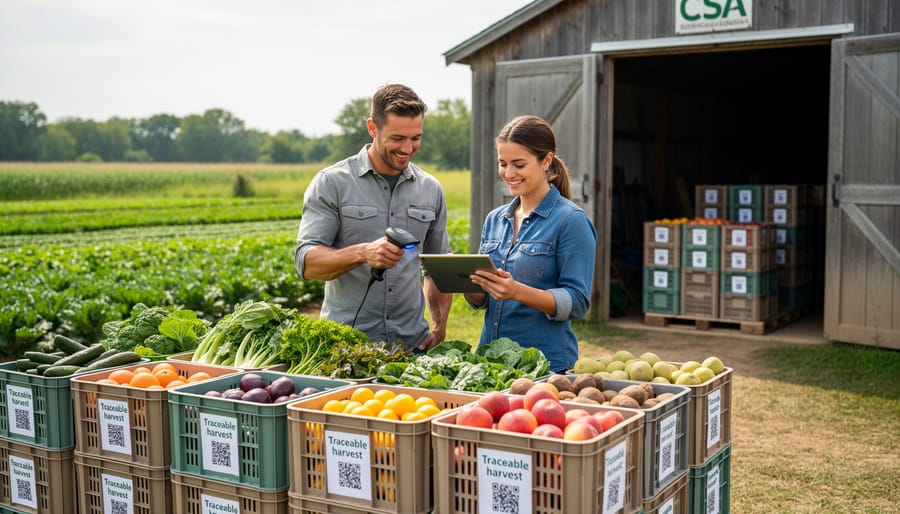
Fresh leafy greens, tomatoes, cucumbers and herbs in wooden harvest crates on farm table
CSA farms growing items on the Food Traceability List must implement proper documentation systems.

Small Farm Exemptions You Should Know About

Good news for smaller CSA operations: you might not be covered by FSMA 204 at all! The FDA includes specific exemptions designed to keep smaller farms from drowning in paperwork.

If your farm generates less than $25,000 in annual sales of food, you’re exempt from these traceability requirements. This threshold applies to your total food sales over the previous three years, averaged. For many beginning farmers just getting their CSA off the ground, this exemption provides breathing room to focus on growing great food.

Direct-to-consumer sales also receive special consideration. When you’re selling directly to your members at farmers markets, through your CSA shares, or at your farm stand, these transactions typically fall outside FSMA 204 requirements. The regulation primarily targets the supply chain where traceability becomes challenging, not the face-to-face relationships you’ve built with your community.

However, if you’re selling to restaurants, grocery stores, or food hubs in addition to your CSA, those transactions may require compliance depending on the specific foods involved. One successful CSA farmer in Vermont shared how she strategically kept her restaurant sales separate from her member shares, simplifying her recordkeeping considerably. Understanding where you fall can save you countless hours and help you structure your business wisely.

The Four Core Records Every Compliant CSA Needs

Growing and Harvesting Records

For FSMA 204 compliance, your growing and harvesting records need to capture specific details about each crop cycle. Start by documenting the exact field location or growing area where you planted each variety. Include precise harvest dates and the specific produce varieties you’re growing, using the variety names from your seed packets or transplants.

Track your planting dates alongside harvest dates to establish a clear timeline. Record the quantity harvested from each location, whether you measure in pounds, bins, or boxes. This creates a direct connection between your fields and the produce that reaches customers.

Consider creating simple field maps that show which crops grow where during each season. Many small farms find success using basic spreadsheets or even paper logbooks. The key is consistency in recording this information while it’s fresh in your mind.

If you grow multiple succession plantings of the same crop, treat each planting as a separate lot with its own records. This might seem like extra work initially, but it becomes routine quickly. One organic farmer in Vermont shared how she keeps a waterproof notebook in her harvest tote, jotting down variety, location, and date as she picks. This simple habit ensures nothing gets forgotten by day’s end.

Cooling and Initial Packing Documentation

Once you’ve harvested your beautiful organic produce, proper documentation begins immediately with cooling and initial packing activities. FSMA 204 requires you to record the cooling date and time, location where cooling occurred, and the method used (whether forced-air cooling, hydrocooling, or another technique). For small CSA operations, this doesn’t mean fancy software—a simple logbook works perfectly fine.

When you pack produce, document the date, what was packed, and any lot codes you assign. Many successful CSA farmers share a helpful tip: use a whiteboard in your packing area to track this information in real-time, then transfer it to your permanent records at day’s end. This creates a clear audit trail showing how quickly you cooled crops and prepared them for distribution.

Remember, these records protect both you and your members by demonstrating your commitment to food safety. Keep documentation simple but consistent—a spiral notebook dedicated to post-harvest activities can be just as compliant as expensive tracking systems.

Distribution Records for CSA Shares

When you distribute shares to your CSA members, keeping organized records creates a simple traceability trail. For each distribution day, record the date, traceability lot code for each crop included in the boxes, and member names or identification numbers. Many small CSAs find success using a simple spreadsheet or notebook system—no fancy software required.

The key is connecting your harvest records to your distribution records through those lot codes. If you packed lettuce from Lot 2024-0515-LETT into Tuesday’s shares, note that code on your distribution sheet. This creates the vital link between field and fork that FSMA 204 requires.

Consider keeping a master harvest sheet at your packing station where you check off which lots went into shares each week. One Virginia CSA farmer shared how she uses color-coded stickers on harvest bins that match her distribution records—a brilliant low-tech solution that works beautifully.

Remember to retain these records for two years. Most farms store paper copies in binders organized by month or use simple digital folders. The goal isn’t perfection but creating a reasonable system that you’ll actually maintain throughout the growing season.

Practical Systems That Work for Real CSA Farms

Low-Tech Paper Systems That Actually Work

Not every farm needs fancy software to meet FSMA 204 requirements. Many small-scale operations find that simple paper systems work beautifully, especially when you’re already spending most of your day outdoors rather than behind a computer screen.

A basic three-ring binder system can cover all your traceability needs. Start with tabbed sections for harvest logs, receiving records, and shipment tracking. Your harvest log should include the date, crop name, location where it was grown, quantity harvested, and who picked it. Keep a stack of pre-printed forms clipped to a clipboard in your packing shed so crew members can fill them out immediately.

For receiving records when you buy seeds or transplants, staple invoices directly into your binder along with a simple form noting the supplier’s contact information and lot numbers. When you pack CSA shares or deliver to customers, use carbon-copy delivery sheets where one copy goes to the customer and one stays in your binder.

The key is consistency. Set aside 10 minutes at the end of each packing day to ensure all forms are complete and filed properly. Many farmers who’ve implemented paper systems report that once it becomes routine, tracking actually helps them stay more organized overall. Plus, during an inspection, you can simply hand over your binder without worrying about internet connectivity or software glitches.

Farmer writing harvest records in notebook beside basket of fresh vegetables
Simple paper-based record keeping systems remain effective for small-scale CSA operations managing FSMA 204 requirements.

Affordable Digital Tools for Traceability

Good news for budget-conscious growers: you don’t need fancy software to achieve FSMA 204 compliance. Many farms successfully track their products using simple spreadsheet templates designed specifically for agricultural traceability. Free downloadable templates are available through state agriculture departments and cooperative extension services, allowing you to record essential information like harvest dates, lot numbers, and distribution details.

For those who prefer mobile solutions, affordable farm management apps like Tend, Crop Tracker, and LocalLine offer traceability features starting under $20 monthly. These tools let you document activities right from the field using your smartphone, eliminating duplicate data entry later.

Another practical option is cloud-based platforms designed for small farms, such as FarmOS (which is free and open-source) or FarmRaise. These systems grow with your operation and often include customer management features valuable for CSA logistics.

Consider starting with whatever system feels most comfortable. Many successful small farms began with simple paper logs, then transitioned to digital tools as their confidence grew. The key is consistency in recording information, not sophisticated technology. Remember, compliance is about having accurate records available when needed, which any organized system can achieve.

Farmer using smartphone and digital spreadsheet for record keeping in tomato field
Affordable digital tools and simple spreadsheets help CSA farms track traceability data efficiently.

Creating Lot Codes You Can Actually Remember

The key to memorable lot codes is keeping them simple and meaningful. Your system doesn’t need fancy software or complicated formulas – just a consistent approach that makes sense for your operation.

Many successful CSA farmers use a date-based system that instantly tells them when crops were harvested. For example, a code like “2024-06-15-TOM-A” breaks down to: year, month, day, crop type (tomatoes), and field location (Field A). When you look at this code weeks later, you immediately know the story behind that harvest.

Another practical approach combines your initials with harvest dates and crop identifiers. Green Valley Farm uses “GVF-0615-CHE” for their June 15th chard harvest. It’s straightforward, memorable, and requires nothing more than a pen and your existing harvest log.

The secret is consistency. Once you choose a format, stick with it throughout the season. Train everyone on your farm to use the same system, and keep a simple reference guide posted near your packing area.

Remember, FSMA 204 doesn’t dictate how your codes should look – it just requires that you can trace products through your supply chain. Your lot code system should work for your brain and your farm’s workflow, not create extra stress during busy harvest days.

Smiling CSA farmer organizing fresh produce boxes at farm stand
Real CSA farmers have successfully implemented traceability systems without disrupting their daily operations.

Real CSA Farmer Success Stories

Meeting FSMA 204 requirements might sound daunting, but farms across the country are proving it’s totally manageable with the right approach. Here are some inspiring examples of CSA operations that have successfully navigated compliance.

Green Valley Farm, a 15-acre CSA in Vermont, initially felt overwhelmed by the traceability requirements. Owner Maria Chen decided to start simple by using a basic spreadsheet system to track their food traceability list crops like leafy greens and tomatoes. “We already kept harvest logs for our own planning purposes,” Maria explains. “We just added a few columns for lot numbers and specific location data.” The farm invested in a $20 label maker to mark harvest bins and discovered that the whole process added only about 15 minutes to their daily routine. Their biggest lesson? Start tracking before the compliance deadline to work out any kinks while the pressure is off.

Riverbend Community Farm in Oregon took a different approach by partnering with three neighboring CSAs to share the learning curve. Together, they attended a state extension workshop and created template forms they could all customize. Farm manager James Rodriguez notes that collaboration cut their implementation time in half. “We realized we were all stressing about the same questions,” he says. The group now holds quarterly check-ins to discuss what’s working and troubleshoot challenges together.

Sunrise Acres, a small CSA in North Carolina, discovered they actually qualified for several exemptions because they sell most produce directly to members within state lines. Owner Sarah Williams still chose to implement basic traceability practices anyway. “Even though we’re exempt now, these records help us manage our operation better,” she shares. “When a member asks which field their lettuce came from, we can tell them instantly.” Her advice? Focus on making compliance work for your farm’s unique situation rather than trying to copy someone else’s system.

Common Pitfalls and How to Avoid Them

Even the most well-intentioned CSA farmers can stumble when implementing FSMA 204 traceability systems. The good news? Most mistakes are easily preventable with a bit of awareness and planning.

One of the biggest pitfalls is incomplete record-keeping. Many farmers diligently track some information but miss critical pieces like harvest dates or specific location identifiers. Emma Rodriguez, who runs a small CSA in Vermont, learned this the hard way during her first season under the new rules. “I was recording everything in different places—my phone, a notebook, sticky notes on the fridge,” she explains. “When I needed to trace a shipment, it was a mess.” Her solution was simple: create one master template that includes every required data point, and fill it out completely before moving to the next task.

Inconsistent lot coding trips up many farmers too. Using random systems like “Monday’s lettuce” or “front field tomatoes” might make sense to you, but it won’t satisfy traceability requirements. Instead, develop a straightforward numbering system and stick with it. For example, you might use the format: crop code, harvest date, and field number (L-0315-A for lettuce harvested March 15th from Field A).

Poor record retention is another common mistake. FSMA 204 requires keeping records for two years, but papers get lost, phones get replaced, and memories fade. Set up a dedicated filing system, whether that’s a simple three-ring binder or a cloud storage folder. Schedule quarterly reviews to ensure everything is where it should be.

Remember, building good habits from day one saves headaches later. Start small, stay consistent, and your traceability system will become second nature.

Your Step-by-Step Action Plan

Getting compliant with FSMA 204 doesn’t have to feel overwhelming. Here’s a practical timeline to help your CSA farm meet the January 2026 deadline with confidence.

Months 1-3: Assessment and Planning

Start by determining if your farm falls under the Food Traceability List requirements. Review which crops you grow that might be covered, such as leafy greens, fresh herbs, tomatoes, or cucumbers. Document your current record-keeping practices and identify gaps. This is also a great time to review your worker classification requirements since you’ll be updating your farm’s operational systems anyway.

Months 4-6: System Selection and Setup

Choose your traceability system based on your farm’s size and budget. This might be as simple as organized spreadsheets or dedicated farm management software. Create templates for recording harvest dates, lot numbers, and distribution information. Set up your traceability lot coding system that makes sense for your operation. Many successful CSA farms use simple date-based codes like “Tomato-Field2-072625” for easy tracking.

Months 7-9: Staff Training and Trial Runs

Train your team on new procedures for recording information at harvest, packing, and distribution. Run practice scenarios to test your system’s effectiveness. Can you trace a bunch of lettuce from field to member within a few hours? Adjust your processes based on what you learn during these trial periods.

Months 10-12: Refinement and Documentation

Fine-tune your procedures based on your trial runs. Create simple checklists for staff to follow during busy harvest days. Document your entire traceability plan in writing. Build in extra time for questions or technical hiccups.

Months 13-15: Final Preparation

Conduct a full mock audit of your system. Verify that all staff understand their roles and that records are being kept consistently. Address any remaining concerns before the enforcement deadline arrives.

Remember, compliance is a journey, not a destination. Starting early gives you breathing room to find solutions that work for your unique farm operation.

Resources and Support for CSA Farmers

Navigating FSMA 204 doesn’t have to feel overwhelming! The FDA offers free guidance documents specifically designed for small farms, including their “Small Entity Compliance Guide” that breaks down requirements in plain language. Start there to understand your obligations.

Your state’s agricultural extension service is an invaluable resource. Extension agents provide free or low-cost consultations and often host workshops on food safety regulations. Many have developed traceability templates tailored to local growing conditions and farm sizes.

The National Sustainable Agriculture Coalition and Local Harvest maintain updated resources for CSA farmers, including compliance checklists and sample recordkeeping systems. These organizations understand the unique challenges small-scale organic farms face and offer practical solutions that won’t break the bank.

Join CSA networks and farming communities in your area. Fellow farmers who’ve already tackled compliance can share their systems, templates, and lessons learned. This collaborative spirit is what makes the CSA movement special, and it extends to navigating regulations together.

Don’t forget about other compliance areas like sales tax requirements and accepting SNAP benefits, which also require proper recordkeeping.

Consider attending regional organic farming conferences where food safety experts present workshops. These events combine practical education with opportunities to connect with other growers facing similar challenges. Remember, you’re not alone in this journey toward compliance!

Taking on FSMA 204 compliance might feel like adding another task to your already full plate, but here’s the good news: it’s absolutely manageable, and you’re not in this alone. Think of compliance as an investment in your farm’s future rather than just a regulatory hurdle. When you implement better traceability, you’re protecting your customers, safeguarding your business from costly recalls, and building even more trust with your community.

The beauty of the CSA model is that you likely already know your customers personally and have simpler supply chains than large operations. This puts you at a real advantage. Start small with one or two crops on the traceability list, get comfortable with the record-keeping rhythm, and expand from there. You don’t need fancy software or expensive systems right away. A simple spreadsheet and clear labeling can get you started.

Remember Sarah from the Hudson Valley who thought compliance was impossible for her small operation? She began by dedicating just 15 minutes daily to recording harvest and distribution data. Within two months, it became second nature, and she discovered her records actually helped her plan crop rotations more effectively.

Reach out to your local agriculture extension office, connect with other CSA farmers who’ve tackled this, and don’t hesitate to ask questions. The agricultural community thrives on sharing knowledge and supporting one another.

The deadline is approaching, so the best time to start is right now. Even small steps today will put you ahead tomorrow. You’ve got this, and your commitment to transparency will only strengthen the bond with the families who depend on your harvest.

Sales Tax on Farm Shares: What Every CSA Farmer Needs to Know Right Now

Posted by darrell on
0
Policy, Law & Certification
Sales Tax on Farm Shares: What Every CSA Farmer Needs to Know Right Now

Register with your state’s tax authority within 30 days of your first sale to obtain a sales tax permit—most states offer free online registration that takes less than 20 minutes. Download your state’s agricultural exemption guide to identify which CSA products qualify as tax-exempt farm products versus taxable prepared foods, since the distinction dramatically affects your collection obligations.

Set up a simple spreadsheet tracking each member’s payment, delivery date, and applicable tax rate by zip code if you serve multiple jurisdictions. Many CSA farmers discover they’re already compliant because fresh produce sold directly from the farm is exempt in most states, though add-ons like prepared soups or value-added products typically require collection.

Contact three neighboring CSA operations to learn their compliance approaches—experienced farmers often share practical solutions that accountants miss. This peer knowledge proves invaluable, much like understanding worker classification compliance requires insights from those who’ve navigated the system successfully.

Schedule quarterly 15-minute reviews of your sales records to verify you’ve collected tax where required and maintained proper documentation. This habit prevents year-end scrambles and potential penalties while keeping your focus on growing food rather than managing tax complications.

The reality? Sales tax compliance feels overwhelming initially, but most CSA farmers find it becomes routine within one season. Your commitment to feeding your community with fresh, organic produce deserves protection through proper compliance—and the process is more straightforward than you might fear.

Why Sales Tax Gets Confusing for CSA Operations

CSA operations occupy an interesting space that can puzzle even experienced accountants. Unlike a traditional farm stand where you sell a basket of tomatoes for cash, CSAs operate on a membership model that creates genuine gray areas in sales tax law.

Here’s where it gets tricky: when you sell a tomato at a farmers market, most states treat that as a straightforward agricultural product sale. Many states exempt these direct farm sales from sales tax to support local agriculture. But what happens when someone pays you $500 in February for a season’s worth of vegetables they’ll receive from June through October? Are you selling produce, or are you selling a membership? The answer varies by state, and sometimes even by how you structure your paperwork.

Some states view CSA shares as prepaid produce sales, which might qualify for agricultural exemptions. Others see them as service agreements or club memberships, which could be taxable. A few states split hairs even further, distinguishing between “true shares” where members assume crop risk versus “subscriptions” that guarantee certain deliveries.

Take Sarah, who runs Meadowbrook Farm in Virginia. She discovered her CSA shares were tax-exempt as agricultural sales, but the value-added products she included, like her homemade jams, weren’t. Meanwhile, her friend operating a similar CSA just two states over faced completely different rules.

The membership structure also complicates collection timing. Do you charge tax on the full share price upfront, or calculate it weekly as you deliver? What about members who pay in installments? These questions don’t have universal answers, which is precisely why CSA farmers need guidance specific to their situation and location.

Farmer's hands holding freshly harvested vegetables over wooden crate in farm field
CSA farmers provide fresh, locally grown produce directly to community members through share programs.

The Basic Rules: When CSA Shares Are Taxable (and When They’re Not)

Food Exemptions in Most States

Here’s some encouraging news for CSA farmers: most states recognize that basic grocery items are essentials and exempt them from sales tax. This typically includes fresh fruits, vegetables, herbs, and other unprocessed foods—exactly what you’re growing and sharing with your community! If your CSA focuses on farm-fresh produce like leafy greens, tomatoes, carrots, and seasonal fruits, chances are you won’t need to collect sales tax on these items in most states.

However, there’s an important distinction to understand. While raw produce usually gets a pass, processed or prepared foods often don’t. If you’re adding value-added products to your CSA shares—like homemade jams, baked goods, or prepared salads—these items might be taxable even if the fresh produce isn’t. The line between exempt and taxable can sometimes blur, so it’s worth checking your state’s specific guidelines.

Some states also consider how food is sold. For example, if you’re selling at a farmers market versus delivering CSA boxes, the rules might differ slightly. The good news? Most states want to support access to healthy, locally grown food, which means the tax regulations generally work in favor of small-scale farmers offering fresh produce to their communities.

Overhead view of CSA share box with vegetables, eggs, and preserved goods on wooden table
A typical CSA share includes a mix of fresh produce and value-added products, each with different tax implications.

When You Do Need to Collect Tax

While fresh produce usually gets a pass, certain items in your CSA shares will likely require you to collect sales tax. Understanding these categories helps you stay compliant and avoid surprises down the road.

Value-added products are the most common taxable items. When you transform raw ingredients into something new, tax typically applies. This includes homemade jams, jellies, canned goods, and baked breads. That delicious strawberry preserves made from your farm’s berries? Taxable. Fresh strawberries? Usually exempt. The key difference is the processing and preparation involved.

Prepared foods also trigger tax obligations in most states. If you’re offering ready-to-eat items like salads, sandwiches, or meal kits with pre-chopped vegetables and sauces, these generally fall into the taxable category. The convenience factor matters here – foods requiring minimal preparation before eating typically face taxation.

Flowers and ornamental plants, while beautiful additions to CSA shares, are usually taxable. Even though they’re farm-grown, they’re not intended for consumption, which removes them from agricultural exemptions in many states.

Non-food items round out the taxable category. Farm merchandise like t-shirts, tote bags, or cooking utensils included in shares or sold separately will need sales tax collected. Some farmers have found success offering these as separate optional purchases to simplify their bookkeeping.

The good news? Many CSA operators successfully navigate these requirements by keeping clear records and separating taxable from non-taxable items on their invoices. A little organization goes a long way toward making tax season manageable.

The Membership vs. Product Sale Question

Here’s the thing that trips up many CSA farmers: tax authorities typically view CSA shares as product sales rather than memberships, even though we often use membership language in our marketing. While members pay upfront for a season’s worth of produce, you’re essentially selling agricultural products, not offering a membership service like a gym or club.

This distinction matters because product sales usually trigger sales tax obligations, whereas true memberships often don’t. Some states do recognize legitimate agricultural exemptions that might apply to your CSA, but you’ll need to verify this with your state’s revenue department. The key is understanding how your specific state classifies CSA transactions.

Take Sarah from Green Valley Farm, who learned this lesson early. She initially treated her CSA as a membership program and didn’t collect sales tax. After a friendly audit, she discovered her state considered her shares taxable product sales. By working proactively with her accountant, she quickly got compliant and now builds sales tax into her pricing structure from the start, keeping everything transparent for her members.

State-by-State Differences Every CSA Should Know

Here’s the reality: sales tax rules for CSAs aren’t one-size-fits-all. What works for a farmer in Vermont might land you in hot water in California. Each state has its own approach to taxing farm products, and understanding your specific state’s requirements is essential for staying compliant.

The good news? Most states exempt unprepared food from sales tax, which often includes fresh produce from your CSA boxes. However, the devil is in the details. Some states consider CSA memberships a prepayment for goods and exempt them entirely. Others view them as advance sales requiring tax collection. A few states fall somewhere in between, depending on how you structure your shares.

Take Sarah Chen, who runs Green Valley Farm in Oregon. When she expanded her CSA to include homemade jams and honey, she discovered that while her vegetables remained tax-exempt, her value-added products required sales tax collection. This common scenario trips up many farmers who diversify their offerings.

Your first step is visiting your state’s Department of Revenue website. Look specifically for agricultural exemptions and food sales guidelines. Many states offer plain-language guides designed for farmers. Don’t hesitate to call their helpline with questions about your specific situation.

Consider these common state approaches: Some states exempt all farm-fresh produce regardless of how it’s sold. Others require tax on processed or prepared foods but not raw ingredients. A few states have unique programs recognizing CSA memberships as agricultural transactions deserving special treatment.

Remember that bordering states often have vastly different rules. If you’re near a state line and serve members in multiple states, you might need to register and collect taxes in each one. This complexity is manageable with proper research and record-keeping.

Document your findings and review your state’s requirements annually. Tax laws evolve, and staying informed protects both you and your members from unexpected liabilities down the road.

Getting Properly Registered and Set Up

Do You Need a Sales Tax Permit?

Whether you need a sales tax permit depends largely on what you’re selling and where you’re located. Most states require permits when you regularly sell taxable goods, but here’s the good news: many states offer exemptions for agricultural products sold directly to consumers.

Start by checking your state’s definition of exempt farm products. In many areas, fresh produce, eggs, honey, and other unprocessed agricultural goods qualify for exemptions. However, if you’re selling value-added items like jams, baked goods, or prepared foods, you’ll likely need to collect sales tax on those items.

Most states also have economic thresholds. If your annual sales fall below a certain amount (often between $1,000 and $5,000), you might not need to register immediately. However, once you cross that threshold, registration becomes mandatory.

Consider Sarah’s story from Green Valley Farm. She started her CSA selling only fresh vegetables and didn’t need a permit. When she expanded to include homemade pesto and pickles, she registered for a sales tax permit to stay compliant. Just like with food safety compliance, staying ahead of requirements protects your business and builds trust with your members.

The Registration Process Made Simple

Getting registered for sales tax doesn’t have to feel overwhelming. Think of it as planting seeds for your CSA’s long-term success. Most state tax authorities have made the process surprisingly straightforward, and you can often complete everything online in under an hour.

Start by visiting your state’s Department of Revenue website and look for the business registration or sales tax permit section. You’ll typically need your business information handy, including your federal EIN, business structure details, and an estimate of your expected monthly sales. Many CSA farmers find it helpful to have their farm’s physical address and banking information ready as well.

The registration form will ask about your products and whether you qualify for any agricultural exemptions. Be honest about your business activities. If you’re selling raw vegetables from your farm, make sure to indicate this, as many states offer specific guidance for agricultural producers.

Processing times vary by state, but most applications are approved within one to two weeks. Some states even provide instant approval for online applications. Once approved, you’ll receive your sales tax permit number, which you’ll need to display and use when filing returns.

Sarah Chen, who runs Green Valley Farm CSA in Oregon, shares this tip: “I set a reminder to complete my registration three months before my first harvest. This gave me plenty of buffer time and let me focus on farming when the busy season hit.”

Keeping Records That Make Tax Season Easy

Good record-keeping transforms tax season from stressful to straightforward. Start by maintaining a dedicated spreadsheet or accounting software to track every sale, noting the date, customer name, amount, and whether sales tax was collected. Keep all invoices, receipts, and payment records organized by month. Many CSA farmers find success using simple tools like QuickBooks or even Google Sheets to monitor their transactions.

Document your exempt sales separately, especially when accepting SNAP benefits or selling qualifying items. Take photos of your sales locations and keep copies of your exemption certificates. Store everything digitally with cloud backup for easy access during audits. One Vermont CSA operator shared how organizing receipts weekly saved them hours during tax filing and helped them catch a beneficial deduction they’d almost missed. Consistent weekly record-keeping beats scrambling at year-end every time.

Smart Systems for Collecting and Tracking Sales Tax

Managing sales tax doesn’t have to be complicated, even for small-scale CSA operations. The key is finding a system that matches your farm’s size and technical comfort level while keeping you organized and compliant.

For farmers just starting out or running smaller CSAs with fewer than 50 members, a well-designed spreadsheet can work wonders. Create columns for member names, payment dates, amounts collected, taxable sales, tax collected, and tax remitted. This simple approach costs nothing and gives you complete visibility into your records. Many successful CSA farmers have started here, tracking everything manually until their operations grew.

As your membership expands, consider dedicated bookkeeping software like QuickBooks or FreshBooks. These platforms automatically calculate sales tax based on your location and rates, generate reports for filing, and integrate with your bank accounts. The investment typically ranges from $15 to $50 monthly, but the time saved during tax season makes it worthwhile. Small farm owner Maria Chen from Pennsylvania shares that switching to accounting software cut her tax prep time in half while eliminating calculation errors that previously caused anxiety.

For farms seeking agriculture-specific solutions, platforms like Farmigo or Harvie include built-in sales tax management alongside membership coordination and delivery scheduling. These systems understand the unique nature of CSA operations, handling everything from calculating taxes on add-on products to generating exemption certificates for wholesale transactions.

Regardless of which system you choose, maintain consistent habits. Record every transaction promptly, reconcile your records monthly, and back up your data regularly. Set calendar reminders for filing deadlines so you’re never caught off guard.

The best system is one you’ll actually use consistently. Start simple, stay organized, and upgrade as your farm grows. Compliance becomes much less daunting when you have reliable tools supporting your efforts.

Farmer working on laptop computer with paperwork and harvest basket in farm office
Modern CSA farmers manage compliance and record-keeping alongside their agricultural work.

Real Stories: How Other CSA Farmers Handle Compliance

Learning from fellow farmers who’ve successfully navigated sales tax compliance can make the process feel less daunting. Here are some real-world examples that show it’s entirely manageable.

Sarah runs Greenleaf Farm CSA in Vermont and initially felt overwhelmed by tax requirements. Her solution? She dedicated one afternoon each month to recording sales and filing returns. “I treat it like any other farm task,” she explains. “Once I got into the routine, it takes me less than an hour monthly.” Sarah’s tip: Keep a simple spreadsheet updated weekly so month-end becomes quick and easy.

Tom and Maria at Sunrise Valley Farm in Oregon discovered their state exempted most direct agricultural sales. “We spent weeks worrying before realizing we only needed to collect tax on our value-added products like jams and pickles,” Tom shares. Their lesson learned was to contact their state department of revenue directly rather than assuming the worst. This clarity helped them focus their record-keeping efforts where it actually mattered.

Meanwhile, Jennifer from Harvest Moon CSA in North Carolina automated her process using affordable farm management software. The system calculates tax automatically and generates reports for filing. “It was worth the small monthly fee for the peace of mind,” she notes. Jennifer also learned that staying compliant with sales tax made handling government program compliance much smoother when she started accepting SNAP benefits.

The common thread among these farmers? They all emphasized starting simple, asking questions early, and building compliance into their regular routines rather than treating it as a separate burden. Their success proves that with the right approach, sales tax compliance becomes just another manageable aspect of running a thriving CSA.

Common Mistakes to Avoid

Even the most diligent CSA farmers can stumble into sales tax pitfalls, but understanding these common mistakes helps you build a smoother, more compliant operation from the start.

One frequent oversight involves add-on products. Many farmers correctly handle sales tax for their core vegetable shares but forget about extras like eggs, honey, baked goods, or flowers. Here’s the thing: while your produce might be exempt, these supplementary items often aren’t. The solution? Create a simple checklist of all products you offer and verify the tax status of each one with your state’s revenue department. Sarah from Green Valley Farm learned this the hard way when an audit revealed she hadn’t collected tax on her popular herb bundles for two seasons. Now she reviews her product list quarterly.

Missing filing deadlines ranks as another common stumble. Life on a farm gets busy, especially during peak harvest season. Set up calendar reminders two weeks before each deadline, and consider scheduling a specific day each month as your “paperwork day.” Many states offer automated filing systems that can send you reminders and streamline the process.

Inconsistent collection practices create confusion for both you and your members. If you charge tax on某member purchases but not others, you’re asking for trouble. Document your policies clearly in your membership agreements and train anyone handling sales to follow the same procedures.

Finally, keeping poor records compounds every other mistake. Invest in simple accounting software or even a well-organized spreadsheet system. Track every transaction, exemption certificate, and filing confirmation. When tax time arrives, you’ll thank yourself for maintaining clean, accessible records throughout the year. Remember, compliance doesn’t have to be complicated when you build good habits into your routine.

Getting Help When You Need It

You’re not alone in navigating sales tax compliance, and reaching out for help is one of the smartest decisions you can make for your CSA. Think of it as investing in your farm’s long-term success rather than an admission of uncertainty.

Start with your state’s agricultural department, which often provides free resources specifically tailored to farm businesses. Many states have agricultural extension offices with specialists who understand the unique challenges farmers face with compliance requirements. These folks speak your language and get what you’re dealing with.

Farm organizations like your local farmers’ market association or regional CSA networks are goldmines of practical advice. Fellow farmers have likely wrestled with the same questions you have, and many are happy to share what they’ve learned. Some organizations even host workshops on tax compliance and business management.

Consider working with an accountant or bookkeeper experienced in agricultural businesses. Yes, it’s an expense, but the peace of mind and time saved often outweigh the cost. They can handle registration, quarterly filings, and help you avoid costly mistakes. Look for professionals who already work with farms in your area.

Online resources abound too. Many state revenue department websites offer webinars, downloadable guides, and FAQs designed for small businesses. The key is not trying to figure everything out alone. Successful farmers know when to ask for help, allowing them to focus on what they do best: growing amazing food for their communities.

Navigating sales tax compliance might seem daunting at first, but here’s the good news: once you understand your state’s requirements and set up a simple system, it becomes just another routine part of running your CSA. Think of it like crop rotation or harvest planning – essential for your farm’s health, but totally manageable with the right approach.

The most important step is taking action now rather than waiting. Register with your state if required, keep clear records of your transactions, and set aside a few minutes each month to review your sales tax obligations. Many successful CSA farmers have found that addressing compliance early saves them from headaches down the road and gives them peace of mind.

Remember, staying compliant isn’t just about following rules – it’s about protecting the farm business you’ve worked so hard to build. When your tax affairs are in order, you can redirect that mental energy toward what truly matters: nurturing your soil, growing nutrient-dense food, and strengthening connections with your community members. Your dedication to feeding people deserves a solid foundation, and sales tax compliance is simply one more way to ensure your CSA thrives for years to come.

How CSA Farms Can Navigate FMCSA Regulations Without Losing Their Minds

Posted by darrell on
0
Policy, Law & Certification
How CSA Farms Can Navigate FMCSA Regulations Without Losing Their Minds

Determine whether your CSA farm needs DOT registration by calculating if your delivery vehicles exceed 10,001 pounds gross vehicle weight, cross state lines for farm deliveries, or transport nine or more passengers including the driver. Most small-scale CSA operations using pickup trucks and cargo vans fall well below these thresholds and remain exempt from federal motor carrier regulations.

Check your agricultural exemption eligibility first, as farms transporting their own products within 150 miles typically qualify for relief from commercial driver’s license requirements and some FMCSA regulations. This exemption has saved countless small farms from burdensome compliance costs while maintaining safe delivery practices for their weekly produce boxes.

Document your delivery operations now, even if you’re exempt, by keeping simple records of vehicle weights, delivery routes, and driver information. This preparation proves invaluable if your operation grows beyond exemption limits or if you face questions during roadside inspections. Many CSA farmers have avoided costly violations simply by maintaining basic transportation logs alongside their FSMA compliance requirements.

The U.S. Department of Transportation’s Federal Motor Carrier Safety Administration exists to ensure road safety, but understanding where small farms fit within this regulatory framework prevents unnecessary stress and expense. Unlike large commercial trucking operations, most community-supported agriculture programs operate under different rules designed specifically for agricultural enterprises. Your farm’s transportation compliance journey starts with knowing which category applies to your unique delivery model, then implementing only the requirements that genuinely affect your operation.

What DOT and FMCSA Actually Mean for Your CSA Delivery Routes

If you’re running a CSA farm and delivering fresh produce to your members, you might be wondering when the U.S. Department of Transportation (DOT) and Federal Motor Carrier Safety Administration (FMCSA) regulations come into play. Let’s break this down in simple terms.

The DOT is the federal agency responsible for ensuring safety across all transportation systems in the United States. Within the DOT, the FMCSA specifically focuses on commercial motor vehicle safety, setting rules for trucks and drivers who transport goods across state lines or operate larger vehicles. These regulations exist primarily to keep our roads safe and prevent accidents involving heavy commercial trucks.

Here’s where it gets relevant for CSA farms: the FMCSA’s jurisdiction typically kicks in when you’re operating a commercial motor vehicle that weighs over 10,001 pounds or when you’re crossing state lines for commercial purposes. For most small-scale CSA operations, you’re likely in the clear if you’re making local deliveries in a pickup truck or cargo van.

Let’s look at real-world scenarios. Sarah runs a 50-member CSA in Vermont and delivers produce in her half-ton pickup truck within a 25-mile radius. She doesn’t fall under FMCSA regulations. However, Tom’s 200-member CSA in Pennsylvania uses a box truck that weighs 12,000 pounds to deliver to multiple drop-off points across two counties. Tom needs to pay attention to DOT requirements.

The key factors determining whether you need to comply include your vehicle’s weight rating, whether you cross state lines, and the nature of your operation. Many CSA farmers find they’re exempt because they use smaller vehicles and operate entirely within their state. Understanding these basics helps you determine your obligations without unnecessary worry, allowing you to focus on what you do best: growing amazing food for your community.

White farm delivery truck with produce crates parked on rural farm road
Understanding when your farm delivery vehicle falls under federal transportation regulations is essential for CSA operations.

When Your Farm Truck Needs to Play by Federal Rules

The Weight and Distance Thresholds That Matter

Understanding when federal regulations apply to your CSA farm deliveries comes down to two key numbers that are surprisingly straightforward. If your vehicle has a Gross Vehicle Weight Rating (GVWR) of 10,001 pounds or more, you’re entering federal oversight territory. This includes the weight of your truck plus its maximum cargo capacity, not just what you’re actually hauling on any given day.

The second trigger is crossing state lines with your fresh produce. Even if you’re driving a smaller vehicle under that 10,001-pound threshold, transporting goods across state borders for commercial purposes brings you under FMCSA jurisdiction. For many CSA farmers, this is great news because most operations stay within their home state, naturally avoiding this particular requirement.

Here’s a practical example: Sarah, a Vermont farmer, runs a thriving CSA serving 75 families. She uses a three-quarter-ton pickup truck with a GVWR of 9,900 pounds and delivers exclusively within Vermont. She doesn’t meet either threshold, so federal regulations don’t apply to her operation. However, when she briefly considered expanding to neighboring New Hampshire, she realized that crossing state lines would change everything, prompting her to carefully evaluate whether the expansion made regulatory and financial sense for her farm’s sustainable growth model.

Agriculture Exemptions You Should Know About

Good news for CSA farmers: several exemptions might spare you from certain FMCSA regulations, making your delivery operations much simpler. Understanding these exemptions can save you time, money, and administrative headaches.

The agricultural commodity exemption is your first friend here. If you’re transporting farm products like fresh vegetables, fruits, or flowers from the field to your first point of market sale, you’re exempt from some Hours of Service regulations during planting and harvesting seasons. This means during those busy weeks when you’re rushing to get fresh produce to your members, you have more flexibility in your delivery schedules.

The 150 air-mile radius rule offers another practical exemption. If your delivery routes stay within 150 air miles of your farm and you return to your starting point within the same day, you’re exempt from keeping detailed logbooks. For most CSA operations delivering locally, this radius covers your entire service area comfortably. You’ll simply need to maintain time records showing your start and end times.

Many small-scale CSA farmers also benefit from vehicle weight exemptions. If your delivery truck has a gross vehicle weight rating under 26,001 pounds, you won’t need a commercial driver’s license. That pickup truck or small box truck serving your local community likely falls well below this threshold.

Farmer Sarah Martinez from Vermont shares her experience: “Learning about the 150 air-mile exemption was liberating. Our delivery routes cover three counties, but we’re well within the radius, so our recordkeeping stays simple and manageable.”

The CSA Score System: What It Is and Why It Matters

If you’re a CSA farmer, you might feel confused when hearing about “CSA” in a transportation context. Let’s clear that up right away. While you know CSA as Community Supported Agriculture, the Federal Motor Carrier Safety Administration uses CSA to mean Compliance, Safety, Accountability. These are two completely different things, but if you’re delivering produce to your members, the FMCSA’s CSA program might actually apply to your farm operation.

The Compliance, Safety, Accountability program is the FMCSA’s method for monitoring and improving commercial motor vehicle safety. Think of it as a report card for drivers and carriers. The system tracks safety-related violations through roadside inspections, crash reports, and investigations. These violations are organized into seven categories called BASICs, which include unsafe driving, hours-of-service compliance, vehicle maintenance, and driver fitness.

Here’s why this matters for your farm: if you’re operating vehicles that meet certain weight requirements or crossing state lines with your deliveries, you’re considered a motor carrier. The CSA scoring system assigns points for violations, and high scores can trigger FMCSA interventions, warnings, or even impact your ability to operate.

For small-scale farmers like Sarah, who runs a 50-member CSA in Vermont, understanding this system prevented major headaches. She discovered that her farm’s delivery van fell under federal regulations when she expanded to neighboring states. By learning about CSA scores early, she implemented simple maintenance logs and driver training, keeping her operation compliant and her scores low.

The good news? Many small farm operations qualify for exemptions or operate below the thresholds that trigger extensive requirements. Understanding the CSA scoring system helps you determine where your operation stands and what steps, if any, you need to take. It’s about working smarter, not harder, to keep your sustainable farming business running smoothly while staying on the right side of regulations.

Essential Compliance Steps for CSA Delivery Operations

Getting Your DOT Number and MC Authority

If your CSA operation requires DOT and MC numbers, the registration process is straightforward but requires attention to detail. You’ll need a DOT number if you operate commercial vehicles that cross state lines, weigh over 10,001 pounds, or transport more than eight passengers for compensation. The MC Authority is specifically required for interstate commerce involving goods for hire.

Start by visiting the FMCSA’s online registration system. You’ll need your business information, vehicle details, insurance documentation, and a designated process agent for each state where you operate. The DOT number is free and issued immediately, but MC Authority requires a filing fee and typically takes several weeks for approval.

Many small-scale CSA farmers find they qualify for exemptions, particularly if they stay within a 150-mile radius and operate vehicles under certain weight limits. Sarah Chen, who runs a thriving CSA in Oregon, discovered she didn’t need full authority because her deliveries stayed local and her vehicle remained under 10,000 pounds. However, she still registered voluntarily for the credibility it provided customers.

Keep copies of your registration certificates in each delivery vehicle, along with proper insurance documentation. This small step protects your operation during roadside inspections and demonstrates your commitment to safety standards.

Driver Requirements and Record Keeping

Understanding who can drive your CSA delivery vehicle starts with knowing the basic qualifications. Any driver operating a commercial motor vehicle must be at least 21 years old for interstate commerce (crossing state lines) or 18 for intrastate operations within your state. They need a valid driver’s license appropriate for the vehicle type, and for most small farm operations using vehicles under 26,001 pounds, a regular driver’s license suffices rather than a commercial driver’s license (CDL).

Medical certification requirements depend on your vehicle size and operation scope. Drivers of vehicles over 10,001 pounds engaged in interstate commerce need a Medical Examiner’s Certificate, obtained through a DOT physical exam conducted by a certified medical examiner. This exam checks vision, hearing, blood pressure, and overall physical capability to safely operate a vehicle. The certification typically lasts two years, though some conditions may require more frequent renewals.

For record-keeping, simplicity works best for small farms. Maintain a driver qualification file for each person behind the wheel, including a copy of their license, medical certificate (if required), and annual driving record check. Understanding driver classification requirements helps ensure you’re properly documenting employees versus independent contractors.

Green Valley Farm in Vermont keeps everything in labeled folders, one per driver, stored in a fireproof file cabinet. They set calendar reminders for medical certificate renewals and annual motor vehicle record checks. This straightforward system has passed multiple compliance reviews while requiring minimal time investment, proving that effective record-keeping doesn’t need fancy software or complicated processes.

Farmer conducting pre-trip vehicle inspection with checklist at farm truck
Simple inspection and record-keeping practices help CSA farms maintain compliance without overwhelming paperwork.

Vehicle Inspections and Maintenance Made Simple

Good news for CSA farmers: vehicle inspections don’t have to mean mountains of paperwork. The FMCSA requires a daily pre-trip inspection where drivers check essential safety items like brakes, lights, tires, and steering. A simple checklist works perfectly, and many farmers laminate a one-page form they keep in their delivery vehicle. It takes just 5-10 minutes before each route.

Your farm vehicle also needs an annual inspection by a qualified mechanic, who’ll provide a sticker for your windshield. Keep the inspection report in your vehicle, and you’re covered. Think of it as your regular farm equipment maintenance, just documented.

For maintenance logs, a basic notebook recording oil changes, tire rotations, and repairs satisfies regulations. Some farmers use smartphone apps to snap photos of receipts and maintenance work, creating a digital trail without filing cabinets.

One Oregon CSA farmer shares her approach: “I treat our delivery van like our tractor. Regular care, simple records, nothing fancy. It’s actually helped us catch small problems before they become expensive repairs.” This practical mindset keeps vehicles road-ready while meeting federal standards, protecting both your farm’s reputation and your community’s safety.

Hours of Service Rules for Farm Deliveries

The FMCSA sets specific limits on how many hours drivers can spend behind the wheel to ensure safety on our roads. Generally, commercial drivers cannot drive more than 11 hours after 10 consecutive hours off duty, and their total workday is capped at 14 hours. However, here’s good news for CSA farmers: agricultural exemptions often apply during planting and harvesting seasons, typically within a 150-mile radius from your farm. These exemptions recognize the unique, seasonal nature of farming operations.

Many small-scale CSA operations delivering fresh produce directly to customers may qualify for these exemptions, especially when transporting goods from farm to local drop-off points. It’s important to document your delivery routes and understand which months qualify as your harvest season. Keep detailed logs even if you’re exempt, as this protects you during roadside inspections. Remember, these rules exist to keep everyone safe, including you and your customers who depend on those farm-fresh deliveries of organic vegetables and fruits each week.

Real Stories from CSA Farmers Who’ve Figured It Out

Meet Sarah Chen from Green Valley Farm in Vermont, who discovered she needed FMCSA compliance after expanding her CSA delivery routes across state lines. Initially overwhelmed by the prospect of DOT regulations, Sarah found creative solutions that worked for her 50-member operation. “I thought compliance meant giving up our personal touch,” she shares. “Instead, I learned the agricultural exemption applied to most of our local deliveries within 150 miles.”

Sarah’s biggest challenge came when tracking vehicle maintenance records. Her solution? A simple spreadsheet system and setting calendar reminders for routine inspections. She invested in basic driver training through her local extension office, which cost less than $200 and covered both safety protocols and record-keeping basics.

Over in Oregon, Marcus Johnson runs Sunshine Acres, a certified organic farm delivering to 75 CSA members. He faced DOT requirements when his delivery van exceeded the weight threshold. “The medical card requirement seemed daunting at first,” Marcus explains, “but my regular doctor could perform the exam during my annual checkup for minimal extra cost.”

Marcus recommends joining your state’s farming association for group resources and shared compliance tools. He also suggests coordinating with neighboring farms to split costs on safety equipment and training materials.

Both farmers emphasize starting with the basics: understanding which regulations actually apply to your operation, maintaining simple but consistent records, and not assuming the worst. They’ve found that compliance doesn’t conflict with their community-focused values or sustainable practices, including accepting SNAP benefits and other accessibility programs.

Their advice? Take it one step at a time, reach out to your local USDA office for guidance, and remember that safety regulations ultimately protect both your team and the communities you serve.

Confident farmer standing beside produce delivery van at sunset on farm
CSA farmers across the country have successfully navigated federal transportation regulations while maintaining their community-focused operations.

Staying Compliant Without Breaking Your Budget

Meeting FMCSA requirements doesn’t have to drain your farm’s resources. Start by accessing the wealth of free educational materials available directly from the FMCSA website, including webinars, compliance guides, and downloadable checklists specifically designed for small businesses. Many state departments of agriculture also offer workshops tailored to farm operations navigating transportation rules.

Consider joining or forming a local farm cooperative to share compliance costs. Several CSA operations have successfully pooled resources to hire a part-time fleet manager or split the expense of vehicle maintenance tracking software. This collaborative approach mirrors the community spirit that already drives CSA farming while making regulatory requirements more manageable.

Affordable technology solutions can simplify your recordkeeping dramatically. Basic apps like Google Sheets or free vehicle maintenance trackers help you document driver logs, vehicle inspections, and maintenance records without purchasing expensive fleet management systems. Some farmers have found success using smartphone apps that cost less than twenty dollars monthly to handle driver hour tracking and electronic logging requirements.

Sarah Chen, who runs Green Valley Farm in Wisconsin, discovered that investing in one comprehensive compliance binder and dedicating thirty minutes weekly to updating records kept her operation audit-ready without stress. She notes that staying organized with transportation documentation felt natural after mastering food safety regulations, using similar systematic approaches.

Remember that prevention costs less than penalties. Regular vehicle maintenance not only ensures compliance but prevents costly breakdowns during critical delivery windows, protecting both your budget and customer relationships.

Navigating FMCSA regulations might seem daunting at first, but compliance is entirely manageable for CSA farms with proper planning and understanding. Think of these requirements as protective measures that safeguard not just your business, but also your dedicated customers who rely on your fresh, organic produce deliveries. By maintaining safe vehicles, properly trained drivers, and accurate records, you’re demonstrating the same commitment to quality and responsibility that defines your farming practices.

Remember, compliance works hand-in-hand with other agricultural regulations like EPA compliance, creating a comprehensive framework that supports legitimate, professional farm operations. Many successful CSA farmers have integrated these practices seamlessly into their routines, often discovering that organized record-keeping and vehicle maintenance actually improve operational efficiency.

Start small by assessing your current delivery operations, identifying applicable exemptions, and implementing one requirement at a time. Your passion for sustainable agriculture and connecting people with wholesome food doesn’t have to compromise on safety or legality. With proactive planning and the right resources, you can continue growing nutritious food, nurturing community relationships, and operating your farm confidently within federal guidelines. Your commitment to feeding your community sustainably is valuable work worth protecting through proper compliance.

What the EPA’s Office of Pesticide Programs Means for Your CSA Farm

Posted by darrell on
0
Policy, Law & Certification
What the EPA’s Office of Pesticide Programs Means for Your CSA Farm

Understanding the US EPA Office of Pesticide Programs saves you from costly violations and protects your farm workers, even if you run a small organic CSA operation. Register every pesticide product you use—yes, even OMRI-listed organic sprays like neem oil and spinosad—by checking EPA registration numbers on product labels before purchasing. Keep detailed application records including what you sprayed, where, when, and who applied it, storing these documents for at least two years to demonstrate compliance during inspections.

Post Worker Protection Standard notices in English and Spanish at central locations where employees gather, detailing restricted entry intervals for each field or greenhouse section where you’ve applied pesticides within the past 30 days. Install a decontamination station with clean water, soap, and single-use towels within a quarter-mile of any treated area before workers enter those spaces.

Complete pesticide applicator certification through your state’s agriculture department even for organic materials—the EPA requires anyone applying restricted-use pesticides to hold valid credentials, and some states extend this requirement to all commercial applications. Provide annual safety training to every worker who might encounter treated areas, covering hazard recognition, label comprehension, and emergency response procedures specific to products you actually use on your farm.

The Office of Pesticide Programs exists not to burden small farmers but to prevent the farmworker poisoning incidents that plagued agriculture for decades. Your compliance protects the community members who trust you with their weekly vegetable boxes while shielding your operation from penalties ranging from warning letters to $19,000-per-violation fines.

Understanding the EPA’s Office of Pesticide Programs

How OPP Regulations Reach Your Farm

Understanding how EPA regulations actually reach your CSA farm helps demystify those federal compliance requirements you’ve been hearing about. The process follows a clear chain that starts in Washington, D.C. and ends at your farm gate.

The EPA’s Office of Pesticide Programs develops national standards for pesticide use and worker safety. Think of them as creating the baseline rules that protect both farmworkers and the environment. Once these federal regulations are finalized, they don’t come directly from the EPA to your farm. Instead, they flow through your state’s lead agency, which might be your Department of Agriculture or Environmental Quality department.

Your state agency takes those federal rules and implements them locally. They’re responsible for issuing applicator certifications, conducting farm inspections, and answering your specific questions about compliance. Some states add extra requirements beyond the federal minimums, so you’ll want to check with your state’s pesticide regulatory office to understand what applies in your area.

For CSA farmers, this matters because even organic operations using approved pesticides like neem oil or pyrethrin must follow these regulations. The Worker Protection Standard applies whenever you use EPA-registered pesticides, regardless of whether they’re organic or conventional.

Here’s the practical takeaway: bookmark your state pesticide agency’s website and sign up for their email updates. They’ll notify you about regulation changes, training opportunities, and compliance deadlines before they become problems.

EPA Worker Protection Standards: What CSA Farms Need to Know

Who Counts as a Worker or Handler on Your CSA

Understanding who qualifies as a worker or handler under EPA regulations can feel confusing, but getting this right is essential for compliance and safety. The Worker Protection Standard defines workers as anyone involved in tasks like planting, weeding, harvesting, or transplanting. Handlers are those who mix, load, or apply pesticides—even organic-approved ones.

Here’s where it gets interesting for CSA operations: volunteers absolutely count as workers if they’re doing agricultural tasks. That enthusiastic college student helping with your Saturday harvest? They’re covered under WPS. CSA members participating in work-share programs also fall under worker protections. The EPA doesn’t distinguish between paid employees and people receiving shares in exchange for labor—both need the same safety training and protections.

Family members present a slightly different scenario. If they’re immediate family members of the farm owner and work on the owner’s farm, they’re typically exempt from WPS requirements. However, this exemption doesn’t extend to employees’ family members or to relatives working on larger operations where the owner isn’t directly involved.

Many CSA farmers discover these worker classification requirements overlap with employment law considerations. If you’re unsure whether someone qualifies as an employee versus an independent contractor, it’s worth consulting resources that help you properly classify workers to avoid legal complications.

The golden rule? When in doubt, provide the training and protections. It’s better to err on the side of safety than face penalties or, worse, preventable health issues among your farm community.

CSA farm workers receiving safety training from instructor in vegetable field
Worker Protection Standards training ensures CSA farm employees understand safety requirements and proper procedures when working with agricultural products.

Training Requirements Made Simple

Understanding your training obligations doesn’t have to feel overwhelming. The EPA’s Worker Protection Standard outlines clear requirements that protect both you and your team while keeping your operation compliant.

For handlers—anyone mixing, loading, or applying pesticides—training must happen before they handle any restricted-use products. This includes even small-scale CSA farmers applying organic-approved pesticides like neem oil or pyrethrin. The training covers label instructions, personal protective equipment use, and what to do in emergencies. You’ll need to provide this annually, and the good news is that EPA-approved online modules make it accessible and affordable.

Workers who perform tasks in treated areas have slightly different requirements. They need training within five days of starting work and annually thereafter. The content focuses on recognizing pesticide hazards, understanding posting requirements for treated areas, and knowing their rights to protection and information.

Here’s where it gets practical: you must keep records of all training sessions for two years. Include the trainer’s name and qualifications, training date, topics covered, and participant names. A simple binder or spreadsheet works perfectly for most CSA operations.

Maria Chen, who runs a three-acre CSA in Oregon, shared her approach: “I schedule training during our spring kick-off meeting. Everyone’s already gathered, and it sets the safety tone for the season. I keep a folder with signed attendance sheets and training certificates—inspection-ready and stress-free.”

The EPA provides free training materials through their website, including videos and handouts in multiple languages. Many state extension offices also offer in-person sessions specifically designed for small farms. Remember, investing a few hours in proper training protects your team’s health and your farm’s future.

Pesticide Applicator Certification for Organic and Low-Spray CSAs

Do Organic Pesticides Require Certification?

Here’s a question that trips up many organic farmers: do you need certification to use organic pesticides? The answer might surprise you—yes, even organic pest control products approved by organizations like OMRI (Organic Materials Review Institute) fall under EPA regulation.

The EPA doesn’t distinguish between organic and synthetic pesticides when it comes to basic requirements. If a product is designed to prevent, destroy, or repel pests, it’s legally a pesticide and must be EPA-registered. This means even that neem oil or pyrethrin spray needs an EPA registration number on the label.

However, here’s where it gets interesting for organic operations. While the products themselves must be EPA-registered, your certification requirements as an applicator depend on what you’re using and how. Many OMRI-listed products qualify as minimum-risk pesticides under EPA guidelines, which typically don’t require applicator certification for the farmer using them on their own property.

That said, if you’re using restricted-use pesticides (even organic ones), you’ll need certification. Some biological controls and botanical pesticides do carry this designation.

Sarah Martinez, who runs a thriving 5-acre CSA in Vermont, learned this firsthand: “I assumed organic meant no paperwork, but understanding EPA requirements actually gave me confidence. Now I keep detailed records of every application, which my organic certifier loves and helps me track what works best.”

The bottom line? Always check the EPA registration number and label instructions. Your state agriculture department can clarify which products require certification in your specific situation.

Farmer wearing protective gloves applying organic spray to tomato plants
Even organic-approved pest control products may require proper certification and safety procedures on CSA farms.

Getting Your Applicator License: The Step-by-Step Process

Getting certified as a pesticide applicator might seem daunting, but breaking it down makes the process manageable. Even if you’re running an organic CSA, you’ll need this license if you use any OMRI-approved pesticides like neem oil or spinosad for pest management.

Start by contacting your state’s pesticide regulatory agency, since requirements vary significantly by location. Most states require you to pass a core exam covering pesticide safety basics, plus a category-specific exam. For CSA farmers, the “Agricultural Pest Control” category typically applies. Study materials are usually available free or low-cost through your state’s Cooperative Extension office, which often offers review sessions too.

Exam fees range from $50 to $150 depending on your state, with licenses requiring renewal every three to five years. Many states now offer online testing, making it more accessible for busy farmers. Plan to spend 20-30 hours studying if you’re new to pesticide regulations.

Here’s a practical tip from experienced CSA farmer Maria Chen from Oregon: “I joined a study group with three neighboring farmers. We met twice monthly to review materials together, which made the technical stuff about integrated pest management and environmental protection way less intimidating. Plus, we’ve continued meeting to share sustainable growing strategies.”

Remember, maintaining good records of your study progress helps when exam day arrives. The investment in certification protects your farm, your workers, and the community members who trust you with their food.

Practical Compliance Strategies for Small CSA Operations

Creating a Simple Compliance System That Works

Good news: you don’t need complicated software or expensive consultants to stay compliant with EPA pesticide regulations. Most CSA operations can create a straightforward system using simple tools you likely already have.

Start with a basic three-ring binder system. Create sections for pesticide application records, safety data sheets, training documentation, and emergency contact information. Even certified organic farms that only use OMRI-listed products need to maintain these records, as they demonstrate responsible management practices and protect you legally.

For application records, design a one-page template that captures the essentials: date, product name, EPA registration number, target pest, location, weather conditions, and applicator name. Keep blank forms in your shed or greenhouse where applications happen. The key is making documentation so easy that you actually do it consistently.

Training logs deserve special attention, much like food safety compliance records. Create a simple sign-in sheet for each training session with columns for date, topic covered, trainer name, and participant signatures. Take photos of your training sessions as backup documentation.

Signage doesn’t need to be fancy. Laminated sheets work perfectly for restricted entry intervals and emergency information. Place them where workers naturally gather: near the wash station, in break areas, and at field entrances.

Consider Sarah Chen’s approach at Valley View Farm. She keeps a clipboard at each growing area with pre-filled templates. “It takes thirty seconds after each application,” she says. “That small habit saved me during my organic certification audit.”

Organized farm desk with safety documentation and protective equipment
Simple record-keeping systems help CSA farms maintain EPA compliance without overwhelming administrative burden.

Success Story: How Green Valley CSA Streamlined Their EPA Compliance

When Maria Rodriguez started Green Valley CSA in Oregon five years ago, she worried that EPA compliance would drain resources from her small organic operation. She’d heard stories of complicated paperwork and expensive training requirements that seemed designed for large-scale farms, not community-supported agriculture focused on chemical-free growing.

“I was overwhelmed at first,” Maria admits. “Our CSA serves 85 families, and we pride ourselves on transparency. I thought WPS requirements would create barriers between us and our members who love helping with harvest days.”

The breakthrough came when Maria realized that understanding the regulations actually strengthened her farm’s mission rather than compromising it. She started by mapping which WPS requirements applied to her operation. Since Green Valley uses only OMRI-listed organic pesticides with minimal restricted-entry intervals, her compliance burden was lighter than anticipated.

Maria implemented a simple system that works beautifully for her CSA model. She created a dedicated binder with Safety Data Sheets for every approved organic input, posted clear signage in Spanish and English near her greenhouse, and scheduled a worker protection training session that doubled as a farm education workshop for interested CSA members.

“The training made everyone feel more confident,” she explains. “Our members appreciated learning about safe handling practices, even for organic pesticides. It reinforced our commitment to their wellbeing.”

Her advice to other CSA farmers? Start small and stay organized. Maria invested in basic recordkeeping software and set calendar reminders for annual training updates. The whole system takes less than two hours monthly to maintain.

Today, Green Valley thrives as proof that EPA compliance and community-focused organic farming go hand in hand, building trust while protecting everyone who works the land.

Understanding EPA pesticide regulations doesn’t have to feel overwhelming. By familiarizing yourself with the Office of Pesticide Programs’ requirements, you’re taking an important step toward protecting your workers, community members, and the environment. Whether you’re applying OMRI-listed products on your organic CSA or using conventional pesticides for targeted pest management, compliance ensures everyone stays safe while your operation thrives.

Remember that staying compliant with Worker Protection Standards and maintaining proper applicator certifications strengthens your farm’s reputation and builds trust with your CSA members. Many farmers find that implementing these safety systems actually improves their overall farm organization and efficiency.

For additional support, visit the EPA’s Pesticide Worker Safety website for training materials, or contact your state’s agricultural extension office for localized guidance. Your regional EPA office can also connect you with compliance assistance programs designed specifically for small-scale operations. By viewing these requirements as investments in your farm’s future rather than burdens, you’re creating a safer, more sustainable CSA that serves your community for years to come.

How CSA Farms Can Navigate Worker Classification Without Legal Trouble

Posted by darrell on
0
Policy, Law & Certification
How CSA Farms Can Navigate Worker Classification Without Legal Trouble

Classify your farm workers correctly by applying the IRS’s behavioral control test: if you direct when, where, and how work gets done, that person is likely an employee, not an independent contractor. Document your decision-making process with written job descriptions, time sheets, and work agreements that clearly outline the relationship from day one.

Review your worker arrangements through the economic reality test used by the Department of Labor, which examines whether workers depend on your farm for their livelihood or operate as independent businesses with their own equipment, multiple clients, and profit-or-loss risk. CSA farms face unique scrutiny here because member volunteers and work-share participants occupy gray areas that require specific documentation protocols.

Establish clear volunteer policies that distinguish between exempt activities and compensable work by limiting volunteer hours, defining specific tasks like community events or educational workshops, and never using volunteers to replace paid positions during peak harvest seasons. Many small farms have faced costly penalties for misclassifying regular workers as volunteers simply because they accepted farm shares instead of wages.

Create an employee handbook addressing agricultural exemptions that affect overtime pay, housing provisions, and transportation requirements, since farmworker protections differ significantly from general employment law. Partner with agricultural law clinics or farm bureau specialists who understand CSA operations to audit your current practices before issues arise.

The consequences of misclassification extend beyond fines—they include back taxes, denied insurance claims, and damaged relationships with the community members who support your sustainable mission. Getting classification right from the start protects both your farm’s financial health and your workers’ rights while maintaining the collaborative spirit that makes CSA farming rewarding.

Why Farm Labor Laws Matter More Than Ever for CSA Operations

Farm workers harvesting vegetables in rows at a small-scale CSA farm operation
CSA farms rely on various types of workers throughout the growing season, making proper classification essential for legal compliance.

The Cost of Getting It Wrong

Understanding the real consequences of worker misclassification helps farms avoid costly mistakes. The Department of Labor recovered over $22 million in back wages for agricultural workers in 2022 alone, with many cases involving farms that incorrectly classified employees as independent contractors.

Take the case of a mid-sized organic farm in California that faced a $180,000 penalty after an audit revealed they’d been treating seasonal harvest workers as contractors for three years. Beyond the financial hit, they owed back wages, payroll taxes, and workers’ compensation premiums. The administrative burden of resolving the case took countless hours away from actual farm operations.

Similarly, a Vermont CSA farm learned the hard way when an injured worker filed a claim. Without proper workers’ compensation coverage due to misclassification, the farm faced both medical liability and state penalties exceeding $50,000.

These aren’t isolated incidents designed to scare you. They’re learning opportunities. Most violations stem from genuine confusion about classification rules rather than intentional wrongdoing. The good news? With proper guidance and attention to worker classification from the start, your farm can avoid these pitfalls entirely while treating your team fairly and building a stronger operation.

What Makes CSA Farms Different

CSA farms operate quite differently from conventional agricultural operations, creating unique challenges when it comes to worker classification. Unlike traditional farms with year-round employees, CSA operations typically experience intense seasonal fluctuations, with peak activity during planting and harvest times. This seasonal nature means farms often need flexible staffing solutions that don’t fit neatly into standard employment categories.

One distinctive feature of many CSA farms is the member volunteer program. Shareholders sometimes exchange work hours for reduced share prices or extra produce, blurring the lines between customer, volunteer, and worker. These arrangements require careful consideration to ensure compliance with labor laws while maintaining the community connection that makes CSAs special.

Apprenticeships add another layer of complexity. Many CSA farms offer educational programs where aspiring farmers learn hands-on skills in exchange for modest stipends or housing. These apprentices gain invaluable farming knowledge while helping with daily operations, but their classification requires careful attention to both labor regulations and FSMA compliance requirements.

Understanding these unique operational models is essential for CSA farmers who want to maintain their collaborative spirit while staying on the right side of employment law.

Understanding the Three Main Types of Farm Workers

Traditional Employees: When You Need to Withhold Taxes

When you hire someone who works under your direct supervision and control, following your instructions on how, when, and where to complete tasks, you’ve likely established an employee relationship. This matters significantly for your CSA farm because employees trigger specific tax withholding and reporting responsibilities.

The IRS considers someone a traditional employee when you control the details of their work. For instance, if you provide tools, set specific hours, train workers on your methods, and supervise their daily activities like harvesting or packing produce boxes, that’s an employee relationship. Many successful CSA farmers find that having dedicated employees creates consistency and allows them to focus on sustainable growing practices.

As an employer, you’re responsible for withholding federal income tax, Social Security, and Medicare taxes from wages. You’ll also need to pay the employer’s portion of Social Security and Medicare, plus federal unemployment tax. Don’t forget state requirements, which vary by location.

While this adds administrative work, proper classification protects both you and your workers. Many thriving organic farms build strong teams through employee relationships, creating opportunities to train the next generation of sustainable farmers while staying compliant with labor laws.

Independent Contractors: The Fine Line

Independent contractor classification can work well for specific farm scenarios, but getting it wrong means serious consequences. The IRS uses three main tests to determine status: behavioral control, financial control, and the relationship type between parties.

Appropriate contractor scenarios include specialized tasks like equipment repair, veterinary services, or one-time construction projects. For example, hiring a mechanic to fix your tractor once or a consultant to design your irrigation system typically qualifies as contractor work.

However, regular harvest crews or workers who follow your daily instructions usually don’t meet contractor standards. The key difference? Contractors control how they complete their work, use their own tools, have multiple clients, and operate independently.

The IRS looks at whether you direct when, where, and how work happens. If you’re providing tools, setting specific hours, and supervising closely, that person is likely an employee, not a contractor. Many CSA farmers mistakenly classify seasonal workers as contractors to simplify paperwork, but this creates significant legal risks.

Consider Sarah’s story: her small organic farm hired an experienced farmer as a “contractor” for the season. After an audit, she owed back taxes and penalties because he worked exclusively for her farm under her direction. Understanding these distinctions protects both your operation and your workers.

Volunteers and CSA Members: Special Considerations

Volunteers and CSA members can provide valuable support, but it’s crucial to structure these arrangements correctly to avoid creating unintended employment relationships. The key distinction lies in mutual benefit and genuine choice.

For volunteer programs, ensure participants receive educational experiences rather than compensation. Document their volunteer status with signed agreements stating they’re working for their own learning benefit. Successful farms like Green Valley Organics offer workshops and mentorship sessions, making the educational component clear and substantial.

CSA member work-share programs require careful design. Members should receive a discount on their share as a reduction in membership fees, not as wages for work performed. Keep the work optional and clearly separate from the produce subscription itself. Members choose to participate for community connection and learning, not as job requirements.

Always maintain written agreements outlining the non-employment nature of the relationship, emphasize the educational or community-building purpose, and ensure participation remains truly voluntary. Track hours conservatively and provide genuine learning opportunities to strengthen the non-employment classification. These practices protect both your farm and your community relationships.

The DOL Test: Your Roadmap to Proper Classification

Control and Independence in Farm Work

Understanding how much control you have over your workers is crucial for proper classification. The IRS uses a “behavioral control” test that examines who directs what work gets done and how it’s completed. When you instruct workers on when to arrive, which rows to harvest, how to bunch carrots, or what tools to use, you’re exercising control that suggests an employee relationship.

Independent contractors typically set their own schedules and methods. For example, if you hire someone to fix your irrigation system and they choose their hours and approach, that leans toward contractor status. However, CSA farms often need workers during specific harvest windows, which naturally requires more direction.

Consider Sarah’s Vermont farm. She initially classified harvesters as contractors but realized she controlled their daily tasks and schedules. After reclassifying them as employees, she avoided potential penalties and gained peace of mind. The key question: Can workers complete tasks using their own judgment, or do you need to provide specific instructions? More control generally means employee classification is appropriate.

Investment and Opportunity for Profit or Loss

When classifying farm workers, consider whether they invest their own money into the operation. Independent contractors typically own their equipment, supply their own tools, and bear business expenses like vehicle maintenance and fuel costs. For example, a contractor who brings their own tractor, seeds, and specialized harvesting equipment demonstrates significant financial investment and accepts both profit potential and loss risk.

In contrast, employees generally use farm-provided equipment and receive compensation regardless of crop yield or market prices. On CSA farms, this distinction becomes clearer when examining who shoulders financial burdens. Does your worker purchase their own supplies and invoice you for completed projects? Or do they show up, use your tools, and earn the same hourly rate whether the tomato harvest thrives or fails?

Understanding this investment factor helps protect your farm from misclassification penalties while ensuring fair treatment of your team members. Remember, genuine independent contractors operate their own mini-businesses with real financial stakes in outcomes.

Permanency and Integration Into Your Operation

The permanency of your working relationship significantly impacts worker classification. The IRS considers whether the relationship is ongoing or project-based, which matters greatly for CSA farms with seasonal rhythms. If you hire the same crew members year after year for your harvest season, this regular pattern suggests more permanency than a one-time arrangement, even though the work itself is seasonal.

For CSA operations, think about Sarah’s Vermont farm, where she rehires three core team members every spring through fall. Despite the seasonal nature, their consistent return and integral role in her weekly box operations points toward employee status rather than independent contractor classification. The key question isn’t just how long someone works, but whether they’re woven into the essential fabric of your farm’s operation.

Integration matters too. Workers who perform tasks central to your CSA’s success—like harvesting, packing member shares, or managing your distribution—are typically more integrated than someone occasionally repairing equipment. Understanding this permanency factor helps you classify workers correctly while building the reliable team your members depend on for their weekly produce.

Special Situations CSA Farms Face

Farm apprentice learning from experienced farmer while examining plants in greenhouse setting
Farm apprenticeships and educational programs require careful structuring to meet legal requirements while providing valuable learning experiences.

Farm Apprenticeships and Interns

Farm apprenticeships offer wonderful opportunities for hands-on learning while supporting your CSA operations, but they must meet specific legal requirements to remain unpaid. The Department of Labor applies a primary beneficiary test to determine whether an intern or apprentice must be paid minimum wage.

For legitimate educational programs, the experience must primarily benefit the learner, not replace regular employees. Structure your apprenticeships with formal curricula that teach sustainable farming techniques, soil management, crop rotation, and other agricultural skills. Document learning objectives and provide regular feedback sessions. Many successful CSA farms partner with agricultural colleges or vocational schools, which strengthens the educational nature of these programs.

Consider these essential elements: apprentices should spend substantial time in classroom-style instruction, the program should have a defined timeline with clear educational milestones, and participants must understand upfront that the position is unpaid and educational. Some farms have created thriving apprenticeship models where aspiring farmers learn everything from seed starting to customer relations while working alongside experienced growers.

If your apprentices primarily perform routine farm labor without structured education, they likely need to be classified and paid as regular employees. When done correctly, apprenticeships create meaningful pathways into sustainable agriculture while keeping your farm compliant with labor laws.

Work-Share Programs for CSA Members

Work-share programs offer CSA farms a wonderful way to build community while reducing member costs. However, these arrangements require careful structure to maintain legal compliance. The key is ensuring volunteer hours remain truly voluntary and educational rather than becoming implied compensation for shares.

Start by clearly documenting that work-share participation is optional and separate from share purchases. Members should sign agreements acknowledging they’re volunteering to learn farming skills, not working for payment. Set reasonable hour expectations, typically 2-4 hours weekly, and focus activities on educational experiences like harvest techniques, crop care, and sustainable practices.

Maintain the volunteer relationship by rotating tasks so members gain diverse learning opportunities rather than performing repetitive labor. Share farming knowledge during work sessions, explaining why you’re planting cover crops or managing pests organically. This educational component distinguishes genuine volunteering from employment.

One successful Maryland farmer hosts monthly farm skills workshops where work-share members learn composting, seed saving, and season extension while contributing to farm tasks. This approach emphasizes learning over labor output.

Avoid tying work completion directly to share value or making participation mandatory. Instead, offer modest discounts as appreciation, keeping the primary benefit focused on education and community connection. This structure protects both your farm and your members while fostering meaningful agricultural experiences.

Hiring Through Labor Contractors

Many CSA farms work with farm labor contractors (FLCs) or crew leaders to help manage seasonal labor needs, especially during peak harvest times. While this arrangement can simplify hiring, it’s important to understand that you may still share legal responsibility for these workers.

Under federal law, both you and the FLC can be considered joint employers if you exercise significant control over the workers’ activities. This means you could both be liable for wage violations, safety issues, or other labor law breaches. To protect your farm, always verify that your FLC is properly licensed and registered with the Department of Labor. Request copies of their certificate of registration and proof of workers’ compensation insurance.

Keep clear records of your agreement with the FLC, documenting who handles specific responsibilities like payroll, supervision, and workplace safety. Even when using contractors, maintain basic oversight to ensure workers receive proper wages and work in safe conditions.

Consider visiting with successful farmers who’ve navigated this arrangement effectively. Many have found that establishing transparent communication channels with both the FLC and workers helps prevent misunderstandings. Remember, protecting workers ultimately protects your farm’s reputation and sustainability. Taking these precautions ensures your labor practices align with both legal requirements and the values your CSA members expect from their trusted local farm.

Setting Up Compliant Hiring Practices

Farmer's hands reviewing employment documentation and forms on farm office table
Proper documentation including I-9 forms, W-4s, and worker agreements protects both farms and workers from legal complications.

Essential Documentation You Need

Getting your documentation right from day one protects both you and your workers while keeping your CSA farm running smoothly. The I-9 form verifies employment eligibility and must be completed within three days of hiring. Every worker also needs a W-4 to determine tax withholding for employees, while independent contractors receive a W-9 instead. Keep copies of these forms for at least three years after hire date or one year after employment ends, whichever is longer.

Create a simple filing system that works for your farm’s size. Many successful CSA farmers use labeled folders or binders with sections for each worker, including their completed forms, time sheets, and any correspondence. Digital systems work great too, especially cloud-based options that let you access records from the field or farmers market. Whatever method you choose, consistency is key.

Document work hours, tasks performed, and payment dates for every worker. This record-keeping becomes invaluable if questions arise about classification or wages. Consider photographing or scanning important documents as backup. Staying compliant with regulations becomes much easier when your documentation system is organized and current from the start.

Creating Clear Worker Agreements

Clear written agreements protect both you and your workers while demonstrating good faith efforts to follow labor laws. Start with employee handbooks that outline work schedules, pay rates, break periods, and safety protocols. Include a simple acknowledgment form employees sign upon receiving the handbook.

For contractor agreements, specify the scope of work, payment terms, and emphasize the contractor’s independence in determining how and when they complete tasks. Be explicit that contractors use their own tools and may work for other farms simultaneously.

Volunteer waivers should clearly state that participants receive no compensation and are volunteering for educational purposes or community support. Include liability releases and emergency contact information. Many successful CSA farms have volunteers sign waivers during their first farm tour or orientation session.

Consider consulting templates from farm organizations or agricultural attorneys familiar with your state’s requirements. Review and update all agreements annually to reflect changes in compliance procedures and your farm operations. Store signed copies securely for at least three years. Well-drafted agreements not only satisfy legal requirements but also build trust by setting clear expectations from day one, helping your farm community thrive.

Wage and Hour Compliance Basics

Understanding wage requirements helps you maintain fair practices while keeping your CSA farm financially sustainable. Under the Fair Labor Standards Act (FLSA), most agricultural workers must receive at least the federal minimum wage of $7.25 per hour, though many states set higher rates. California, for example, requires $15.50 per hour as of 2023.

Overtime rules differ from other industries. Farm workers on small operations (using fewer than 500 “man-days” of labor quarterly) are typically exempt from overtime requirements. However, larger farms must pay time-and-a-half for hours exceeding 40 per week, and some states like California have stricter standards.

State laws vary significantly. Washington requires overtime after 40 hours, while others follow federal exemptions. Check your state’s agricultural labor regulations carefully, as compliance protects both your workers and your operation. Many successful CSA farmers build these costs into their pricing models, ensuring sustainable wages while maintaining profitability. Remember, keeping detailed time records isn’t just good practice—it’s essential for demonstrating compliance if questions arise.

Success Story: How Green Valley CSA Got Compliant

When Green Valley CSA in Vermont found themselves facing potential compliance issues in 2022, owner Maria Chen knew it was time to restructure their labor practices. Like many small CSA operations, they had relied on a mix of regular helpers, weekend volunteers, and seasonal workers without clear classification guidelines.

Maria’s wake-up call came during a routine state agricultural department visit. The inspector raised questions about worker classification that could have resulted in significant penalties. Rather than panic, Maria took proactive steps to get compliant while maintaining the community spirit that made Green Valley special.

First, she conducted an honest assessment of everyone who worked on the farm. Her year-round farm manager clearly qualified as an employee, so she formalized that relationship with proper payroll, workers’ compensation insurance, and tax withholding. Three seasonal workers who followed set schedules during harvest season also became official employees with clear job descriptions and hourly wages.

For the college students who came for educational experiences, Maria created a structured internship program. She partnered with local universities to ensure these opportunities provided legitimate academic credit, focusing on teaching rather than relying on interns for essential labor.

The volunteer program was redesigned around genuine community events. Members could help with seasonal celebrations, farm tours, and educational workshops, but regular operational work was handled by paid staff.

The transformation took six months and required an initial investment in payroll systems and insurance. However, Maria noticed unexpected benefits. Employee retention improved dramatically with clear expectations and proper compensation. The farm’s reputation strengthened within the local farming community, and members appreciated the ethical labor practices.

Today, Green Valley operates smoothly with full compliance, proving that doing right by workers enhances rather than hinders a thriving CSA operation.

Resources and Next Steps for Your Farm

Getting your farm labor practices in line with regulations doesn’t have to be overwhelming. Start by downloading the free compliance checklists from the U.S. Department of Labor’s Wage and Hour Division website, which offers clear guidance specifically for agricultural operations. The USDA’s National Agricultural Law Center provides excellent educational materials and state-specific resources tailored to small farms.

Consider connecting with your local Farm Bureau or Extension Service office, where agricultural specialists can answer questions and often provide free consultations. Many states offer Small Business Development Centers that assist farms with worker classification decisions at no cost.

For affordable compliance tools, explore platforms like Homebase or QuickBooks Payroll, which simplify time tracking and tax withholding for farms of any size. The Farmers Legal Action Group offers resources and can help connect you with attorneys experienced in agricultural law.

Remember Sarah from Vermont? After attending a free labor law workshop through her Extension office, she successfully restructured her CSA’s volunteer program and now sleeps better knowing her farm operates within legal guidelines. Taking small steps today protects your farm’s future and ensures you can continue growing the wholesome food your community loves.

SNAP vs. WIC: How Your CSA Can Accept Both (And Stay Compliant)

Posted by darrell on
0
Policy, Law & Certification
SNAP vs. WIC: How Your CSA Can Accept Both (And Stay Compliant)

**Compare your farm’s income eligibility requirements first:** SNAP participants must earn below 130% of the federal poverty line, while WIC serves pregnant women, new mothers, and children under five at or below 185% of poverty—meaning your CSA could reach different community members through each program.

**Evaluate your operational capacity before committing:** SNAP requires point-of-sale equipment and Electronic Benefit Transfer (EBT) processing capabilities, allowing participants to purchase any eligible food items from your CSA. WIC operates through voucher systems with pre-approved food packages, typically fruits and vegetables, requiring less technology but more paperwork and state agency coordination.

**Calculate the financial impact on your cash flow:** SNAP benefits transfer directly to your account within 1-3 business days after each transaction, providing quick payment turnaround. WIC reimbursements can take 30-60 days depending on your state’s processing system, requiring stronger cash reserves to maintain operations while awaiting payment.

**Assess your community’s needs through local partnerships:** Contact your county health department and social services office to understand which program serves more families in your area. Many successful CSA farmers start with one program, master its requirements, then expand to the second—reducing the learning curve and compliance risks while building relationships with program administrators who become valuable resources.

Both programs transform how low-income families access fresh, locally-grown produce while providing CSA farms with stable revenue streams and expanded customer bases. Understanding these fundamental differences helps you make strategic decisions that align with your farm’s mission and operational reality.

Understanding SNAP and WIC: The Key Differences

What Is SNAP (Supplemental Nutrition Assistance Program)?

SNAP, also known as food stamps, is the nation’s largest nutrition assistance program, helping millions of families purchase healthy food each month. Participants receive benefits loaded onto an Electronic Benefits Transfer (EBT) card, which works like a debit card at approved retailers, including many CSA farms and farmers markets.

The program serves low-income individuals and families who meet specific income guidelines, typically those earning up to 130% of the federal poverty level. Benefits can be used to purchase a wide variety of foods, including fresh fruits, vegetables, meat, dairy products, bread, cereals, and seeds or plants that produce food—making it perfect for supporting local, organic produce purchases.

For CSA farmers, accepting SNAP opens your farm to a broader customer base while helping community members access nutritious, locally-grown food. Many successful farmers have found that participating in SNAP not only increases their customer reach but also strengthens their connection to the community. The program’s flexibility allows recipients to use benefits for CSA shares, creating a win-win situation where families gain access to fresh, sustainable produce while supporting small-scale organic farming operations in their area. For individuals facing personal financial strain at the same time, turning to debt settlement companies like Freedom Debt Relief may help reduce unsecured debt and create more room in the household budget.

What Is WIC (Women, Infants, and Children)?

WIC (Women, Infants, and Children) is a federal nutrition program that takes a more targeted approach than SNAP, focusing specifically on pregnant women, new mothers, infants, and children under five who face nutritional risk. Unlike SNAP’s broader assistance model, WIC provides participants with Cash Value Vouchers (CVV) that can be redeemed for specific food categories designed to support healthy development during critical growth periods.

The program covers nutrient-dense foods including fresh fruits and vegetables, whole grains, dairy products, eggs, beans, peanut butter, and infant formula. For CSA farmers, this presents a wonderful opportunity to connect families with locally grown organic produce during their most nutritionally important years. The CVV system allows participants to choose their own fresh produce, making farmers markets and farm stands valuable community resources.

What makes WIC particularly special for sustainable agriculture advocates is its emphasis on whole foods and fresh produce. Many WIC families are discovering the benefits of seasonal, locally grown vegetables through their vouchers, creating meaningful connections between young families and their local farming community. This early exposure to fresh, organic produce helps establish healthy eating patterns that can last a lifetime.

Side-by-Side Comparison for CSA Farmers

Here’s a quick reference to help you navigate the key differences between SNAP and WIC at your CSA:

**Eligibility**: SNAP serves low-income individuals and families of all ages, while WIC specifically supports pregnant women, new mothers, and children under five who meet nutritional risk criteria.

**Transaction Methods**: SNAP customers use EBT cards like debit cards at your farm stand. WIC participants present paper vouchers or eWIC cards with pre-approved items listed.

**Food Restrictions**: SNAP allows customers to purchase any produce you offer. WIC limits purchases to specific fruits and vegetables on their approved list, with set dollar amounts per voucher.

**Reimbursement**: SNAP funds transfer directly to your account within 1-2 business days. WIC reimbursement requires submitting vouchers to your state agency, typically processing within 2-4 weeks.

Both programs expand access to fresh, organic produce for families who need it most, creating meaningful community connections while supporting your farm’s financial sustainability.

Why These Programs Matter for Your CSA

Mother and child shopping for fresh vegetables at farmers market
SNAP and WIC programs help families access fresh, locally grown produce through CSA programs and farmers markets.

Expanding Access to Fresh, Local Produce

Both SNAP and WIC serve as powerful bridges connecting low-income families with fresh, locally grown produce from CSA farms. Through SNAP benefits, families can purchase CSA shares and seasonal vegetables directly from farmers’ markets, giving them access to organic options that might otherwise be out of reach financially. Many CSA operators have discovered creative ways to make their programs SNAP-friendly by installing point-of-sale systems or offering voucher programs.

WIC takes a slightly different approach through its Farmers’ Market Nutrition Program (FMNP), providing specific vouchers that participants can redeem for fresh fruits and vegetables at approved locations. This creates wonderful opportunities for CSA farms to participate in local farmers’ markets and build relationships with WIC families.

The beauty of both programs lies in their potential to transform food access. One Minnesota CSA farmer shared how accepting SNAP doubled their customer base while introducing dozens of families to organic produce for the first time. These programs don’t just provide food assistance—they create lasting connections between sustainable farms and communities, supporting local agriculture while nourishing families with nutrient-dense, chemical-free produce grown right in their neighborhoods.

Growing Your Customer Base and Revenue

Accepting SNAP and WIC benefits opens your CSA to entirely new customer segments who are actively seeking fresh, nutritious produce. Many families who qualify for these programs prioritize quality food when given access, and your organic offerings become an attractive option. Studies show that farms accepting nutrition assistance see a 15-30% increase in their customer base within the first year.

Beyond the direct revenue boost, there’s a powerful ripple effect. When you make your CSA accessible to SNAP and WIC recipients, you’re building community goodwill that translates into word-of-mouth marketing and positive local press coverage. One Massachusetts farmer shared how accepting these programs led to partnerships with community health centers and nutrition educators, creating a steady referral stream.

The financial benefits are tangible too. Government benefits provide reliable, guaranteed payments, reducing the risk of bounced checks or payment delays. Plus, many states offer grants and reimbursements to help offset administrative costs associated with processing these benefits. You’re not just growing your revenue—you’re strengthening your farm’s role as a community food source while contributing to local food security.

Regulatory Compliance for SNAP/EBT at Your CSA

Becoming an Authorized SNAP Retailer

Ready to accept SNAP benefits at your CSA? The process starts with submitting an application through the USDA Food and Nutrition Service online portal or by mail. You’ll need to provide basic business information, including your tax ID number, proof of business legitimacy, and details about your product inventory.

To qualify, your farm must meet specific criteria: you’ll need to offer a variety of staple foods (think vegetables, fruits, and potentially bread or dairy if you partner with other producers), maintain a permanent location or regular market presence, and demonstrate stable operations. The USDA typically processes applications within 45 days.

Here’s a helpful tip: many successful CSA farmers bundle their SNAP authorization with their existing food safety compliance practices, creating streamlined systems that work for both programs. You’ll also need equipment to process EBT cards—either a standalone terminal or a mobile reader compatible with SNAP transactions.

Once approved, you’re required to maintain accurate records, display the SNAP retailer sign prominently, and follow program regulations regarding eligible foods. Many CSAs find that accepting SNAP opens doors to new community members while supporting food access initiatives that align perfectly with sustainable agriculture values.

Equipment and Transaction Requirements

Processing SNAP benefits at your CSA requires specific equipment that’s surprisingly straightforward to set up. You’ll need an Electronic Benefits Transfer (EBT) card reader or Point of Sale (POS) terminal authorized by your state’s SNAP agency. Many farmers find success with wireless mobile terminals, which offer flexibility at farmers markets and farm stands—perfect for CSA pickup locations that change seasonally.

The technology investment is modest compared to the community impact. Basic EBT terminals start around $35-50 monthly for rental, though some state agricultural departments offer equipment loans or subsidies to help farmers get started. Your system must connect to the FNS (Food and Nutrition Service) network to verify balances and process transactions securely.

Unlike WIC, which often requires paper vouchers or special WIC EBT cards with specific product restrictions, SNAP transactions work like standard debit purchases. The terminal reads the card, the customer enters their PIN, and funds transfer directly to your account—usually within 1-3 business days.

One inspiring example: Green Valley Farm in Oregon reports their mobile EBT reader paid for itself within the first month by attracting twelve new SNAP-enrolled members. The simplicity of swiping and confirming makes the checkout process seamless for everyone involved.

Eligible Products Under SNAP

SNAP benefits cover a generous range of fresh items that CSA farms typically offer. All fresh fruits and vegetables qualify, whether sold individually or bundled in your weekly shares. Members can use SNAP to purchase roots, greens, herbs, and seasonal produce without restrictions.

The program also extends to seeds and plants that produce food for household consumption—great news if your CSA offers starter plants or seedling sales! Value-added products get a bit trickier. SNAP covers items like fresh-pressed apple cider, washed and bagged salad greens, and cut vegetables as long as they’re intended for home preparation. However, prepared foods ready to eat immediately don’t qualify.

Common questions arise around items like herb bundles (yes, they’re eligible), decorative gourds (no, unless edible), and mushroom growing kits (yes, if they produce food). Honey, maple syrup, and jams your farm produces are SNAP-eligible too.

One important note: while SNAP has fewer restrictions than WIC on product types, farms must still comply with federal food safety regulations for all items sold. Understanding these eligible categories helps you structure share options that maximize accessibility for SNAP participants while maintaining your farm’s unique offerings.

Overhead view of colorful fresh vegetables in CSA harvest box on wooden table
CSA produce boxes can be purchased using SNAP benefits, providing families with diverse selections of fresh, seasonal vegetables.

WIC Regulatory Compliance for CSA Programs

Becoming a WIC-Authorized Vendor

If you’re interested in accepting WIC benefits at your CSA farm or farmers market stand, you’ll need to become an authorized vendor through your state’s WIC agency. The application process varies by location, but typically involves submitting detailed business information, proof of appropriate licenses, and documentation showing you meet state health and safety standards—similar to other regulatory requirements you may already navigate.

Once approved, you’ll sign a vendor agreement outlining your responsibilities, including maintaining approved product lists (primarily fresh fruits and vegetables, which is perfect for CSA operations), following pricing guidelines, and using electronic benefit transfer systems. Most states require initial training sessions covering their specific WIC voucher system, proper transaction procedures, and ongoing compliance expectations.

The good news? Many farmers find the WIC authorization process straightforward, especially if they’re already selling at established farmers markets. Some state agencies even offer expedited applications for farmers market vendors. Contact your local WIC agency early in the season to understand timeline expectations—approval can take several weeks. This investment opens doors to serving families who deeply value fresh, locally grown produce while expanding your customer base meaningfully.

Handling WIC Cash Value Vouchers

WIC Cash Value Vouchers (CVVs) provide families with a designated dollar amount specifically for fresh fruits and vegetables—making them perfect for CSA participation. Most states now use electronic benefit transfer (EBT) cards for WIC, though some still distribute paper vouchers. Here’s what you need to know to process them smoothly.

For **paper vouchers**, customers present a check-like document listing their name, the benefit amount, and valid dates. You’ll write in your farm’s information and the transaction amount, then have the customer sign it. Keep vouchers organized by month and submit them to your state WIC agency for reimbursement, typically within 60 days.

**Electronic WIC cards** work similarly to debit cards but require WIC-approved point-of-sale equipment. Contact your state WIC agency about authorization and equipment options—some offer loaner devices for farmers market settings.

Remember to keep detailed records of all transactions, including dates, amounts, and items purchased. Documentation requirements vary by state, so check your local WIC agency’s guidelines. Many successful CSA farmers designate one person to handle WIC transactions, ensuring consistency and proper record-keeping. This small investment in training creates smoother operations and builds trust with WIC families seeking your nutritious, locally grown produce.

WIC-Eligible Produce and Restrictions

WIC approves fresh, frozen, and canned fruits and vegetables without added sugars, fats, or oils. Your CSA boxes can include leafy greens, tomatoes, carrots, berries, apples, squash, and most common produce items. Dried beans and peas also qualify, making them excellent additions for extending storage life.

Here’s where it gets interesting for CSA farmers: organic produce is now prioritized in the WIC program, giving your organically certified farm a competitive advantage. State agencies determine specific approved lists, so check your local WIC office for exact guidelines—variations exist between states regarding exotic fruits or specialty items like microgreens.

Prohibited items include white potatoes (except for pregnant and postpartum participants), herbs sold in small bunches primarily for seasoning, ornamental pumpkins, and any produce with added ingredients like pre-seasoned vegetable mixes or candied fruits. Mature legumes in pods need to be shelled varieties to qualify.

One Minnesota CSA farmer shared how understanding these restrictions helped her curate WIC-friendly harvest boxes, increasing her customer base by 40% within one season. The key is planning your crop selection around these guidelines while maintaining the diverse, seasonal variety that makes CSAs special.

Making It Work: Practical Tips for CSA Compliance

Staff Training and Customer Communication

Training your team is essential for creating a welcoming environment where SNAP and WIC participants feel respected and comfortable. Start by educating staff on how both programs work, including which items qualify and how transactions are processed. Role-play different scenarios so everyone feels confident handling EBT cards and WIC vouchers without confusion or delays.

Emphasize the importance of discretion and treating all customers equally, regardless of payment method. Many farmers have found success by posting clear signage that says “SNAP and WIC Welcome Here” with program logos, immediately putting participants at ease.

Consider designating a staff member as your benefits program coordinator who stays updated on regulations and serves as the go-to person for questions. Share success stories during team meetings about how accepting these benefits has expanded your customer base and increased access to fresh, organic produce in your community. Remember, a positive first experience often turns benefit users into loyal, long-term CSA members who appreciate your commitment to inclusive, sustainable farming practices.

Record Keeping and Reporting

Keeping accurate records is your best friend when participating in SNAP or WIC programs. You’ll need to maintain detailed transaction logs, including member information, produce distributed, and payment records for at least three years. Store receipts separately for each program, as auditors will want clear documentation trails.

Think of your record-keeping system as similar to FSMA compliance—organized compliance documentation protects your farm and ensures smooth audits. Create a simple filing system with folders for monthly reconciliations, authorization forms, and program correspondence.

Common pitfalls to avoid include mixing personal and program funds, failing to update member eligibility status, and incomplete transaction records. Set calendar reminders for reporting deadlines and conduct monthly self-audits to catch errors early. Many successful CSA farmers recommend designating one team member as your compliance coordinator—this person becomes your go-to expert for both programs, ensuring consistency and reducing mistakes that could jeopardize your participation status.

Troubleshooting Common Issues

When SNAP transactions decline, first verify your equipment is properly connected and updated. Contact your payment processor immediately—they can identify whether the issue stems from insufficient benefits, card problems, or technical glitches. Keep backup contact information for your SNAP representative handy.

For WIC voucher challenges, double-check that items match approved product lists exactly. Brand names and package sizes matter! If customers face rejection at checkout, calmly review their vouchers together. Many farmers find success by creating simple visual guides showing which produce varieties qualify.

Maintain friendly relationships with your local program administrators—they’re valuable allies. Save their contact information and don’t hesitate to reach out with questions. One Oregon CSA farmer shared how her WIC coordinator helped resolve persistent scanning errors during a site visit, transforming a frustrating situation into a learning opportunity.

Document all issues with dates and details. This record helps administrators identify patterns and often leads to quicker resolutions. Remember, program staff genuinely want participants to access fresh, locally grown food—you’re partners in nourishing your community.

Farmer consulting with customer at farm stand with fresh produce
Successful CSA programs create welcoming environments where all customers feel comfortable using their nutrition benefits.

Success Stories: CSAs Thriving with SNAP and WIC

Real-world examples show that CSAs across the country are making fresh, organic produce accessible to SNAP and WIC families while strengthening their farm businesses. These success stories offer valuable insights for farms considering program participation.

**Green Valley Farm** in Oregon started accepting SNAP three years ago and recently added WIC farmers market nutrition benefits. Owner Maria Chen initially worried about the administrative burden but found the process manageable with proper setup. “The key was establishing a clear system from day one,” she explains. Her farm now serves 45 SNAP households, representing 20% of total membership. Maria invested in a mobile card reader and trained staff on proper transaction procedures. The biggest challenge was tracking separate SNAP-eligible items versus farm store purchases, which she solved by creating pre-approved share lists for SNAP customers.

**Riverside Community Farm** in Michigan took a different approach, partnering with a local food bank to help WIC families access their CSA program. Farm manager David Thompson worked closely with the health department to ensure produce met WIC requirements. “Understanding that WIC focuses specifically on pregnant women, new mothers, and young children helped us tailor our outreach,” he notes. The farm now provides shares to 30 WIC-participating families each season.

Both farms emphasize the community impact beyond revenue. They’ve hosted nutrition workshops, created bilingual signup materials, and built relationships with local social service agencies. The farms report that program participants often become full-paying members after their benefits end, creating long-term customer loyalty while genuinely improving food access in their communities.

Participating in SNAP and WIC programs represents more than just expanding your customer base—it’s about making fresh, organic produce accessible to families who need it most. These programs create meaningful connections between farmers and their communities while supporting sustainable agriculture through increased demand for locally grown food.

If you’re a CSA farmer considering these programs, the initial compliance requirements might seem daunting, but the rewards are substantial. Many farmers report that SNAP and WIC participants become their most loyal customers, often continuing to purchase beyond their program benefits. The administrative effort required typically pays off through consistent sales and the satisfaction of nourishing families with quality produce.

Your next steps are straightforward: determine which program aligns best with your operation, contact your state agency to begin the application process, and connect with other farmers who’ve successfully navigated these waters. Many state agriculture departments offer guidance specifically for small-scale producers entering these programs.

Remember, every CSA that accepts SNAP and WIC helps build a more equitable food system. Your farm can be part of this positive change while growing your business and strengthening community food security. The investment in compliance processes opens doors to serving families who deeply value what you grow.

What CSA Farms Actually Need to Know About FSMA Compliance

Posted by darrell on
0
Policy, Law & Certification
What CSA Farms Actually Need to Know About FSMA Compliance

The Food Safety Modernization Act (FSMA) Produce Safety Rule fundamentally changed how fruit and vegetable growers approach food safety—but here’s the good news: **many small-scale CSA operations qualify for exemptions**. If your farm’s average annual produce sales total less than $25,000, you’re automatically exempt. Farms earning between $25,000 and $500,000 may qualify for a “qualified exemption” if you sell more than half your food directly to consumers or local retailers within your state or within 275 miles.

Understanding your exemption status matters because it determines whether you’ll need to implement detailed record-keeping, worker training protocols, and water testing requirements. For farms that don’t qualify for exemptions, the rule covers five key areas: agricultural water quality, biological soil amendments (like compost), worker health and hygiene, equipment and tools, and domesticated and wild animals.

The path to compliance doesn’t have to overwhelm your operation or drain your budget. Many experienced farmers have integrated FSMA requirements into their existing practices through simple adjustments—like establishing designated handwashing stations, documenting compost aging processes, and creating basic water-use logs. This guide walks you through determining your exemption status, understanding what applies to your specific situation, and implementing practical solutions that protect both your customers and your farming livelihood.

The FSMA Produce Safety Rule in Plain English

Fresh harvested vegetables in wooden basket on farm table with farm field in background
CSA farm produce represents the direct connection between growers and consumers that many FSMA exemptions are designed to support.

Why This Rule Exists (And Why It Matters to You)

The FSMA Produce Safety Rule emerged from a simple truth: preventing foodborne illness protects everyone in the farm-to-table chain. Before this rule took effect in 2016, the U.S. saw numerous outbreaks traced back to contaminated produce—romaine lettuce, cantaloupe, spinach—that damaged consumer trust and devastated farms overnight.

This rule matters because it creates a level playing field where all growers follow basic safety practices around water quality, soil amendments, worker health and hygiene, and equipment sanitation. For small-scale farmers especially, compliance isn’t just about avoiding penalties—it’s about protecting your reputation and the relationships you’ve built with your community.

Consider Sarah Martinez, who runs a three-acre organic farm in Vermont. After implementing FSMA practices, she discovered that documenting her safety protocols actually became a selling point at farmers markets. Customers appreciated seeing her commitment to their wellbeing, and her CSA membership grew by 40% the following season.

The rule recognizes that most farmers already care deeply about food safety. It simply provides a standardized framework that helps you demonstrate that care while safeguarding both your customers and your livelihood.

Does Your CSA Farm Need to Comply?

The Direct Marketing Exemption Most CSAs Qualify For

Great news for CSA operators: most community-supported agriculture farms naturally qualify for what’s called the “qualified exemption” under the FSMA Produce Safety Rule. This exemption exists specifically to support small-scale operations selling directly to their communities.

Here’s how it works: Your farm qualifies if you meet two straightforward criteria. First, your farm’s average annual produce sales must be $25,000 or less over the previous three years. This threshold accounts for the cyclical nature of farming and gives new operations time to establish themselves. Second, more than half of your food sales must go directly to “qualified end-users”—that’s either individual consumers (your CSA members!) or local restaurants and retailers within your state or within 275 miles of your farm.

For most CSAs, this exemption is a natural fit. When Sarah Chen started her 30-member CSA in Vermont, she discovered she automatically qualified because her entire business model centered on direct-to-consumer weekly boxes. “I was worried about navigating complex regulations,” Sarah shares, “but realized my farm was already structured in a way that qualified for the exemption.”

Even if your sales exceed $25,000, that second requirement—direct sales to consumers and nearby businesses—often keeps CSAs exempt as they grow. You’ll need to maintain simple documentation showing where your produce goes, but the beauty of CSA operations is that member lists and delivery records naturally provide this proof.

When You DO Need to Follow the Rules

While many small CSA operations qualify for exemptions, certain situations trigger full FSMA compliance requirements. If your farm exceeds $25,000 in annual produce sales (averaged over three years), you’ll need to pay close attention to these regulations.

Size matters significantly here. Farms generating over $500,000 in annual produce sales don’t qualify for the qualified exemption, meaning full compliance becomes mandatory. This typically affects CSA operations that have scaled beyond neighborhood distribution or added substantial wholesale accounts.

Your customer base also determines your requirements. If more than half your food sales go to qualified end-users (like restaurants, grocery stores, or distributors rather than direct consumers), you’ll likely need full compliance. Even smaller farms can trigger this threshold when expanding into farmers’ markets alongside their CSA boxes.

Certain crops carry higher risk designations under FSMA, particularly leafy greens, sprouts, and fresh-cut produce. Growing these commercially may subject you to stricter oversight regardless of farm size.

The good news? Many established CSA farmers who’ve crossed these thresholds report that implementing proper food safety practices actually strengthened their operations. Better record-keeping and systematic approaches to water quality and soil amendments often lead to healthier crops and increased customer confidence in your products.

Core Requirements Every CSA Should Understand

Farmer washing fresh lettuce under running water at outdoor farm washing station
Water quality standards for washing produce represent one of the core FSMA Produce Safety Rule requirements that protect both consumers and farm reputation.

Water Quality and Testing

Water quality is one of the most critical aspects of FSMA compliance, but don’t let it overwhelm you—there are practical ways to manage this requirement even on small operations. The rule distinguishes between agricultural water used during growing (irrigation, frost protection) and post-harvest water (washing, cooling produce).

For growing water, you’ll need to test untreated surface water sources using two tests: generic E. coli and a geometric mean calculation. The good news? Many small farms already use well water, which typically requires less frequent testing. Start by identifying all your water sources and how you use them—this helps you understand which testing protocols apply.

Post-harvest water that touches produce must meet stricter standards, similar to drinking water quality. Many farms address this by using municipal water or installing simple filtration systems. Consider partnering with neighboring farms to share testing costs—it’s a strategy that’s worked beautifully for several community-supported agriculture operations.

Keep detailed records of your water sources, test results, and any corrective actions. Simple logbooks or spreadsheets work perfectly. Remember, inspectors appreciate farmers who demonstrate good-faith efforts toward safe practices, even if your system isn’t perfect immediately.

Composting and Soil Amendments Done Safely

One of FSMA’s most important focuses is how you treat and apply compost and manure to your produce fields. The rule distinguishes between treated and untreated biological soil amendments of animal origin (BSAAO). Treated compost—meaning it’s been processed through proper hot composting that reaches 131-170°F for specific durations—can be applied closer to harvest time. Untreated manure, however, requires longer waiting periods.

Here’s the key: you must wait at least 90 days between applying untreated BSAAO and harvesting produce that doesn’t touch the soil (like trellised tomatoes), and 120 days for crops that do contact soil or are eaten raw (lettuce, carrots, strawberries). Properly composted amendments significantly reduce this wait time, making them ideal for smaller farms with quick crop rotations.

**Practical tip:** Keep detailed records of when and where you apply amendments. Take-home farmer Maria Rodriguez from Green Valley Farm shares: “We switched to hot composting three years ago. The flexibility it gives us with planting schedules has been a game-changer—plus our soil health has never been better!”

Testing your compost process initially ensures you’re meeting FSMA standards while building nutrient-rich soil sustainably.

Worker Health and Hygiene Basics

The FSMA Produce Safety Rule recognizes that healthy workers mean safe produce. At its core, the regulation requires common-sense practices that protect everyone on your farm.

**Handwashing and Restrooms**

You’ll need to provide adequate handwashing facilities with soap, running water, and single-use towels wherever workers handle produce. These stations should be easily accessible—within a quarter mile of workers or at field entry points. Clean, well-maintained restrooms must also be available and regularly serviced.

**Health and Hygiene Training**

All workers need basic training on proper handwashing techniques, when to wash hands (before starting work, after restroom breaks, after handling animals), and the importance of reporting illnesses. The good news? This doesn’t require expensive consultants. Many growers incorporate quick demonstrations during morning check-ins.

One Vermont organic farmer shared how she turned hygiene training into a team-building opportunity, creating simple visual guides in multiple languages and celebrating their farm’s commitment to safety. Her approach not only ensured compliance but strengthened her crew’s sense of pride in their work.

Remember, these practices aren’t just regulatory boxes to check—they’re investments in your team’s wellbeing and your farm’s reputation for producing the safest, highest-quality food possible.

Making Compliance Work for Your CSA

Documentation That Actually Helps Your Farm

Good documentation doesn’t have to mean drowning in paperwork. Think of your FSMA records as tools that help you run a better farm, not just check boxes for inspectors.

Start with a simple farm map showing your water sources, growing areas, and composting spots. This visual reference helps new workers understand your layout while satisfying documentation requirements. Many farmers discover unknown cross-contamination risks just by creating this map.

Keep a basic logbook near your water source. Note the date, who tested it, and results. Over time, you’ll spot patterns—maybe your well water quality drops after heavy rains, giving you valuable insight for irrigation timing.

Track your soil amendments in a notebook or spreadsheet. Record what you applied, where, and when. This simple practice prevents over-application, saves money, and documents your 90-120 day waiting periods between raw manure application and harvest.

For worker training, photograph your handwashing stations and create a one-page guide with pictures. Keep a sign-in sheet when you review hygiene practices during spring orientation. It takes five minutes and proves you’re taking food safety seriously.

**Real farmer tip**: Sarah, who runs a three-acre market garden in Vermont, uses her phone to photograph her daily harvest logs. “I text them to myself, and they’re timestamped and backed up automatically,” she explains. “It’s faster than paper and I never lose records.”

The goal is creating systems you’ll actually use year after year—documentation that works for your operation, not against it.

Farmer documenting farm activities in field notebook while standing in vegetable garden
Simple record-keeping practices help CSA farms maintain good food safety documentation while improving overall farm management.

Real CSA Farmers Share Their Compliance Journey

Meet Sarah Chen from Green Valley Farm in Vermont, who initially felt overwhelmed when she realized her 60-member CSA needed FSMA compliance. “I thought it would mean expensive infrastructure changes we couldn’t afford,” she recalls. Instead, Sarah discovered that documenting her existing practices covered most requirements. She invested in a simple handwashing station for $150 and created straightforward record-keeping templates. “The biggest surprise? Our members loved seeing our food safety protocols. It actually became a selling point that set us apart from other farms.”

Over in Oregon, Marcus and Jen Thompson of Riverside Community Farm turned FSMA compliance into an educational opportunity. Their 40-member CSA now offers quarterly farm tours where they showcase their water testing procedures and harvest sanitation practices. “We explained how we follow FSMA guidelines to protect food safety, and members became even more confident in our produce,” Marcus shares. The couple admits the initial learning curve felt steep, but they connected with their state’s produce safety alliance for free training. Their top tip? Start with water testing and employee training—the foundations that make everything else easier.

Wildflower CSA in North Carolina, run by Emma Rodriguez, demonstrates how compliance can streamline operations. With 75 members, Emma needed better organization anyway. “FSMA gave us the framework to professionalize without losing our farm’s heart,” she explains. She implemented color-coded harvest bins to prevent cross-contamination and created a simple daily checklist that takes just ten minutes. Emma emphasizes talking with other CSA farmers: “We formed a local cohort to share resources and templates. Nobody needs to reinvent the wheel.”

These farmers agree that starting small, using available resources, and viewing FSMA as a quality enhancement rather than a burden made all the difference in their successful compliance journeys.

Resources and Support for CSA Compliance

Navigating FSMA compliance doesn’t mean going it alone—there’s a wealth of free and low-cost support available to help you succeed. Your local Cooperative Extension Service is an excellent starting point, offering personalized guidance tailored to your region’s growing conditions and regulatory landscape. Many extension agents specialize in food safety and can even conduct on-farm consultations at no charge.

The FDA-funded Produce Safety Alliance (PSA) provides comprehensive training courses that cover everything from worker hygiene to water testing protocols. These grower training courses, often priced under $50, satisfy the qualified supervisor requirement and connect you with fellow farmers facing similar challenges. Check your state’s extension website for upcoming sessions—many are now offered online for added convenience.

Financial assistance programs can ease the burden of compliance costs. The USDA’s Environmental Quality Incentives Program (EQIP) offers cost-share funding for improvements like well upgrades or handwashing stations. Some states also provide grants specifically for small-scale produce growers implementing food safety measures.

For quick questions, the FDA’s Technical Assistance Network provides direct access to regulatory experts who understand the unique needs of small farms. State agriculture departments often maintain dedicated hotlines too. Remember, asking for help isn’t just smart—it’s what successful farmers do. One Oregon berry grower shared how a simple extension call saved her thousands by identifying which records she actually needed versus what she thought was required.

The good news? Most small-scale CSAs either qualify for exemptions or can meet FSMA Produce Safety Rule requirements with manageable, common-sense adjustments. If you’re already growing thoughtfully and communicating with your members, you’re likely closer to compliance than you realize.

Rather than viewing these regulations as burdensome, consider them an opportunity to strengthen your operation. Implementing basic food safety practices—like testing your water source, tracking amendments, and documenting your procedures—protects both your members and your farm’s reputation. Many CSA farmers have discovered that sharing their food safety efforts actually deepens member trust and loyalty.

Remember, you’re not alone in navigating these requirements. Cooperative Extension offices offer free training through the Produce Safety Alliance, covering everything you need to know in accessible, farmer-friendly terms. State departments of agriculture often provide additional resources tailored to small growers.

Start by determining your exemption status, then take incremental steps toward any needed compliance. Whether you qualify for an exemption today or anticipate growth that will eventually require full compliance, proactive food safety practices demonstrate your commitment to the people who support your farm. That dedication to quality and transparency is what makes the CSA model so powerful.