
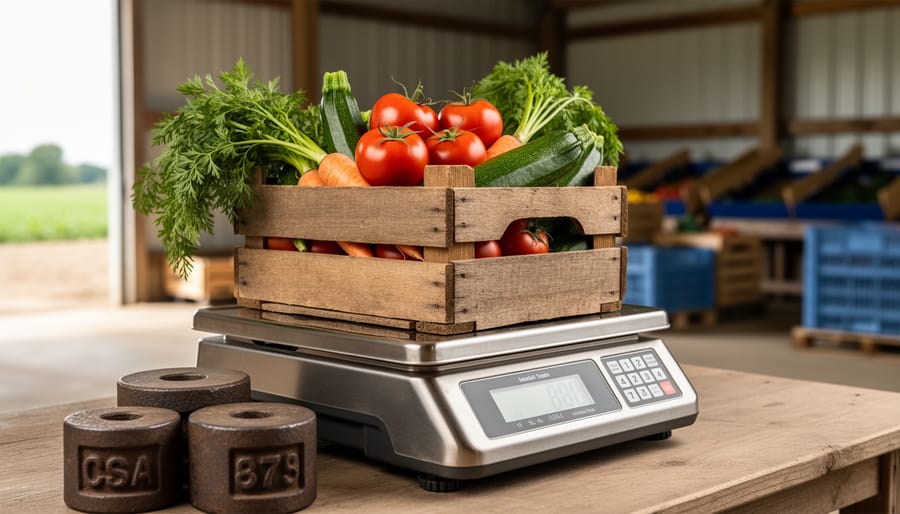
Register your farm scale with the California Division of Measurement Standards before your first CSA harvest—most counties require certification for any device used to determine the price of produce sold by weight. Download the device registration form from your county’s agriculture department website, pay the nominal fee (typically $50-150 annually), and schedule your initial inspection at least 30 days before you plan to weigh products for customers.
Purchase a commercial-grade scale certified for legal trade, identifiable by the NTEP (National Type Evaluation Program) seal or Certificate of Conformance number on the device. Avoid bathroom scales, kitchen scales, or unmarked equipment, as inspectors will reject these during certification. Place your scale on a stable, level surface away from wind and vibration, and test it weekly using certified test weights to maintain accuracy between official inspections.
Keep detailed records of all scale calibrations, inspection certificates, and any adjustments made to your measuring equipment. California law requires these documents remain accessible during farmers market sales and CSA pickups, protecting both your farm and your members. Most county sealers conduct annual re-inspections, so mark your calendar and ensure your scale remains in compliance—a simple practice that builds trust with CSA members who appreciate transparent, legally compliant farming operations.
Understanding these requirements transforms what seems like bureaucratic red tape into a straightforward process that legitimizes your farm business and reassures customers they’re receiving honest value for their investment in local, sustainable agriculture.
What Weights and Measures Compliance Actually Means for CSA Farms
If you’re running a CSA farm in California, you’re probably familiar with various regulations already, like sales tax compliance. But weights and measures laws often catch new farmers by surprise. Here’s what you need to know.
California’s weights and measures regulations exist to ensure fairness in commercial transactions. When you sell produce by weight, whether to CSA members or at farmers markets, you’re legally required to use certified scales and follow specific practices. These rules apply to farms of all sizes, from backyard operations to large commercial growers.
County Sealers of Weights and Measures are the local officials who enforce these regulations in your area. Think of them as your go-to resource rather than just enforcers. Most County Sealers genuinely want to help small farms succeed and understand the unique challenges you face. They conduct annual inspections, test your scales for accuracy, and provide guidance on compliance.
Why do CSA farms fall under these requirements? The moment you engage in commercial transactions involving weight-based pricing, you’re subject to weights and measures laws. This includes selling produce shares, operating farm stands, or participating in farmers markets. The key trigger is the commercial exchange of goods by weight, not the size of your operation.
The good news? Compliance doesn’t have to be complicated or expensive. Most County Sealers offer affordable annual certification services, typically ranging from thirty to one hundred dollars depending on your equipment. They’ll test your scales, apply certification seals, and ensure you’re meeting legal standards. Many farmers report that once they understand the process, maintaining compliance becomes a simple part of their annual routine alongside other farm management tasks.
When Your CSA Farm Needs Certified Scales
Weight-Based Pricing and Share Distributions
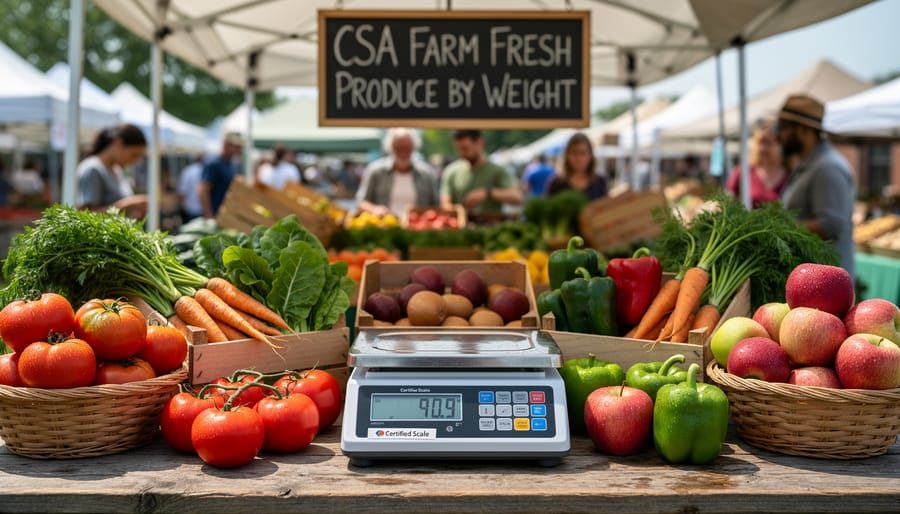
When you’re selling produce by the pound at farmers markets or through direct sales, California law requires you to use certified scales. This means your scale must be inspected and approved by your local county weights and measures office. The certification process is straightforward: contact your county office to schedule an inspection, pay a modest fee (typically between $25-$75), and receive your official certification seal. These scales need recertification annually to ensure accuracy and protect both you and your customers.
Here’s where it gets interesting for CSA farmers: share distributions operate in a gray area. If you’re providing predetermined boxes or bags as part of a subscription model where members pay upfront for a season’s worth of produce, you’re generally not required to use certified scales. The key distinction is that members are buying a share of the harvest, not purchasing produce by weight. However, if you offer add-ons or extra items priced by the pound, those transactions do require certified scales.
Many successful CSA farmers keep a certified scale on hand anyway. It builds trust with members, helps with harvest planning, and gives you flexibility if you decide to sell at farmers markets. Consider it an investment in transparency and professional operation of your farm business.
Farmers Market and Direct Sales
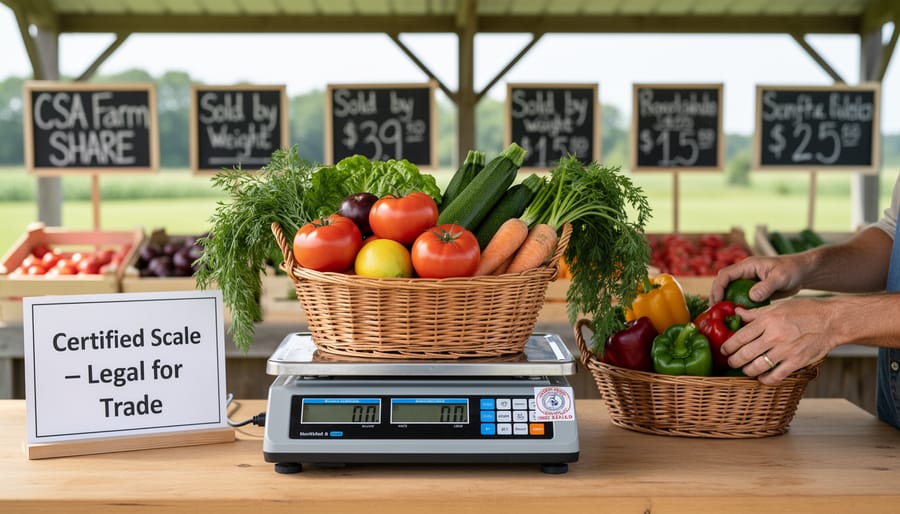
When you’re selling your fresh harvest at farmers market sales venues or from your farm stand, California’s Division of Measurement Standards requires your scales to meet the same certification standards as retail stores. This means you’ll need a Type Approved scale with a valid Certificate of Approval, even if you’re only selling a few times per month.
The good news? Many portable battery-operated scales designed for farmers markets already come Type Approved. Look for a National Type Evaluation Program certificate number on the device. Your scale must display weights clearly to both you and your customers, and it needs annual inspection by your county’s weights and measures department.
Here’s a practical tip from successful market vendors: invest in a quality digital scale with a large display that’s easy to read in outdoor lighting conditions. Keep your most recent inspection certificate handy at your booth, as inspectors can make surprise visits during market hours.
Remember, accurate weighing builds trust with your customers and protects your farming business from potential fines. Many counties offer dedicated farmers market inspection days to make compliance easier for small-scale growers. Contact your local agricultural commissioner’s office to schedule your inspection and join their support programs for sustainable farming operations.
Getting Your Scales Certified in California
Getting your scales certified might sound intimidating, but it’s actually a straightforward process that protects both you and your customers. Think of it as getting a health inspection for your farm stand—just with numbers instead of lettuce.
Your first step is locating your County Sealer of Weights and Measures. Every California county has one, and they’re genuinely there to help you succeed. A quick online search for “weights and measures” plus your county name will pull up contact information. Many sealers now offer online appointment scheduling, making the process even easier. Don’t hesitate to call them with questions before your inspection—most are friendly folks who appreciate farmers taking compliance seriously.
When inspection day arrives, the sealer will test your scales using certified test weights to ensure accuracy. They’ll check that your equipment meets California’s tolerance standards, which typically allow for minimal variance. For a 10-pound measurement, your scale needs to be accurate within about 0.1 ounces. If your scale passes, you’ll receive a certification sticker valid for one year. If it doesn’t pass initially, the sealer will explain what adjustments are needed—often it’s something simple like recalibration.
Fees vary by county but generally range from 25 to 75 dollars per scale annually. Some counties charge based on scale capacity, while others have flat rates. It’s a small investment considering the trust it builds with your CSA members. One organic farmer in Sonoma County shared that displaying her certification sticker actually increased customer confidence and led to more word-of-mouth referrals.
Annual recertification is required in California, so mark your calendar each year. Pro tip: schedule your inspection during your slower season to avoid any disruption to peak harvest times.
To make the process smoother, keep your scales clean and level, store them properly when not in use, and avoid placing them on uneven surfaces. Test them periodically with known weights—like a bag of flour—to catch potential drift early. Many farmers keep a simple log of their own accuracy checks, which demonstrates good faith effort during inspections.
Remember, certification isn’t about catching you doing something wrong—it’s about ensuring fairness in the marketplace and protecting the integrity of sustainable farming practices.
Choosing the Right Scales for Your CSA Operation
Selecting the right scale for your CSA operation doesn’t have to break the bank, but it does require meeting California’s legal standards. The good news? You have several options that balance compliance with affordability.
For most small to medium CSA operations, a legal-for-trade bench scale is your best bet. These scales must carry a Certificate of Conformance (CoC) number, which indicates they’ve been approved by the National Type Evaluation Program. Look for this number on the scale itself or in the product documentation before purchasing. Prices typically range from $200 to $800 for models suitable for weighing produce.
When shopping for scales, prioritize these features: a capacity of at least 30 to 60 pounds to accommodate larger orders, readability in 0.01-pound increments for accuracy, and a platform large enough for boxes or bags. Stainless steel platforms are worth the investment since they’re easy to clean and resist corrosion from moisture. Battery operation provides flexibility for farmers market setups, while AC adapters work well for on-farm sales.
Popular brands among CSA farmers include Avery Weigh-Tronix, Ohaus, and Brecknell, all of which offer legal-for-trade models. Sarah Chen, who runs a thriving CSA in Sonoma County, shares this tip: “I started with a basic $300 bench scale, and it’s served me perfectly for five years. Don’t feel pressured to buy top-of-the-line equipment when you’re starting out.”
Remember to factor in the annual certification fee, usually around $50 to $100, when budgeting for your scale investment. This small ongoing cost ensures your measurements remain accurate and legally compliant, protecting both you and your customers.
Common Mistakes CSA Farmers Make (And How to Avoid Them)
Nobody starts their CSA journey planning to run into compliance issues, but even well-intentioned farmers sometimes stumble with weights and measures requirements. The good news? Most mistakes are easily preventable once you know what to watch for.
One of the most common pitfalls happens when farmers purchase a scale at a big-box store or online marketplace without checking certification status. Sarah, who runs a thriving CSA in Sonoma County, learned this the hard way during her first year. “I bought what I thought was a professional scale, only to discover during an inspection that it wasn’t certified for commercial use in California,” she recalls. Now she always verifies that scales carry the appropriate Certificate of Approval sticker before making purchases.
Another frequent issue involves scale maintenance. Scales can drift out of calibration over time, especially with regular use and seasonal temperature changes. Setting a quarterly reminder to check calibration and scheduling annual professional inspections keeps you ahead of potential problems. Think of it like maintaining your tractor – preventive care beats emergency repairs.
Pricing signage causes confusion too. Some farmers display only the price per box without clarifying the weight or unit cost, which can lead to misunderstandings with both customers and inspectors. Clear signage showing “5 lbs for $15” or “$3 per pound” eliminates ambiguity and builds trust with your members.
Unit conversion mistakes also crop up occasionally, particularly when farmers work with recipes or planting guides using different measurement systems. A simple conversion chart posted near your packing station prevents errors when customers request specific weights.
Remember, regulatory compliance isn’t about catching farmers doing something wrong – it’s about protecting consumers and creating fair marketplaces. Viewing these requirements as part of your commitment to transparency and quality service helps maintain the integrity that makes CSA farming so special.
Success Story: How Green Valley Farm Simplified Their Compliance
When Maria Rodriguez launched Green Valley Farm CSA in Sonoma County three years ago, she felt overwhelmed by California’s weights and measures requirements. Like many small-scale farmers, she worried that compliance would eat into her limited time and budget.
“I was selling produce at farmers markets and running my CSA boxes, but I wasn’t sure if my home scale was legal,” Maria recalls. “The regulations seemed complicated, and I didn’t want to risk fines or lose customer trust.”
Maria decided to tackle compliance head-on. She contacted her local County Agricultural Commissioner’s office and discovered the process was more straightforward than expected. Within two weeks, she had her scale tested and certified for just $50. The inspector even provided helpful tips on proper weighing procedures.
The results surprised her. “Customers noticed the certification sticker on my scale immediately,” Maria explains. “It boosted their confidence, and I actually saw an increase in sales.” She also discovered that accurate weighing helped reduce waste and improved her profit margins by ensuring consistent portions.
Today, Maria maintains her certification annually and has invested in a second certified scale for her packing area. She estimates the entire compliance process takes less than four hours per year, including record-keeping.
“It seemed daunting at first, but getting certified was one of the best business decisions I made,” she says. “My customers trust me, and I sleep better knowing everything is above board.”
Here’s the good news: staying compliant with California’s weights and measures requirements doesn’t have to be complicated or overwhelming. Think of it as an investment in your farm’s future rather than just another regulatory hurdle. When you consistently use certified scales and follow proper measuring practices, you’re doing more than checking boxes—you’re building a foundation of trust with your customers that can set your CSA apart.
Accurate weights and measures show your members that you respect their investment and take your business seriously. This transparency strengthens the connection between you and the people who depend on your farm for fresh, healthy food. Plus, proper compliance protects you legally, giving you peace of mind as your operation grows.
Your next steps are straightforward: locate your nearest County Sealer of Weights and Measures office, schedule an inspection for your scales, and establish a simple system for regular checks. Many successful CSA farmers report that once they’ve set up their initial practices, maintaining compliance becomes second nature.
Remember, every accurate measure you provide contributes to the integrity of local food systems across California. You’re not just following regulations—you’re helping to create a marketplace where honesty and quality thrive, benefiting farmers and eaters alike.
