Daily Archives

2 Articles

How Universities Power Local Food Economies Through CSA Partnerships

Posted by darrell on
0
Business and Economic Impact
How Universities Power Local Food Economies Through CSA Partnerships

Universities catalyze profound economic transformations far beyond their campus boundaries, generating billions in direct spending and spawning innovative partnerships that reshape regional economies. From employing thousands of local residents to driving real estate development and attracting knowledge-intensive businesses, higher education institutions serve as powerful economic engines for their communities. Recent studies show that for every dollar invested in public universities, states see an average return of $3.80 in increased tax revenues and reduced social service costs. This multiplier effect extends into the agricultural sector, where university partnerships with local farms and CSA programs create sustainable food systems while boosting regional agricultural revenues. Through research commercialization, workforce development, and community engagement, universities cultivate economic ecosystems that nurture innovation, entrepreneurship, and sustainable growth. Understanding these complex economic relationships helps stakeholders maximize the potential of university-community partnerships while building more resilient local economies.

Direct Economic Benefits to Local Farms

University students picking up their weekly CSA shares at a campus distribution center
Students collecting fresh produce from a CSA distribution point on campus

Student Meal Plan Integration

Universities are increasingly integrating CSA shares into their meal plan options, creating a win-win situation that helps support local farmers while providing students with fresh, seasonal produce. Many institutions offer students the ability to use their meal plan points or dining dollars to purchase CSA shares, making local food more accessible to the campus community.

For example, some universities have implemented hybrid systems where students can collect their weekly CSA shares at campus dining locations, seamlessly blending local agriculture into existing food service infrastructure. Others have created designated pickup points in residence halls or student centers, making it convenient for students to access their shares.

This integration often includes educational components, such as cooking demonstrations using seasonal produce, farm visits, and workshops on sustainable eating. These programs help students develop healthy eating habits while understanding the importance of supporting regional agriculture. The flexibility of modern meal plan systems allows universities to track CSA participation and adjust offerings based on student demand, ensuring program sustainability and growth.

Faculty and Staff CSA Programs

Faculty and staff CSA programs serve as powerful economic drivers within university communities. When universities actively promote and facilitate CSA memberships among their employees, they create reliable customer bases for local farmers while supporting sustainable agriculture practices. These programs typically operate through payroll deduction options or convenient on-campus pickup locations, making it easier for busy professionals to access fresh, local produce.

Studies have shown that university employee participation in CSA programs can generate significant economic benefits. A single medium-sized university with 1,000 faculty and staff CSA members can channel upwards of $500,000 annually into local farming operations. This steady income stream helps farmers plan their crops, invest in infrastructure, and maintain stable employment for farm workers.

Beyond direct financial impact, these programs foster lasting relationships between academic communities and local farmers. Many participating universities report that faculty and staff members become long-term CSA subscribers, contributing to the sustained growth of regional agricultural economies. Additionally, these partnerships often lead to educational opportunities, research collaborations, and increased awareness of sustainable food systems within the broader university community.

Research and Innovation Benefits

Agricultural Extension Services

Universities significantly boost regional agricultural economies through their extension services, providing vital support to local farmers and agricultural businesses. These programs offer hands-on training, research-based solutions, and technical assistance that help farmers improve crop yields, adopt sustainable practices, and increase profitability.

Extension specialists work directly with farmers to solve real-world challenges, from soil testing and pest management to marketing strategies and business planning. They organize workshops, field days, and demonstration projects that showcase innovative farming techniques and technologies. This knowledge transfer helps farmers stay competitive and adapt to changing market conditions.

The economic ripple effect is substantial. When farmers implement improved practices learned through extension services, they often see increased yields and reduced operating costs. This leads to higher farm incomes, job creation, and greater investment in local agricultural infrastructure. Extension programs also support new farmer initiatives, helping launch the next generation of agricultural entrepreneurs and strengthening the local food system.

These services create lasting partnerships between academic expertise and farming communities, fostering agricultural innovation and economic resilience in rural areas.
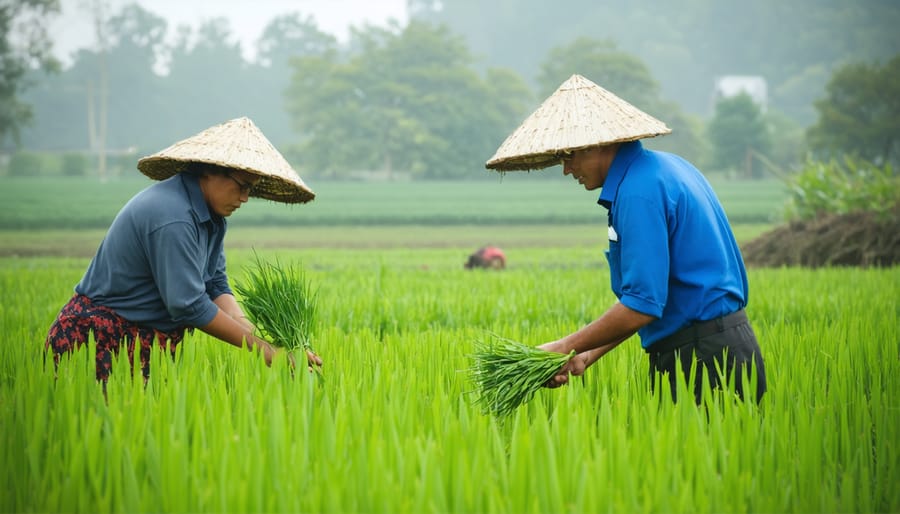
Agricultural extension specialists demonstrating farming techniques to CSA farmers
University agricultural researchers working with local farmers in a field

Student Research Projects

Student research projects on local farms create valuable synergies between academic institutions and agricultural communities. Through hands-on field studies, students contribute to farm innovation while gaining practical experience. These projects often focus on crop yield optimization, sustainable farming techniques, and market analysis, providing farmers with data-driven insights at minimal cost.

Local farms benefit from access to university resources, including soil testing laboratories, agricultural technology, and expert consultation. Students frequently develop solutions for real-world challenges, such as water conservation methods and pest management strategies, which farmers can implement immediately to improve their operations.

The economic impact extends beyond direct farm benefits. Many student researchers go on to establish their own agricultural enterprises in the region, creating jobs and strengthening local food systems. Their research findings often lead to improved farming practices that increase productivity and profitability for the entire farming community.

These collaborative projects also help secure grant funding and agricultural development resources, creating additional economic opportunities for both the university and local agricultural sector.
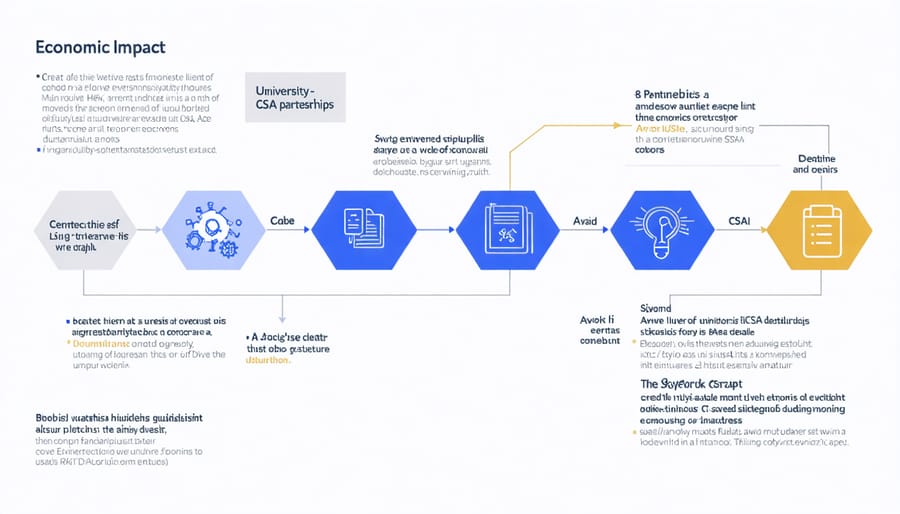
Flow diagram illustrating economic benefits from university-CSA partnerships to local community
Infographic showing economic impact flow chart of university-CSA partnerships

Community Economic Multiplier Effects

Job Creation and Retention

University-CSA partnerships create significant employment opportunities across multiple sectors of the local economy. These partnerships directly support farmers and farm workers through increased demand for local produce, while also generating positions in food distribution, marketing, and administrative roles.

Success stories like the Green Valley Farm CSA showcase how university partnerships can help sustain full-time farming jobs. After partnering with State University’s dining services, Green Valley Farm expanded from two full-time farmers to a team of six, plus seasonal workers during peak growing seasons.

Beyond direct farm employment, these partnerships create positions in:
– Food hub operations and logistics
– Quality control and food safety
– Student worker programs and internships
– Market coordination and customer service
– Educational outreach and community programs

Universities often integrate CSA programs into their curriculum, creating teaching and research positions. Student workers gain valuable hands-on experience in sustainable agriculture, while graduate assistantships support advanced research in farming practices and food systems.

The multiplier effect extends into the broader community, as increased local food production supports jobs in related industries such as:
– Local food processing
– Restaurant and catering services
– Farmers market management
– Agricultural supplies and equipment
– Marketing and communications

These partnerships also foster entrepreneurship, with many student workers and interns going on to start their own agricultural enterprises, further strengthening the local food economy and job market.

Local Business Growth

Universities serve as powerful catalysts for local business growth, creating a ripple effect that extends far beyond campus boundaries. When students, faculty, and staff become regular customers, nearby restaurants, bookstores, and retail shops experience significant increases in foot traffic and sales. Many successful businesses have flourished by catering specifically to university-related clientele, from coffee shops that become favorite study spots to tech repair services that support student devices.

The presence of a university often leads to the emergence of specialized business clusters. Innovation districts frequently develop around research institutions, attracting startups and established companies eager to tap into academic expertise and the skilled workforce pipeline. These businesses create additional employment opportunities for both students and local residents, contributing to a more diverse and resilient local economy.

Local service providers also benefit from university contracts and purchasing agreements. From catering services for campus events to maintenance contracts for university facilities, these partnerships provide steady revenue streams for local businesses. Additionally, universities often prioritize local vendors in their procurement policies, helping to keep economic benefits within the community.

The hospitality sector sees particular advantages during university events like graduation ceremonies, sports competitions, and academic conferences. Hotels, restaurants, and transportation services experience regular surges in demand, supporting year-round business sustainability and encouraging new entrepreneurial ventures in the area.

Future Growth Potential

The potential for expanding university-CSA partnerships presents exciting opportunities for sustainable growth and enhanced economic impact in local communities. Universities can leverage their resources and influence to create innovative programs that benefit both students and local farmers.

One promising avenue is the integration of CSA programs into university dining services, potentially scaling up to supply multiple campus locations. This expansion could create stable, year-round markets for local farmers while providing fresh, seasonal produce to thousands of students and staff members.

Educational institutions can also develop specialized training programs for aspiring farmers, combining classroom learning with hands-on experience at partner CSA farms. These programs could include business management courses, sustainable farming techniques, and marketing strategies, helping to cultivate the next generation of successful agricultural entrepreneurs.

Technology integration presents another growth opportunity, with universities potentially developing apps and platforms to streamline CSA operations, improve member communication, and track produce distribution. These tools could be shared across multiple CSA partnerships, creating more efficient and sustainable operations.

Research opportunities abound as well, with possibilities for studying sustainable farming methods, analyzing consumer behavior, and developing new crop varieties suited to local growing conditions. Such research could directly benefit partner CSAs while advancing agricultural science.

Looking ahead, universities might establish agricultural innovation centers that serve as hubs for farmer training, research, and community engagement. These centers could become catalysts for regional food system development, creating jobs and strengthening local agricultural economies while promoting sustainable farming practices.

Universities serve as powerful economic engines, generating substantial benefits for their local communities and regions. Through direct employment, research commercialization, student spending, and partnership initiatives, these institutions create ripple effects that strengthen local businesses and foster innovation. The evidence clearly shows that investing in higher education yields significant returns for both urban and rural economies. As we look to the future, universities should continue expanding their economic development programs, fostering more community partnerships, and measuring their impact. Other institutions can follow these successful models by engaging local businesses, supporting student entrepreneurship, and creating targeted initiatives that address community needs. By taking an active role in regional development, universities can help build more resilient and prosperous local economies while fulfilling their educational mission.

Smart Irrigation Software That Saves Time and Water on Your CSA Farm

Posted by darrell on
0
Seasonal Planning and Management
Smart Irrigation Software That Saves Time and Water on Your CSA Farm

Transform your farm’s efficiency with modern irrigation scheduling software – the digital cornerstone of precision agriculture that’s revolutionizing how small-scale farmers manage water resources. Today’s smart irrigation systems combine real-time weather data, soil moisture sensors, and crop-specific algorithms to deliver exactly what your plants need, when they need it.

Gone are the days of guesswork watering. Forward-thinking farmers are cutting water usage by up to 30% while boosting crop yields through automated scheduling that factors in everything from soil type to growth stage. Whether you’re managing a 5-acre organic vegetable operation or a sprawling orchard, these tools provide actionable insights through user-friendly mobile apps and desktop interfaces.

For small-scale organic farmers, irrigation scheduling software offers a perfect balance of sophistication and simplicity – helping you maintain optimal soil moisture levels while saving precious time and resources. It’s not just about water conservation; it’s about growing smarter and more sustainably in an increasingly unpredictable climate.

Why Your CSA Farm Needs Digital Irrigation Management

Water Conservation Benefits

Irrigation scheduling software stands at the forefront of modern smart water-saving techniques, offering substantial benefits for farms of all sizes. By analyzing real-time soil moisture data, weather patterns, and crop requirements, these systems can reduce water consumption by 20-50% while maintaining or even improving crop yields.

The software prevents both over-watering and under-watering by delivering precise amounts of water exactly when plants need it. This precision not only conserves water but also reduces energy costs associated with pumping and distribution. Many farmers report seeing their water bills decrease by up to 30% within the first growing season of implementation.

Additionally, these systems help prevent water runoff and soil erosion, protecting valuable topsoil and reducing nutrient leaching. By maintaining optimal soil moisture levels, the software also creates healthier growing conditions that naturally suppress many common plant diseases, leading to stronger, more resilient crops.

Labor and Time Savings

Irrigation scheduling software dramatically reduces the time farmers spend monitoring and adjusting water systems. Instead of walking the fields multiple times daily to check soil moisture and plant health, farmers can view real-time data from their smartphones or computers. The software automatically tracks weather patterns, soil conditions, and crop water needs, making adjustments without constant human intervention.

Many farmers report saving 15-20 hours per week during peak growing seasons. Take Sarah Miller, an organic vegetable farmer in Colorado, who used to spend her mornings and evenings checking irrigation lines. Now, she simply reviews the software dashboard over breakfast and can focus on other important tasks like harvest planning and market preparation.

The automation also eliminates the need for midnight adjustments during extreme weather events, as the system can respond to unexpected temperature changes or rainfall automatically. This improved work-life balance has been a game-changer for small-scale farmers managing diverse crop operations.

Modern irrigation software dashboard displaying real-time monitoring data and control options
Dashboard view of an irrigation software interface showing weather data, soil moisture levels, and scheduling controls

Key Features of Modern Irrigation Software

Weather Integration

Modern irrigation scheduling software leverages real-time weather data to make smart watering decisions for your crops. These systems connect to local weather stations or online weather services to gather crucial information like rainfall, temperature, humidity, and wind speed. By analyzing this data, the software automatically adjusts your irrigation schedule to provide optimal water amounts.

For example, if unexpected rain is forecasted, the system will postpone scheduled watering to prevent overwatering. During hot, dry spells, it might increase water delivery to compensate for higher evaporation rates. This dynamic response to weather conditions helps conserve water while ensuring crops receive exactly what they need.

Many systems also track historical weather patterns and combine this with soil moisture sensors to create highly accurate watering predictions. Some advanced platforms even factor in microclimates within your growing area, recognizing that different parts of your farm might experience slightly different weather conditions.

This weather-smart approach not only saves water but also protects plants from stress caused by under or overwatering, leading to healthier crops and better yields.

Soil Moisture Monitoring

Modern soil moisture monitoring systems are the eyes and ears of effective irrigation scheduling software. These systems use strategically placed sensors throughout your growing areas to collect real-time data about soil moisture levels at different depths. The software interprets this data and presents it through user-friendly dashboards, helping you understand exactly when and how much to water your crops.

Many farmers find that integrating soil sensors with their irrigation software reduces water usage by 20-30%. The sensors measure important factors like soil moisture tension, temperature, and electrical conductivity, giving you a complete picture of your soil’s health. When the moisture levels drop below preset thresholds, the software can automatically trigger irrigation cycles or send alerts to your phone.

Sarah Wilson, a small-scale organic farmer in Vermont, shares: “Since installing soil moisture sensors, I’ve eliminated the guesswork. My plants get exactly what they need, when they need it, and my water bill has dropped significantly.”

Agricultural professional using mobile device to monitor soil moisture sensors in crop field
Farmer checking soil moisture sensors while referring to mobile app on tablet

Mobile Control and Alerts

Modern irrigation scheduling software puts control right in your pocket through user-friendly mobile apps. These apps let you manage your entire irrigation system from anywhere, whether you’re at the farmers market or taking a well-deserved break. Get real-time updates on soil moisture levels, weather conditions, and system performance through push notifications on your smartphone.

Set custom alerts for critical events like unexpected pressure drops, unusual water flow, or when soil moisture reaches specific thresholds. Many systems also send daily irrigation reports and weather forecasts to help you make informed decisions about your watering schedule.

The mobile interface typically includes an intuitive dashboard where you can adjust watering times, activate or pause zones, and view water usage statistics. Some apps even integrate with smart home systems, allowing you to control irrigation alongside other farm management tools. This connectivity ensures you’re always in tune with your crops’ needs, even when you can’t be physically present in the field.

Implementation Success Story

Green Acres CSA, a 15-acre organic farm in Vermont, transformed their irrigation practices through the implementation of smart scheduling software in 2021. Owner Sarah Mitchell had previously relied on traditional methods and intuition to manage water distribution across her diverse crop fields, but increasing weather unpredictability prompted her to seek a more precise solution.

“Before the software, we were either over-watering or scrambling to catch up during dry spells,” Sarah explains. “We needed a system that could help us make better decisions, especially with our limited labor resources.”

The farm installed soil moisture sensors across different growing zones and connected them to an irrigation management platform. The software integrates local weather data, crop-specific water requirements, and real-time soil moisture readings to generate customized watering schedules for each section of the farm.

The results were remarkable. Within the first growing season, Green Acres reduced their water usage by 30% while maintaining optimal soil moisture levels. The automated alerts helped Sarah’s team respond quickly to changing conditions, preventing both water stress and excess irrigation.

The software proved particularly valuable for their high-value crops like tomatoes and leafy greens. “We saw a 20% increase in our tomato yield,” Sarah notes. “The consistent moisture levels also improved the quality of our salad greens, which our CSA members definitely noticed.”

The system’s user-friendly interface allowed Sarah’s seasonal workers to quickly adapt to the new technology. Daily irrigation tasks that once took hours to plan now require just minutes to review and adjust. The mobile app enables the team to monitor and control irrigation from anywhere on the farm.

The investment paid for itself within two seasons through water savings, reduced labor costs, and improved crop yields. For Sarah, the peace of mind knowing her irrigation decisions are backed by data has been invaluable. “It’s like having an expert irrigation consultant available 24/7,” she says.

Data visualization showing water consumption reduction through smart irrigation implementation
Before/after comparison of water usage charts showing reduction after implementing irrigation software

Getting Started with Irrigation Software

Getting started with irrigation software doesn’t have to be overwhelming. Begin by assessing your farm’s specific needs, including the size of your growing area, types of crops, and local climate conditions. These factors will help narrow down your software options and ensure they align with your CSA planning process.

Start with a basic checklist:
1. List your must-have features (weather integration, mobile access, automated scheduling)
2. Set a realistic budget
3. Check your internet connectivity in the field
4. Consider your comfort level with technology

Many irrigation software providers offer free trials – take advantage of these to test different solutions. Begin with a small area of your farm to experiment and learn the system before scaling up. This approach helps minimize risks and allows you to build confidence with the technology.

When implementing your chosen solution:
– Take time to input accurate field data
– Map out your irrigation zones carefully
– Set up weather station connections if available
– Train any team members who’ll be using the system
– Keep backup manual schedules during the learning phase

Remember to start simple and add more advanced features as you become comfortable with the basics. Many successful farmers begin with basic scheduling functionality and gradually incorporate soil moisture sensors, weather forecasting, and automation tools.

Look for software providers offering good customer support and training resources. Having access to help when you need it makes the transition much smoother and helps you get the most value from your investment.

As we’ve explored throughout this article, irrigation scheduling software has become an invaluable tool for modern farmers and gardeners looking to optimize their water usage while maximizing crop yields. By implementing these smart solutions, growers can save time, reduce water waste, and maintain healthier plants through precise irrigation management.

The benefits are clear: reduced water bills, decreased labor costs, improved crop quality, and a smaller environmental footprint. Many farmers who have adopted this technology report seeing positive results within their first growing season, often achieving water savings of 20-30% while maintaining or improving their harvest quality.

Whether you’re managing a small market garden or a larger agricultural operation, today’s user-friendly irrigation scheduling tools make it easier than ever to embrace sustainable water management practices. With options ranging from simple smartphone apps to comprehensive farm management systems, there’s a solution for every scale and budget.

Take the first step toward smarter irrigation by exploring the various software options available and choosing one that fits your specific needs. Your plants, your wallet, and our planet will thank you for it.