
Daily Archives

2 Articles

Regenerative Agriculture: The Key to Long-Term CSA Farm Success

Posted by darrell on
0
Organic Farming and Cultivation
Regenerative Agriculture: The Key to Long-Term CSA Farm Success

As global food demands surge and climate concerns intensify, regenerative agriculture stands at the crossroads of farming’s future. This holistic approach to food production – focusing on soil health, biodiversity, and ecosystem restoration – promises to revolutionize how we grow food while healing our planet. But amid the growing buzz around regenerative practices, a crucial question emerges: Is this system truly sustainable for farmers and our food supply?

From small family farms to large agricultural operations, producers worldwide are discovering that regenerative methods can actually increase yields while reducing input costs. These practices, including no-till farming, cover cropping, and rotational grazing, work with nature rather than against it. Yet the transition requires significant knowledge, investment, and patience – factors that deserve careful consideration before making the switch.

As we explore the sustainability of regenerative agriculture, we’ll examine both its remarkable potential and practical challenges, backed by real-world evidence from farmers who’ve successfully made the transition.

The Core Principles of Regenerative Agriculture in CSA Farms

Soil Health Management

At the heart of regenerative agriculture lies the essential practice of building healthy soil ecosystems. This approach prioritizes minimal soil disturbance through reduced tillage techniques, which protect beneficial microorganisms and maintain soil structure. Farmers employ cover cropping to prevent erosion and add organic matter, while crop rotation helps break pest cycles naturally and enhances nutrient availability.

Composting and the application of natural amendments like aged manure play crucial roles in boosting soil fertility. These practices increase organic matter content, improve water retention, and enhance the soil’s ability to sequester carbon. Many regenerative farmers also integrate livestock, using carefully managed grazing to stimulate plant growth and naturally fertilize fields.

The beauty of these soil management techniques lies in their self-reinforcing nature – as soil health improves, the need for external inputs decreases, creating a more resilient and truly sustainable farming system. This approach not only nurtures the land but also produces more nutrient-dense crops while reducing operational costs over time.

Side-by-side comparison of regenerative and conventional farm soil quality
Split-screen comparison of healthy, dark soil with visible organic matter next to depleted, lighter colored soil

Biodiversity and Crop Rotation

Biodiversity is a cornerstone of regenerative agriculture, where farmers create resilient ecosystems through thoughtful crop rotation strategies and diverse plantings. By growing different crops in sequence, farmers naturally enrich their soil while reducing pest and disease pressures. Think of it as nature’s version of risk management!

Instead of growing a single crop, regenerative farmers plant a variety of complementary species that work together. For example, deep-rooted plants like carrots help break up compacted soil, while nitrogen-fixing legumes naturally fertilize the earth. Cover crops protect bare soil between growing seasons, while flowering plants attract beneficial insects that help control pests naturally.

This diversity creates a balanced ecosystem where each plant plays a vital role. When one crop might struggle due to weather or pest challenges, others can thrive, providing farmers with multiple income streams while building healthier soil. It’s a win-win approach that mimics natural ecosystems while producing abundant, nutrient-rich food.

Economic Viability of Regenerative CSA Farming
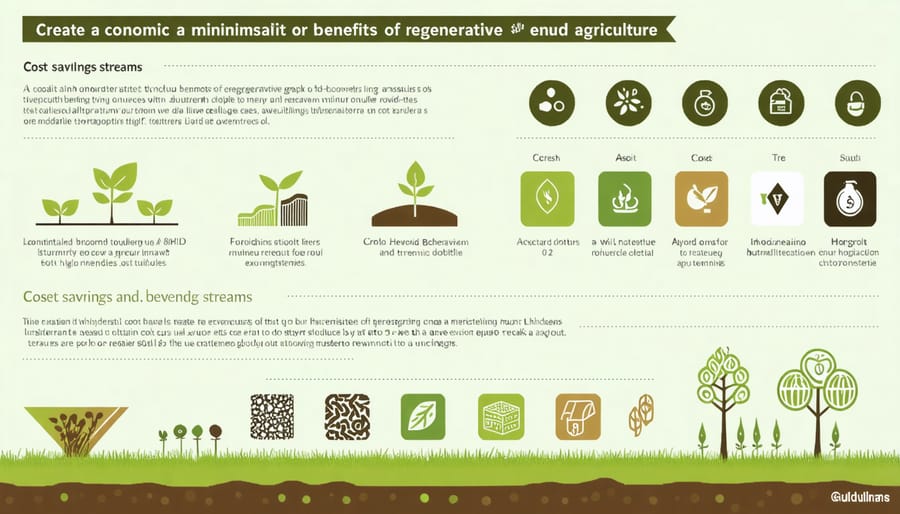
Visual representation of regenerative agriculture financial benefits and ROI
Infographic showing the economic benefits of regenerative agriculture with charts and icons representing cost savings and revenue streams

Cost-Benefit Analysis

While regenerative agriculture requires initial investments, many farmers find the long-term benefits outweigh the upfront costs. The main startup expenses include soil testing equipment ($300-500), cover crop seeds ($50-100 per acre), and potential machinery modifications ($2,000-5,000). Training and education costs typically range from $500-2,000.

However, these investments often pay off within 3-5 years through reduced input costs. Farmers report 30-50% savings on chemical fertilizers and pesticides, while improved water retention can cut irrigation costs by up to 40%. Enhanced soil health leads to better crop yields, with many farms seeing 10-20% increases in production after transitioning to regenerative practices.

Additional financial benefits come from premium pricing for regeneratively grown products and potential carbon credits. Many farmers also save money through reduced fuel consumption and equipment wear, as regenerative practices often require fewer passes over fields. When considering labor costs, while some practices may require more initial effort, the reduced need for chemical applications and irrigation often balances out the workload over time.

The key is viewing these costs as investments in your farm’s future rather than expenses, as the returns typically compound year after year through improved soil health and ecosystem services.

Market Advantages

Regenerative agriculture offers compelling market advantages that extend beyond environmental benefits. Farmers practicing these methods often command premium prices for their products, with consumers willing to pay 20-30% more for regeneratively grown produce. This price premium reflects the higher quality and nutritional value of the food, as well as the environmental stewardship that goes into its production.

Customer loyalty is another significant advantage. When consumers understand the positive impact of regenerative farming on soil health and ecosystem restoration, they tend to become dedicated supporters. Many regenerative farmers build strong community connections through CSA programs and farmers’ markets, creating lasting relationships with customers who value transparency and sustainable practices.

These market advantages create a positive feedback loop: higher prices support continued investment in sustainable practices, while loyal customers provide stable income through direct sales channels. Additionally, regenerative farms often diversify their revenue streams through value-added products, educational programs, and agritourism activities, making their business models more resilient to market fluctuations.

Environmental Impact and Long-Term Sustainability

Carbon Sequestration

One of the most exciting benefits of regenerative agriculture is its potential to capture and store atmospheric carbon dioxide in the soil. Through practices like no-till farming, cover cropping, and diverse crop rotations, regenerative farms can turn their soil into a powerful carbon sink. When plants photosynthesize, they pull carbon from the air and transfer it to the soil through their root systems and beneficial relationships with soil microorganisms.

Research shows that farms using regenerative practices can sequester between 2-5 tons of carbon per acre annually. This adds up quickly – a 100-acre regenerative farm could potentially offset the annual carbon emissions of over 100 cars! Beyond climate benefits, increased soil carbon also improves water retention, enhances nutrient availability, and creates healthier crops.

The carbon storage potential varies based on factors like soil type, climate, and specific farming practices. While more long-term studies are needed, early results from regenerative farms show promising carbon sequestration rates that continue building year after year. This natural carbon capture technology makes regenerative agriculture a vital tool in addressing climate change while producing nutritious food.

Water Conservation

Regenerative agriculture stands out for its remarkable ability to improve water management on farms. Through practices like cover cropping and no-till farming, these methods help soil retain moisture more effectively, reducing the need for irrigation. Farmers implementing water conservation techniques often report using up to 30% less water compared to conventional farming methods.

The enhanced soil structure created by regenerative practices acts like a natural sponge, capturing rainfall and preventing runoff. This improved water retention not only helps crops thrive during dry spells but also reduces erosion and protects local waterways from pollution. Many farmers have found that after just a few years of regenerative practices, their fields require significantly less irrigation, even during challenging weather conditions.

The water-saving benefits extend beyond the farm itself. By reducing water consumption and improving groundwater recharge, regenerative agriculture helps preserve local water resources for the entire community. This makes it particularly valuable in regions facing water scarcity or irregular rainfall patterns.

Bird's eye view of a thriving regenerative CSA farm with diverse crop patterns
Aerial photograph of a diverse CSA farm showing multiple crop rotations, cover crops, and integrated livestock

Real Success Stories from CSA Farms

Let’s explore some inspiring success stories from farms that have embraced regenerative agriculture principles. The Brown Family Farm in Vermont transformed their struggling dairy operation into a thriving CSA by implementing cover cropping and rotational grazing. Within three years, they reduced their external input costs by 60% while increasing their soil organic matter from 2% to 5%.

In California, Sweet Creek Farm’s journey shows how regenerative practices can succeed even in challenging climates. Owner Maria Rodriguez introduced no-till farming and diverse crop rotations, leading to a 40% reduction in water usage. Her CSA membership grew from 50 to 200 families in just two years, with customers repeatedly praising the superior taste of her produce.

Heartland Roots Farm in Iowa presents another compelling case. Farmers Tom and Sarah Wheeler integrated livestock with their vegetable production, using chickens and sheep to naturally fertilize fields and control pests. This system eliminated their need for synthetic inputs while boosting their profit margins by 35%. Their soil tests show significantly improved nutrient density, and they’ve maintained a waiting list for their CSA shares since 2019.

Perhaps most remarkable is the story of New Dawn Farm in North Carolina. After transitioning to regenerative practices, they weathered three major hurricanes with minimal crop loss, while neighboring conventional farms suffered severe damage. Their resilient soil structure, built through years of regenerative management, helped prevent erosion and retained crucial moisture during extreme weather events.

These success stories share common threads: reduced operational costs, improved soil health, greater climate resilience, and strong community support. While the transition period required patience and learning, each farm emerged more economically stable and environmentally sustainable, proving that regenerative agriculture can work at the CSA scale.

Regenerative agriculture has proven to be a sustainable model for CSA farms, offering both environmental benefits and economic viability. Through the implementation of soil-building practices, water conservation methods, and biodiversity enhancement, these farms are creating resilient ecosystems that can withstand climate challenges while producing nutrient-dense food. The success stories of numerous CSA farmers demonstrate that when properly managed, regenerative practices can reduce operational costs, increase crop yields, and build customer loyalty.

What makes regenerative agriculture particularly sustainable for CSA farms is the symbiotic relationship between farmers and their community members. This direct-to-consumer model provides stable income through member subscriptions while allowing farmers to focus on land stewardship rather than mass production. As more consumers seek locally grown, environmentally responsible food options, regenerative CSA farms are well-positioned to meet this demand while continuing to improve soil health and ecosystem function.

While challenges exist, the growing body of evidence suggests that regenerative agriculture in CSA farms offers a promising path forward for sustainable food production that benefits both people and the planet.

CSA Teacher Certification: Empowering Educators to Share Sustainable Agriculture

Posted by darrell on
0
Educational Programs and Partnerships
CSA Teacher Certification: Empowering Educators to Share Sustainable Agriculture

Become a certified Kansas teacher and shape the future of sustainable agriculture education through a streamlined four-step process. Complete a bachelor’s degree in education or your content area from an accredited institution, maintaining a minimum 2.75 GPA. Pass both the Praxis Subject Assessment and the Principles of Learning and Teaching (PLT) exam specific to your grade level. Submit fingerprints for a background check and complete the Kansas Educator Ethics assessment. Apply through the Kansas State Department of Education’s online licensure system, KEEP, with all required documentation and fees. This pathway opens doors to teaching positions across Kansas’s 286 school districts, where educators earn competitive salaries while making meaningful impacts in their communities through hands-on learning experiences.

Understanding CSA Teacher Certification in Kansas

Eligibility Requirements

To qualify for Kansas teacher certification, candidates must hold a bachelor’s degree from an accredited college or university with a minimum GPA of 2.75. The degree should include a state-approved teacher preparation program focusing on the specific subject area or grade level you wish to teach.

First-time applicants need to complete the following prerequisites:
– Pass both the Praxis Content Assessment and Principles of Learning and Teaching (PLT) tests
– Complete a supervised teaching practicum of at least 12 weeks
– Submit fingerprints for a background check
– Complete a pedagogical assessment
– Demonstrate knowledge of teaching methods and classroom management

Alternative pathways exist for career changers through the Restricted License Program, which allows individuals with relevant work experience to teach while completing education requirements. Military veterans may qualify for expedited certification through the Troops to Teachers program.

All candidates must complete approved coursework in teaching methods for students with disabilities and teaching English language learners. Maintaining certification requires ongoing professional development and periodic renewal.

Core Competencies

Kansas teacher certification requires mastery of several core competencies that ensure educators are well-prepared for the classroom. These essential skills include content knowledge in the specific subject area, understanding of educational psychology, and proficiency in classroom management techniques.

Aspiring teachers must demonstrate strong instructional planning abilities, showing they can create engaging lessons that meet state standards while accommodating diverse learning needs. Assessment and evaluation skills are crucial, as teachers need to effectively measure student progress and adjust their teaching methods accordingly.

Technology integration competency has become increasingly important, with teachers expected to utilize digital tools and platforms effectively in their instruction. Communication skills are equally vital, encompassing both student interaction and professional collaboration with colleagues and parents.

Cultural awareness and sensitivity form another key component, preparing teachers to work with students from various backgrounds. Classroom safety and emergency response protocols round out the core requirements, ensuring teachers can maintain a secure learning environment.

These competencies are assessed through a combination of coursework, practical teaching experience, and standardized tests, creating well-rounded educators ready for Kansas classrooms.

Flow chart diagram illustrating the CSA teacher certification process steps and requirements
Infographic showing the certification process steps and timeline

Certification Process and Timeline

Application Process

To begin the Kansas teacher certification process, you’ll need to gather several essential documents. These include official transcripts from all attended colleges, a completed fingerprint card for background checks, and verification of teaching experience if applicable. You’ll also need to complete the Kansas Performance Teaching Portfolio (KPTP) during your student teaching experience.

Submit your application through the Kansas State Department of Education’s online licensing system. The application requires a non-refundable fee, which varies depending on the type of license you’re seeking. Make sure to upload clear, legible scans of all required documents.

For first-time applicants, you’ll need to demonstrate completion of a state-approved teacher preparation program. This includes passing the required Praxis tests – both content area and pedagogy assessments. Score reports should be sent directly to the Kansas State Department of Education.

If you’re seeking alternative certification, additional documentation showing your work experience and subject matter expertise will be required. The department typically processes complete applications within 6-8 weeks during peak seasons.

Remember to maintain copies of all submitted documents for your records. The licensing office will communicate through email regarding any missing information or additional requirements. Once approved, your teaching license will be available electronically through the state’s online portal.

Training Components

To become a certified teacher in Kansas, you’ll need to complete specific educational components and hands-on training. The foundation begins with a bachelor’s degree in education or your content area from an accredited institution. During your undergraduate studies, you’ll take courses in teaching methods, classroom management, educational psychology, and child development.

Core coursework typically includes curriculum planning, assessment strategies, and teaching diverse learners. You’ll also need to complete subject-specific courses aligned with your intended teaching area, whether that’s elementary education, secondary mathematics, science, or other specialties.

A crucial part of the certification process is the student teaching experience, which usually lasts 12-16 weeks. During this time, you’ll work alongside an experienced mentor teacher, gradually taking on more classroom responsibilities. This hands-on experience allows you to apply theoretical knowledge in a real classroom setting.

Additionally, you must complete the Kansas Performance Teaching Portfolio (KPTP), demonstrating your ability to plan, teach, and assess student learning. The portfolio includes lesson plans, student work samples, and reflective analysis of your teaching practice.

Professional development courses in technology integration, special education, and English language learners are also required. These components ensure teachers are well-prepared to meet the diverse needs of Kansas students while maintaining high educational standards.

Certified agriculture teacher showing students how to plant seedlings in a school garden
Teacher working with students in a school garden, demonstrating sustainable farming practices

Benefits and Career Opportunities

Professional Growth

Kansas teacher certification opens doors to numerous career advancement opportunities within the education sector. Certified teachers can progress to roles such as department heads, curriculum specialists, or educational administrators. Many educators find fulfilling paths in mentoring new teachers or developing innovative agricultural education programs.

The certification also provides access to valuable professional networks and communities. Teachers can join organizations like the Kansas Association of Agricultural Educators (KAAE) and the National Association of Agricultural Educators (NAAE), connecting with peers who share their passion for sustainable agriculture education.

Professional development opportunities abound through workshops, conferences, and continuing education programs. These events not only help maintain certification requirements but also introduce teachers to the latest sustainable farming practices and educational methodologies.

Many certified teachers also become involved in state-wide initiatives, agricultural literacy programs, and community outreach efforts. This engagement helps build a robust professional portfolio while contributing to the broader mission of sustainable agriculture education in Kansas.

The certification serves as a foundation for specialized endorsements in areas like environmental education or STEM integration, further expanding teaching capabilities and career possibilities.

Community Impact

Certified teachers play a vital role in transforming local communities through sustainable agriculture education. By bringing their expertise into classrooms and community programs, these educators cultivate a deeper understanding of food systems and environmental stewardship among students of all ages.

Through hands-on learning experiences, certified teachers help students develop practical skills in sustainable farming practices, from composting and soil management to crop rotation and water conservation. They create school gardens that serve as living laboratories, where students can witness the full cycle of food production while learning about nutrition and environmental responsibility.

These educators also forge valuable partnerships with local farmers and agricultural organizations, creating bridges between schools and the farming community. Their work extends beyond traditional classroom walls, inspiring students to become environmental stewards and informed consumers who understand the importance of supporting local food systems.

The ripple effect of their teaching reaches far into the community, as students share their knowledge with family members and friends, fostering a broader awareness of sustainable agriculture practices and food security issues. This educational foundation helps build more resilient and environmentally conscious communities for future generations.

Certified CSA educator presenting to diverse group of community members in a greenhouse setting
Professional CSA teacher leading a community workshop on sustainable agriculture

Success Stories and Resources

Meet Sarah Johnson, a former corporate professional who successfully transitioned to teaching agriculture science in rural Kansas. After completing her KS teacher certification, she now leads an award-winning school garden program that connects students with sustainable farming practices.

“The certification process was challenging but incredibly rewarding,” shares Sarah. “The support from my mentor teacher and the professional development resources provided by KSDE were invaluable.”

Another inspiring story comes from Marcus Rodriguez, who obtained his certification through the alternative pathway. His background in organic farming, combined with his teaching credentials, allowed him to develop an innovative curriculum that’s now being adopted by several districts across the state.

For aspiring teachers, Kansas offers numerous resources to support your certification journey:

– Kansas Teaching & Learning Communities (TLC) provides networking opportunities and mentorship programs
– KSDE Professional Development Portal offers free workshops and continuing education courses
– Kansas Association of Agricultural Educators maintains a job board and certification guidance
– Local agricultural extension offices frequently host educational events and training sessions

The Kansas State Department of Education also maintains an updated database of scholarship opportunities and financial assistance programs for individuals pursuing teacher certification in high-need areas, including agricultural education.

Remember, your journey to becoming a certified teacher in Kansas can be uniquely yours, and these resources are here to help you succeed.

Embarking on your Kansas teaching certification journey is an important step toward making a difference in students’ lives. By following the outlined requirements, completing necessary assessments, and fulfilling educational prerequisites, you’ll be well-prepared to join the rewarding field of education. Remember to maintain your certification through professional development and continuing education opportunities.

For those ready to begin, start by reviewing your current qualifications, selecting an approved educator preparation program, and creating a timeline for completion. The Kansas State Department of Education website offers comprehensive resources and support throughout the process. Whether you’re a career changer or recent graduate, Kansas schools welcome dedicated educators committed to student success. Take that first step today toward your teaching career and join a community of passionate education professionals shaping the future of Kansas students.