Monthly Archives

19 Articles

Stop Losing Hours on Delivery Routes: How CSA Farms Cut Drive Time in Half

Posted by darrell on
0
Operations and Logistics
Stop Losing Hours on Delivery Routes: How CSA Farms Cut Drive Time in Half

Map your current delivery stops on paper or use a free tool like Google Maps to visualize where your CSA members live. Group customers by geographic clusters—north, south, east, west—rather than delivering in the order they signed up. This single change typically cuts drive time by 30-40% and saves enough fuel money to justify the planning effort within your first month.

Plan routes that flow in a logical loop rather than crisscrossing back and forth across town. Start from your farm, move through one neighborhood completely, then progress to the next adjacent area before returning home. Time your stops during windows when customers are most likely to be available, reducing failed deliveries and the need for costly return trips.

Test your new route for two weeks and track actual drive time, fuel costs, and any delivery issues. Many small-scale farmers discover they can serve the same number of members in half the time simply by reorganizing their stops strategically. Sarah Martinez, who runs a 50-member CSA in Oregon, reduced her Wednesday delivery route from five hours to just under three by implementing geographic clustering, giving her afternoon back for farm tasks that actually grow food.

Why Route Scheduling Makes or Breaks Your CSA Delivery Operation

Route scheduling in the CSA world means planning the most efficient path to deliver fresh produce to all your members each week. Think of it as creating a strategic roadmap that connects your farm to every pickup location or member’s doorstep while minimizing backtracking and wasted miles. For CSA farmers already juggling harvest schedules, packing, and farm tasks, this planning step often gets overlooked, but it’s actually one of the most critical factors determining whether your delivery operation thrives or drains your resources.

Poor route planning comes with real costs that add up fast. There’s the obvious hit to your wallet from burning extra fuel driving in circles or crisscrossing the same areas multiple times. But the hidden costs hurt even more. Extended travel time means your carefully harvested greens might wilt before reaching members, directly impacting maintaining produce freshness and member satisfaction. When deliveries run late or produce arrives in less-than-perfect condition, members notice, and retention suffers.

Sarah, who runs a 75-member CSA in Oregon, knows these challenges firsthand. “I’d leave the farm at 1 PM thinking I’d be home for dinner,” she recalls. “But I was zigzagging across town with no real plan, sometimes passing the same intersection three times. I’d roll back in at 9 PM, exhausted and frustrated, with my truck still half-full because I’d mapped it all wrong.” The physical and mental toll of inefficient routes leads directly to farmer burnout, something our agricultural community already faces at alarming rates.

The good news? Route scheduling doesn’t require fancy technology or complicated systems. Even simple planning can cut delivery time by 30-40 percent, saving fuel, preserving produce quality, and giving you back precious hours to focus on what you love: farming.

Farmer reviewing delivery schedule next to van loaded with CSA produce boxes
CSA farmers face daily decisions about delivery routes that impact fuel costs, produce quality, and customer satisfaction.

The Building Blocks: What You Need Before Planning Routes

Member Location Data That Actually Works

Your route scheduling success starts with clean, organized member data. Begin by creating a master spreadsheet with delivery addresses, contact numbers, and any specific location notes like gate codes or challenging driveways. Take time to physically verify each address, especially for rural members where GPS can be unreliable.

Group your members into geographic clusters by neighborhood or area. You might discover that Tuesday deliveries work perfectly for the west side of town, while Thursday serves the east side more efficiently. Consider creating simple zone maps using free tools like Google My Maps to visualize where your members cluster naturally.

Don’t forget to plan for the seasonal shifts that come with CSA farming. Mark which members take summer vacations or winter breaks, and note any snowbirds who change locations seasonally. Keep a running list of delivery preferences, like members who prefer morning drop-offs before work or those with flexible schedules.

Update your database weekly as changes happen. When Green Valley Farm in Vermont implemented this system, they reduced their delivery time by 30 percent simply by reorganizing their member data into five clear zones. The investment of a few hours organizing addresses can save you countless hours behind the wheel throughout the season.

Understanding Your Delivery Constraints

Before you can optimize your delivery routes, you need a clear picture of what you’re working with. Start by listing your vehicle capacity—how many boxes or totes can you safely transport per trip? Understanding this number prevents overloading and helps you determine if you’ll need multiple runs. Consider how efficient packing systems might maximize your space.

Next, identify your time windows. Some members need morning deliveries due to work schedules, while others prefer afternoon drop-offs. Document these preferences carefully—they’ll become crucial when mapping routes. Also note any special requests, like gate codes, preferred drop locations, or members who need a quick phone call upon arrival.

Take stock of your farm’s operational reality. Which days can you realistically dedicate to deliveries? How many staff members or volunteers are available? Martha from Green Valley CSA learned this lesson when she scheduled aggressive Tuesday routes, only to realize her only delivery driver worked off-farm that day. Honest assessment of your constraints now saves headaches later. List everything on paper—your delivery windows, vehicle limitations, staff availability, and member needs. This foundation makes route planning actually work for your unique situation.

Mapping Your Delivery Zones

Start by examining your current member distribution with a simple map—even a printed one with pushpins works! Look for natural clusters where several members live close together. These groups become the foundation of your delivery zones.

Consider dividing your service area based on three key factors. First, distance from your farm helps determine whether a zone is suitable for morning or afternoon delivery. Second, member density matters—you’ll want at least 5-10 members per zone to make the trip worthwhile. Third, use logical geographic boundaries like highways, rivers, or neighborhood borders to keep zones distinct and easy to navigate.

For example, Green Acres Farm in Vermont transformed their chaotic delivery system by creating four zones based on postal codes. They found that grouping 8-12 members within a 3-mile radius reduced their weekly driving by 40 miles. The key was balancing zone size with delivery efficiency—too large means excessive driving, too small creates too many delivery days.

Don’t forget to factor in traffic patterns and road conditions. A zone that looks compact on paper might take twice as long during rush hour or involve challenging rural roads that slow you down considerably.

Simple Route Scheduling Methods That Work for Small CSAs

The Paper Map Method

Sometimes the simplest tools work best, especially when you’re just getting started with route optimization. The paper map method is a tried-and-true approach that many small CSA farmers swear by, particularly those serving fewer than 50 members.

Here’s how it works: grab a large physical map of your delivery area and mount it on a wall in your packing shed or office. Use different colored pushpins to represent each delivery day – maybe red for Mondays, blue for Wednesdays, and green for Fridays. As you add new members, place a pin at their location with their member number written on a small label.

Step back and look at your map. You’ll quickly spot clusters of customers and natural route patterns that might not be obvious from a spreadsheet. This visual approach makes it easy to group nearby members together and identify the most efficient path between stops.

Sarah Martinez, who runs a 35-member CSA in Vermont, credits this method with cutting her delivery time by nearly two hours each week. She simply rearranged her routes based on what the map revealed, eliminating backtracking and unnecessary miles.

The beauty of this low-tech solution? No learning curve, no subscription fees, and you can update it instantly as your membership changes.

Overhead view of road map with colored pushpins marking CSA delivery locations on farmhouse table
Simple paper map methods help small CSA farms visualize delivery routes and group members by geographic location.

Free Digital Tools You Already Have

You don’t need expensive software to start optimizing your CSA delivery routes. Most farmers already have access to powerful free tools that can dramatically reduce drive time and fuel costs.

Google Maps is your first essential resource. Simply enter your delivery addresses in the order you think makes sense, then review the suggested route. The platform will often highlight a more efficient path you hadn’t considered. You can save multiple routes for different delivery days, making week-to-week planning faster. The traffic prediction feature also helps you avoid rush hour delays, which is especially valuable if you’re delivering to urban customers.

Google Sheets or Microsoft Excel provides another layer of organization. Create a simple spreadsheet listing customer names, addresses, delivery windows, and any special instructions. Sort by neighborhood or zip code to identify natural clusters. This visual overview helps you spot patterns, like realizing you have five customers within a two-mile radius who could be served in sequence.

For slightly more sophistication, try Google My Maps. Plot all your delivery points on a custom map using different colored pins for different days or routes. This visual representation makes geographic relationships obvious at a glance. One Oregon farmer discovered she was crisscrossing the same neighborhood twice on Wednesdays simply by seeing her pin layout.

These free tools require minimal tech skills but deliver meaningful results. Start simple, experiment with different sequences, and you’ll quickly develop an intuition for efficient routing.

Budget-Friendly Route Planning Apps

For small CSA operations just getting started with route optimization, you don’t need expensive software to see real results. Several budget-friendly apps offer the essential features you need without breaking the bank.

Look for route planning tools that handle at least 25-50 stops per route, allow manual adjustments for your specific delivery preferences, and provide turn-by-turn navigation. Many affordable options like Route4Me, Circuit, and Optimoroute offer basic plans starting around $20-40 monthly, perfect for farms managing weekly delivery rounds.

The key features to prioritize include multi-stop optimization that considers actual drive times rather than just distance, the ability to save customer addresses for repeated use, and mobile access so you can navigate while driving. Some apps even let you send automatic delivery notifications to customers, adding a professional touch to your service.

Green Valley Farm in Vermont reduced their delivery time by 40% using a simple $30 monthly route planner, saving enough on fuel costs to cover the subscription within two weeks. Start with a free trial to test whether the interface feels intuitive for your workflow. Remember, the best app is the one you’ll actually use consistently, not necessarily the one with the most features. Simple, reliable tools often outperform complex systems for small-scale operations.

Farmer using smartphone navigation app while preparing CSA deliveries
Digital route planning tools help farmers optimize delivery sequences and reduce unnecessary drive time.

Creating Your Weekly Route Schedule Step by Step

Matching Routes to Your Harvest Schedule

Your harvest schedule is the heartbeat of your delivery route planning. Start by mapping out what crops reach peak ripeness on which days, then build your routes backward from there. For example, delicate greens and herbs should be harvested the morning of delivery, while hardier root vegetables can be picked the day before. This timing strategy ensures customers receive the freshest possible produce.

Consider organizing routes so heat-sensitive items like lettuce and berries are delivered first, especially during warmer months. One successful farmer in Ontario restructured her Thursday route to prioritize urban customers with limited refrigeration, delivering to them before noon while saving rural members with basement cold storage for afternoon stops. This simple adjustment dramatically reduced waste and customer complaints.

Temperature control is crucial for keeping produce fresh throughout your route. Pack insulated coolers with ice packs for your most perishable items, and arrange boxes strategically in your vehicle to maintain cool temperatures. By syncing your harvest timing with delivery sequences, you’ll maximize freshness while minimizing the stress of last-minute packing rushes.

Sequencing Stops for Maximum Efficiency

Smart stop sequencing can slash your delivery time by 30% or more. The key is creating logical loops that flow naturally through your delivery area rather than crisscrossing back and forth.

Start by clustering your delivery addresses geographically. Group customers by neighborhood or zone, then connect these clusters in a circular pattern that brings you back toward your farm. Think of it like a cloverleaf rather than a star pattern radiating from center.

Consider traffic patterns when ordering your stops. Schedule residential neighborhoods during mid-morning when school drop-offs are done but before lunch rush. Save business district deliveries for early morning or late afternoon when parking is easier to find.

Use natural landmarks and major roads as boundaries. For example, complete all deliveries north of Main Street before crossing over, or finish the entire eastside loop before heading west. This mental mapping prevents the common mistake of “just one more stop” that sends you backtracking.

Lucy Chen, who runs Green Valley Farm in Vermont, redesigned her Thursday route using this cluster method. “I was zigzagging across town hitting 25 stops in five hours,” she explains. “Now I complete 28 stops in three and a half hours by following neighborhood loops.” That time savings means she can spend more hours in the field during peak growing season.

Building in Buffer Time That Saves Your Sanity

The reality of farm deliveries is that they rarely go exactly as planned, and that’s completely normal. When mapping your route, build in cushion time between stops to preserve your peace of mind and keep customers happy.

Start by adding 10-15 minutes at your first stop for loading reusable delivery containers and doing final quality checks. This prevents the domino effect of running late all day. Between stops, factor in an extra 5 minutes for friendly conversations with members. These connections are valuable for building community and getting feedback, but they can derail a tight schedule.

Weather, traffic, and the occasional wrong turn happen. Adding a 20-minute buffer to your total route time creates breathing room for these surprises without sending stress levels through the roof. Consider clustering your most chatty members earlier in the route so any delays don’t affect your final stops.

One successful CSA farmer shared that switching from 15-minute intervals to 20-minute windows reduced her delivery-day anxiety dramatically while only adding 45 minutes to her total route. The trade-off was absolutely worth it for maintaining sanity and ensuring every customer received the same cheerful service, whether they were first or last on the list.

Real CSA Farms Share What Works

When Sarah Martinez started her 60-member CSA outside Portland, she spent nearly eight hours every Thursday driving in circles across the city. “I’d backtrack constantly, waste gas, and still arrive late to drop-off sites,” she recalls. After implementing basic route scheduling with a free mapping tool, Sarah cut her delivery time to four hours and saved $200 monthly in fuel costs. “Those extra four hours let me actually enjoy dinner with my family on delivery nights.”

The transformation wasn’t just about time. Jake Henderson runs Green Valley Farm in Vermont with 85 CSA members spread across three counties. Before optimizing his routes, he noticed produce quality suffering during long delivery days. “Delicate greens would wilt by the afternoon stops,” he explains. By reorganizing his route to create a logical loop and investing in better coolers, Jake reduced his delivery window from nine hours to five. His members immediately noticed fresher produce, and cancellations dropped by 40 percent the following season.

For Emma Chen’s small operation in North Carolina, better route scheduling meant she could finally grow her business. With only 25 members, she thought optimization wasn’t necessary. “I was wrong,” she admits. After mapping her routes properly, she discovered she could serve 15 additional members without adding delivery time. “I was driving past potential customers while zigzagging to existing ones.”

These farmers all started with simple solutions like printing maps and grouping nearby drop-offs. The common thread? They reclaimed precious hours, reduced stress, and created sustainable businesses that didn’t demand every waking moment. As Sarah puts it, “Route scheduling gave me back my life while making my farm more profitable.”

Farmer delivering CSA produce box to member at home doorstep
Efficient route scheduling allows farmers to deliver fresh produce on time while building stronger relationships with CSA members.

Troubleshooting Common Route Scheduling Headaches

When Members Are Spread Too Far Apart

When your CSA members live scattered across a wide geographic area, efficient route scheduling becomes especially challenging. Rather than zigzagging across the countryside burning fuel and time, consider establishing central pickup points where multiple members can collect their shares. Community centers, farmers markets, or friendly local businesses often make ideal hubs.

Green Valley Farm found success by requiring a minimum of five members per neighborhood before adding that area to their delivery route. This cluster approach transformed their delivery day from a grueling 8-hour drive to a manageable 4-hour route. They communicated this policy transparently during signup, and members actually appreciated the honesty about operational realities.

Another effective strategy involves partnering with established businesses along your route. Coffee shops, yoga studios, and natural food stores often welcome the foot traffic CSA pickups bring. One farmer shared how his partnership with a local café created a win-win situation where members grabbed their produce boxes while enjoying a morning coffee, and the café owner saw increased weekday business.

Handling Last-Minute Changes and No-Shows

Life happens, and CSA delivery routes are no exception. The key to managing last-minute changes is building buffer time into your schedule from the start. Valley View Farm’s Sarah Martinez recommends adding 15-minute cushions between delivery clusters, giving you flexibility when customers text about unexpected delays or location changes.

Create a clear communication protocol that works for both you and your members. Establish a cutoff time for change requests, typically 24 hours before delivery day. For unavoidable same-day changes, consider designating a backup drop-off spot at each delivery area where shares can be safely left if members aren’t home.

No-shows deserve a straightforward policy. Many successful farms implement a “three strikes” rule where repeatedly missed pickups without notice result in switching the member to a different delivery day or pickup location. Always document these occurrences to track patterns.

Keep a cooler with ice packs in your vehicle for unexpected delays. This simple preparation protects your produce quality when routes run longer than planned. Consider using a group messaging app where members can communicate directly about schedule changes, reducing the coordination burden on you while maintaining that personal CSA connection.

Managing Multiple Drop-Off Types

Managing multiple drop-off types adds complexity, but the right approach keeps everything flowing smoothly. Start by grouping your deliveries into clear categories: home deliveries in one zone, pickup sites in another, and market booths as fixed destinations.

The key is scheduling your markets first since they’re time-sensitive commitments. Then build your home delivery routes around them, clustering customers geographically. Pickup sites work beautifully as anchor points between neighborhoods, allowing you to consolidate deliveries efficiently.

Sarah from Green Valley Farm discovered that dedicating specific days to each delivery type reduced her weekly mileage by 40%. She runs home deliveries Tuesday and Wednesday, serves three pickup sites on Thursday, and reserves Saturday for farmers markets. This separation eliminates backtracking and creates predictable patterns for customers.

Consider offering incentives for customers who switch to pickup sites, like an extra item or discount. This naturally shifts your operation toward more efficient delivery methods while maintaining customer satisfaction.

Making Route Scheduling Easier as You Grow

As your CSA grows from 20 members to 50 or beyond, your route scheduling system needs to grow with you. The good news? You don’t need to overhaul everything at once.

Start by documenting your current system, even if it’s simple. Write down your route patterns, time estimates, and any quirks specific to delivery locations. This becomes your training manual when you bring on help. Many successful farmers keep a simple route binder with maps, customer notes, and backup contact information that anyone can follow.

Consider upgrading your tools when manual methods take more than 30 minutes per week to manage. Free options like Google My Maps work well up to about 40 customers, while dedicated route planning software makes sense for larger operations. The investment typically pays for itself through fuel savings and time recovered within a few months.

Training delivery helpers doesn’t need to be complicated. Have new assistants ride along for two delivery days before going solo. Create a one-page quick reference guide with the route order, parking tips, and how to handle common situations like customers not answering their door. Sarah Chen, who runs Green Valley CSA in Ontario, prints laminated route cards showing the delivery sequence with photos of each drop-off location, making it foolproof for her three part-time drivers.

As you expand, protect produce quality by scheduling realistic delivery windows. Building in buffer time prevents rushed deliveries that lead to mistakes or damaged produce. Remember, sustainable growth means maintaining the personal touch and reliability that made your CSA successful in the first place. Add customers gradually, test new routes on slower weeks, and always keep communication open with your members about any schedule adjustments.

Better route scheduling isn’t just about saving a few minutes here and there—it’s about reclaiming your time, reducing the daily stress that comes with chaotic deliveries, and creating a smoother experience for your members. When your routes run efficiently, you have more energy to focus on what matters most: growing exceptional food and nurturing the relationships that make your CSA special.

This week, start with just one simple improvement. Maybe it’s grouping deliveries by neighborhood, or testing a free route planning tool for your busiest delivery day. Small changes add up quickly, and you’ll notice the difference almost immediately.

Remember, efficient operations aren’t just about convenience—they’re essential for sustainable farming over the long haul. When you’re not burning excess fuel or spending extra hours on the road, you’re conserving resources and protecting your own wellbeing. You didn’t get into farming to sit in traffic. With smarter route scheduling, you can spend less time behind the wheel and more time doing the work that feeds your community and sustains your land for years to come.

What the FDA Actually Says About Eggs from Your CSA Farm

Posted by darrell on
0
Livestock & Grazing
What the FDA Actually Says About Eggs from Your CSA Farm

Understand that CSA farm eggs fall into a different regulatory category than supermarket cartons—most small-scale producers operate under state rather than federal oversight, which means the FDA’s large-scale commercial egg regulations often don’t apply to your local farmer. Check your state’s Department of Agriculture website to learn the specific rules governing small flock operations in your area, as requirements vary significantly from state to state regarding licensing, testing, and handling procedures.

Ask your farmer directly about their flock management practices during farm visits or pickup days. Look for clean coops, healthy-looking hens with space to roam, and proper egg storage at temperatures below 45°F. Small producers who care about their customers typically welcome these conversations and take pride in explaining their safety protocols, even when formal certification isn’t required.

Recognize that fresher eggs from well-managed small flocks often present lower salmonella risk than industrial operations because smaller populations reduce disease transmission, and quick farm-to-table timing limits bacterial growth opportunities. The USDA estimates backyard and small farm flocks account for less than 1% of egg-related illness despite producing millions of eggs annually.

Request information about vaccination programs, feed sources, and cleaning routines—responsible farmers track these details whether or not regulations mandate it. Many CSA egg producers exceed minimum requirements because their reputation and community relationships depend on consistent quality and safety, creating accountability that goes beyond government oversight alone.

How the FDA Views Small-Scale Egg Producers

Farmer's hands holding wire basket of fresh farm eggs in rustic kitchen setting
Fresh eggs from small CSA farms are often gathered daily and reach members within hours of collection.

The 3,000-Hen Threshold That Changes Everything

Here’s what makes many CSA egg operations unique: the FDA provides a specific exemption for farms with fewer than 3,000 laying hens. This threshold exists because smaller operations present lower food safety risks compared to large commercial facilities housing hundreds of thousands of birds.

Most CSA farms operate well below this 3,000-hen mark. A typical community-supported agriculture program might maintain anywhere from 50 to 500 laying hens, depending on their membership size and egg share demand. This smaller scale allows farmers to provide more individualized care to their flocks, monitor each bird’s health closely, and maintain cleaner living conditions.

What does this exemption mean for you as a CSA member? Farms below the threshold aren’t required to follow the FDA’s Egg Safety Rule, which mandates specific testing, refrigeration timelines, and record-keeping requirements for larger operations. However, this doesn’t mean your eggs are unregulated or unsafe. State and local health departments still oversee these smaller farms, and many CSA farmers voluntarily adopt best practices that meet or exceed federal standards.

The real advantage of this exemption is that it allows small farmers to focus their energy on quality rather than navigating complex federal compliance systems. Many CSA farmers take pride in their flock management, implementing rotational grazing, providing supplemental organic feed, and collecting eggs multiple times daily to ensure freshness. When you know your farmer and can visit the operation, you gain transparency that no regulation can fully provide.

State Regulations Fill the Gap

When FDA regulations don’t apply to your local egg producer, state and local authorities step in to ensure safety. Most states have their own egg laws specifically designed for small-scale operations, and these rules can vary significantly from one location to another. For instance, some states allow farmers to sell unwashed eggs directly to consumers, while others require washing and refrigeration before sale.

If you’re buying eggs from a small farm or through a CSA, it’s worth taking a few minutes to research your state’s specific requirements. State agriculture departments typically maintain websites with clear guidelines about egg handling, storage, and sales. Many states require small producers to register with the state, follow basic sanitation practices, and label their eggs with farm information and packing dates.

Here’s a practical tip: ask your egg farmer about their state licensing and what food safety practices they follow. Reputable farmers are usually happy to share this information and take pride in exceeding basic requirements. This conversation not only helps you understand the safety measures in place but also builds trust and connection with the people growing your food. Remember, state oversight exists to protect consumers while supporting local agriculture, creating a win-win for everyone involved.

Safety Standards CSA Farms Follow (Even Without FDA Oversight)

Why CSA Eggs Are Often Fresher Than Store-Bought

The journey from hen to breakfast table tells a remarkably different story for CSA eggs compared to their store-bought counterparts. When you collect eggs from your CSA share, they’ve typically been laid within the past few days—often just 24 to 48 hours before reaching your hands. Many small-scale pasture-raised operations gather eggs daily and distribute them at weekly pickups, creating an incredibly short farm-to-table timeline.

Commercial eggs, however, navigate a much longer path. After collection, they’re transported to processing facilities for washing, grading, and packaging—a process that can take several days. From there, they move through distribution networks to retailers, often sitting in warehouses and on store shelves for weeks. The FDA allows commercially sold eggs to be up to 30 days old before reaching stores, where they may remain for another two weeks.

This freshness advantage matters beyond just taste. Fresher eggs naturally maintain stronger protective barriers and membranes, reducing contamination risks. Their whites stand taller, their yolks remain firmer, and they often last longer in your refrigerator than eggs that have already spent weeks in transit.

What to Look for When Picking Up Your Egg Share

When you arrive at pickup, take a moment to examine your egg share before heading home. Start by gently inspecting each egg for cracks or damage. Even hairline cracks can allow bacteria to enter, so set aside any questionable eggs to ask your farmer about. Quality eggs should feel clean to the touch, though they may have slight variations in color or occasional feather debris, which is normal for farm-fresh eggs.

Check how your farmer stores eggs at the pickup location. While small farms aren’t required to refrigerate eggs immediately after collection due to the protective bloom coating, many CSAs do refrigerate shares to extend freshness. If eggs are kept at room temperature during pickup, ask your farmer about their collection schedule and washing practices. This conversation helps you understand their food safety approach.

Don’t hesitate to engage with your farmer about their flock management. Ask about feed quality, coop cleanliness, and how frequently they collect eggs. Farmers passionate about their practices love sharing details about their hens’ care. Some even offer farm visits where members can see operations firsthand.

One CSA member in Vermont shared how her farmer texts updates about egg availability and any factors affecting production, like extreme weather or molting seasons. This transparency builds trust and ensures members know what to expect.

Store your eggs in the coldest part of your refrigerator immediately after pickup, preferably in their original carton to maintain freshness. With proper handling and open communication, your egg share provides nutritious, locally sourced protein you can feel confident about serving your family.

Understanding the Real Risks (And They’re Smaller Than You Think)

Free-range chickens foraging naturally in green pasture during golden hour
Pasture-raised hens with access to outdoor foraging often produce eggs with lower pathogen rates than confined operations.

Why Pasture-Raised Hens Might Actually Be Safer

Research consistently shows that hens raised with access to pasture and outdoor environments tend to have lower rates of harmful pathogens like Salmonella compared to their conventionally raised counterparts. The connection is straightforward: when chickens have more space to roam, their stress levels decrease and their immune systems function better, creating a natural defense against disease.

Farms using rotational grazing practices and silvopasture systems provide hens with diverse forage, sunshine, and fresh air—all factors that contribute to healthier birds. These conditions allow chickens to express natural behaviors like scratching and dust bathing, which support their overall wellbeing.

While pasture-raised doesn’t automatically guarantee safety, the evidence suggests that animal welfare and food safety often go hand in hand. Many small-scale egg producers find that investing in better living conditions for their flocks naturally results in healthier, more robust birds that produce safer eggs. It’s worth noting that proper handling and storage remain essential regardless of production method, but starting with healthier birds certainly provides a solid foundation for food safety.

Farmer and customer discussing egg quality and farm practices at CSA pickup location
Building a transparent relationship with your CSA farmer allows you to understand their egg safety practices firsthand.

Questions to Ask Your CSA Farmer About Egg Safety

Building a relationship with your CSA farmer starts with open conversation, and asking thoughtful questions about egg safety demonstrates your commitment to understanding where your food comes from. Rather than viewing this as an interrogation, think of it as a collaborative effort to ensure you’re both on the same page about best practices.

Start with the basics by asking how eggs are collected and stored on the farm. A simple “Can you walk me through your daily egg collection routine?” opens the door to understanding their timeline and temperature control practices. Follow up by inquiring about refrigeration: “How quickly do eggs go into cold storage after collection?”

Flock health directly impacts egg safety, so don’t hesitate to ask about their chickens’ wellbeing. Questions like “What does your flock health monitoring look like?” or “How do you manage biosecurity on your farm?” show genuine interest. Many farmers love sharing stories about their birds and take pride in their preventive care approaches.

The washing debate is worth discussing. Ask “Do you wash your eggs before distribution, and what’s your reasoning?” This helps you understand whether you’re receiving eggs with their natural protective bloom intact or cleaned according to different protocols.

If certifications matter to you, inquire about any organic, Certified Naturally Grown, or state inspection programs they participate in. “Are you certified by any food safety programs?” is perfectly appropriate.

Finally, ask about their education and training: “Have you taken any workshops on egg safety or food handling?” Many successful farmers actively pursue continuing education and are happy to share their knowledge journey.

Remember, transparent farmers welcome these conversations. Their willingness to answer thoroughly speaks volumes about their commitment to producing safe, quality eggs for your family.

How CSA Egg Shares Compare to Meat and Dairy Regulations

Understanding how CSA egg shares fit into the broader regulatory landscape can help you see the bigger picture of farm product oversight. While eggs fall under FDA jurisdiction, meat and dairy products operate under different regulatory systems that vary in complexity.

Meat products from CSA farms face considerably stricter requirements. Even small-scale operations typically need USDA-inspected processing facilities to sell meat shares. This means farmers often work with licensed butchers or on-farm facilities that meet specific USDA standards. These regulations exist regardless of farm size, making meat shares more complex to manage than egg programs.

Dairy follows a different path depending on pasteurization. Pasteurized dairy products have more straightforward regulations similar to eggs, with oversight shared between FDA and state agencies. However, raw milk operates under highly variable state-specific laws. Some states permit raw milk sales through CSA models, while others prohibit them entirely. This creates a patchwork of regulations across the country.

For CSA members, this means your egg share likely operates under simpler guidelines compared to meat shares and potentially more flexible rules than dairy, especially raw dairy. Many farmers appreciate that egg regulations allow them to connect directly with customers without the extensive infrastructure required for meat processing. This regulatory difference is one reason egg shares remain popular and accessible for both small farms and members seeking fresh, local options. Understanding these distinctions helps you make informed choices about which CSA shares best fit your needs and comfort level.

Choosing CSA eggs from small farms means you’re making a decision that benefits your family, your community, and the environment. These eggs are safe, often fresher than supermarket alternatives, and come from farms that prioritize animal welfare and sustainable farming practices. While small egg producers may not face the same FDA oversight as large commercial operations, many go above and beyond basic requirements, implementing rigorous safety measures and raising their chickens with genuine care.

The real advantage of CSA eggs lies in the relationship you build with your farmer. You can visit the farm, see how the chickens live, ask questions about feed and handling practices, and gain confidence in the quality you’re receiving. This transparency simply doesn’t exist in conventional supply chains.

By supporting local egg producers, you’re investing in food security, environmental stewardship, and a more resilient agricultural system. Ready to find fresh, local eggs near you? Use our CSA directory to discover farms offering egg shares in your area and start enjoying the difference that local, pasture-raised eggs can make.

How Rotational Grazing Transforms Small CSA Farms (Without Adding Animals to Your Workload)

Posted by darrell on
0
Livestock & Grazing
How Rotational Grazing Transforms Small CSA Farms (Without Adding Animals to Your Workload)

Divide your pasture into 4-8 smaller paddocks using temporary electric netting, moving your chickens or sheep every 3-5 days to fresh grass while giving grazed areas 21-30 days to recover. This simple rhythm prevents overgrazing, builds soil fertility naturally, and transforms even a quarter-acre plot into productive grazing space alongside your vegetable beds.

Start with mobile infrastructure that grows with your operation. A basic setup costs $800-1,200 for premier electric netting, a solar charger, and portable water tanks. Position your first paddock adjacent to high-value crops like tomatoes or squash, where chickens excel at pest control and fertilization during their off-season months.

Map your rotation by walking your land with string flags, marking paddock divisions that accommodate natural features like trees, slopes, and irrigation lines. Calculate 50-100 square feet per chicken or 200-400 square feet per sheep, adjusting density based on forage quality and season. Small CSA farms typically succeed with 15-30 laying hens or 3-6 sheep integrated into 2-5 acres.

Track your grazing days using a simple calendar or phone app, noting when animals enter and exit each paddock. This data reveals patterns in grass recovery, optimal stocking rates, and seasonal adjustments. After three rotation cycles, you’ll notice darker soil, thicker grass stands, and reduced feed costs as your system matures into a regenerative powerhouse that enhances both animal welfare and vegetable production.

Why Small CSA Farms Are Perfect for Rotational Grazing

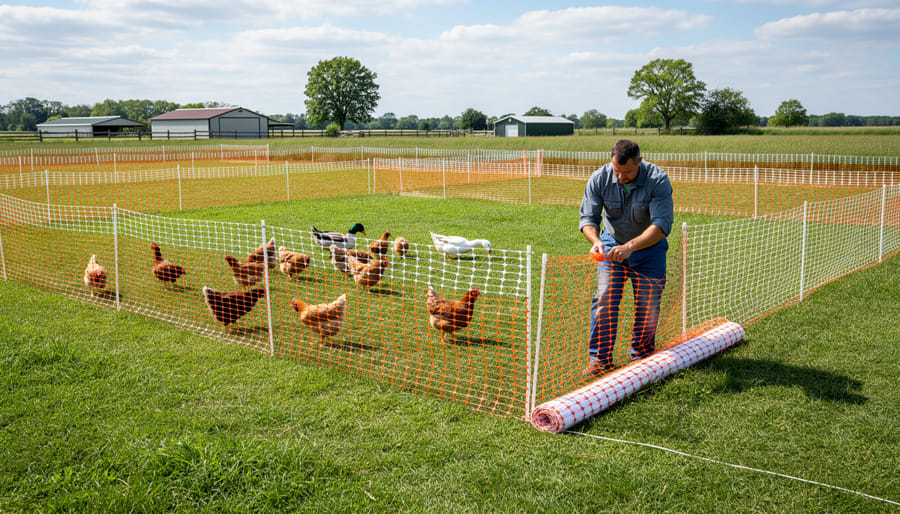
White chickens grazing in green pasture with portable electric netting fence
Portable electric netting allows easy movement of poultry between paddocks, making rotational grazing manageable for small-scale farmers.

The Soil Health Connection Your Vegetables Will Thank You For

Here’s what happens when your livestock become soil-building partners: as animals graze through designated paddocks, their hooves break up compacted soil surfaces, creating tiny pockets for water and air to penetrate deeper. This natural tilling action improves soil structure without machinery, and the results show up beautifully in your vegetable beds.

The magic really happens through what animals leave behind. Each grazing rotation deposits nutrient-rich manure directly onto future growing areas, adding organic matter that feeds soil microbes and builds long-term fertility. Unlike synthetic fertilizers that only provide quick nutrients, this biological approach creates a living soil ecosystem that sustains itself over time.

Sarah Martinez, a CSA farmer in Vermont, discovered this connection firsthand. “After three years of rotating chickens through our fallow beds, our soil tests showed dramatic improvements in organic matter and nitrogen levels,” she shares. “We’ve cut our fertilizer costs by 60% while growing better vegetables than ever before.”

The timing matters too. By planning your rotational grazing patterns with next season’s vegetable beds in mind, you’re essentially pre-fertilizing your growing areas naturally. Animals graze cover crops in fall, deposit nutrients through winter, and by spring, you have rich, biologically active soil ready for planting. These land healing strategies work particularly well on small-scale operations where integration between animals and vegetables creates powerful synergies. The animals feed themselves while building your garden’s future productivity—a perfect closed-loop system.

Diversifying Income While Building Your Land

Rotational grazing creates a perfect opportunity to diversify your CSA income beyond vegetables. Many small farms find that adding animal products like fresh eggs, pasture-raised chicken, and lamb to their weekly shares significantly boosts revenue while delighting members who appreciate the convenience of one-stop farm shopping.

The beauty of this approach lies in how the animals earn their keep twice over. Your laying hens can follow cattle or sheep through paddocks, spreading manure and eating pest larvae while producing premium eggs. Meat chickens thrive in mobile tractors that you move daily across recently grazed areas, fertilizing the soil while converting pasture into protein. Sheep or goats work wonders on overgrown areas and can integrate beautifully with silvopasture systems if you have wooded sections.

Start small with a flock of 20-30 laying hens to test member interest. Survey your CSA members about their protein preferences before investing in larger livestock. Many farmers report that animal products command premium prices and create stronger member loyalty, as families come to rely on their weekly farm protein alongside vegetables. This diversity also smooths out seasonal income fluctuations that vegetable-only operations face.

Designing Your Rotational Grazing System: Start Small, Think Smart

Choosing the Right Animals for Your Farm Size and Goals

Selecting the right animals for your small CSA farm depends on your acreage, infrastructure, and production goals. Each species offers unique benefits and challenges worth considering.

Chickens are the gateway animal for most CSA operations, requiring minimal investment in fencing. A simple electric poultry netting system works well, costing around $200-300 for a portable setup. They need about 1 gallon of water per 10 birds daily and excel at pest control in vegetable beds after harvest. Processing can happen on-farm in most states for direct sales, making them ideal for small-scale operations. Sarah Chen of Green Valley Farm integrates 50 laying hens into her 3-acre CSA, rotating them through garden beds to manage insects and fertilize simultaneously.

Sheep fit beautifully into small operations, typically requiring 4-6 animals per acre in rotational systems. They need more robust fencing than chickens, usually five-strand electric or woven wire, but their grazing patterns complement vegetable production nicely. Water requirements run about 1-2 gallons per sheep daily. Processing logistics prove trickier since you’ll likely need to transport to a USDA facility, but their compact size makes them manageable.

Goats require the most secure fencing since they’re notorious escape artists. Plan for 6-8 goats per acre and consider their browsing behavior, which works wonderfully for clearing overgrown areas but requires vigilance near vegetable crops. Water needs mirror sheep at 1-2 gallons daily.

Cattle demand the most infrastructure and space, needing at least 2-3 acres for a small herd in rotation. Unless you have existing pasture and sturdy perimeter fencing, start with smaller livestock first. However, their manure builds soil fertility rapidly, and many CSA members appreciate beef shares alongside vegetables.

Paddock Layout That Works With Your Vegetable Beds

Designing paddocks around your existing vegetable beds requires thoughtful planning, but it’s simpler than you might think. Start by mapping your growing areas and identifying the spaces between and around them that animals can graze. These transitional zones, pathways, and fallow sections become your grazing paddocks.

Here’s a straightforward formula to calculate paddock size: divide your total grazing area by the number of days you want grass to recover. For most small farms, grass needs 21-35 days of rest during the growing season. If you have one acre available for grazing and want a 28-day recovery period, you’ll need about 14 paddocks at roughly 3,000 square feet each.

For stocking density, use this simple calculation: a sheep or goat needs approximately 50-75 square feet for a one-day graze, while chickens in portable coops need about 10 square feet per bird daily. Sarah Chen, who runs a 3-acre CSA in Vermont, rotates 12 sheep through paddocks between her raised bed sections. She moves them every two days, giving each paddock a month to recover while fertilizing pathways that would otherwise need mowing.

Consider integrating trees with grazing in your border areas to add shade and biodiversity. Mark your paddock boundaries with temporary electric netting, which costs about 50 cents per linear foot and can be easily reconfigured as your vegetable layout changes seasonally.

The key is starting small. Begin with 4-6 paddocks and adjust based on how quickly your grass recovers and how your animals perform. You’ll quickly develop an intuitive sense of timing that matches your farm’s unique rhythm.

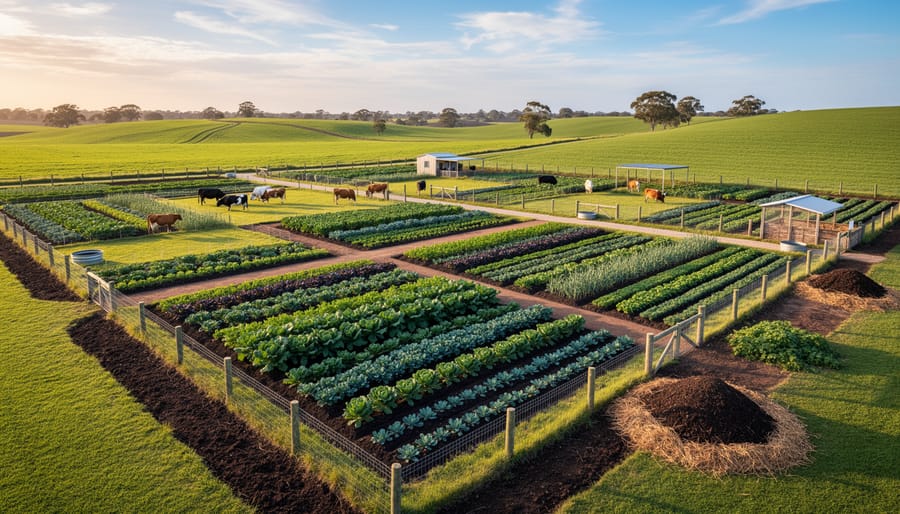
Aerial view of small farm showing vegetable beds and grazing paddocks side by side
Strategic farm layout integrates vegetable production areas with rotational grazing paddocks to maximize land use and soil fertility.

Fencing Solutions That Won’t Break the Bank

Good news: you don’t need thousands of dollars in permanent fencing to start rotational grazing on your CSA farm. Temporary, moveable fencing offers flexibility and affordability that’s perfect for small-scale operations.

Electronet fencing is a popular choice for beginners, especially with sheep, goats, or poultry. These pre-woven nets with built-in support posts cost around $150-250 for a 164-foot roll. They’re self-supporting, easy to move, and highly visible to both animals and people. The biggest advantage? You can set up a new paddock in under 10 minutes once you get the hang of it.

For cattle and larger animals, polywire or polytape with step-in posts provides excellent value. A basic setup costs roughly $100-150 for 1,300 feet of polywire and 20 step-in posts. Polytape is more visible than wire, making it ideal if your animals are new to electric fencing. Budget an additional $200-300 for a quality solar energizer that’ll power your system reliably.

Here’s a money-saving tip from experienced graziers: start small with one or two paddocks, then expand as you learn your animals’ behavior and your land’s quirks. Test your fence regularly with a voltage tester (around $20) to ensure it’s working properly. Most escape attempts happen because the fence lost its charge, not because animals are testing boundaries.

Remember, even a modest investment in moveable fencing pays for itself quickly through improved pasture health and reduced feed costs.

The Movement Schedule: Timing Is Everything

Reading Your Pasture (No Degree Required)

You don’t need a degree in agronomy to know when it’s time to move your animals. With a few simple observation skills, you’ll quickly become fluent in reading your pasture’s signals.

Start with the easiest indicator: grass height. For most small-scale operations, move animals when grass reaches 8-10 inches tall and relocate them before it drops below 3-4 inches. This sweet spot ensures plants have enough leaf surface to photosynthesize efficiently while preventing overgrazing damage. Think of it as harvesting at peak ripeness, just like you would with vegetables.

Watch for the three-leaf stage as your green light. Most pasture grasses recover best when they’ve regrown to three full leaves after grazing. This indicates the plant has replenished its root reserves and is ready for another grazing cycle. Count the leaves on several plants across your paddock for a quick assessment.

Red flags for overgrazing are surprisingly obvious once you know what to look for. Bare soil patches, animals grazing plants down to nubbins, and the appearance of weedy species all signal you’ve waited too long to move. You might also notice animals spending excessive time searching for preferred plants rather than grazing contentedly.

Sarah Mitchell, who runs a two-acre CSA in Vermont, keeps it simple: “I walk the paddock daily with my coffee. If I see mostly stems and my chickens are pecking at dirt instead of grass, it’s time to move.” Trust your observations, adjust based on what you see, and your instincts will sharpen quickly.

Farmer's hands measuring pasture grass height with grazing sheep in background
Monitoring grass height helps farmers determine optimal timing for moving animals to fresh paddocks.

Creating a Rotation Calendar That Fits Your CSA Season

Planning your rotation calendar starts with understanding your CSA’s rhythm. Map out your harvest days and market schedules first, as these anchor points determine when animals need to be moved to fresh paddocks. Most small-scale CSA farmers find success moving animals early in the morning before harvest begins or in the late afternoon after market prep wraps up.

Consider seasonal grass growth when setting move frequency. During spring’s explosive growth (May-June), you might rotate sheep or chickens every 1-2 days to keep up with the forage. Summer’s slower growth extends this to 3-4 days per paddock, while fall may stretch to 5-7 days as grass production slows.

Here’s a sample weekly schedule that works beautifully for a vegetable-focused CSA:

Monday: Move animals after morning chores (7-8 AM)
Tuesday-Wednesday: Regular animal checks only
Thursday: Afternoon move (4-5 PM) before Friday harvest prep
Friday: CSA harvest day, no animal moves
Saturday: Farmers market prep and delivery
Sunday: Light move if needed, farm rest day

Sarah Chen from Green Valley Farm shares her success: “I sync my chicken tractor moves with my harvest schedule. Thursday afternoons work perfectly because Friday mornings are crazy with CSA packing. The chickens get fresh ground, and I’m not scrambling during peak harvest time.”

Track paddock conditions in a simple notebook or phone app, noting recovery times and adjusting your calendar monthly as seasons shift. This flexibility keeps both your animals and vegetables thriving without overwhelming your schedule.

Integrating Grazing With Your Vegetable Production

Using Animals as Cover Crop Terminators

One of the most satisfying aspects of rotational grazing is watching your animals do double duty as living tillers. Instead of mowing down cover crops and working them into the soil with machinery, you can move chickens, sheep, or cattle onto plots planted with ryegrass, clover, or winter rye. The animals graze the biomass down to a manageable level while simultaneously depositing nitrogen-rich manure exactly where your next vegetable crop will grow.

Timing is everything here. Plan to move animals onto cover crop areas about two to three weeks before you intend to plant. This gives the manure time to begin breaking down and allows any remaining plant material to decompose slightly. Chickens work particularly well for this task on smaller plots, with a mobile coop providing flexibility to target specific beds. At Spring Valley Farm in Oregon, farmer Marcus Chen uses a flock of 30 chickens to terminate cover crops across his half-acre vegetable garden, saving both fuel costs and soil compaction while building fertility. The result? Soil that’s primed for planting with minimal equipment needed, plus eggs as a bonus product for your CSA members.

Post-Harvest Cleanup Crews

One of the most satisfying aspects of rotational grazing is putting animals to work as your post-harvest cleanup crew. After you’ve harvested your vegetable beds, chickens and sheep can move through those spaces to handle the mess you’d otherwise clear by hand.

Chickens excel at this job, scratching through finished beds to devour crop residues, weed seeds, and pest larvae hiding in the soil. A flock of 15-20 laying hens can clear a 30-foot bed in just a few days while depositing nitrogen-rich manure that will feed your next planting. They’re particularly effective at reducing pest populations since they hunt for insects, slugs, and grubs with remarkable enthusiasm.

Sheep offer different advantages, especially for larger CSA operations. They’ll mow down cover crops, eat tougher plant material, and compact the soil less than cattle would. Their manure breaks down quickly and adds valuable organic matter to tired beds.

The key is timing your rotations carefully. Move animals onto beds after you’ve harvested but before you need to prepare for the next crop. Use portable electric netting to contain them in specific areas, preventing them from wandering into active growing spaces. Most small-scale CSA farmers find that 3-5 days per bed provides thorough cleanup without over-fertilizing.

Sarah Chen, who runs a two-acre CSA in Vermont, shares this tip: “My chickens follow right behind every harvest. They’ve reduced my pest pressure by at least 60 percent, and I’ve cut my fertilizer costs in half. It’s like having a maintenance crew that pays me in eggs.”

Chickens foraging through vegetable crop residue in garden bed
Chickens naturally clear crop residue from finished beds while adding fertility and controlling pests for the next planting season.

Real Farm Success: Sarah’s 3-Acre Integration

When Sarah Martinez started her CSA farm in Vermont, she worked three acres alone, spending long days managing vegetable beds while watching soil fertility decline each season. Five years ago, she introduced rotational grazing with 25 laying hens and 8 Katahdin sheep, transforming both her farm’s productivity and her quality of life.

Sarah divided her three acres into six paddocks using portable electric netting, keeping two acres in vegetable rotation and dedicating one acre to permanent pasture and cover crops. Each paddock measures roughly half an acre, allowing her animals to move every 3-5 days during the growing season. “The sheep graze down cover crops in early spring, fertilizing future vegetable beds, while the chickens follow two days later, spreading manure and controlling pests,” Sarah explains.

Her initial investment totaled $2,400, including $800 for electric netting, $600 for a mobile chicken coop, $400 for waterers and feeders, and $600 for the animals themselves. Within two years, egg sales alone covered her setup costs, generating $3,200 annually at local markets. The sheep provide additional income through breeding stock sales and occasional lamb harvests.

The seasonal workflow integrates seamlessly with vegetable production. In early spring, sheep graze winter-killed cover crops on designated sections, trampling residue and adding fertility. Sarah transplants vegetables three weeks after animals leave, allowing time for manure to stabilize. During peak summer, chickens rotate through harvested garlic and early pea beds, cleaning up debris while her sheep maintain pathways and hedgerows. Come fall, both species tackle cover crop cocktails before winter dormancy.

Challenges emerged quickly. Sarah initially underestimated water needs, hauling 15 gallons daily until she installed a permanent waterline with multiple hookup points. Predator pressure required upgraded fencing and a livestock guardian dog, adding $1,200 to expenses. “Learning animal behavior took time,” she admits. “Sheep can be stubborn about moving, and timing moves around vegetable harvest required careful planning.”

Her biggest lesson? Start smaller than you think. “I wished I’d begun with 12 hens only, mastering the system before adding sheep,” Sarah reflects. Today, her soil organic matter has increased from 3.2% to 5.8%, and CSA members rave about optional egg and meat shares, creating a truly integrated, profitable operation.

Common Mistakes to Avoid (So You Don’t Learn the Hard Way)

Even the most well-intentioned grazing plans can go sideways without some foresight. Let’s talk about the mistakes that trip up many beginners, so you can sidestep them entirely.

Overstocking is probably the biggest culprit. It’s tempting to squeeze in extra animals, but too many mouths in too small a space defeats the whole purpose. Your paddocks get hammered, recovery time vanishes, and you’re left with mud and stress. Start conservative with your stocking density. A good rule of thumb for beginners is to aim for about 80 percent of what calculators suggest, then adjust upward once you see how your land responds through a full season.

Moving too slowly or too fast creates its own headaches. Leave animals in one spot too long, and they’ll overgraze their favorites while trampling everything else. Move them too quickly, and they won’t consume enough forage, wasting your pasture’s potential. Watch your grass height closely. Most pasture species do best when grazed down to about 3-4 inches, then given time to bounce back to 8-10 inches before the animals return.

Inadequate water systems will sabotage everything. Hauling water by hand gets old fast, and animals won’t thrive if they’re thirsty. Invest in a good portable watering system from the start, whether that’s a gravity-fed tank on a sled or a simple IBC tote with quick-connects. Your future self will thank you.

Predator problems catch many CSA farmers off guard when they first add livestock. Electric netting works wonders for poultry, but only if you keep it charged and vegetation-free. Consider getting a livestock guardian dog if predation becomes persistent.

Fence failures often happen at the worst possible moments. Test your charger weekly, walk your perimeter regularly, and keep a repair kit handy. One Ontario CSA farmer shared that his breakthrough came when he started treating fence maintenance like crop maintenance, scheduling it into his weekly routine rather than waiting for emergencies.

Getting Started: Your First Season Action Plan

Winter planning sets the foundation for success. Begin three to four months before your planned start date by mapping your available pasture space on paper. Walk the land and identify water access points, natural shade, and existing fence lines. This quiet season is perfect for reading books, watching tutorials, and connecting with local graziers who can share practical wisdom from their own experiences.

As spring approaches, invest in your essential infrastructure. For a starter operation on 1-2 acres, budget approximately $800-1,200 for basic supplies: a solar-powered fence charger ($150-250), 1,000 feet of polywire or polytape ($75-100), 15-20 step-in posts ($60-80), a gate handle ($15), and a voltage tester ($25). Add temporary water containers like 100-gallon stock tanks ($100-150) and basic hoof care supplies ($50). Larger operations spanning 5-10 acres should expect $2,000-3,500 in startup costs for more robust fencing materials and additional water infrastructure.

Begin with a small, manageable number of animals. Two to four sheep or a couple of goats allow you to learn the rhythm of moves without feeling overwhelmed. Set up three to five paddocks initially, planning to move animals every 2-3 days. This gives you time to observe, adjust, and build confidence.

Your first moves will feel clumsy, and that’s completely normal. Keep a simple notebook tracking which paddocks you grazed, rest periods, and what you notice about regrowth. These observations become invaluable as you refine your system and develop profitable small farm systems.

Connect with your regional grazing network or extension office. Many areas offer farm tours, workshops, or mentorship programs where experienced graziers welcome newcomers with open advice. Consider joining online communities where you can ask questions and share your learning journey.

By mid-season, evaluate what’s working. Are paddock sizes appropriate? Is rest time adequate? Do animals have enough forage? Adjust your rotation speed and paddock dimensions based on real results, not just theory. Remember that every farm’s conditions differ, so your system should evolve uniquely to match your land, climate, and goals. The first season is about learning through doing, building skills that will serve you for years to come.

Rotational grazing isn’t just a farming technique—it’s a pathway to building a truly resilient and profitable small farm while actively healing the land beneath your feet. Whether you’re managing a compact CSA operation or dreaming of starting one, this regenerative practice offers real benefits: healthier soil, reduced feed costs, happier animals, and vegetables that practically grow themselves in nutrient-rich pastures.

The beauty of rotational grazing lies in its flexibility. You don’t need to transform your entire operation overnight. Start with one species—perhaps chickens in mobile coops following your bed rotations—and observe how your soil responds. As you gain confidence and see results, you can gradually introduce sheep, goats, or other animals that complement your vegetable production goals.

Remember Sarah’s story? She began with just six chickens and now runs a thriving integrated farm. Every farmer who’s embraced rotational grazing started exactly where you are now, with questions and curiosity.

By implementing rotational grazing, you’re joining a growing movement of farmers who recognize that agriculture can regenerate rather than deplete. Your small farm has the power to sequester carbon, build topsoil, and produce nourishing food—all while becoming more profitable. That’s something worth celebrating.

What the EPA’s Office of Pesticide Programs Means for Your CSA Farm

Posted by darrell on
0
Policy, Law & Certification
What the EPA’s Office of Pesticide Programs Means for Your CSA Farm

Understanding the US EPA Office of Pesticide Programs saves you from costly violations and protects your farm workers, even if you run a small organic CSA operation. Register every pesticide product you use—yes, even OMRI-listed organic sprays like neem oil and spinosad—by checking EPA registration numbers on product labels before purchasing. Keep detailed application records including what you sprayed, where, when, and who applied it, storing these documents for at least two years to demonstrate compliance during inspections.

Post Worker Protection Standard notices in English and Spanish at central locations where employees gather, detailing restricted entry intervals for each field or greenhouse section where you’ve applied pesticides within the past 30 days. Install a decontamination station with clean water, soap, and single-use towels within a quarter-mile of any treated area before workers enter those spaces.

Complete pesticide applicator certification through your state’s agriculture department even for organic materials—the EPA requires anyone applying restricted-use pesticides to hold valid credentials, and some states extend this requirement to all commercial applications. Provide annual safety training to every worker who might encounter treated areas, covering hazard recognition, label comprehension, and emergency response procedures specific to products you actually use on your farm.

The Office of Pesticide Programs exists not to burden small farmers but to prevent the farmworker poisoning incidents that plagued agriculture for decades. Your compliance protects the community members who trust you with their weekly vegetable boxes while shielding your operation from penalties ranging from warning letters to $19,000-per-violation fines.

Understanding the EPA’s Office of Pesticide Programs

How OPP Regulations Reach Your Farm

Understanding how EPA regulations actually reach your CSA farm helps demystify those federal compliance requirements you’ve been hearing about. The process follows a clear chain that starts in Washington, D.C. and ends at your farm gate.

The EPA’s Office of Pesticide Programs develops national standards for pesticide use and worker safety. Think of them as creating the baseline rules that protect both farmworkers and the environment. Once these federal regulations are finalized, they don’t come directly from the EPA to your farm. Instead, they flow through your state’s lead agency, which might be your Department of Agriculture or Environmental Quality department.

Your state agency takes those federal rules and implements them locally. They’re responsible for issuing applicator certifications, conducting farm inspections, and answering your specific questions about compliance. Some states add extra requirements beyond the federal minimums, so you’ll want to check with your state’s pesticide regulatory office to understand what applies in your area.

For CSA farmers, this matters because even organic operations using approved pesticides like neem oil or pyrethrin must follow these regulations. The Worker Protection Standard applies whenever you use EPA-registered pesticides, regardless of whether they’re organic or conventional.

Here’s the practical takeaway: bookmark your state pesticide agency’s website and sign up for their email updates. They’ll notify you about regulation changes, training opportunities, and compliance deadlines before they become problems.

EPA Worker Protection Standards: What CSA Farms Need to Know

Who Counts as a Worker or Handler on Your CSA

Understanding who qualifies as a worker or handler under EPA regulations can feel confusing, but getting this right is essential for compliance and safety. The Worker Protection Standard defines workers as anyone involved in tasks like planting, weeding, harvesting, or transplanting. Handlers are those who mix, load, or apply pesticides—even organic-approved ones.

Here’s where it gets interesting for CSA operations: volunteers absolutely count as workers if they’re doing agricultural tasks. That enthusiastic college student helping with your Saturday harvest? They’re covered under WPS. CSA members participating in work-share programs also fall under worker protections. The EPA doesn’t distinguish between paid employees and people receiving shares in exchange for labor—both need the same safety training and protections.

Family members present a slightly different scenario. If they’re immediate family members of the farm owner and work on the owner’s farm, they’re typically exempt from WPS requirements. However, this exemption doesn’t extend to employees’ family members or to relatives working on larger operations where the owner isn’t directly involved.

Many CSA farmers discover these worker classification requirements overlap with employment law considerations. If you’re unsure whether someone qualifies as an employee versus an independent contractor, it’s worth consulting resources that help you properly classify workers to avoid legal complications.

The golden rule? When in doubt, provide the training and protections. It’s better to err on the side of safety than face penalties or, worse, preventable health issues among your farm community.

CSA farm workers receiving safety training from instructor in vegetable field
Worker Protection Standards training ensures CSA farm employees understand safety requirements and proper procedures when working with agricultural products.

Training Requirements Made Simple

Understanding your training obligations doesn’t have to feel overwhelming. The EPA’s Worker Protection Standard outlines clear requirements that protect both you and your team while keeping your operation compliant.

For handlers—anyone mixing, loading, or applying pesticides—training must happen before they handle any restricted-use products. This includes even small-scale CSA farmers applying organic-approved pesticides like neem oil or pyrethrin. The training covers label instructions, personal protective equipment use, and what to do in emergencies. You’ll need to provide this annually, and the good news is that EPA-approved online modules make it accessible and affordable.

Workers who perform tasks in treated areas have slightly different requirements. They need training within five days of starting work and annually thereafter. The content focuses on recognizing pesticide hazards, understanding posting requirements for treated areas, and knowing their rights to protection and information.

Here’s where it gets practical: you must keep records of all training sessions for two years. Include the trainer’s name and qualifications, training date, topics covered, and participant names. A simple binder or spreadsheet works perfectly for most CSA operations.

Maria Chen, who runs a three-acre CSA in Oregon, shared her approach: “I schedule training during our spring kick-off meeting. Everyone’s already gathered, and it sets the safety tone for the season. I keep a folder with signed attendance sheets and training certificates—inspection-ready and stress-free.”

The EPA provides free training materials through their website, including videos and handouts in multiple languages. Many state extension offices also offer in-person sessions specifically designed for small farms. Remember, investing a few hours in proper training protects your team’s health and your farm’s future.

Pesticide Applicator Certification for Organic and Low-Spray CSAs

Do Organic Pesticides Require Certification?

Here’s a question that trips up many organic farmers: do you need certification to use organic pesticides? The answer might surprise you—yes, even organic pest control products approved by organizations like OMRI (Organic Materials Review Institute) fall under EPA regulation.

The EPA doesn’t distinguish between organic and synthetic pesticides when it comes to basic requirements. If a product is designed to prevent, destroy, or repel pests, it’s legally a pesticide and must be EPA-registered. This means even that neem oil or pyrethrin spray needs an EPA registration number on the label.

However, here’s where it gets interesting for organic operations. While the products themselves must be EPA-registered, your certification requirements as an applicator depend on what you’re using and how. Many OMRI-listed products qualify as minimum-risk pesticides under EPA guidelines, which typically don’t require applicator certification for the farmer using them on their own property.

That said, if you’re using restricted-use pesticides (even organic ones), you’ll need certification. Some biological controls and botanical pesticides do carry this designation.

Sarah Martinez, who runs a thriving 5-acre CSA in Vermont, learned this firsthand: “I assumed organic meant no paperwork, but understanding EPA requirements actually gave me confidence. Now I keep detailed records of every application, which my organic certifier loves and helps me track what works best.”

The bottom line? Always check the EPA registration number and label instructions. Your state agriculture department can clarify which products require certification in your specific situation.

Farmer wearing protective gloves applying organic spray to tomato plants
Even organic-approved pest control products may require proper certification and safety procedures on CSA farms.

Getting Your Applicator License: The Step-by-Step Process

Getting certified as a pesticide applicator might seem daunting, but breaking it down makes the process manageable. Even if you’re running an organic CSA, you’ll need this license if you use any OMRI-approved pesticides like neem oil or spinosad for pest management.

Start by contacting your state’s pesticide regulatory agency, since requirements vary significantly by location. Most states require you to pass a core exam covering pesticide safety basics, plus a category-specific exam. For CSA farmers, the “Agricultural Pest Control” category typically applies. Study materials are usually available free or low-cost through your state’s Cooperative Extension office, which often offers review sessions too.

Exam fees range from $50 to $150 depending on your state, with licenses requiring renewal every three to five years. Many states now offer online testing, making it more accessible for busy farmers. Plan to spend 20-30 hours studying if you’re new to pesticide regulations.

Here’s a practical tip from experienced CSA farmer Maria Chen from Oregon: “I joined a study group with three neighboring farmers. We met twice monthly to review materials together, which made the technical stuff about integrated pest management and environmental protection way less intimidating. Plus, we’ve continued meeting to share sustainable growing strategies.”

Remember, maintaining good records of your study progress helps when exam day arrives. The investment in certification protects your farm, your workers, and the community members who trust you with their food.

Practical Compliance Strategies for Small CSA Operations

Creating a Simple Compliance System That Works

Good news: you don’t need complicated software or expensive consultants to stay compliant with EPA pesticide regulations. Most CSA operations can create a straightforward system using simple tools you likely already have.

Start with a basic three-ring binder system. Create sections for pesticide application records, safety data sheets, training documentation, and emergency contact information. Even certified organic farms that only use OMRI-listed products need to maintain these records, as they demonstrate responsible management practices and protect you legally.

For application records, design a one-page template that captures the essentials: date, product name, EPA registration number, target pest, location, weather conditions, and applicator name. Keep blank forms in your shed or greenhouse where applications happen. The key is making documentation so easy that you actually do it consistently.

Training logs deserve special attention, much like food safety compliance records. Create a simple sign-in sheet for each training session with columns for date, topic covered, trainer name, and participant signatures. Take photos of your training sessions as backup documentation.

Signage doesn’t need to be fancy. Laminated sheets work perfectly for restricted entry intervals and emergency information. Place them where workers naturally gather: near the wash station, in break areas, and at field entrances.

Consider Sarah Chen’s approach at Valley View Farm. She keeps a clipboard at each growing area with pre-filled templates. “It takes thirty seconds after each application,” she says. “That small habit saved me during my organic certification audit.”

Organized farm desk with safety documentation and protective equipment
Simple record-keeping systems help CSA farms maintain EPA compliance without overwhelming administrative burden.

Success Story: How Green Valley CSA Streamlined Their EPA Compliance

When Maria Rodriguez started Green Valley CSA in Oregon five years ago, she worried that EPA compliance would drain resources from her small organic operation. She’d heard stories of complicated paperwork and expensive training requirements that seemed designed for large-scale farms, not community-supported agriculture focused on chemical-free growing.

“I was overwhelmed at first,” Maria admits. “Our CSA serves 85 families, and we pride ourselves on transparency. I thought WPS requirements would create barriers between us and our members who love helping with harvest days.”

The breakthrough came when Maria realized that understanding the regulations actually strengthened her farm’s mission rather than compromising it. She started by mapping which WPS requirements applied to her operation. Since Green Valley uses only OMRI-listed organic pesticides with minimal restricted-entry intervals, her compliance burden was lighter than anticipated.

Maria implemented a simple system that works beautifully for her CSA model. She created a dedicated binder with Safety Data Sheets for every approved organic input, posted clear signage in Spanish and English near her greenhouse, and scheduled a worker protection training session that doubled as a farm education workshop for interested CSA members.

“The training made everyone feel more confident,” she explains. “Our members appreciated learning about safe handling practices, even for organic pesticides. It reinforced our commitment to their wellbeing.”

Her advice to other CSA farmers? Start small and stay organized. Maria invested in basic recordkeeping software and set calendar reminders for annual training updates. The whole system takes less than two hours monthly to maintain.

Today, Green Valley thrives as proof that EPA compliance and community-focused organic farming go hand in hand, building trust while protecting everyone who works the land.

Understanding EPA pesticide regulations doesn’t have to feel overwhelming. By familiarizing yourself with the Office of Pesticide Programs’ requirements, you’re taking an important step toward protecting your workers, community members, and the environment. Whether you’re applying OMRI-listed products on your organic CSA or using conventional pesticides for targeted pest management, compliance ensures everyone stays safe while your operation thrives.

Remember that staying compliant with Worker Protection Standards and maintaining proper applicator certifications strengthens your farm’s reputation and builds trust with your CSA members. Many farmers find that implementing these safety systems actually improves their overall farm organization and efficiency.

For additional support, visit the EPA’s Pesticide Worker Safety website for training materials, or contact your state’s agricultural extension office for localized guidance. Your regional EPA office can also connect you with compliance assistance programs designed specifically for small-scale operations. By viewing these requirements as investments in your farm’s future rather than burdens, you’re creating a safer, more sustainable CSA that serves your community for years to come.

How Your Local CSA Keeps Produce Fresh from Farm to Fridge

Posted by darrell on
0
Operations and Logistics
How Your Local CSA Keeps Produce Fresh from Farm to Fridge

Picture this: A CSA member opens their weekly box to find crisp lettuce, firm tomatoes, and vibrant berries that taste like they were just picked—because proper cold chain management kept them that way. The cold chain is simply the unbroken series of refrigerated steps that preserve your produce from harvest to your kitchen, and it makes all the difference between wilted greens and farm-fresh quality.

For CSA farmers, mastering the cold chain means harvesting in the cool morning hours, immediately moving produce into a walk-in cooler or refrigerated space, maintaining temperatures between 32-40°F depending on the crop, and using insulated delivery vehicles or coolers packed with ice packs for distribution. This controlled temperature journey prevents the enzymatic breakdown that causes produce to lose flavor, texture, and nutritional value within hours of harvest.

The magic happens when farmers understand that different vegetables have different cold chain needs. Leafy greens and herbs demand immediate cooling and high humidity, while tomatoes and peppers prefer slightly warmer holding temperatures to maintain their flavor profiles. Even a few hours at room temperature can reduce shelf life by days.

For CSA members, recognizing strong cold chain practices helps you choose quality operations and properly store your produce at home. When farmers invest in refrigeration infrastructure and temperature-controlled logistics, they’re investing in your experience—delivering produce that stays fresh for a week or more, reducing food waste, and proving that local can absolutely mean longer-lasting. This commitment to the cold chain transforms CSA boxes from a nice idea into a genuinely superior alternative to supermarket shopping.

What Is Cold Chain Logistics (And Why CSA Farms Need It)

The Science Behind Temperature Control

Think of temperature as a time machine for your fresh produce. Just like leftovers in your fridge last longer than food left on the counter, the temperature at which you store fruits and vegetables dramatically affects how quickly they spoil.

Here’s what happens at the microscopic level: every piece of produce contains natural enzymes that continue working after harvest, slowly breaking down cell walls and converting starches to sugars. When temperatures rise, these enzymes kick into high gear, accelerating the aging process. Picture a banana ripening on your kitchen counter versus one in the refrigerator—that’s enzyme activity in action.

Temperature also controls microbial growth. Bacteria and fungi that cause decomposition multiply rapidly in warm conditions. At room temperature, these microorganisms can double their population every 20 minutes, but cold temperatures slow this growth dramatically. For most produce, keeping temperatures between 32-40°F creates an inhospitable environment for these unwanted guests.

There’s also the matter of respiration. Fresh produce continues “breathing” after harvest, consuming oxygen and releasing carbon dioxide, heat, and moisture. Higher temperatures increase respiration rates, causing produce to burn through its stored energy faster and deteriorate more quickly.

By maintaining proper cold chain temperatures from farm to table, CSA farmers can preserve that just-picked freshness you love, ensuring your weekly share arrives with maximum nutrition, flavor, and shelf life. It’s about respecting the produce’s natural biology while extending its peak quality.

Why Local CSAs Have a Cold Chain Advantage

When your salad greens travel just five miles instead of 1,500, the difference in freshness is remarkable. Local CSAs have a built-in cold chain advantage simply because of geography. While conventional grocery store produce might spend a week bouncing between refrigerated trucks, distribution centers, and storage facilities, your CSA lettuce could be harvested in the morning and in your hands by afternoon.

This shorter journey means fewer temperature fluctuations and less time for nutrients to degrade. Every hour that produce spends in transit, it loses vital vitamins and that just-picked flavor. CSA farmer Maria Rodriguez from Green Valley Farm shares her approach: “We harvest at dawn when vegetables are crisp and cool, then pack them immediately into our refrigerated space. Our members pick up within 24 hours, so there’s minimal cold chain complexity.”

The proximity factor also reduces the need for extensive refrigeration infrastructure. Many small CSAs can maintain quality with simple walk-in coolers rather than elaborate cold storage systems. This simplicity translates to lower costs and a smaller carbon footprint. For consumers, it means biting into a tomato that tastes like summer, not cardboard. That’s the power of a short, well-managed cold chain working in perfect harmony with local food systems.

The CSA Cold Chain Journey: From Field to Your Kitchen

Harvest Timing and Field Heat Removal

Ever wondered why your CSA farmer is out in the fields at dawn? There’s science behind those early morning harvests. Many successful CSA operations, like Green Valley Farm in Vermont, schedule picking during the coolest parts of the day when vegetables are naturally crisp and hydrated from overnight dew.

Here’s the challenge: the moment a tomato, lettuce head, or bunch of kale is picked, it begins losing quality. This stored energy, called “field heat,” causes produce to respire faster, burning through nutrients and moisture. Think of it like leaving your smartphone on full brightness—the battery drains quickly.

Removing field heat rapidly is essential for maintaining freshness. CSA farmers typically aim to cool produce within one to two hours of harvest. Small-scale growers use creative methods like cold water baths for leafy greens, shade structures near picking areas, and immediate refrigeration. Some even pre-cool harvest bins before heading to the fields.

The result? When you receive your CSA box, those vegetables haven’t just been picked recently—they’ve been carefully handled to preserve their just-picked vitality, flavor, and nutritional value from field to your kitchen.

Farmer's hands holding fresh leafy greens with morning dew in early light
CSA farmers harvest produce in cool morning hours to minimize field heat and preserve freshness from the moment of picking.

On-Farm Cooling Methods

For small-scale CSA farms, maintaining produce freshness starts the moment vegetables leave the field. The right on-farm cooling methods can mean the difference between crisp greens that last a week and wilted produce that disappoints members.

Walk-in coolers are the backbone of most CSA cooling operations. These refrigerated rooms allow farmers to rapidly drop the temperature of freshly harvested produce to around 35-40°F. Green Meadow Farm in Ontario installed a walk-in cooler three years ago and saw their waste drop by 30 percent. Owner Sarah Martinez shares, “We can now harvest in the morning and have everything cooled down before we start packing for our members.”

Hydrocooling offers a faster alternative for certain crops. This method uses cold water to quickly remove field heat from vegetables like carrots, radishes, and leafy greens. Valley View CSA uses a simple setup with a stock tank and recirculating cold water, cutting cooling time from hours to just 15 minutes. The produce then gets stored in reusable bins and crates that allow continued air circulation.

Forced-air cooling works wonders for berries and tender crops. By pushing cold air through stacked containers, farms can cool produce evenly in half the time of passive cooling. Sunrise Acres built their own forced-air system for under $500 using a used air conditioner and some creative ductwork.

The key is choosing methods that match your farm’s scale and crop mix while keeping energy costs reasonable.

Interior of farm walk-in cooler with crates of fresh vegetables on shelving
Walk-in coolers allow CSA farms to maintain optimal temperatures for different produce types, extending shelf life and preserving nutrients.

Packing and Sorting in Cool Environments

After harvest, the race against time continues in the packing shed, where maintaining cool temperatures is essential for preserving that just-picked freshness. Many successful CSA farms have invested in cooled packing areas, often keeping temperatures between 35-45°F depending on the produce being handled. These climate-controlled spaces slow respiration and prevent moisture loss while workers sort and pack your weekly share boxes.

The key to effective cold chain management during this stage is speed combined with organization. Farmers design workflows that minimize handling time and keep produce exposure to warmer temperatures brief. Some farms use efficient packing systems with pre-cooled containers and strategic staging areas. Greenleaf Valley Farm in Ontario, for example, reduced their pack-to-cooler time by 40% simply by reorganizing their shed layout and training their team on cold chain principles.

For smaller operations without full refrigeration, creative solutions work wonders. Early morning packing sessions, portable fans, shaded work areas, and immediate transfer to coolers all help maintain quality. The investment in proper packing infrastructure directly translates to crisper greens and longer-lasting vegetables in your CSA box.

Temperature-Controlled Storage

Maintaining the right temperature is crucial for preserving your harvest’s freshness and nutritional value. Leafy greens and herbs thrive at 32-36°F, while tomatoes prefer slightly warmer conditions around 55°F to prevent flavor loss. Root vegetables store well at 32-40°F with high humidity.

Many small CSA farms creatively manage storage challenges with limited budgets. Some farmers invest in used walk-in coolers or convert old refrigerators, while others partner with nearby farms to share cooling facilities. Dawn Creek Farm in Ontario started with just two chest freezers before upgrading to a small walk-in unit as membership grew.

Smart practices make a big difference even with basic equipment. Using proper storage containers that allow air circulation helps maintain consistent temperatures. Some farmers pre-cool produce using ice water baths before storage, extending shelf life significantly. Organizing your cooler by temperature zones maximizes efficiency, keeping cold-sensitive items separate from those needing near-freezing conditions.

Remember, even modest cold storage investments pay dividends in reduced waste and happier members receiving peak-quality produce.

The Last Mile: Distribution and Pickup

The final stretch of your cold chain journey is critical—this is where fresh produce meets eager members! For CSA farmers, investing in refrigerated delivery vehicles makes a significant difference, especially during warm months. Even a basic insulated van can maintain temperatures 15-20 degrees cooler than ambient conditions, preserving that just-picked quality your members love.

At pickup locations, strategic placement matters. Choose shaded areas and schedule pickups during cooler parts of the day when possible. Use insulated containers or coolers with ice packs for produce sitting at drop-off sites. Some successful CSA operations provide communal refrigeration at pickup locations—a shared fridge can be a game-changer for member satisfaction.

For members, bring your own cooler bags and head straight home after pickup. If you’re running errands, save the CSA pickup for last. One Vermont farmer shared how educating members about proper transport increased retention rates by 25 percent—people truly appreciate understanding how to protect their investment in fresh, local food. Remember, maintaining the cold chain right to your refrigerator ensures you enjoy maximum nutrition and flavor from your weekly harvest.

Real CSA Success Stories: Temperature Control in Action

When Green Valley Farm in Vermont noticed members complaining about wilted greens by mid-week, farmer Maria Chen knew something had to change. Her lettuce and spinach looked perfect at harvest, but the journey from field to fridge was taking its toll. The solution? A simple yet effective cold chain overhaul. Maria invested in a walk-in cooler and began pre-cooling produce within 30 minutes of harvest, dropping field heat immediately. She also switched to insulated delivery boxes with ice packs for her pickup locations. The results were remarkable: member retention jumped 40% in one season, and complaints virtually disappeared. Maria shares that the initial $3,000 investment paid for itself within eight months through reduced waste and increased membership renewals.

Meanwhile, Sunrise Community Farm in North Carolina faced a different challenge. Operating in hot, humid conditions, farmer James Mitchell struggled to maintain quality during summer distributions. His breakthrough came from observing commercial operations and adapting their methods to a smaller scale. James created a simple staging area with portable air conditioning units where packed shares could wait in 45-degree temperatures before member pickup. He also educated members about the importance of bringing coolers and getting shares home quickly. This collaborative approach transformed the experience. Member surveys showed a 65% increase in satisfaction with produce quality, and James noticed he could finally grow delicate crops like butter lettuce in summer months.

Over in Oregon, Harvest Moon Farm tackled the storage puzzle creatively. Farmer couple Sarah and Tom Rodriguez converted an old shipping container into an affordable cold storage unit using off-the-shelf refrigeration equipment and excellent insulation. This DIY approach cost them under $2,000 compared to commercial units starting at $8,000. They maintain different temperature zones for various crops, keeping root vegetables separate from leafy greens. Their innovation earned praise from members who noticed carrots staying crisp for three weeks and herbs maintaining vibrant color throughout the week. The couple now mentors other small farms on budget-friendly cold chain solutions, proving that effective temperature control doesn’t require breaking the bank.

What CSA Members Can Do to Maintain the Cold Chain

Pickup Day Best Practices

Timing is everything when it comes to protecting your fresh CSA produce. Plan to pick up your share as close to the designated time as possible, ideally during cooler morning or evening hours if you have flexibility. This minimizes the time your vegetables spend at ambient temperatures.

Bring insulated bags or a cooler with ice packs to your pickup location. Think of it as creating a mini cold chain right in your vehicle. This simple step can make a significant difference, especially during hot summer months when leafy greens and delicate items like berries are most vulnerable to heat stress.

Once you’ve collected your share, head straight home. Resist the temptation to run additional errands with fresh produce in your car. Even a quick 20-minute stop at another store can compromise the quality of temperature-sensitive items. When you arrive home, unpack immediately and store everything according to its specific needs. Your farmers have worked hard to maintain the cold chain from harvest to pickup, and these final steps ensure you enjoy peak freshness and flavor throughout the week.

Woman with insulated bag collecting fresh vegetables at CSA pickup location
CSA members play a crucial role in maintaining the cold chain by bringing insulated bags to pickup and refrigerating produce promptly at home.

Home Storage Tips for CSA Produce

Once your beautiful CSA produce arrives home, proper storage becomes your responsibility in the cold chain. Think of your refrigerator as a preservation tool that extends the farm-fresh quality you’ve been promised.

Start by organizing your fridge strategically. Keep your crisper drawers set to high humidity for leafy greens, herbs, and cruciferous vegetables like broccoli and cauliflower. These items thrive in moisture-rich environments. Set one drawer to low humidity for fruits and vegetables that prefer drier conditions, such as peppers and summer squash.

Not everything belongs in the fridge immediately. Tomatoes, winter squash, potatoes, onions, and garlic actually lose flavor and texture when refrigerated. Store these at room temperature in a cool, dark spot. Basil also prefers countertop storage in a glass of water, like a little bouquet.

Here’s a quick reference for common CSA vegetables: Lettuce and greens need high humidity and immediate refrigeration. Root vegetables like carrots and beets stay fresh longer when stored in sealed bags with humidity. Cucumbers and zucchini do well in low humidity settings. Corn tastes sweetest when refrigerated promptly, as its natural sugars convert to starch quickly.

Understanding these simple storage principles helps you honor the careful cold chain work your farmer invested in, ensuring nothing goes to waste and every meal celebrates peak freshness.

The Environmental and Quality Benefits of CSA Cold Chains

When CSA farms embrace proper cold chain practices, they’re doing more than just keeping vegetables crisp—they’re contributing to a healthier planet. Temperature-controlled storage and transport significantly reduce food waste, a major environmental concern. Studies show that up to 40% of produce can be lost without proper cold chain management, but CSA farms using these systems can cut spoilage dramatically.

Beyond waste reduction, cold chains preserve the nutritional integrity of your harvest box. Those delicate vitamins and antioxidants that make organic produce so valuable? They’re protected when temperatures stay consistent from field to fridge. This means you’re getting maximum health benefits from every carrot and leafy green.

For farmers, efficient cold chain systems support sustainable farm operations by reducing energy consumption through strategic cooling methods. Many CSAs are investing in solar-powered coolers or utilizing naturally cool spaces like root cellars, blending traditional wisdom with modern technology.

The ripple effects extend to farming practices too. When farmers know their cold chain can maintain quality for reasonable periods, they can focus on regenerative growing methods rather than rushing harvests. This supports soil health and biodiversity on the farm.

Take Green Valley Farm in Ontario—after implementing a simple walk-in cooler and insulated delivery bins, they reduced produce waste by 30% and extended their growing season offerings. Their members noticed the difference immediately: crisper greens, longer-lasting produce, and the satisfaction of supporting truly sustainable agriculture.

The next time you bite into a crisp head of lettuce or enjoy perfectly ripe strawberries from your CSA box, take a moment to appreciate the careful cold chain management that preserved that farm-fresh goodness. From the moment those vegetables leave the field to when they reach your kitchen, proper cooling practices ensure you’re getting the most nutritious, flavorful produce possible. Your local farmers work tirelessly behind the scenes, often starting their days before sunrise to harvest during the coolest hours and implementing thoughtful storage solutions to maintain quality.

Understanding cold chain logistics helps us recognize the dedication required to bring truly fresh food to our tables. If you’re already part of a CSA community, consider asking your farmer about their cooling and storage practices during your next pickup. Their story might surprise and inspire you! Not yet a CSA member? Seek out programs in your area that prioritize freshness through proper temperature management. Supporting these farmers means investing in sustainable food systems that nourish both our bodies and our communities while reducing food waste and environmental impact.

How Silvopasture Turns Small Farms Profitable While Healing the Land

Posted by darrell on
0
Livestock & Grazing
How Silvopasture Turns Small Farms Profitable While Healing the Land

Picture your livestock grazing contentedly beneath a canopy of productive trees, the pasture below thriving in dappled sunlight while your animals enjoy natural shelter from summer heat and winter winds. This is silvopasture, an intentional combination of trees, forage, and livestock that transforms traditional grazing into a regenerative, multi-layered farm ecosystem.

For CSA farmers managing small acreages, silvopasture offers a practical pathway to increased farm productivity and resilience. The system generates multiple income streams from the same land—meat, eggs, timber, nuts, or fruit—while reducing feed costs through extended grazing seasons and improved forage quality. Trees provide natural livestock welfare benefits that eliminate infrastructure expenses, and the integrated approach builds soil health faster than grazing or forestry alone.

Starting a silvopasture system doesn’t require converting your entire operation overnight. Many successful farmers begin by planting tree rows through existing pastures or by thinning woodlots to allow forage growth beneath established trees. The key is matching your tree species, spacing, and livestock type to your specific goals and climate.

Whether you’re managing sheep, cattle, pigs, or poultry through rotational grazing, silvopasture adapts to diverse farm contexts. The approach aligns naturally with CSA values of environmental stewardship and farm diversity while addressing practical concerns like erosion control, water quality, and climate adaptation. Understanding the fundamentals helps you design a system that works for your land, your animals, and your members.

What Makes Silvopasture Different from Regular Grazing

Cows grazing peacefully under shade trees in silvopasture system
Livestock grazing under established trees demonstrates the core principle of silvopasture: intentional integration of trees, forage, and animals on the same land.

The Three Pillars: Trees, Grass, and Animals Working Together

Think of silvopasture as nature’s perfect partnership, where each component plays a vital role in supporting the others. It’s a beautiful example of how working with natural systems creates something greater than the sum of its parts.

Trees form the protective canopy of your system, offering shade that keeps animals comfortable during hot summer days and reduces heat stress. Their deep roots pull up nutrients from lower soil layers, making them available to plants near the surface. Trees also provide browse—nutritious leaves and twigs that animals love to nibble on, adding variety to their diet. As a bonus, they act as windbreaks and improve air quality across your farm.

Grasses and other ground covers create a living carpet that prevents soil erosion and captures rainfall. They provide the primary forage for your livestock while their roots build soil structure and feed beneficial microorganisms underground. These plants thrive in the dappled sunlight created by tree canopies, often growing more nutritious forage than they would in harsh full sun.

Animals are the active managers of your silvopasture system. As they graze, they naturally prune grasses to optimal heights, preventing any single species from taking over. Their manure returns nutrients to the soil in a readily available form, fertilizing both trees and pasture. When animals rub against tree trunks or browse lower branches, they’re actually helping with tree maintenance—though you’ll want to protect young saplings until they’re established.

This circular relationship means less work for you and healthier outcomes for everyone involved.

Why CSA Farms Are Perfect for Silvopasture

Multiple Harvests from the Same Acre

One of silvopasture’s greatest advantages for CSA operations is the ability to generate multiple income streams from the same plot of land. While traditional pastures produce only livestock products, silvopasture transforms that acre into a multifaceted production system that can significantly boost your farm’s profitability.

The tree component opens immediate opportunities. Nut trees like chestnuts or walnuts provide annual harvests, while fruit trees can supply your CSA boxes with apples, pears, or plums. Even timber trees generate value through periodic thinning and eventual harvest, creating a long-term investment that appreciates while your livestock grazes below.

Beyond trees and animals, the forest floor itself becomes productive space. Many farmers successfully cultivate shade-loving mushrooms like shiitakes on logs beneath their canopy. Others harvest medicinal herbs, berries, or specialty forest products that thrive in dappled sunlight. Consider Sarah Martinez from Vermont, who added shiitake cultivation to her silvopasture system and now supplies three restaurants with gourmet mushrooms alongside her pastured pork CSA shares.

This stacking of enterprises means your land works harder for you. Rather than choosing between livestock or orcharding, silvopasture lets you do both. For farmers working with limited acreage, this efficiency can mean the difference between a struggling operation and a thriving, diversified farm business that serves your community year-round.

Chickens and sheep integrated with fruit trees in diversified silvopasture system
Multiple animal species and tree crops on the same acreage create diverse income streams ideal for CSA operations seeking to maximize small farm profitability.

What Your CSA Members Actually Want to See

Your CSA members are looking for more than just meat—they want a connection to how their food is raised. Silvopasture systems create exactly the kind of story that resonates with today’s conscious consumers.

Animals grazing peacefully under dappled shade look healthier and happier than livestock standing in bare, dusty paddocks. Your members notice the difference. When they visit your farm during member events or pick-up days, those shaded pastures with chickens foraging beneath apple trees or pigs rooting around oak groves create Instagram-worthy moments that members eagerly share with their networks.

This visual appeal translates into powerful marketing. One Vermont farmer shared how her silvopasture lamb operation became her most popular CSA add-on after members toured the wooded pastures. “People kept saying how ‘natural’ everything looked,” she explained. “They could see the animals had choices—sun or shade, grass or browse.”

The welfare story practically tells itself. You can honestly say your livestock have access to natural shelter, diverse forage, and enriched environments. These aren’t just buzzwords—they’re observable realities that build trust and justify premium pricing. Members also love learning about the dual benefits: the trees grow while animals thrive, creating a win-win system that feels innovative yet timeless.

Real Benefits You’ll Notice in the First Year

Healthier Animals, Lower Vet Bills

One of the most rewarding aspects of silvopasture is watching animals thrive in a more natural environment. When livestock have access to shade, they experience significantly less heat stress during summer months, which means they spend more energy on healthy weight gain rather than cooling themselves down. Many farmers report their animals naturally seek shelter under trees during the hottest parts of the day, reducing respiratory issues and heat-related illnesses.

The diverse forage available in a silvopasture system provides better nutrition than monoculture pastures alone. Trees drop leaves, nuts, and seeds that supplement grazing animals’ diets with additional proteins and minerals. This varied diet often translates to improved coat condition, stronger immune systems, and better overall vitality.

Animals in silvopasture environments also exhibit more natural behaviors like browsing, exploring, and dust bathing in dappled shade. This environmental enrichment reduces stress-related conditions that can plague confined livestock. Farmers consistently report fewer vet visits, reduced medication costs, and lower mortality rates. One Virginia farmer shared that after establishing silvopasture, her sheep herd’s parasite load decreased noticeably, likely due to the drier conditions under tree canopy and the tannins in tree browse that have natural antiparasitic properties.

Pigs resting comfortably in shade under trees in silvopasture environment
Animals in silvopasture systems benefit from natural shade that reduces heat stress and creates healthier, more comfortable livestock with lower veterinary costs.

Your Pasture Stays Green Longer

One of the most striking benefits farmers notice after establishing silvopasture is how their pastures maintain that vibrant green color well into the summer months. The tree canopy acts like nature’s climate control system, moderating extreme temperatures and creating a protective microclimate for the grass below.

During hot summer days, the dappled shade keeps soil temperatures cooler, which means less moisture evaporation. This extended moisture availability helps your forage plants continue growing during those typically stressful mid-summer weeks when open pastures often turn brown and crispy. Many farmers report their silvopasture areas staying productive two to four weeks longer than their open fields.

The reduced temperature stress also means the dreaded summer slump in forage production becomes far less dramatic. Instead of scrambling to find enough feed during July and August, you’ll notice consistent growth patterns. Sarah Martinez, a livestock farmer in Virginia, shares that her silvopasture paddocks produce about 30% more grazing days per season compared to her traditional pastures. “It’s like having built-in irrigation without the water bill,” she explains.

This extended grazing season translates directly to reduced hay feeding costs and healthier animals with continuous access to fresh forage. The trees essentially buy you precious growing time when you need it most.

Getting Started: Designing Your Silvopasture System

Working with What You Already Have

Before investing in new plantings, take stock of what’s already on your farm. Walk your pastures during different seasons to identify existing trees—their species, spacing, and health. Are they providing adequate shade coverage? Mature trees are your most valuable assets, offering immediate benefits while new plantings take years to establish.

If you have open pasture with scattered trees, you’re already partway there. Count roughly 30-50 trees per acre as a starting benchmark, though this varies by tree size and species. Too few trees? Consider interplanting with fast-growing nitrogen-fixers like black locust alongside slower-growing hardwoods for long-term value.

For farms with wooded areas, thinning might be your best approach. Remove less desirable species and underbrush to create an open canopy that allows sunlight to reach grass below. This costs less than planting and gives quicker results.

Sarah Chen, a Vermont CSA farmer, transformed her overgrown woodlot into productive silvopasture by selectively thinning maples and oaks. “We didn’t plant a single tree the first three years,” she shares. “Just worked with what nature gave us and saved thousands of dollars.”

Check your soil quality and drainage patterns too. These factors determine which improvements you’ll need and help you identify prime grazing zones versus areas better left as wildlife corridors.

Choosing Trees That Do Double Duty

The best silvopasture trees work hard for your farm, serving multiple purposes beyond just shade. For CSA operations, prioritizing trees that produce both livestock benefits and marketable products creates additional revenue streams while you wait for timber value to accumulate.

Nut trees like chestnuts, walnuts, and pecans are silvopasture superstars. They provide excellent forage through dropped nuts (livestock love them), create valuable timber, and give you a premium product to include in CSA shares or sell at farmers markets. Black walnut, while toxic to horses, works beautifully with cattle and sheep in many regions. Chestnuts are particularly forgiving, thriving across diverse climates and soil types.

Fruit and mast trees offer similar versatility. Apples, pears, and persimmons feed your animals while providing human-grade harvests. Oaks produce acorns that fatten livestock naturally, especially beneficial for heritage pig breeds that your members will appreciate.

Regional matching matters tremendously. Northern growers succeed with apples, hazelnuts, and white pine, while southern farmers thrive with pecan, persimmon, and southern pine species. Consult your local extension office or experienced silvopasture neighbors for specific recommendations.

Start with fast-growing nurse trees like black locust or hybrid poplar alongside your long-term investments. This strategy provides earlier shade benefits and nitrogen fixation while your valuable nut and fruit trees mature over 7-10 years.

Simple Layouts That Actually Work

Getting started with silvopasture doesn’t require complicated blueprints. Three basic layouts work well for most farms, and choosing the right one depends on your specific situation.

Alley cropping arranges trees in straight rows with grazing lanes between them. This layout works beautifully for smaller CSA farms with 5-20 acres because it’s easy to manage and maintain with basic equipment. You can mow between rows, rotate animals systematically, and harvest tree products efficiently. Sarah Martinez, who runs a chicken-and-vegetable CSA in North Carolina, uses 30-foot-wide alleys between her pecan rows, giving her birds plenty of foraging space while protecting them from hawks.

Dispersed tree layouts scatter individual trees or small clusters across pastures. This approach suits larger properties and works especially well with cattle or sheep that need extensive grazing areas. It’s the most flexible design and easiest to retrofit into existing pastures since you’re simply adding trees strategically over time.

Forest grazing integrates livestock into existing woodland by thinning trees and managing understory vegetation. This layout makes sense if you already have wooded areas and want to add livestock without clearing land. It’s particularly popular with pig operations since hogs thrive in shaded environments.

Start small with whichever layout matches your current infrastructure and gradually expand as you learn what works best for your animals and management style.

Managing Livestock in Silvopasture: What’s Different

Rotational Grazing with Trees in the Mix

Adapting your rotational grazing system for silvopasture takes some creative thinking, but it’s absolutely doable and worth the effort. The key is designing paddocks that work with your trees rather than around them.

Start by mapping your tree locations and creating paddock layouts that incorporate them naturally. You’ll want to position your trees to provide shade in high-use areas like water sources or natural congregation spots. Trees can actually serve double duty as living fence posts, which saves money and adds stability to your fencing system. Just wrap your wire carefully to avoid damaging bark, and leave room for growth.

Managing grazing pressure becomes even more important in silvopasture. Young trees need protection from browsing, so plan on using tree guards or adjusting your rotation to keep animals away during establishment. Once trees mature, rotate livestock through quickly enough that they don’t overgraze the understory or compact soil around tree roots.

A farmer in Virginia shared that his cattle naturally gravitate to wooded paddocks during summer heat, which actually improved his rotation success. The animals spend less time standing in one spot and distribute manure more evenly. Start with longer rest periods between grazing cycles in tree-integrated paddocks while you learn how your specific system responds. This flexibility helps both your pasture and trees thrive together.

Which Animals Thrive in Silvopasture

Not all livestock thrive equally in silvopasture systems, and understanding these differences will save you headaches down the road.

Chickens are silvopasture superstars, naturally seeking shade and scratching around tree bases for insects. They control pests while fertilizing your trees, making them perfect for beginners. At Green Acre Farm in Vermont, mobile chicken coops rotate through their apple orchard, producing eggs while managing weeds and bugs.

Pigs excel in silvopasture too, especially for clearing understory vegetation and preparing new areas. Their rooting behavior aerates soil, though you’ll need strategic fencing to protect young trees. They appreciate shade during hot summers, reducing heat stress significantly.

Sheep and goats work well but require careful management. Sheep prefer grass over browsing and generally respect mature trees, making them ideal for established systems. Goats, however, are notorious browsers who will damage trees if not properly managed. Use them intentionally for clearing brush, then rotate them out.

Cattle can thrive in silvopasture, particularly in systems with established trees over fifteen feet tall. They provide excellent returns for larger operations but need more space and infrastructure than smaller livestock. Young calves especially benefit from shade, showing improved weight gain.

Start small with chickens or sheep to learn your land’s patterns before scaling up to larger animals.

A Farmer Who Made It Work: Real Results from a Pennsylvania CSA

When Jake Morrison took over his family’s 40-acre property in Lancaster County five years ago, he knew traditional intensive grazing wouldn’t work. His fields were mostly wooded, and clearing land seemed both expensive and wasteful. That’s when he discovered silvopasture, and it transformed his CSA operation.

Jake started small in spring 2019, thinning a three-acre section of mature oak and walnut trees to about 40% canopy cover. He kept the healthiest trees spaced roughly 30 feet apart, then seeded shade-tolerant fescue and clover underneath. His initial investment was around $2,500, mostly for tree work he couldn’t handle himself.

The first summer brought immediate surprises. His small flock of laying hens thrived in the dappled shade, and egg production actually increased during July and August when his pasture-only birds typically slowed down. CSA members noticed the difference too. “People kept commenting on how orange the yolks were,” Jake says. “The bugs and diverse forage under those trees made a real difference.”

By year three, Jake had expanded to eight acres of silvopasture, rotating chickens, sheep, and a few heritage breed pigs through the system. His numbers tell the story: a 25% reduction in supplemental feed costs during summer months, virtually zero heat stress losses in poultry, and parasite loads in sheep dropping significantly compared to open pasture.

The challenges were real. Managing rotations around trees took more planning, and he lost some seedlings to animal damage before learning proper timing. Fencing required creative solutions around established root systems.

But the payoff extends beyond his farm gate. CSA members love visiting the silvopasture during farm tours, and the system became a key marketing point. Jake added five new livestock shares last year specifically because families wanted meat raised in this integrated, nature-friendly way. His advice to other CSA farmers? “Start with one section. Learn from it. The land will teach you what works.”

Common Mistakes and How to Avoid Them

Starting a silvopasture system is exciting, but let’s talk about some bumps you might hit along the way. Don’t worry—every successful silvopasture farmer has been there, and learning from these common missteps will save you time and frustration.

The biggest mistake newcomers make is underestimating how vulnerable young trees are to livestock. Those adorable goats or curious cattle can destroy years of planning in an afternoon by rubbing against saplings, nibbling tender bark, or trampling roots. The solution? Protect your trees with sturdy fencing or tree tubes for at least the first 3-5 years. Yes, it’s an extra expense upfront, but it’s far cheaper than replanting your entire tree investment.

Another frequent error is choosing trees based solely on what looks nice rather than what works. That fast-growing willow might seem perfect, but if your soil is bone-dry in summer, you’re setting yourself up for disappointment. Take time to match tree species to your specific climate, soil type, and livestock needs. Talk to your local extension office or visit established silvopasture operations nearby to see what thrives in your area.

Finally, many beginners expect results too quickly. One farmer shared with us that she nearly gave up after two years when her system “wasn’t working yet.” Here’s the truth: silvopasture is a long game. Trees need 5-10 years before they provide meaningful shade and forage. Plan your finances accordingly and celebrate small wins—that first year of dappled shade, your first tree-ripened nuts for the animals, the gradual cooling of summer pastures.

Patience, proper planning, and realistic expectations will transform these potential pitfalls into stepping stones toward a thriving silvopasture system.

Silvopasture isn’t about achieving perfection overnight—it’s about taking thoughtful steps toward a more resilient farm system. For CSA farmers already committed to sustainable practices, this approach represents a natural evolution rather than a radical departure. You’re already managing diverse crops, rotating animals, and building soil health. Silvopasture simply weaves these elements together in a way that maximizes benefits for your land, animals, and community.

Start small and use what you have. Maybe that means protecting a few existing trees in your pasture or planting a single row of suitable species along a fence line. Sarah from Three Oaks Farm began with just a quarter-acre test plot, and five years later, her entire operation has transformed. The beauty of silvopasture lies in its flexibility—there’s no single right way to do it.

Your next step could be as simple as walking your property with fresh eyes, identifying where trees and grazing animals might coexist. Reach out to your local extension agent who can connect you with resources specific to your region. Better yet, visit an established silvopasture farm and see the system in action.

The journey toward integrating trees, forages, and livestock creates farms that weather storms—both literal and economic—while nourishing the communities they serve.

How Your Soil Can Fight Climate Change (While Growing Better Food)

Posted by darrell on
0
Agroecology and Ecosystem Practices
How Your Soil Can Fight Climate Change (While Growing Better Food)

Beneath our feet lies one of the most powerful climate solutions available: soil that actively pulls carbon from the atmosphere and stores it underground. Every time you walk through a garden, farm field, or prairie, you’re standing on a potential carbon vault capable of capturing greenhouse gases and reversing their damage. The secret? Living soil teeming with microorganisms, plant roots, and organic matter that transform atmospheric carbon dioxide into stable compounds that can remain sequestered for decades or even centuries.

This natural process, supercharged through agroecological practices, offers hope in our fight against climate change while simultaneously improving food security, water quality, and farm profitability. Farmers across the country are already seeing remarkable results by adopting regenerative techniques that work with nature rather than against it. From reducing tillage to planting diverse cover crops, these methods rebuild soil health while drawing down carbon at impressive rates.

The best part? You don’t need to own a farm to participate. Whether you manage a backyard garden, support local organic producers, or simply want to understand how your food choices impact the planet, soil carbon sequestration offers tangible ways to make a difference. The ground beneath us holds extraordinary potential, and learning to harness it through thoughtful agricultural practices represents one of the most promising paths forward for both environmental healing and sustainable food production.

What Carbon Sequestration in Soil Actually Means

Close-up of dark, nutrient-rich soil with visible organic matter held in farmer's hands
Healthy, carbon-rich soil teeming with life demonstrates the foundation of climate-friendly farming practices.

The Natural Carbon Cycle in Your Garden

Your garden is already a carbon-capturing powerhouse, working quietly beneath your feet. Every time a plant photosynthesizes, it pulls carbon dioxide from the air and converts it into sugars. Here’s where it gets really interesting: plants don’t keep all those sugars for themselves. Through their roots, they release up to 40% of the carbon they capture as liquid carbon compounds (called exudates) directly into the soil.

Why would plants give away precious energy? It’s a brilliant trade. These carbon-rich exudates feed an underground community of bacteria, fungi, and other microorganisms. In return, these soil organisms break down organic matter and deliver essential nutrients back to the plant roots. Think of it as an underground farmers market where carbon is the currency.

As these microorganisms live, die, and decompose, their bodies and byproducts become stable soil organic matter, locking carbon underground for years or even decades. The fungi are particularly impressive, forming sticky substances that bind soil particles together, creating those beautiful crumbly aggregates that good gardeners love. This natural cycle transforms your garden into a living carbon storage system, pulling greenhouse gases from the atmosphere while building healthier, more fertile soil.

Why Healthy Soil Matters More Than You Think

Healthy soil does far more than anchor plant roots—it’s the foundation of our food system and a powerful climate solution. When soil is rich in carbon through regenerative farming practices, it creates a thriving ecosystem that benefits everyone. Carbon-rich soil acts like a sponge, holding up to 20 times its weight in water, which helps farms weather droughts and reduces irrigation needs. This same soil produces more nutrient-dense vegetables and grains because healthy microbial communities unlock minerals that plants absorb and pass along to us. For farmers, carbon-packed soil means stronger crop yields, lower input costs, and fields that bounce back faster after challenging weather. Whether you’re growing tomatoes in your backyard or supporting your local CSA, understanding this connection helps you make choices that nourish both people and planet.

Agroecological Practices That Build Carbon-Rich Soil

Cover Cropping: Your Soil’s Year-Round Protector

When your main crops finish their season, don’t leave the soil bare. Cover cropping acts like a protective blanket for your earth, keeping it alive and carbon-capturing year-round. These hardworking plants prevent erosion, suppress weeds, and most importantly, feed the underground ecosystem that stores carbon.

Cover crops work their magic by pumping sugars into the soil through their roots, feeding beneficial microbes that transform carbon into stable soil organic matter. Their extensive root systems also create channels that improve water infiltration while physically holding carbon in place. When you eventually cut them down and leave them as mulch, they add even more organic material to your soil’s carbon bank.

Popular options include clover, which fixes nitrogen while building soil carbon, and winter rye, whose aggressive root system breaks up compaction and captures nutrients that would otherwise leach away. Hairy vetch and crimson clover are favorites among small farmers because they’re cold-hardy and provide substantial biomass. Many growers use mixtures combining legumes with grasses for maximum benefits.

Sarah Martinez, a regenerative vegetable farmer in Ontario, saw her soil organic matter increase from 2.8% to 4.1% within three years of consistent cover cropping. This practice is essential for climate-resilient agriculture, helping farms become carbon sinks rather than sources. Even home gardeners can plant buckwheat or clover between growing seasons to protect and enrich their soil.

Lush cover crops growing between vegetable rows on organic farm
Cover crops like clover and winter rye protect soil year-round while feeding beneficial microbes and sequestering atmospheric carbon.

Composting and Organic Matter Addition

Adding compost and organic matter to your soil is one of the simplest yet most powerful ways to lock carbon away while improving soil health. When you incorporate compost, aged manure, leaf mulch, or crop residues, you’re feeding soil microorganisms that transform these materials into stable carbon compounds called humus. This dark, spongy substance can remain in soil for decades or even centuries, making it a long-term carbon storage solution.

For home gardeners, start by spreading a two to three inch layer of finished compost over garden beds each spring and fall. Mulching around plants with wood chips, straw, or shredded leaves not only sequesters carbon but also suppresses weeds and retains moisture. Small-scale farmers like Maria Rodriguez in Vermont saw her soil organic matter increase from three percent to nearly six percent in just five years by consistently applying compost and cover crop residues.

The key is regularity. Even modest organic additions compound over time, gradually building that precious carbon-rich topsoil. Remember that fresher materials decompose quickly, while woodier amendments release carbon more slowly, creating a balanced, sustained effect that benefits both your plants and the planet.

No-Till and Reduced Tillage Methods

When soil is tilled or plowed, it’s like opening a window to release stored carbon. Traditional tillage breaks apart soil aggregates—those tiny clusters where carbon hides safely—exposing organic matter to oxygen and triggering rapid decomposition. The result? Carbon dioxide escapes into the atmosphere instead of staying locked underground.

No-till and reduced tillage methods flip this script entirely. By leaving soil undisturbed, farmers protect those precious carbon stores while maintaining soil structure. Plant residues remain on the surface, slowly decomposing into stable organic matter. Root systems stay intact, creating channels for water infiltration and feeding beneficial fungi that help sequester even more carbon.

Farmers across the country are embracing these minimal disturbance techniques with impressive results. Take Sarah Martinez, who transitioned her 200-acre farm to no-till five years ago. “The first season felt risky,” she admits, “but within two years, I noticed richer, darker soil and better water retention during droughts.”

Getting started doesn’t require fancy equipment. Many farmers begin with strip-tillage, disturbing only narrow bands where seeds are planted. Others use cover crops and roller-crimpers to create natural mulch without turning soil. These practices not only sequester carbon but also reduce fuel costs, save time, and build resilient farmland for future generations.

Crop Rotation and Diversity

Diversifying what you grow isn’t just good garden sense—it’s a powerful carbon sequestration strategy. When you rotate crops season after season, you’re essentially feeding the soil different types of root systems. Deep-rooted plants like daikon radishes reach down to deposit carbon in lower soil layers, while fibrous-rooted crops like grasses create dense networks near the surface. This variety keeps soil microbes thriving and builds organic matter at multiple depths.

Intercropping takes this further by growing complementary plants together. Picture beans climbing up corn stalks while squash spreads below—this classic “Three Sisters” combination maximizes photosynthesis and root diversity in a single space. Each plant contributes different root exudates that feed distinct microbial communities, creating a richer soil ecosystem.

Sarah Chen, who runs a small organic operation in Vermont, rotates cover crops with vegetables and reports her soil organic matter increased from 3% to 5.5% in just four years. Her tip? “Never leave soil bare, and always think about what root system comes next.”

Integrating Animals into the System

Animals play a surprisingly powerful role in building carbon-rich soils. When integrated thoughtfully into farming systems, livestock become living catalysts for soil health rather than environmental liabilities.

Rotational grazing is the cornerstone of this approach. Instead of allowing animals to continuously graze the same pasture, farmers move herds through paddocks on a planned schedule. This mimics how wild herbivores naturally moved across grasslands, grazing briefly before predators pushed them onward. The result? Plants get crucial recovery time to regrow deep roots that pump carbon underground, while animal manure and trampled plant material become organic matter that feeds soil microbes.

Consider Ontario farmer Sarah Chen, who transformed depleted cropland into thriving pasture through managed animal integration. Within three years of implementing rotational grazing with sheep and cattle, her soil organic matter increased by 2.5 percent, essentially banking tons of atmospheric carbon in her fields.

The magic happens through natural fertilization. As animals graze and deposit manure, they’re delivering a perfectly balanced package of nutrients directly where plants need them. This eliminates the need for synthetic fertilizers while simultaneously building soil structure and carbon storage capacity. The hoofprints even create small depressions that capture rainfall and reduce erosion.

Real Farmers Making It Happen

From Depleted to Thriving: A Northeast Farm’s Journey

When Sarah Chen purchased her 40-acre farm in Vermont back in 2018, soil tests revealed a sobering reality: her fields contained just 1.2% organic matter after decades of conventional corn production. The compacted, lifeless earth produced meager yields and drained away precious topsoil with every rainstorm.

Determined to restore her land, Sarah implemented a comprehensive carbon-building strategy. She planted diverse cover crop cocktails each fall, mixing nitrogen-fixing crimson clover with deep-rooted daikon radishes and nutrient-scavenging rye. Instead of tilling these crops under, she terminated them with a roller-crimper, leaving a protective blanket that fed soil organisms while preventing erosion.

Sarah also partnered with local restaurants to compost their food scraps, applying finished compost at two tons per acre annually. She introduced rotational grazing with a small sheep flock, allowing their manure to fertilize pastures naturally while giving the land recovery time between grazing periods.

The transformation proved remarkable. By 2023, follow-up soil tests showed organic matter had climbed to 4.1%, nearly tripling baseline levels. Water infiltration improved dramatically, helping her fields weather both droughts and deluges. Crop yields increased by 35%, and earthworm populations exploded from barely visible to abundant.

Sarah’s success demonstrates that patient, consistent practices can heal damaged land while actively fighting climate change through carbon sequestration.

Small-Scale Success: What Backyard Gardeners Are Achieving

You don’t need acreage to make a meaningful impact on carbon sequestration. Backyard gardeners across the country are proving that small spaces can yield big environmental benefits through simple regenerative practices.

Take Sarah from Portland, who transformed her 400-square-foot lawn into a thriving vegetable garden. By adding compost regularly, keeping her soil covered with mulch, and planting a diverse mix of vegetables alongside flowering plants, she’s created a mini carbon sink while producing enough tomatoes, greens, and herbs to share with neighbors.

In suburban Chicago, the Martinez family ditched chemical fertilizers and embraced no-till gardening methods. They layer cardboard and organic matter directly onto their beds, letting earthworms do the heavy lifting. After three years, their soil is noticeably darker and richer, a visual sign of increased organic matter and stored carbon.

Even container gardeners are joining the movement. Urban gardeners are choosing peat-free potting mixes, composting kitchen scraps in worm bins, and growing climbing plants on balconies to maximize their carbon-capturing potential.

These small-scale successes demonstrate that carbon sequestration isn’t reserved for large farms. Every garden bed, every compost pile, and every chemical-free growing space contributes to healthier soil and a healthier planet. When multiplied across thousands of backyards, these individual efforts create collective climate action.

Getting Started: Practical Steps for Any Scale

Diverse group of farmers and gardeners working together in community garden setting
Farmers and gardeners at every scale are joining the movement to rebuild soil health and fight climate change through regenerative practices.

For Home Gardeners

You don’t need acres of farmland to become a carbon gardener! Home gardens offer wonderful opportunities to capture and store atmospheric carbon right in your backyard. Start by adding compost regularly to your beds—this rich organic matter feeds soil microbes that lock carbon underground while improving soil structure. Apply a thick layer of mulch around plants using wood chips, straw, or shredded leaves, which slowly breaks down and adds carbon to the soil while suppressing weeds and retaining moisture.

Consider dedicating more space to perennial plants like fruit trees, berry bushes, asparagus, and perennial herbs. Unlike annuals that require replanting, perennials develop extensive root systems that store carbon deep in the soil year after year. Even simple choices make a difference: leave grass clippings on your lawn, avoid tilling when possible, and let plant roots remain in the ground after harvest. These small changes add up, transforming your garden into a climate solution while growing healthier, more abundant food for your table.

For Small Farmers and CSA Operators

If you’re managing a small farm or CSA operation, you’re perfectly positioned to make a real difference in carbon sequestration. Start by introducing cover crops like clover, rye, or vetch during off-seasons. These plants keep living roots in the soil year-round, feeding beneficial microbes that store carbon while preventing erosion.

Reducing tillage is another game-changer. While we understand that going completely no-till isn’t always practical, even minimizing how often and how deeply you disturb the soil helps preserve those carbon-rich soil aggregates. Consider using a broadfork instead of a plow for certain crops.

Plan your crop rotations strategically by alternating deep-rooted plants with shallow ones and incorporating nitrogen-fixing legumes. This diversity builds soil structure and increases organic matter naturally. One Vermont CSA farmer shared that after three years of implementing these practices, her soil organic matter increased by 2%, meaning more carbon stored underground and healthier, more productive crops above. These small changes add up to significant climate impact while improving your farm’s resilience and soil health.

Measuring Your Progress

You don’t need fancy lab equipment to see your soil-building efforts paying off! Start by observing texture—healthy soil should feel crumbly and smell earthy, not compacted or clay-like. Count earthworms in a shovel-full of soil; finding five or more indicates thriving biology. Test water infiltration by pouring water on bare soil—if it soaks in quickly rather than pooling or running off, you’re successfully building organic matter. Local farmer Maria Chen monitors these simple indicators quarterly, noting steady improvements after just one growing season of cover cropping and compost additions.

The Bigger Picture: Why Your Soil Choices Matter

Every time you choose vegetables from a regenerative farm, you’re casting a powerful vote for the planet’s future. While changing your personal gardening practices helps, supporting farms that prioritize carbon sequestration creates ripples that extend far beyond your backyard.

When you join a CSA or shop at farmers’ markets offering regeneratively grown produce, you’re providing the economic foundation these farms need to continue building healthy agroecosystems. Each dollar spent signals to more farmers that soil health matters to consumers, encouraging others to transition away from practices that degrade soil and release carbon.

Consider the math: a single regenerative farm sequestering just one ton of carbon per acre annually might manage 100 acres, that’s 100 tons pulled from the atmosphere each year. Now multiply that by hundreds of farms making the transition. The collective impact becomes genuinely significant in our fight against climate change.

Your purchasing choices also strengthen local food systems, reducing transportation emissions while building community resilience. When farms thrive financially through direct consumer support, they can invest in the cover crops, compost systems, and diverse crop rotations that maximize carbon capture.

The transition to regenerative agriculture won’t happen through policy alone. It requires consumers who understand the connection between their food choices and planetary health. By supporting these farms today, you’re helping create the agricultural landscape we desperately need for tomorrow.

You’re now part of something bigger than a simple grocery decision—you’re joining a growing movement that’s healing the planet from the ground up. Every time you support farms that prioritize carbon sequestration practices, you’re voting with your dollar for healthier soil, more nutritious food, and a more stable climate for future generations.

The beauty of soil carbon sequestration is that it creates wins across the board. Farmers build resilience and fertility into their land. Communities gain access to fresher, more flavorful produce packed with nutrients that only healthy soil can provide. And our atmosphere benefits from carbon being pulled out of the air and locked safely underground where it belongs.

Ready to make a tangible difference? Start by connecting with Community Supported Agriculture farms in your area that practice regenerative methods like cover cropping, composting, and reduced tillage. These farmers are the climate heroes working quietly in fields across the country, and they need your support. Visit local farmers markets and ask growers about their soil health practices. Many will light up at the opportunity to share their approaches.

By strengthening local food networks, you’re not just feeding your family—you’re cultivating hope. You’re proving that individual choices ripple outward, transforming entire food systems one season, one farm, one meal at a time. The path to a cooler planet truly does begin beneath our feet.

Native Seed Exchange: How Traditional Communities Preserve Heritage and Build Resilience

Posted by darrell on
0
Cultural Agriculture Practices
Native Seed Exchange: How Traditional Communities Preserve Heritage and Build Resilience

Seeds carry stories—passed hand to hand through generations, adapted to local soils, and preserved by communities who understood that biodiversity isn’t just about survival, it’s about thriving together. Native seed exchange networks represent one of humanity’s oldest forms of cooperation, where gardeners and farmers share regionally adapted varieties that commercial catalogs have long forgotten.

These traditional exchanges operate on a principle both simple and profound: when you give away seeds, you multiply abundance rather than diminish it. A single heirloom tomato shared in spring can produce hundreds of seeds by fall, each one capable of feeding families and strengthening local food systems. Indigenous communities have practiced this wisdom for millennia, creating resilient crop varieties that withstand drought, resist local pests, and deliver exceptional flavor without synthetic inputs.

Today’s native seed exchanges blend ancestral knowledge with modern urgency. As climate patterns shift and industrial agriculture narrows genetic diversity to dangerously thin margins, these grassroots networks preserve thousands of heritage varieties while building community resilience. Members swap Cherokee Trail of Tears beans, Navajo blue corn, and countless regional treasures that adapt better to local conditions than any store-bought hybrid.

Whether you’re transforming your backyard into a productive garden or dreaming of farming your own land, joining a seed exchange connects you to living agricultural history while ensuring these irreplaceable genetics survive for future generations. The seeds you share today become tomorrow’s food security.

The Ancient Practice of Seed Saving and Sharing

Elderly indigenous woman's hands holding basket of diverse colorful heirloom bean seeds
Traditional seed keepers preserve hundreds of varieties of heirloom seeds, each carrying generations of agricultural knowledge and cultural heritage.

Why Seeds Matter Beyond Food Production

Seeds represent far more than simple packets of genetic information waiting to sprout. In traditional societies worldwide, seeds carry ancestral knowledge passed down through countless generations, embodying the wisdom of those who carefully selected and saved the strongest, most resilient varieties season after season.

When Indigenous communities and traditional farmers exchange seeds, they’re sharing stories alongside those tiny vessels of life. Each variety carries a narrative about where it thrived, which families nurtured it, and how it sustained communities through challenging times. These exchanges strengthen social bonds and create networks of trust that extend beyond the growing season.

The spiritual dimension of seed exchange runs deep in many cultures. Seeds represent hope, continuity, and the sacred responsibility of stewardship. Many traditional societies view seed saving as a spiritual practice, honoring the gifts of the earth and ensuring future generations can continue their agricultural heritage.

Community-building happens naturally through seed exchange. When gardeners gather to share varieties, they’re not just trading plant material but exchanging growing tips, recipe ideas, and personal experiences. These gatherings create spaces where experienced growers mentor newcomers, cultural traditions stay alive, and collective agricultural knowledge expands.

For today’s sustainability-minded gardeners, participating in seed exchanges means joining this rich tradition. You’re not simply obtaining unique varieties for your garden but becoming part of a living heritage that values biodiversity, community resilience, and the profound connection between people, plants, and place.

Traditional Methods of Seed Selection and Storage

For generations, indigenous farmers and traditional communities have perfected the art of seed selection and preservation, developing techniques that modern gardeners can embrace today. These time-honored practices focus on observing plants throughout the growing season and choosing seeds from the strongest, most productive specimens.

The selection process begins in the field. Experienced seed savers mark their best plants early in the season, looking for traits like disease resistance, vigorous growth, and superior flavor. They avoid selecting from plants that bolt too quickly or show signs of weakness. This careful observation, part of traditional seed selection methods, ensures genetic strength passes to future generations.

Once harvested, proper storage becomes essential. Many communities have relied on simple yet effective techniques. Clay pots sealed with beeswax, glass jars stored in cool dark places, and cloth bags hung in dry locations all serve as excellent storage solutions. The key is maintaining low humidity and stable temperatures, typically between 32-41°F for long-term storage.

Sarah Chen, a third-generation farmer in British Columbia, shares her grandmother’s technique: “We dry our seeds thoroughly on screens for two weeks, then store them in paper envelopes inside mason jars with food-grade silica packets. This method has kept our heirloom tomato seeds viable for over five years.”

These practices aren’t just nostalgic traditions. They’re practical, cost-effective methods that connect us to agricultural heritage while building resilience in our food systems.

How Native Seed Exchange Works Today

Overhead view of diverse community members exchanging seed packets and jars at table
Community seed exchanges bring together gardeners and farmers to share locally-adapted varieties and preserve agricultural biodiversity.

Finding and Joining a Native Seed Exchange

Finding a native seed exchange near you is easier than you might think, and it’s a wonderful way to connect with your community while supporting biodiversity. Start by searching online for local seed libraries, community gardens, and farmers’ markets that often host seasonal seed swaps. Many indigenous agricultural organizations maintain their own seed exchange programs focused on preserving culturally significant varieties.

When you’re ready to join, expect a welcoming environment where experienced gardeners share knowledge alongside seeds. Most exchanges operate on a simple bring-what-you-can, take-what-you-need model, though some may ask for a small membership fee to cover administrative costs. Don’t worry if you’re new to seed saving—many programs offer workshops to teach you how to properly harvest, clean, and store seeds.

To participate responsibly, always label your seeds clearly with variety name, growing conditions, and harvest date. Be honest about whether seeds are organic or open-pollinated. Consider starting with easy-to-save varieties like tomatoes, beans, or lettuce before tackling more complex crops.

Connect with local indigenous communities by attending their cultural events, supporting Native-led agricultural initiatives, and respecting traditional knowledge-sharing protocols. Remember that some seeds hold deep cultural significance and may not be available for general exchange. Building these relationships takes time and genuine respect, but the rewards include access to rare varieties and invaluable growing wisdom passed down through generations.

The Benefits of Participating in Seed Exchange Networks

Building Climate Resilience Through Local Varieties

Native and heirloom seeds carry generations of genetic wisdom, making them champions of climate resilience in your garden. These climate-adapted varieties have naturally developed resistance to local pests, diseases, and weather patterns through years of careful selection by farmers and gardeners who came before us.

Unlike commercial seeds bred for uniform conditions, locally adapted varieties thrive in your specific microclimate. They know when to germinate after your last frost, how to handle your soil type, and which local insects to resist. This built-in intelligence means less intervention needed from you and stronger harvests even during challenging growing seasons.

Consider Sarah, a community gardener in Ontario, who switched to regionally adapted tomato varieties through her local seed exchange. While neighbors battled blight, her heritage tomatoes flourished through an unusually wet summer. The secret? Those seeds carried generations of adaptation to humid Great Lakes conditions.

By growing these time-tested varieties, you’re not just planting seeds but cultivating food security for uncertain climate futures while preserving agricultural biodiversity that commercial agriculture often overlooks.

Success Stories: Communities Keeping Seeds Alive

Across North America, dedicated communities are breathing new life into heirloom varieties that were nearly lost to time. Their stories offer hope and practical blueprints for anyone interested in seed preservation.

In Northern New Mexico, the Traditional Native American Farmers Association has revitalized over 40 indigenous crop varieties through their annual seed exchange gatherings. Farmer Miguel Santistevan shares how receiving ancestral Pueblo corn seeds five years ago transformed his small farm. “These seeds told stories my grandparents once knew,” he explains. “The corn adapted perfectly to our drought conditions, yielding 30% more than commercial varieties without irrigation.” Today, Miguel hosts monthly exchange meetups where 25 local families trade seeds and growing knowledge, creating a living seed library that strengthens food security across their community.

The Eastern Band of Cherokee Women’s Seed Keepers demonstrates the power of intergenerational exchange. When elder gardener Mary Thompson distributed Cherokee White Eagle corn to twelve younger members in 2019, she sparked a movement. These gardeners now cultivate seven traditional varieties, from Candy Roaster squash to greasy beans. Participant Sarah Wildcatt notes, “Receiving these seeds felt like holding my heritage. Now my children know the taste of food our ancestors grew.” Their informal exchange network has expanded to include 40 families, with each grower pledging to share seeds with at least three newcomers annually.

In Vermont, the Fruition Seeds community seed swap started with just eight gardeners in a barn. Founder Sasha Rosen witnessed remarkable biodiversity growth when participants began sharing regionally adapted varieties. “One member’s Italian heirloom tomatoes now thrive in thirty local gardens,” she recalls. “Exchange creates resilience we can’t buy.” Their annual event now attracts 200 participants who’ve preserved 150 vegetable varieties suited to short growing seasons.

These communities prove that seed exchange isn’t just about preservation. It builds relationships, strengthens regional food systems, and reconnects us with agricultural wisdom worth saving.

Starting Your Own Seed Saving Journey

Gardener's hands harvesting seeds from flowering plants into ceramic bowl
Learning basic seed saving techniques empowers gardeners to preserve their favorite varieties and participate in local seed networks.

Simple Tips for Successful Seed Saving

Getting started with seed saving is easier than you might think. These practical seed saving techniques will help you build confidence and contribute to native seed exchanges in your community.

Begin by selecting the healthiest, most vigorous plants in your garden. Look for specimens that show strong disease resistance, produce abundantly, and display characteristics true to their variety. Let these champion plants go to seed rather than harvesting all their produce.

Timing is everything when harvesting seeds. Wait until seed pods turn brown and brittle, or seed heads feel dry to the touch. For tomatoes and other fleshy fruits, choose fully ripe specimens and extract seeds when the fruit reaches peak maturity. A good rule of thumb is to harvest on a dry, sunny day after morning dew has evaporated.

Proper drying prevents mold and ensures long-term viability. Spread seeds in a single layer on paper plates or screens in a warm, well-ventilated area away from direct sunlight. Most seeds need one to two weeks of drying time. Test by biting a seed gently; it should crack rather than squish.

Store dried seeds in paper envelopes or glass jars in a cool, dark, dry location. Your refrigerator works wonderfully for this purpose. Label everything clearly with the plant variety, harvest date, and any special characteristics you noticed. This information becomes invaluable when sharing seeds at exchanges and helps preserve knowledge about local varieties.

Connecting Seed Exchange to Your CSA Experience

Your CSA membership offers a perfect gateway into the world of native seed exchange. Start by having a conversation with your farmer during your next pickup—ask about the varieties they grow and whether they save seeds from any heirloom or native plants. Many farmers are passionate about preserving traditional varieties and love sharing their knowledge with curious members.

Consider proposing a seed swap event at your CSA distribution site. These gatherings create wonderful opportunities for members to exchange seeds, share growing tips, and build community connections. You might be surprised how many fellow members already save seeds from their gardens and would welcome the chance to trade varieties. Even if you’re new to seed saving, participating in a swap introduces you to diverse native plants perfectly adapted to your local climate.

Some CSAs have started incorporating seed packets as part of their seasonal shares, giving members the chance to grow heritage varieties at home. If your CSA doesn’t offer this yet, suggest it as an add-on option. You could also organize a simple seed library within your CSA community—members contribute saved seeds in labeled envelopes, creating a shared resource that grows each season.

Remember, every gardener was once a beginner. Starting small with easy-to-save seeds like beans, tomatoes, or squash helps you develop confidence while contributing to the preservation of agricultural diversity. Your CSA community provides the perfect support network for this rewarding journey into seed stewardship.

Native seed exchange isn’t just for experienced gardeners or large-scale farmers—it’s an accessible practice that anyone can embrace, regardless of where you are in your growing journey. Every seed saved represents a small but meaningful act of resistance against biodiversity loss and corporate control of our food supply. These exchanges preserve agricultural heritage that stretches back generations, connecting us to the wisdom of farmers who came before us while building resilient food systems for the future.

The beauty of participating in a native seed exchange is that getting started requires nothing more than curiosity and willingness to learn. This week, choose one simple action: visit your local seed library to see what varieties grow well in your region, save seeds from just one plant in your garden to share next season, or strike up a conversation with your CSA farmer about the heirloom varieties they’re growing. Ask if they’re interested in trading seeds or can recommend local exchange networks.

Remember, every thriving seed exchange began with one person deciding to save and share. Your participation, no matter how small, strengthens the living thread that connects traditional agricultural practices to tomorrow’s harvests.

How Reusable Bins and Crates Are Transforming CSA Farm Operations

Posted by darrell on
0
Operations and Logistics
How Reusable Bins and Crates Are Transforming CSA Farm Operations

Replace disposable cardboard boxes with stackable plastic crates that last 50+ trips between your farm and CSA members. Start with 20-30 containers to test the system before investing in your full fleet—most farms need one crate per member plus 25% extras for rotation. Choose collapsible designs that fold flat for easy transport back to the farm, cutting storage space by 70% compared to rigid bins.

Set up a simple deposit system charging $5-10 per container, automatically refunded when members return clean bins at their next pickup. This approach has helped farms like Green Valley CSA achieve a 95% return rate while eliminating over $2,000 annually in packaging waste. Print your farm name and clear return instructions directly on each container to prevent mix-ups at shared pickup locations.

Track containers using a basic spreadsheet or farm management software, noting which members have bins and flagging any overdue returns with friendly reminders. The initial investment typically pays for itself within two seasons through eliminated cardboard costs and reduced labor from pre-packing vegetables into returnable containers the night before distribution. Members appreciate the commitment to sustainability, and you’ll spend less time breaking down boxes after every delivery—turning a waste problem into a competitive advantage that strengthens your farm’s environmental credentials while improving efficiency.

What Is Reusable Transport Packaging for CSAs?

Reusable transport packaging for Community Supported Agriculture programs offers a practical, eco-friendly alternative to the mountains of single-use boxes and bags that typically accompany weekly produce deliveries. Instead of disposable cardboard boxes that end up in recycling bins or landfills, CSA farms use durable containers designed for multiple trips between farm and member households.

The most common types include sturdy plastic bins with handles, similar to what you might see at farmers markets. These stackable containers resist moisture and last for years with proper care. Wooden crates provide another popular option, bringing rustic charm while offering excellent ventilation for leafy greens and delicate produce. Many farms have found success with collapsible containers that nest together when empty, making return transportation far more space-efficient. For CSAs offering dairy, meat, or items requiring temperature control, insulated coolers maintain product quality during delivery while eliminating styrofoam waste.

The key difference from single-use packaging lies in the circular system these containers create. Rather than grabbing a new cardboard box each week, members receive their produce in a clean, sanitized bin that returns to the farm for the next delivery cycle. This closed-loop approach dramatically reduces waste while often cutting packaging costs over time.

Take Green Valley Farm in Vermont, where switching to reusable bins eliminated over 2,000 cardboard boxes annually. Farmer Maria Chen shares that members appreciate the sturdier containers, which prevent crushed tomatoes and bruised peaches during transport. The containers also stack neatly in members’ garages or mudrooms between pickups, creating less clutter than flattened cardboard boxes. While implementing a return system requires planning, many CSAs find the environmental and practical benefits well worth the initial setup effort.

Stacked reusable plastic bins and wooden crates filled with fresh produce in farm packing area
Reusable bins and crates offer CSA farms a durable, sustainable alternative to disposable packaging materials.

The Real Benefits for Your CSA Farm

Cutting Costs While Going Green

Switching to reusable transport packaging requires an upfront investment, but the numbers tell an encouraging story. Take Green Valley Farm, a mid-sized CSA in Oregon that invested $2,800 in durable plastic crates and bins. Within eight months, they’d eliminated their previous $450 monthly cardboard box expense, breaking even before their first anniversary. Now in year three, they’re saving over $5,000 annually while reducing waste headed to landfills.

The math works because you’re replacing a recurring cost with a one-time purchase. Single-use packaging means paying week after week, season after season. Quality reusable containers typically last five to seven years with proper care, spreading that initial cost across hundreds of uses.

Start small if budget concerns you. Many farmers begin by purchasing enough reusable containers for their most committed members, gradually expanding as savings accumulate. Some CSAs implement a modest deposit system, where members pay $10-15 per container, refundable when they return it. This approach effectively lets your member base help finance the transition while ensuring accountability.

The environmental bonus sweetens the deal. You’ll dramatically reduce your carbon footprint while building a reputation as a sustainability leader in your community.

Fresh vegetables and leafy greens arranged in reusable plastic crate viewed from above
Sturdy reusable containers protect delicate produce during transport while maintaining freshness and professional presentation.

Keeping Produce Fresh and Protected

One of the biggest challenges for CSA farmers is getting fresh produce from field to table while maintaining peak quality. Sturdy, reusable containers make all the difference here. Unlike flimsy cardboard boxes that can collapse when damp or single-use plastic bags that offer little protection, durable plastic bins and crates provide a cushioned, stable environment for your delicate leafy greens, heirloom tomatoes, and just-picked berries.

These containers feature ventilation holes that allow air circulation, preventing moisture buildup that leads to spoilage. Their rigid structure prevents crushing during stacking and transport, which means fewer bruised apples and damaged lettuces reaching your members. Many farmers report significant reductions in produce waste after switching to reusable systems.

Take Green Valley Farm in Oregon, for example. After investing in stackable reusable bins, they cut their produce damage by 40% and noticed members commenting on how fresh everything looked at pickup. The farmer shared that the bins’ consistent sizing also made packing more efficient, allowing them to organize shares more quickly while ensuring every vegetable arrived in pristine condition. This protection translates directly to happier CSA members and less food waste for everyone involved.

How Reverse Logistics Actually Works for Small Farms

Setting Up a Simple Return System

Getting your reusable container system off the ground doesn’t have to be complicated. Start small by designating specific bins or crates for just one or two produce items, then expand as you learn what works best for your operation.

Communication is everything. Send a welcome email or newsletter explaining your new system before launch day. Let members know why you’re making the switch, what containers they’ll receive, and exactly when and where to return them. Most CSA members are thrilled to reduce waste once they understand the simple steps involved.

Set up a clearly marked return station at your pickup location. A simple table or designated corner with signage like “Clean Containers Go Here” works wonders. Include a quick visual guide showing acceptable cleanliness standards—members genuinely want to help but need clear expectations.

Create a rhythm that’s easy to remember. Many successful farms use a “return next week” policy where members bring back last week’s containers when picking up their fresh share. This keeps containers cycling smoothly without members accumulating stacks at home.

Consider a small deposit system if containers aren’t returning consistently. Even five dollars per bin encourages responsibility without feeling punitive. Valley Harvest Farm in Vermont found their return rate jumped from 60% to 95% after implementing modest deposits.

Keep backup disposable options available during the transition period. Some members will forget occasionally, and having a plan B prevents frustration on both sides while everyone adjusts to the new routine.

Keeping Track Without Getting Overwhelmed

You don’t need fancy software to keep track of your reusable containers. Many successful CSA farmers start with a simple sign-in sheet at pickup locations where members check off their names and note how many containers they’re returning. This low-tech approach works beautifully for smaller operations and costs nothing.

If you prefer digital tracking, a basic spreadsheet does the trick. Create columns for member names, containers checked out, and containers returned. You can even color-code cells to quickly spot who’s holding onto containers for too long. Some farmers use free apps like Google Forms for members to self-report their returns, which automatically updates a shared spreadsheet.

The key is choosing a system you’ll actually use consistently. Emma Rodriguez, who runs a 75-member CSA in Vermont, keeps it refreshingly simple: “I have a clipboard with member names and a tally system. Takes me two minutes at each pickup, and I haven’t lost a single container in three years.”

Consider implementing a friendly reminder system too. A quick text or email a few days before pickup asking members to bring containers prevents forgetfulness without creating confrontation. Remember, most people want to return containers but simply need gentle nudges to build the habit.

Real CSA Farms Making It Work

Real farmers are proving that reusable packaging systems work beautifully across different scales and models. Their experiences offer valuable insights for anyone considering this sustainable shift.

Green Valley Farm, a 15-acre operation in Vermont, started with just 50 members and a simple crate system. Owner Sarah Martinez invested in 200 stackable plastic bins that members exchanged weekly. The biggest challenge? Getting consistent returns during the first season. Sarah solved this by implementing a deposit system of $5 per crate and setting up clearly marked return stations at both pickup locations. “We now have a 98% return rate,” she shares. “The deposit was key, but so was making returns super convenient.” The farm has saved over $3,000 annually on packaging costs and virtually eliminated their cardboard waste.

Riverside Community Farm in Oregon takes a different approach with their 300-member CSA. They use sturdy cloth bags for greens and collapsible wooden crates for everything else. Farm manager Tom Chen admits the initial investment felt steep at $2,500, but the payback period was just 18 months. “Our members love the aesthetic and feel good about reducing waste,” he explains. The farm created a simple tracking system using numbered tags, which helped them identify patterns and reduce loss rates from 15% to just 3%.

For smaller operations, Meadowbrook Farm’s story resonates strongly. This 5-acre Michigan farm serves 30 families using repurposed restaurant delivery totes purchased secondhand. Farmer Lisa Wong keeps things manageable by doing doorstep delivery and collecting empties on the next round. “You don’t need fancy systems,” she emphasizes. “Start small, communicate clearly with members, and build from there.”

Each farm demonstrates that reusable packaging success depends less on farm size and more on clear communication, convenient return systems, and member buy-in.

Getting Members On Board With Returns

The success of any reusable packaging system hinges on one critical factor: getting your members to actually return the containers. This is often the biggest hurdle CSA farmers face, but with the right approach, you can create a smooth-running system that works for everyone.

Start with crystal-clear communication from day one. When members sign up or receive their first delivery, provide a simple one-page guide explaining exactly how the return system works. Include photos showing where to place empty containers, what condition they should be in (rinsed, no food residue), and your specific timeline expectations. Many successful CSAs find that demonstrating the process during farm tours or pickup orientations dramatically improves compliance rates.

Creating the right incentives makes a world of difference. Consider implementing a deposit system where members pay a small refundable fee for each container, encouraging timely returns. Alternatively, some farms offer bonus items like extra eggs or a jar of homemade jam to members who consistently return containers on time. One Wisconsin CSA farmer shared that offering a “sustainability star” loyalty program increased their return rate from 60% to 95% within a single season.

Make the return process ridiculously easy. Designate a clearly marked collection area at your pickup location with signs and bins. For delivery members, provide a simple bag or crate where they can leave empties at their doorstep. The fewer steps involved, the better your success rate.

Build community around the practice by regularly sharing the positive impact. Post updates about how many containers were reused and the waste diverted from landfills. When members understand they’re part of something meaningful, they become champions of the system rather than participants who occasionally forget.

Starting Small: Your First Steps Toward Reusable Packaging

Ready to make the switch but not sure where to begin? The beauty of transitioning to reusable packaging is that you don’t need to overhaul everything overnight. Start small and build momentum as you go.

Launch a pilot program with your most engaged members first. Choose 10-15 enthusiastic customers who already show commitment to sustainability, and test your system with them for 4-6 weeks. This gives you valuable feedback without overwhelming your operations. One Vermont CSA discovered through their pilot that members preferred shallow crates over deep bins because produce stayed fresher and was easier to unpack at home.

When selecting containers, prioritize durability over price. Look for stackable plastic crates or collapsible bins that can withstand years of use and fit your vehicle’s storage space. Calculate roughly 2-3 containers per member to allow for rotation while some are being cleaned and returned.

Budget realistically for your initial investment. Plan on spending between 10-15 dollars per container, plus any deposit tracking systems you might need. While this seems significant upfront, most farms recover costs within 18-24 months through eliminated packaging expenses.

Track everything during your trial period: return rates, cleaning time, member feedback, and cost savings. These metrics help you adjust your approach before scaling up. A Massachusetts farm found that sending weekly reminder texts boosted their container return rate from 65 percent to 92 percent within a month. Use what works, modify what doesn’t, and gradually expand to your full membership once you’ve refined the process.

Making the switch to reusable transport packaging isn’t just good for the planet—it’s a practical step that can strengthen your CSA operation from the ground up. Whether you start with just bins for bulk items or dive into a comprehensive container system, you’re joining a growing movement of farms proving that sustainability and profitability can go hand in hand.

Remember, there’s no one-size-fits-all approach here. A small urban CSA might thrive with collapsible crates and a simple rotation system, while a larger operation could benefit from sturdy plastic totes and a deposit program. The beauty of reusable packaging is its flexibility—you can tailor your system to match your farm’s unique needs, budget, and member base.

Start small if you need to. Test one type of container with a handful of willing members. Learn what works, adjust what doesn’t, and grow from there. Your members will likely surprise you with their enthusiasm once they understand the environmental and cost benefits. Many farmers report that their CSA community embraces reusable packaging as another way to participate in sustainable agriculture.

The first step is simply deciding to try. Your future self—and your farm—will thank you.