Category Archives

39 Articles

How Satellites Are Helping Your Local Farm Know Exactly What Your Soil Needs

Posted by darrell on
0
Technology and Innovation
How Satellites Are Helping Your Local Farm Know Exactly What Your Soil Needs

Picture this: satellites orbiting hundreds of miles above your small organic farm are tracking soil moisture levels, monitoring crop health, and predicting yields with stunning accuracy. What once seemed like technology reserved for industrial agriculture giants is now becoming accessible to family farms and CSA operations, transforming how we grow food sustainably.

Satellite earth observation uses specialized cameras and sensors mounted on orbiting spacecraft to capture detailed images and data about our planet’s surface. For farmers, this means gaining insights that were previously impossible without expensive equipment or time-consuming field walks. These eye-in-the-sky tools can detect plant stress before it’s visible to the human eye, identify areas needing irrigation, and even estimate harvest timing down to the week.

The beauty of this technology lies in its democratic potential. Free and low-cost satellite data from programs like NASA’s Landsat and the European Space Agency’s Copernicus are leveling the playing field. Small-scale organic farmers are using these resources to make smarter decisions about water management, identify pest pressure zones early, and provide transparency to CSA members about farm practices and progress throughout the growing season.

Think of satellite observation as having a tireless farm assistant who never sleeps, constantly monitoring your fields and alerting you to changes. It complements traditional farming wisdom rather than replacing it, combining generations of knowledge with cutting-edge insights. Whether you’re managing five acres or fifty, understanding how to access and interpret this data can reduce input costs, minimize environmental impact, and increase productivity without compromising your organic principles.

This technology isn’t science fiction anymore. It’s practical, affordable, and increasingly essential for farmers committed to sustainable agriculture in our changing climate.

What Satellite Earth Observation Actually Means for Small Farms
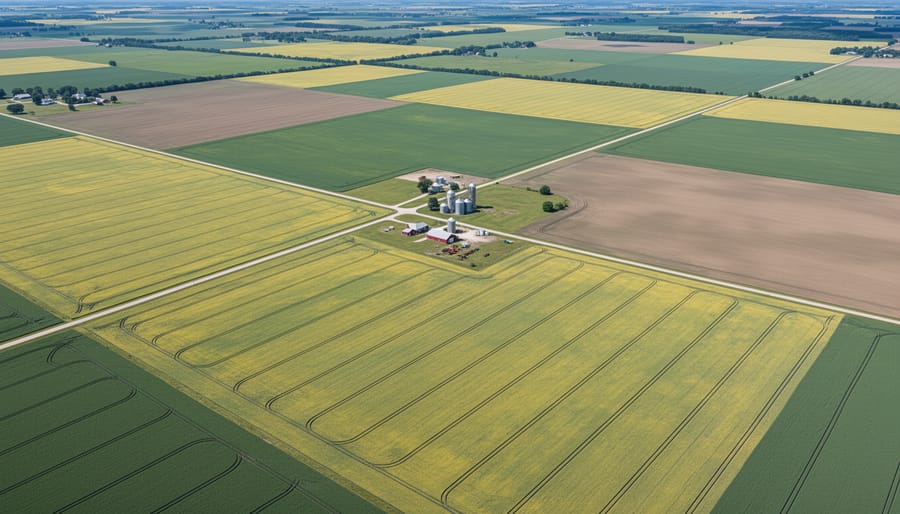
Aerial view of small organic farm showing organized crop rows and field patterns
Satellite imagery provides farmers with a comprehensive view of their entire operation, revealing patterns and variations invisible from ground level.

From Space to Your CSA Box: The Journey of Farm Data

You might imagine satellite technology as something reserved for big commercial farms with deep pockets, but here’s the exciting news: the journey from space to your CSA box is more accessible than ever, and much of it is completely free.

Here’s how it works. Satellites like those in the European Space Agency’s Copernicus program and NASA’s Landsat series continuously photograph Earth, capturing detailed images every few days. These images reveal invisible patterns—like which areas of your field have stressed plants or uneven moisture—using special sensors that detect light beyond what human eyes can see.

The best part? You don’t need fancy equipment to access this information. Platforms like Google Earth Engine, Sentinel Hub, and the USDA’s CropScape offer user-friendly interfaces where farmers can simply draw their field boundaries and receive customized data. Many of these tools work right from your smartphone or laptop.

Take Sarah Chen, who runs a 15-acre CSA in Vermont. She discovered FarmLens, a free tool that sends her weekly field health reports based on satellite imagery. “I was skeptical at first,” she admits, “but now I check it like I check the weather. Last season, it spotted an irrigation issue I would have missed for weeks.”

Getting started is straightforward: create a free account on platforms like Planet’s Education and Research Program or NASA’s Earthdata, enter your farm coordinates, and explore pre-made agricultural monitoring tools. Most platforms include tutorials designed specifically for small-scale farmers, making space-age technology genuinely accessible to everyone growing food.

Real Ways CSA Farms Are Using Satellite Data Right Now

Spotting Problem Areas Before Your Eyes Can

Imagine having a crystal ball that reveals hidden troubles in your fields weeks before they become visible to the naked eye. That’s exactly what satellite imagery offers organic farmers today. These orbiting cameras capture data beyond what we can see, measuring light reflection patterns that indicate plant health.

When crops face stress from drought, disease, or nutrient deficiencies, their leaves reflect light differently long before they show visible symptoms like yellowing or wilting. Satellites detect these subtle changes through specialized sensors, creating detailed maps that highlight problem zones in your fields. Similar to aerial technology, this bird’s-eye perspective helps farmers spot issues early.

For organic growers, this early warning system is invaluable. Instead of treating entire fields with organic inputs, you can target specific areas where plants need help. Notice a patch showing nitrogen deficiency? Apply compost or organic fertilizer precisely where needed. Spot potential pest pressure building in one corner? Introduce beneficial insects or apply natural deterrents before the problem spreads.

Take Sarah Chen, an organic vegetable farmer in Ontario, who credits satellite monitoring with saving her tomato crop last season. The imagery revealed stress patterns suggesting fungal issues two weeks before visible symptoms appeared, giving her time to adjust irrigation and apply organic fungicides preventatively. “It’s like having a health monitor for my entire farm,” she explains, noting how this technology helps stretch her organic input budget while protecting yields.
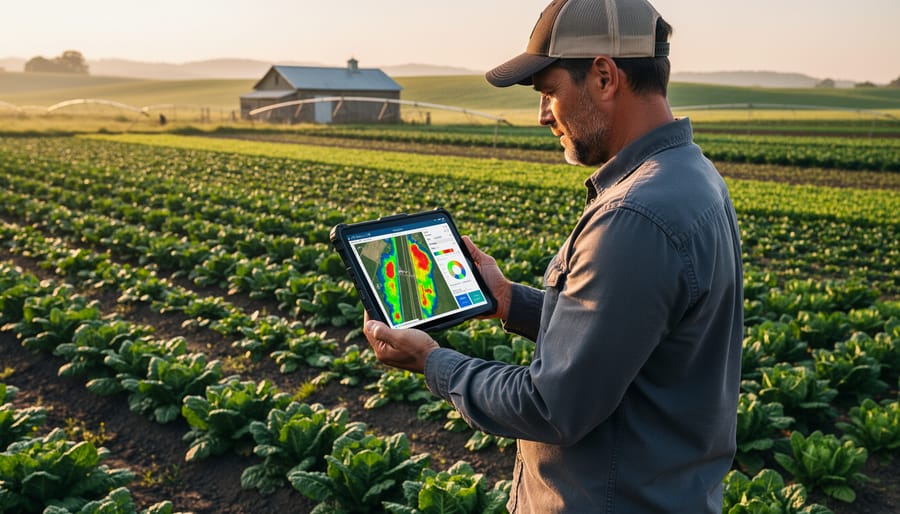
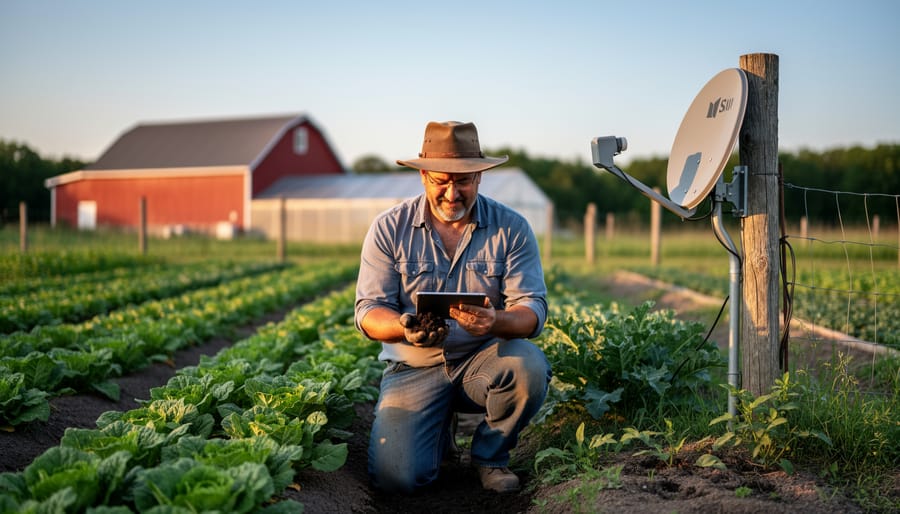
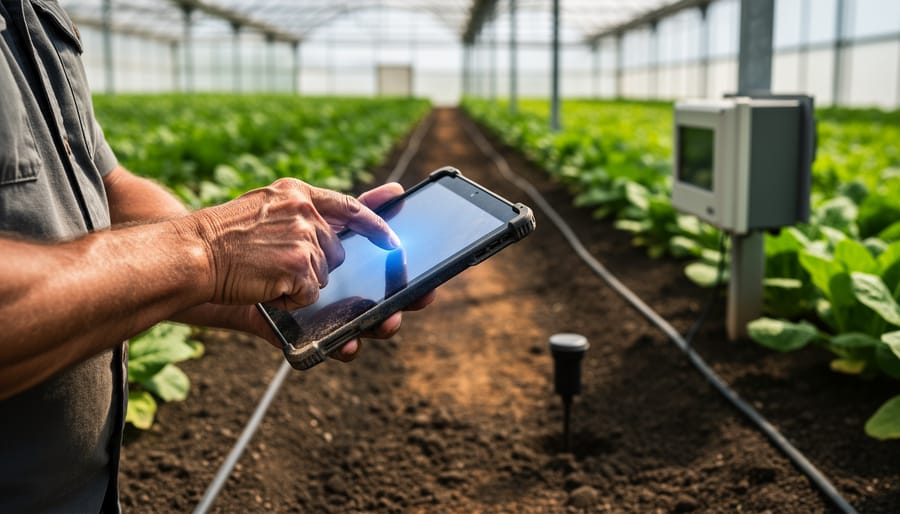
Farmer holding tablet with agricultural data in vegetable field
Modern CSA farmers combine traditional expertise with satellite data to make informed decisions about crop health and resource management.

Watering Smarter, Not Harder

Water is one of farming’s most precious resources, and satellite technology is revolutionizing how CSA farms manage every drop. Instead of watering entire fields uniformly, satellite imagery reveals exactly which areas need moisture and which don’t. Infrared sensors detect subtle plant stress before it’s visible to the naked eye, allowing farmers to intervene early and target irrigation precisely where needed.

This precision approach saves thousands of gallons of water each season while ensuring crops stay healthy. When combined with real-time monitoring systems, farmers can create customized watering schedules based on actual soil moisture levels and crop needs rather than guesswork or fixed routines.

During drought seasons, this technology becomes invaluable. Sarah Chen, who runs Green Valley Farm in Ontario, credits satellite-guided irrigation with reducing her water usage by 35 percent while improving crop yields. “I can see exactly where my tomatoes are thirsty versus where they’re fine,” she explains. “It’s like having x-ray vision for soil moisture.”

The cost savings extend beyond water bills. Targeted irrigation reduces energy costs from running pumps, minimizes fertilizer runoff by avoiding overwatering, and prevents crop diseases that thrive in overly wet conditions. For small CSA operations working with tight margins, these efficiencies make sustainable farming more economically viable while protecting our most vital natural resource.

Success Story: How One CSA Increased Yields by Watching From Above

When Green Valley Farm in upstate New York started their CSA five years ago, farmer Maria Chen relied on traditional methods and intuition to manage her 15-acre organic operation. While her produce was beautiful, she struggled with uneven crop performance across different field sections and couldn’t quite pinpoint why some areas consistently underperformed.

Everything changed when Maria discovered free satellite imagery through the European Space Agency’s Copernicus program. By downloading images every few weeks during the growing season, she could view her entire farm through specialized filters that revealed plant health invisible to the naked eye.

The results were eye-opening. Satellite data showed that a section she’d assumed was thriving actually had struggling crops compared to the rest of the field. This prompted soil testing that revealed a drainage issue she’d never noticed from ground level. After addressing the problem with contour planting and cover crops, that troublesome area became one of her most productive.

Maria also began using historical satellite images to track how different crop rotations affected soil health over time. She discovered that certain combinations left fields in better condition than others, allowing her to optimize her three-year rotation plan. The data helped her explain these improvements to CSA members during farm tours, and many appreciated seeing the high-tech approach behind their organic vegetables.

Three years after adopting satellite monitoring, Green Valley Farm increased overall yields by 22 percent while maintaining organic certification. Member retention jumped to 85 percent, partly because Maria could now predict and prevent problems before they affected harvest shares. Best of all, she spends less time guessing and more time growing.

What This Means for You as a CSA Member

When choosing a CSA farm, you’re investing in more than just fresh vegetables. You’re supporting a farming approach that increasingly harnesses cutting-edge technology to deliver the quality and sustainability you value. Here’s how satellite earth observation directly benefits your CSA experience.

First and foremost, you’ll notice the difference in your produce box. Satellite-informed farming allows your farmers to monitor crop health with incredible precision, catching potential issues before they affect quality. This means you receive vegetables at their nutritional peak, harvested at exactly the right moment. Your tomatoes taste better, your greens stay fresher longer, and your root vegetables have that perfect texture because farmers can track growing conditions down to specific field sections.

The environmental benefits align perfectly with why many people choose CSA memberships. Satellite data helps farmers apply water and nutrients only where needed, dramatically reducing waste and runoff. This precision approach means your food is grown with a lighter environmental footprint, protecting local waterways and soil health for future seasons. One member from a satellite-using farm in Ontario shared how her farmer explained they reduced water usage by 30 percent while actually improving yields, something that made her membership feel even more impactful.

You’ll also likely enjoy greater variety throughout the season. Better crop monitoring means farmers can confidently experiment with diverse plantings, knowing they can track how different varieties perform in various field locations. This translates to more interesting weekly boxes and exposure to unique heirloom varieties that might have been too risky without precise monitoring.

Perhaps most importantly, this technology helps small organic farms remain viable and competitive. By improving efficiency and reducing losses, satellite observation supports the long-term sustainability of the farms you depend on. Your CSA isn’t just surviving; it’s thriving with tools that make sustainable farming both environmentally sound and economically practical, ensuring fresh, local food remains accessible for years to come.
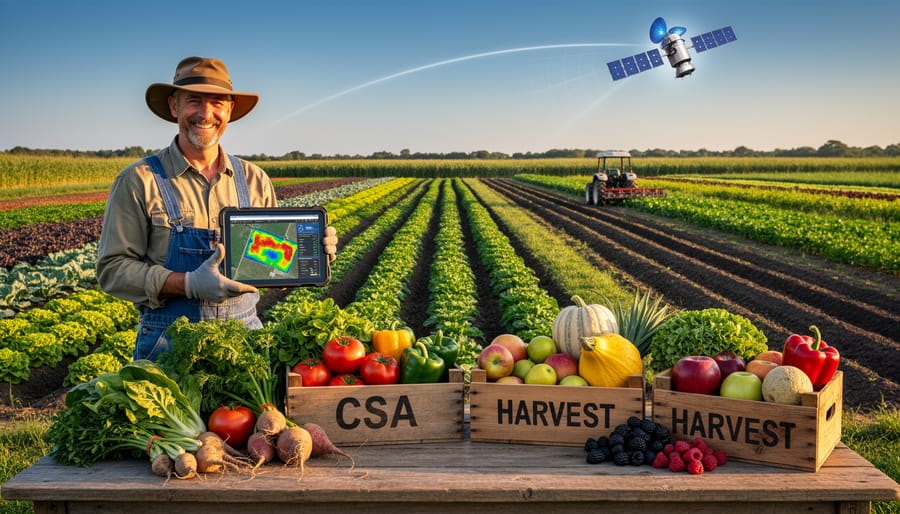
Wooden box filled with freshly harvested organic vegetables from CSA farm
Satellite-informed farming practices help CSA operations deliver higher quality, more diverse produce to their members throughout the growing season.

Getting Started: Resources for Farmers and Farm-Curious Folks

Free Tools Your Local Farm Can Use Today

Ready to explore satellite technology for your farm without breaking the bank? Several free platforms make precision agriculture tools accessible to small-scale growers today.

LandViewer offers beginner-friendly access to satellite imagery from multiple sources. You can view your fields in different light spectrums to spot crop health issues before they’re visible to the naked eye. The platform’s intuitive interface makes it easy to compare images from different dates, helping you track seasonal changes.

Sentinel Hub Playground provides free access to European Space Agency data updated every few days. It’s perfect for monitoring soil moisture, vegetation health, and even frost risk. The visual tools help you understand what satellites see without needing a science degree.

NASA’s LANCE system delivers near real-time Earth observation data. While it has a learning curve, the wealth of information about weather patterns, temperature variations, and environmental conditions proves invaluable for planning planting and harvest schedules.

FarmLens brings satellite technology directly to your smartphone. This mobile app translates complex satellite data into simple crop health reports, making it ideal for farmers just starting their precision agriculture journey.

Google Earth Engine, though slightly more technical, offers incredible power for those willing to invest learning time. Many farmers use it to analyze historical land use patterns and make informed decisions about crop rotation and field management.

Questions to Ask Your CSA Farmer

Curious about whether your CSA farm uses satellite technology? Great! Most farmers love talking about their practices. Start by asking if they use any remote sensing or satellite data to monitor crop health or soil conditions. You might be surprised to learn they’re already using free tools from NASA or the European Space Agency to optimize watering schedules or detect plant stress early.

Ask how technology helps reduce water usage or minimize inputs on the farm. This shows you value their sustainable practices while learning about precision agriculture firsthand. If they’re not currently using these tools, you could share what you’ve learned—many farmers appreciate when members bring new resources to their attention.

Consider questions like: “How do you decide when to irrigate different fields?” or “Do you use any mapping tools to track soil health across seasons?” These conversations build community and deepen your connection to where your food comes from. Remember, technology adoption looks different for every farm. Some use advanced satellite imagery, while others rely on time-tested observation skills. Both approaches deserve respect and curiosity. Your genuine interest might even inspire farmers to explore new sustainable solutions that benefit everyone.

The marriage of satellite earth observation technology with traditional organic farming practices represents one of the most exciting developments in sustainable agriculture today. It’s a partnership that honors the wisdom passed down through generations while embracing tools that help us farm more intelligently and responsibly.

What’s truly remarkable is that satellite technology doesn’t diminish the farmer’s role. Instead, it amplifies their expertise, providing another layer of insight to inform the decisions they’ve always made with careful observation and deep knowledge of their land. When a farmer combines their understanding of soil texture, crop behavior, and seasonal patterns with precise satellite data, they create a powerful synergy that benefits everyone in the food chain.

For CSA members, this technology translates into tangible improvements: healthier, more nutrient-dense produce, reduced environmental impact, and the assurance that your farm is operating at the cutting edge of sustainable practices. These aren’t industrial-scale operations losing touch with the land. These are dedicated farmers using every available tool to grow food that’s better for you, better for the soil, and better for future generations.

The farmers leading this charge demonstrate that innovation and organic principles aren’t opposing forces. They work hand in hand. Whether it’s detecting water stress before plants show visible signs, identifying nutrient deficiencies early, or monitoring soil health across entire fields, satellite observation helps organic farmers be more precise, more efficient, and more sustainable.

As you explore CSA options in your community, consider supporting farms that embrace these innovations. Ask questions about how they use technology to enhance their organic practices. By choosing farms that blend tradition with innovation, you’re investing in a food system that’s resilient, sustainable, and ready for whatever challenges tomorrow brings.
Why Your CSA Farm Might Be Leaving Members Behind (And How to Bridge the Digital Gap)

Posted by darrell on
0
Technology and Innovation
Why Your CSA Farm Might Be Leaving Members Behind (And How to Bridge the Digital Gap)

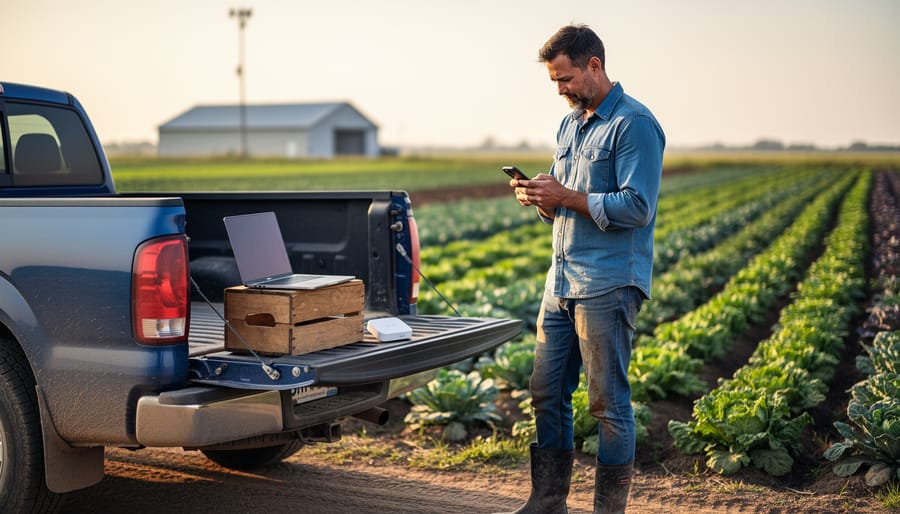
The WiFi signal drops just as you’re about to send your weekly CSA newsletter. Your farm’s Instagram post won’t upload from the field. Members email asking why they can’t access your online harvest schedule, but you’re still waiting for that page to load yourself.

Sound familiar? You’re not alone. Nearly 19 million rural Americans lack reliable high-speed internet, and CSA farmers face unique challenges when limited connectivity meets the growing expectation for digital engagement. Your members want real-time updates, online ordering, and social media glimpses of their food’s journey from seed to table, but delivering these experiences feels impossible when your internet crawls slower than your tomato seedlings in April.

The rural digital divide isn’t just an inconvenience. It directly impacts your ability to retain members, attract new subscribers, and compete with grocery stores offering seamless online experiences. When urban CSAs post daily farm stories and offer text message harvest reminders while you struggle to send a single email, the gap widens between customer expectations and what you can realistically deliver.

But here’s the encouraging truth: you don’t need Silicon Valley-level connectivity to create meaningful digital engagement. Smart farmers across the country are finding creative, affordable solutions that work within rural limitations. From offline-friendly strategies to strategic timing of digital tasks, you can bridge the connectivity gap and build the thriving member community your farm deserves, even with inconsistent internet access.

What the Rural Digital Divide Actually Means for CSA Communities

The rural digital divide refers to the gap in internet access and connectivity quality between urban areas and rural communities. While city dwellers typically enjoy high-speed, reliable internet, many rural regions struggle with slow connections, limited service options, or no internet access at all. For Community Supported Agriculture operations, this divide creates unique challenges that affect both farmers and members.

When your farm sits in an area with spotty internet service, basic tasks that urban businesses take for granted become frustrating obstacles. Uploading weekly newsletters with photos of the harvest can take hours instead of minutes. Video content showcasing farm activities might be impossible to share. Even simple email communications can become unreliable when connections drop unexpectedly. Many CSA farmers find themselves driving to town just to send member updates or process online payments.

The impact extends to your members too. While urban subscribers enjoy seamless access to digital community platforms, recipe databases, and farm updates, the connectivity gap means these resources might not reach everyone equally. Members living in rural areas face similar challenges accessing your carefully crafted content, participating in online discussions, or viewing pickup schedules.

This digital barrier affects the heart of what makes CSA communities thrive: connection and communication. When farmers cannot easily share their stories, growing practices, or seasonal updates, members miss out on the educational aspect that makes CSA membership meaningful. The photos of new baby goats, the excitement of the first tomato harvest, or tips for storing root vegetables all become harder to share when technology works against you.

Understanding this divide is the first step toward finding practical solutions that keep your community engaged regardless of where they live or farm.

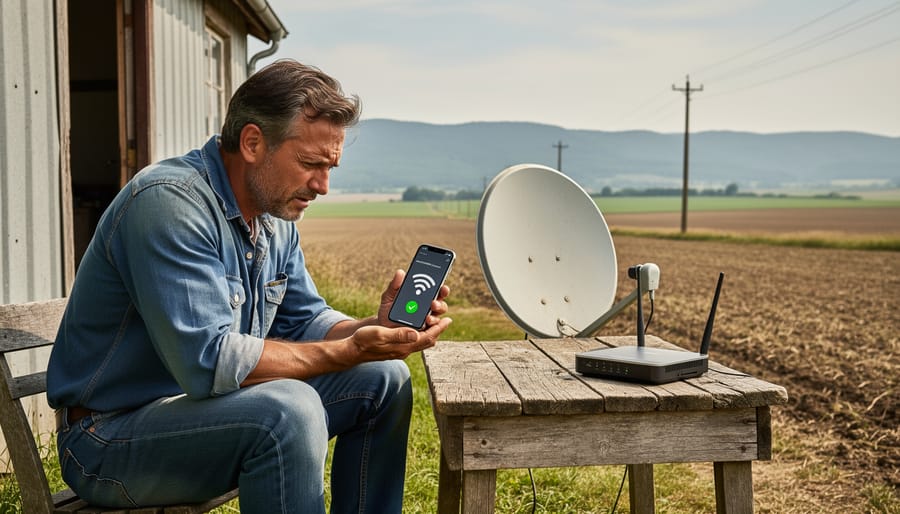
Farmer in field holding smartphone showing rural connectivity challenges
Many rural farmers struggle with unreliable internet connectivity that makes digital member communication challenging.

The Real-World Impact on Your Farm-Member Relationship

When Members Can’t Access Your Weekly Updates

When your CSA members face unreliable internet access, they miss crucial weekly updates about what’s in their share, pickup times, and storage tips. Imagine a member receiving a box of delicate greens without knowing they should be refrigerated immediately, or missing the announcement about an extra-early harvest day. This disconnect leads to forgotten pickups, spoiled produce, and frustrated members who feel out of the loop.

The ripple effects go beyond individual inconvenience. Members who can’t reliably access your newsletters might overlook creative recipe ideas for unfamiliar vegetables like kohlrabi or romanesco, leading those items to languish unused. They miss seasonal cooking workshops, farm tour invitations, and volunteer opportunities that build community connection. Over time, this communication gap erodes the relationship between farmer and member, turning what should be an engaging partnership into a simple transaction.

Poor connectivity also prevents members from providing timely feedback about their shares or asking questions about growing practices. This two-way communication breakdown means you’re farming in the dark, unable to adjust offerings based on member preferences, ultimately affecting retention rates and community satisfaction.

The Challenge of Digital Payment Systems

Digital payment challenges create real headaches for CSA communities when internet connectivity is spotty. Picture this: a farmer trying to process membership renewals from their barn, only to have their connection drop mid-transaction. Meanwhile, members in rural areas struggle to complete online payments, leading to frustration on both sides.

These technical hiccups can seriously impact your farm’s cash flow. When payment portals time out or fail to load, members might give up entirely, delaying their renewals or missing payment deadlines. Some farmers have shared stories of losing potential members who simply couldn’t complete the signup process due to poor connectivity.

The solution often involves offering multiple payment options. Consider accepting checks or cash alongside digital payments, and communicate clearly about offline alternatives. Some successful CSA operations send paper invoices with pre-addressed envelopes as backup options. Others schedule specific “payment days” at farmers markets where members can pay in person.

For farmers with limited connectivity, batching payment processing during trips to town or areas with better internet can help. Simple mobile payment apps that work offline and sync later can be lifesavers. The key is building flexibility into your payment systems so connectivity issues don’t become barriers to participation.

Missing Out on Community Building Online

Modern CSAs thrive on connection, not just through farm visits, but increasingly through vibrant online communities. Unfortunately, when rural internet access falls short, farmers and members alike miss out on these meaningful digital interactions that strengthen the farm-to-table bond.

Picture a CSA member who wants to share photos of last night’s roasted beet salad on the farm’s Facebook group, or a farmer hoping to send weekly recipe videos featuring the harvest. Without reliable connectivity, these simple acts of building digital CSA communities become frustratingly difficult or impossible. Member forums where people swap cooking tips, ask questions about storage, and celebrate their farm-fresh meals remain inaccessible to those on the wrong side of the digital divide.

CSA apps that allow members to customize their shares, view farm updates, or participate in polls about upcoming crops require consistent internet access. When farmers can’t reliably upload content or members can’t engage with these platforms, the community feeling weakens. That recipe exchange thread where someone shares their grandmother’s kale technique? Those photos of kids harvesting carrots? The weekly newsletter with planting updates? All of these connection points fade away.

The impact goes beyond convenience. Strong digital communities help with member retention, create enthusiasm for challenging vegetables, and build the personal relationships that make CSA membership feel special. When connectivity barriers prevent participation, both farmers and members lose out on the rich, supportive community that makes sustainable agriculture so rewarding.

Farmer Success Story: How Meadowbrook Farm Overcame Connectivity Challenges

When Sarah and Tom Mitchell took over Meadowbrook Farm in rural Vermont three years ago, they quickly discovered that their dream of running a thriving CSA came with an unexpected obstacle: internet speeds that barely reached 3 Mbps on good days. With over 150 CSA members expecting weekly updates, recipe ideas, and seamless communication, the couple knew they needed creative solutions.

Their first challenge was the weekly newsletter. Large photo files would take hours to upload, often timing out completely. Sarah’s solution was refreshingly simple: she began compressing photos using free mobile apps before uploading, reducing file sizes by 70% without sacrificing quality. She also scheduled uploads for early morning hours when bandwidth competition was lowest, setting her alarm for 5 AM on newsletter days.

For member communication, the Mitchells moved away from bandwidth-heavy video content and embraced what Tom calls “strategic scheduling.” They downloaded member questions and emails during off-peak hours, crafted responses offline using a simple document, then uploaded everything in one batch. This approach transformed their communication from frustrating to efficient.

The farm’s most innovative solution came through community partnership. Meadowbrook established a “farm ambassador” program, recruiting five members who lived in town with reliable internet. These ambassadors helped manage the farm’s social media presence, shared real-time updates during harvest days, and even hosted virtual farm tours from their own homes. In exchange, they received discounted CSA shares and first pick of specialty crops.

The results exceeded expectations. Member retention jumped from 68% to 89% within one year. The Mitchells also discovered that their offline-first approach created richer content. Sarah’s handwritten notes, later photographed and shared, became beloved features that members said felt more personal than typical digital updates.

Perhaps most importantly, the farm attracted media attention for their creative connectivity solutions, leading to feature articles that brought in 40 new members. As Tom reflects, “Poor internet forced us to be more intentional about our communication. We can’t rely on constant posting, so every message we send has real value. Our members appreciate that authenticity, and honestly, it’s less stressful for us too.”

Practical Solutions That Work Right Now

Low-Tech Communication Alternatives

Sometimes the best solutions are the simplest ones. When internet connectivity becomes a barrier, stepping back to low-tech communication methods can actually strengthen your CSA community connections.

Text-only emails work wonderfully in low-bandwidth areas. Strip away images, logos, and fancy formatting to create messages that load quickly even on spotty connections. Your members will appreciate the straightforward updates about harvest schedules and pickup reminders.

SMS text messages reach nearly everyone, regardless of internet access. Set up a simple text alert system for urgent updates like weather-related pickup changes or unexpected crop availability. Many farmers find that members actually prefer these quick notifications over lengthy emails.

Don’t underestimate the power of printed newsletters at your pickup location. A single-page update about upcoming harvests, recipes, and farm happenings creates a tangible connection. Members can take them home, post them on refrigerators, and share with neighbors who might be interested in joining.

Phone trees remain incredibly effective for time-sensitive information. Designate a few reliable members to help spread the word when you need to reach everyone quickly. This builds community while solving communication challenges.

Consider combining methods too. A farmer in Tennessee successfully uses text confirmations for pickups alongside monthly printed newsletters, ensuring everyone stays informed regardless of their internet situation.

Farm bulletin board with printed newsletters at CSA pickup location
Low-tech communication solutions like printed newsletters and bulletin boards at pickup locations ensure all members stay informed.

Smart Use of Offline-First Tools

When internet access comes and goes in rural areas, offline-first tools become game-changers for keeping your CSA community connected. These smart applications are designed to work beautifully even when connectivity is spotty, storing information locally on phones or tablets and syncing updates whenever a connection becomes available.

Think of tools like Google Drive or Evernote that let you draft newsletters, update member lists, or create seasonal recipes entirely offline. When you’re back in range, everything syncs automatically. For CSA operations, apps like Farmigo or Harvie can cache member preferences and ordering data, allowing farmers to manage pickups and deliveries without constant internet access.

Downloadable content is another powerful approach. Create PDF guides about seasonal produce, preservation techniques, or farm updates that members can download once and reference anytime. Video content about sustainable farming practices can be downloaded during good connectivity periods and watched later. This strategy complements your digital marketing strategies by ensuring your content remains accessible regardless of signal strength.

Sarah from Meadowbrook Farm batches her social media posts weekly using scheduling tools during her Saturday market trips to town, keeping followers engaged throughout the week without daily internet needs. This practical approach keeps communities thriving despite connectivity challenges.

Creating Hybrid Engagement Models

The beauty of CSA engagement is that it doesn’t have to live entirely online. Some of the most meaningful connections happen face-to-face, making hybrid models perfect for rural communities facing connectivity challenges.

Start by transforming your pickup sites into community hubs. A simple bulletin board at each location can share weekly updates, recipes, and farm news without requiring internet access. Members can post their own messages, creating organic conversations that might never happen in a Facebook group.

Member ambassadors are another powerful tool. These enthusiastic supporters act as communication bridges, sharing important updates through phone calls, text messages, or in-person conversations at pickup. One Vermont farm recruits one ambassador per pickup site, ensuring every member stays informed regardless of their digital access.

Farm visits create irreplaceable experiences that no virtual tour can match. Host monthly open farm days where members can walk the fields, meet the farmers, and understand where their food comes from. These events strengthen relationships while giving you direct feedback about what members want.

Community potlucks, seasonal celebrations, and hands-on workshops bring people together without requiring stable internet. A spring planting party or fall harvest festival builds the kind of loyalty that transcends any digital platform. These gatherings remind everyone that community-supported agriculture is fundamentally about people supporting people, with or without Wi-Fi.

Exploring Connectivity Improvement Options

Good news! Several practical solutions exist to bridge the connectivity gap in rural CSA communities. Federal and state programs like the USDA’s ReConnect Program offer grants and loans specifically for rural broadband infrastructure, helping farm communities invest in lasting connectivity improvements.

For immediate needs, mobile hotspots provide flexible internet access using cellular networks, perfect for farmers market setups or on-farm member events. Satellite internet has evolved dramatically, with newer low-earth orbit options delivering faster speeds than traditional satellite services, though weather can still affect performance.

Community broadband cooperatives represent an exciting grassroots approach where neighbors pool resources to build shared infrastructure. Several farming communities have successfully launched their own internet networks, reducing costs while maintaining local control. Some CSA farmers have partnered with nearby farms to share installation costs and create stronger connectivity zones.

Libraries and community centers often offer free WiFi access and can serve as pickup locations where members can connect while collecting shares. Additionally, many telecommunications companies provide discounted services for agricultural businesses, though you’ll need to ask specifically about these programs as they’re not always widely advertised. Start by researching what’s available in your area and don’t hesitate to explore multiple solutions simultaneously.

Building an Inclusive Digital Strategy for Your CSA

Creating an inclusive digital strategy starts with understanding your members’ actual access to technology. Consider sending a simple survey (available in both digital and paper formats at pickup) asking members about their internet reliability, preferred communication methods, and device access. This information becomes your roadmap for reaching everyone effectively.

The foundation of an inclusive approach is multi-channel communication. Never rely solely on email or social media to share important updates. Pair digital communications with physical bulletin boards at pickup locations, printed newsletters tucked into share boxes, and occasional phone calls for critical announcements. Some of the most successful innovative CSA approaches combine traditional and digital methods seamlessly.

Consider implementing a tiered communication system. Essential information like pickup schedule changes or safety alerts should go through multiple channels simultaneously. Weekly newsletters with recipes and farm updates can lean more digital while ensuring print versions are available upon request. Member stories and community-building content work well as optional extras through social media or blog posts.

Make digital tools work harder by keeping them simple and accessible. If using a member portal, ensure it works on smartphones with slow connections and includes downloadable PDF options for offline viewing. Text messaging can be surprisingly effective for quick updates since most phones receive texts even in low-signal areas.

Build personal connections that transcend technology. Designate team members as community liaisons who chat with members during pickup, gathering feedback and sharing updates face-to-face. These conversations often reveal concerns that never make it into online forums and strengthen the human bonds that make CSAs special.

Remember that flexibility is key. Some members will embrace digital platforms enthusiastically while others prefer traditional methods, and both preferences are equally valid. By honoring these differences and creating multiple pathways for engagement, you ensure every member feels connected to your farm community regardless of their internet access.

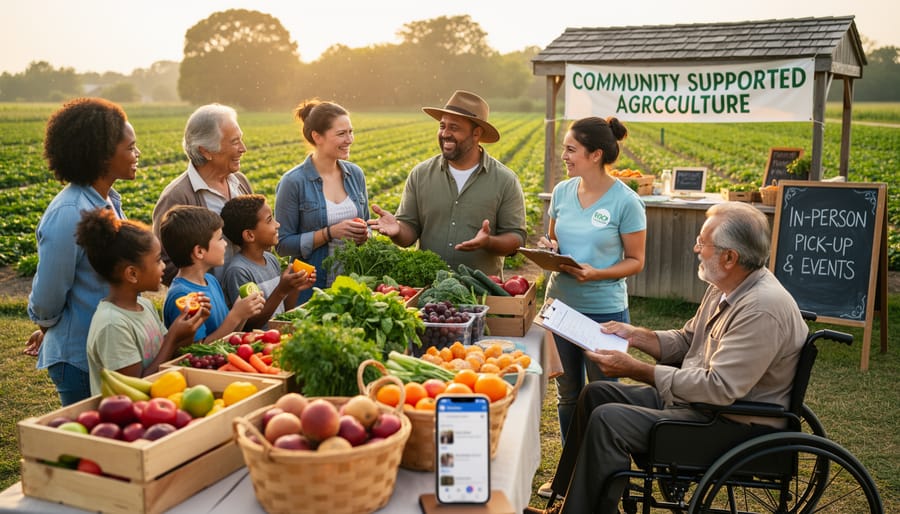
CSA members and farmers gathering together at outdoor farm event
In-person community events strengthen CSA connections beyond digital platforms and ensure inclusive engagement.

Looking Ahead: The Future of Connected Rural Communities

The future looks brighter for rural farmers and CSA communities navigating the digital divide. Recent federal and state initiatives are directing billions toward rural broadband expansion, recognizing that connectivity is no longer a luxury but essential infrastructure. For CSA operators, this means better days are ahead, with improved connectivity solutions becoming increasingly accessible even in remote areas.

Innovation is also meeting rural farmers where they are. Agricultural technology companies are developing smart farming tools designed specifically for low-bandwidth environments. These include offline-capable farm management apps that sync when connectivity is available, SMS-based communication systems for member updates, and lightweight platforms that work smoothly even with slower internet speeds. Some progressive CSAs are already testing these solutions with remarkable success.

What’s particularly exciting is the unique position CSA communities hold in advocating for rural digital infrastructure. Your members are your most powerful advocates. Many CSA supporters live in urban and suburban areas where high-speed internet is taken for granted. When they understand how connectivity challenges affect their farmers’ ability to communicate, process payments, and operate efficiently, they become passionate voices for change. Consider organizing member letter-writing campaigns to local representatives or partnering with other rural businesses to demonstrate collective need.

Farmer-led cooperatives are also pooling resources to negotiate better internet packages or invest in shared connectivity solutions. By working together, rural agricultural communities are finding creative paths forward. The digital divide won’t disappear overnight, but with continued advocacy, targeted investment, and innovative tools designed for rural realities, connected farming communities are within reach.

The rural digital divide is absolutely real, but here’s the good news: it’s not insurmountable. When farmers and members work together to bridge connectivity gaps, the entire CSA community becomes stronger and more resilient. Remember, the heart of Community Supported Agriculture has always been about connection, trust, and partnership. Technology simply gives us new tools to nurture those relationships, even when internet access is spotty.

If you’re facing connectivity challenges, don’t struggle in silence. Farmers, let your members know about your limitations and celebrate your creative solutions. Members, be patient and communicate your preferences. Sometimes the best engagement happens through a simple phone call or a handwritten note tucked into the weekly veggie box.

Your next step? Choose just one strategy from this article and implement it this week. Maybe it’s setting up an offline pickup station newsletter, establishing a member buddy system for those without reliable internet, or scheduling your social media posts during your weekly library visit. Small steps lead to meaningful change.

The digital divide doesn’t have to mean disconnection. With understanding, creativity, and commitment to community, your CSA can thrive regardless of bandwidth limitations. After all, the most important connections happen heart to heart, not just screen to screen.

How Smart CTAs Transform Your CSA Farm From Unknown to Sold Out

Posted by darrell on
0
Technology and Innovation
How Smart CTAs Transform Your CSA Farm From Unknown to Sold Out

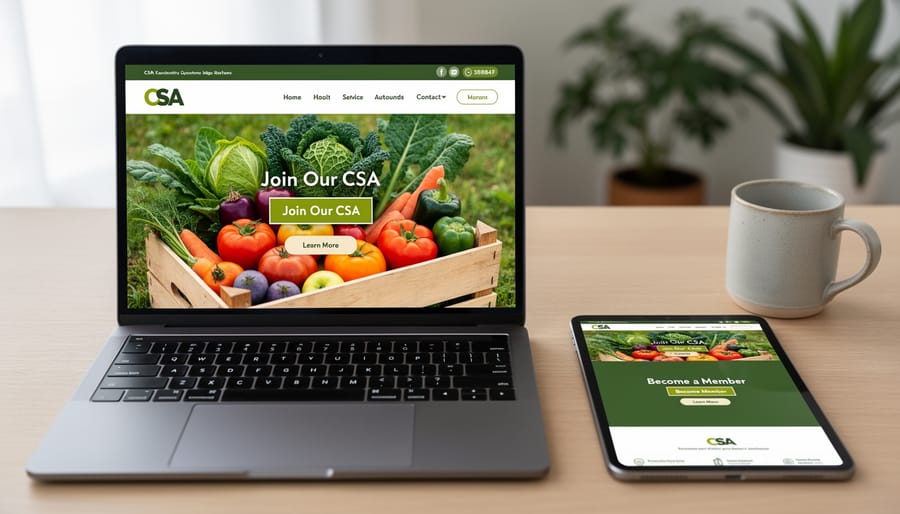
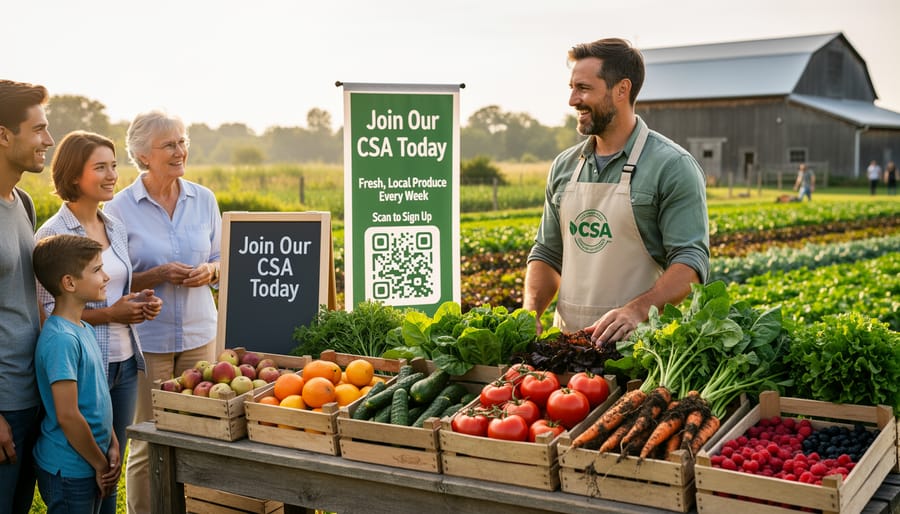
Place a bright “Join Our CSA Today” button above the fold on your homepage where visitors can see it within three seconds of landing—this single change can boost signup rates by up to 40% for small farms. Your call-to-action (CTA) is the bridge between interested visitors and committed CSA members, yet most farm websites bury these crucial conversion points in dense paragraphs or place them where nobody clicks.

Transform your farm’s online presence by treating CTAs as digital farm stands—clear, inviting, and impossible to miss. Unlike corporate marketing, CSA farms have a unique advantage: you’re offering real relationships with real farmers, fresh weekly harvests, and a tangible connection to the land. Your CTAs should reflect this authenticity while making the signup process effortless.

Consider how Green Valley Farm in Ontario increased their CSA membership by 65% in one season simply by adding action-oriented buttons throughout their website and email campaigns. They replaced vague links like “Learn More” with specific prompts like “Reserve Your Share for Spring” and “Get Farm-Fresh Eggs Delivered.” These weren’t aggressive sales tactics—they were helpful guideposts for people already interested in supporting local agriculture.

Effective digital marketing strategies for CSA farms hinge on understanding that your audience wants to say yes—they just need clear direction on how. This guide will show you exactly how to create CTAs that convert curious visitors into loyal CSA members while staying true to your farm’s values and community-focused mission.

What Makes a CTA Work for CSA Farms (Hint: It’s Not Just a Button)

Farmer's hand pointing to call-to-action button on CSA farm website
Effective call-to-action buttons on CSA websites guide visitors toward membership signup with clear, compelling design.

The Difference Between Generic and CSA-Specific CTAs

Generic CTAs like “Learn More” or “Click Here” are the marketing equivalent of saying “something’s here” without explaining what makes it special. For CSA farms, these vague phrases miss the opportunity to connect with your community’s unique interests and concerns.

Instead, craft CTAs that speak directly to what your members care about. When someone visits your CSA website, they’re wondering about harvest timing, getting to know who grows their food, and understanding what they’ll receive. A CTA like “Reserve Your Summer Harvest” immediately addresses seasonal planning and creates urgency, while “Meet Your Farmers” builds the personal connection that sets CSAs apart from grocery stores.

Context makes all the difference. Consider the farm that changed their homepage button from “Sign Up” to “Join Our Farm Family for 2024.” Their conversion rate jumped because the new CTA emphasized community belonging rather than just a transaction. Another successful example: “Get Your Weekly Veggie Guide” performs better than “Download Now” because it clearly communicates the value members receive.

The key is specificity. Your CTAs should reflect the real reasons people choose CSA membership: fresh seasonal produce, supporting local agriculture, and becoming part of a sustainable food system.

Where to Place CTAs That Actually Get Clicked

Your Homepage: The First Handshake

Your homepage is where potential members first discover your farm, so think of your CTA as a warm, welcoming handshake rather than a pushy sales pitch. Position your primary CTA above the fold—that’s the portion visitors see without scrolling. A clear, action-oriented button like “Join Our CSA Today” or “Reserve Your Weekly Harvest” works beautifully here, paired with a brief sentence explaining the immediate benefit: “Get farm-fresh vegetables delivered every week starting this spring.”

Below the fold, consider softer CTAs that nurture interest without demanding commitment. A newsletter signup with copy like “Get Growing Tips & Farm Updates” invites visitors to stay connected at their own pace. One successful organic farm in Vermont increased signups by 40% by offering a free seasonal planting guide in exchange for email addresses—a gentle way to build relationships before asking for full membership commitments. Remember, your homepage should guide visitors naturally toward action while respecting their decision-making journey.

Blog Posts and Educational Content

Your blog content offers the perfect opportunity to naturally guide readers toward membership. When sharing a seasonal recipe featuring heirloom tomatoes, include a simple CTA like “Join our CSA to enjoy these varieties in your weekly box.” This feels organic because readers are already imagining the produce.

Farming updates work beautifully for CTAs too. After describing your recent strawberry harvest, add “Reserve your share for next season’s berry bounty.” This creates excitement and urgency without feeling pushy.

Gardening tips attract engaged readers who value growing food. When explaining crop rotation techniques, try “Want expert-grown organic produce without the guesswork? Our CSA delivers weekly.” This acknowledges their interest while offering a solution.

The key is matching your CTA to the content context. Educational posts build trust, making readers more receptive when you invite them to take the next step. These CTAs complement your broader digital marketing channels by converting curious visitors into committed members. Keep CTAs concise, relevant, and focused on the value members receive rather than just asking for a purchase.

Farm Visit and Market Pages

Your farm visit and market pages naturally attract engaged community members who are already curious about your operation. This is prime real estate for strategic CTAs that guide visitors toward membership. After listing your farmers market schedule, add a simple button: “Reserve Your Weekly Box – Skip the Market Rush!” This taps into convenience while maintaining that personal connection. On farm tour pages, include CTAs like “Loved What You Saw? Join Our Farm Family Today” immediately following visit details. Consider adding a seasonal urgency element: “Only 15 Spring Shares Remaining” creates gentle motivation without pressure. One successful Pennsylvania farmer includes a post-visit CTA offering a 10% discount code for attendees who sign up within 48 hours of their tour, converting that warm in-person experience into immediate action.

Writing CTAs That Speak to Your Community

Use Action Words That Reflect CSA Values

The words you choose for your CTAs can make all the difference in connecting with potential CSA members. Action verbs that reflect community values and sustainable living resonate deeply with environmentally conscious consumers.

Start with “Join” to emphasize the community aspect of your CSA. This simple word invites people to become part of something larger than a transaction. “Reserve Your Share” works beautifully for seasonal signups, creating a sense of exclusivity while highlighting the share-based model.

“Connect With Your Farmer” bridges the gap between producer and consumer, addressing the desire for transparency that many organic food seekers value. For donation or volunteer opportunities, use “Support Local Agriculture” to appeal to community-minded individuals.

“Grow With Us” serves double duty, suggesting both personal growth through sustainable living and the literal growing of your farm community. “Start Your Farm Fresh Journey” works well for newcomers unfamiliar with CSAs.

Other effective phrases include “Discover Seasonal Eating,” “Commit to Local Food,” and “Build Food Security Together.” These action words go beyond simple transactions and speak to the values-driven decisions your target audience makes daily. Choose verbs that feel authentic to your farm’s mission while inspiring immediate action.

Address Common Hesitations Head-On

Potential CSA members often hesitate due to understandable concerns about commitment, variety, and convenience. Your CTAs can directly address these worries with reassuring language that removes barriers to signup. Instead of a generic “Join Now,” try “Start with a Half Share—No Long-Term Commitment” to ease fears about overcommitting. This approach speaks directly to what members look for when considering a CSA investment.

For variety concerns, CTAs like “Get 15+ Different Vegetables Weekly” or “See This Week’s Harvest” provide concrete details that build confidence. Address pickup logistics head-on with phrases such as “Three Convenient Pickup Locations” or “Switch Your Pickup Day Anytime.” Consider seasonal flexibility too—”Join Anytime, Cancel Between Seasons” respects members’ need for control.

Successful farmer Melissa from Green Valley Farm increased signups by 40% after adding “First Box Free if You’re Not Delighted” to her main CTA. This guarantee-style language transforms risk into opportunity. Remember that building community connections starts with trust, and your CTAs should reflect that understanding by acknowledging real concerns while offering practical solutions.

Create Urgency Without Sounding Pushy

Creating urgency in your CTAs doesn’t require aggressive sales language. Instead, align your messaging with the natural rhythms of farming to create authentic scarcity. For example, “Spring Shares Filling Fast – Reserve Your Spot by March 15th” works because it reflects reality: you genuinely have limited shares available based on your planting capacity.

Frame deadlines around agricultural milestones that your audience understands. Try “Lock in Your Summer Harvest – Planting Starts April 1st” or “Final Week to Join Our Fall CSA Before Seed Orders Close.” These create legitimate time pressure while educating members about farm operations.

Share real updates that build natural urgency: “Only 8 shares remaining for this season” or “We’re at 75% capacity for our winter CSA.” Transparency about your actual numbers builds trust while encouraging action.

Seasonal language resonates particularly well. “Get Fresh Strawberries This June – Spring Shares Closing Soon” connects the signup deadline to something members can taste and anticipate. One Massachusetts farm saw a 40% increase in signups by simply adding “Don’t miss tomato season” to their summer CTA, reminding people what they’d be missing. Authentic urgency respects your audience while motivating timely decisions.

Design Elements That Make Your CTAs Impossible to Miss

Colors, Buttons, and Visual Hierarchy

Your call-to-action buttons should stand out like a vibrant red tomato in a field of green lettuce. For farm websites with earthy tones like greens, browns, and creams, choose button colors that create contrast. Bright orange, deep blue, or bold red work beautifully against natural backgrounds without clashing with your farm’s aesthetic.

Size matters when it comes to buttons. Make them large enough to tap easily on mobile phones, since many customers browse while on the go. A good rule is to keep buttons at least the size of your thumb pad. Place your most important buttons, like “Join Our CSA” or “Reserve Your Share,” above the fold where visitors see them immediately.

White space is your friend. Give your buttons breathing room by surrounding them with empty space, making them impossible to miss. Think of it like proper plant spacing in your garden—crowding reduces impact. Keep your button text short and action-focused: “Get Started,” “Sign Up Today,” or “Claim Your Box” work better than lengthy explanations. Test different colors and placements to see what resonates with your community, just like you’d trial different crop varieties to find what grows best.

Mobile-Friendly CTAs for Market Shoppers

Most of your potential CSA members are discovering your farm while scrolling through their phones at the farmers market or researching dinner options during their commute home. That’s why mobile-friendly CTAs aren’t just nice to have—they’re essential for converting interested shoppers into committed members.

Your CTA buttons need to be thumb-friendly, ideally 44×44 pixels or larger, so people can easily tap them without frustration. Think about those moments when someone’s juggling grocery bags or standing in line—your “Join Our CSA Today” button should be impossible to miss and effortless to click.

Place your CTAs where mobile users naturally look: near the top of your homepage and immediately after compelling content like a farmer success story about this season’s heirloom tomatoes. Avoid tiny text links that require pinching and zooming. Instead, use contrasting colors that pop against your background and create generous spacing around buttons to prevent accidental clicks.

Consider adding quick-action CTAs like “Text Us to Reserve Your Share” or “Call Now for Farm Tour” that leverage smartphone capabilities. When Sarah’s Farm implemented larger mobile buttons and simplified their signup form for phone users, they saw a 40 percent increase in mobile conversions within just two weeks.

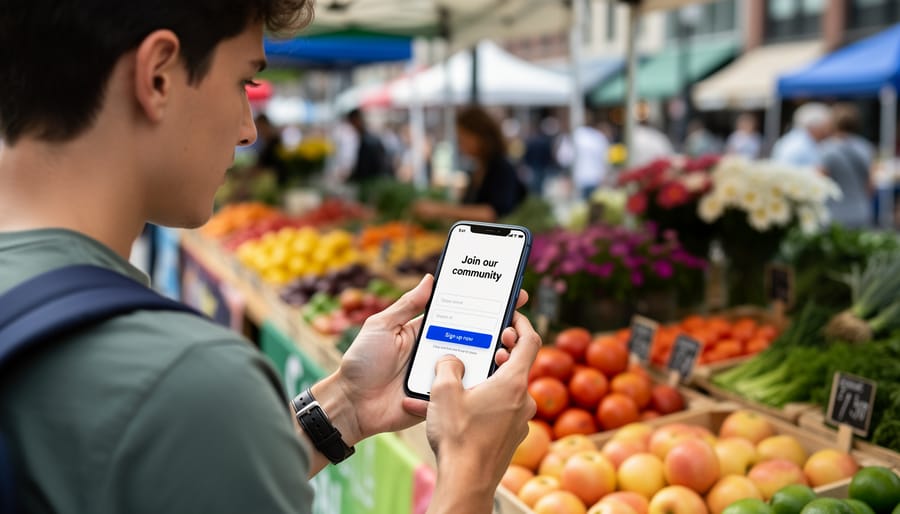
Person holding smartphone displaying mobile-friendly CSA farm website at farmers market
Mobile-optimized CTAs allow potential members to sign up while browsing at farmers markets or researching on the go.

Real CSA Success Stories: CTAs That Changed Everything

When Green Valley Farm in Vermont was struggling with only 45 CSA signups in their second season, founder Maria Chen knew something had to change. Her website had a simple “Learn More” button buried at the bottom of her homepage. After attending a local farm marketing workshop, she transformed her approach with a vibrant green button reading “Reserve Your Share of Fresh Organic Veggies Today.” She placed it prominently above the fold and added another at the end of her farm story. The result? Her next season brought 112 signups, more than doubling her membership.

Brookside Community Farm in Oregon faced a different challenge. Owner James Park had plenty of website visitors but few conversions. His generic “Sign Up” button wasn’t creating urgency. He redesigned his CTA to read “Join 50 Families Eating Fresh This Summer” and added a countdown showing spots remaining. He also included a secondary button saying “Take a Virtual Farm Tour First” for hesitant visitors. This two-pronged approach increased his conversion rate by 67 percent, filling his 80-member CSA three weeks earlier than previous years.

Perhaps most inspiring is Sunrise Acres, a small family farm in Pennsylvania. Owner Rachel Thompson had no CTA at all, just her email address listed on a basic webpage. After creating a simple button with the words “Start Your Farm-Fresh Journey” linked to a straightforward signup form, she went from 12 members to 34 in one season. Rachel’s experience proves you don’t need fancy technology or a huge budget. Sometimes a clear, welcoming invitation makes all the difference.

CSA farm owner working at computer with fresh harvest vegetables beside them
CSA farms that implement strategic call-to-action improvements see increased member signups and stronger community connections.

Testing and Tweaking: How to Know What’s Working

Understanding whether your CTAs are working doesn’t require fancy software or a degree in data analysis. Start with the free tools you likely already have access to. Most website builders, email platforms, and social media accounts include basic analytics that show how many people clicked your buttons or links. For example, if you send an email newsletter promoting your summer CSA shares with a “Reserve Your Box” button, check how many subscribers actually clicked it. This simple metric tells you if your message resonated.

Pay attention to conversion rates rather than just total clicks. If 500 people saw your CTA but only 5 clicked, that’s a 1% conversion rate, which suggests something needs adjusting. Try changing one element at a time – maybe swap “Learn More” for “Join Our Farm Family Today” – then compare the results over a week or two.

Sarah, a small-scale organic farmer in Vermont, discovered her signup rates doubled when she tested buttons with warmer language like “Start Your Fresh Food Journey” instead of generic phrases. She simply kept notes in a spreadsheet tracking each version’s performance.

Watch for patterns in timing too. Do CTAs in Tuesday morning emails perform better than Friday afternoons? Does your Instagram story CTA for farm tours get more taps on weekends? These insights help you optimize when and where you place your calls to action. Remember, even small improvements in CTA performance can mean several new CSA members throughout the season, making this simple testing worthwhile for your farm’s growth.

Your CTAs are the digital handshake between curious visitors and committed CSA members. They’re the moment when someone’s interest in fresh, organic produce transforms into real support for your sustainable farming mission. Every button, form, and link on your website holds the potential to grow your farm community and strengthen local food systems.

Take a moment this week to audit your current CTAs. Choose just one to improve—maybe it’s adding urgency to your signup button, creating a mobile-friendly form, or testing a more personal message that reflects your farm’s unique story. Small changes can yield significant results, just like the careful tending of seedlings leads to abundant harvests.

Remember, you’re not just marketing vegetables; you’re inviting people into a meaningful relationship with their food and the land that grows it. Every CSA member who joins through an effective CTA becomes part of your farm’s success story, supporting sustainable agriculture and enjoying the freshest produce their region has to offer.

Your farm has an incredible story to tell and a community waiting to be nurtured. With thoughtful, well-crafted CTAs, you’re building bridges that connect passionate growers with conscious eaters, one click at a time. Start today, and watch your community flourish.

Why Your CSA Farm’s Digital Systems Are More Vulnerable Than You Think

Posted by darrell on
0
Technology and Innovation
Why Your CSA Farm’s Digital Systems Are More Vulnerable Than You Think

Your CSA farm’s online ordering system, customer database, and automated irrigation controls need protection just like your crops need fencing against deer. Modern farming operations increasingly depend on digital tools—from payment processors and email marketing platforms to soil sensors and climate monitoring apps—making cybersecurity as essential as crop rotation or pest management.

The eight cybersecurity domains provide a comprehensive framework for protecting digital assets on small-scale farms. Originally developed for large corporations, these domains translate surprisingly well to agricultural settings where a single data breach could expose customer payment information, delete years of planting records, or compromise automated growing systems. Think of them as different aspects of farm security: just as you protect your physical infrastructure through fences, locks, and insurance, you protect digital infrastructure through layered defenses.

Small farms face unique cybersecurity challenges. Unlike corporations with dedicated IT departments, most CSA operators manage technology alongside countless other responsibilities. You’re vulnerable to the same threats as larger operations—ransomware, phishing emails, stolen customer data—but with fewer resources to respond. A hacker doesn’t care whether you’re managing 5 acres or 500; they see an opportunity.

Understanding these eight domains empowers you to make informed decisions about farm technology without becoming a cybersecurity expert. Each domain addresses a specific aspect of digital protection, from controlling who accesses your systems to planning recovery after equipment failure. Together, they create a practical roadmap for securing your farm’s digital future while you focus on what matters most: growing healthy food for your community.

What Are the 8 Cybersecurity Domains?

If you’re running a Community Supported Agriculture operation, you might wonder what cybersecurity has to do with growing fresh, organic vegetables. The truth is, modern farms rely on digital tools more than ever before. From online payment systems and customer databases to automated irrigation controls and social media marketing, your farm’s digital infrastructure needs protection just like your crops need proper care.

The 8 cybersecurity domains originated from information security professionals who needed a comprehensive framework to protect sensitive data and systems. Think of these domains as eight different garden beds in your farm’s security garden—each one requires attention and specific care to keep your entire operation healthy and thriving.

These domains cover everything from securing your physical equipment to protecting customer information and responding to potential threats. For CSA operators, understanding these areas means safeguarding member payment details, protecting harvest planning data, and ensuring your farm management software stays reliable during critical growing seasons.

The framework might sound technical, but it’s surprisingly practical for farmers. Just as you rotate crops and maintain soil health using proven agricultural principles, these eight domains provide time-tested methods for keeping your digital operations secure. Whether you’re managing a small family farm or a larger cooperative, these guidelines help you protect the trust your community places in you while keeping your systems running smoothly season after season.

Farmer using smartphone and laptop for farm management with fresh vegetables on table
Modern CSA farms rely on digital systems to manage customer data, payments, and communications, making cybersecurity essential to farm operations.

Security and Risk Management: Protecting Your Farm’s Foundation

Think of your farm’s digital foundation like the soil you tend—it needs protection to thrive. Security and risk management starts with knowing exactly what you’re protecting. Your CSA operation likely manages customer databases with names, addresses, and payment information, online payment processing systems, your website with product listings and blog content, and perhaps email marketing platforms. Each of these represents a digital asset that needs safeguarding.

Start by creating a simple inventory. List every system where customer information lives, from your farm management software to that spreadsheet you use for delivery routes. Next, assess your risks. What would happen if your customer database disappeared overnight? Could you fulfill orders without access to your digital records? Small farms face unique vulnerabilities—limited IT budgets, shared devices among staff, and often, one person managing everything.

Creating basic security policies doesn’t require a law degree. Begin with fundamentals: require strong passwords that mix letters, numbers, and symbols. Establish who can access what information—your harvest crew doesn’t need payment system access. Schedule regular backups of critical data, storing copies both online and on an external drive kept safely off-site.

Green Valley Farm in Vermont learned these lessons the hard way. In 2022, a ransomware attack locked their customer database right before spring share sign-ups. Thanks to weekly backups they’d started just months earlier, they restored operations within 48 hours. Owner Maria Chen now conducts quarterly security reviews and trains each team member on data protection. “We thought cybersecurity was for big corporations,” she shares. “Protecting our members’ trust became as important as protecting our crops from pests.”

Asset Security: Safeguarding Your Member Information

When you’re running a CSA operation, you’re collecting valuable information from your members—names, addresses, email contacts, and payment details. Think of this data like the seeds in your greenhouse: it needs proper protection and careful handling to maintain trust with your community.

Asset security starts with understanding what information you have and how sensitive it is. Member payment information requires the highest level of protection, while your weekly newsletter list might need less intensive security. Create a simple classification system—perhaps using labels like “public,” “member-only,” and “highly sensitive”—to organize your digital assets appropriately.

For payment processing, never store credit card numbers on your personal computer or spreadsheets. Instead, use reputable payment processors that handle this responsibility for you. These services are designed specifically to meet legal requirements and protect financial data, giving you peace of mind while you focus on growing food.

Store member contact lists in password-protected files, and limit access to only those team members who truly need it. Consider using encrypted cloud storage services rather than keeping everything on a single laptop that could be lost or stolen. Regular backups are essential—treat your digital records with the same care you’d give to your heirloom seed collection.

Remember that in most regions, you have legal obligations around personal data protection. These laws exist to protect your members’ privacy, and compliance builds the trust that makes your CSA community thrive. When members know their information is safe, they’re more likely to recommend your farm to friends and remain loyal subscribers season after season.

Security Architecture: Building Strong Digital Defenses

Think of your farm’s digital security like the physical barriers you use to protect your crops and livestock. Just as you wouldn’t leave your greenhouse unlocked or your chicken coop gate open, your digital infrastructure needs similar protection layers.

Security architecture is about building strong defenses around your farm’s technology systems. Start with your network setup—the digital equivalent of a perimeter fence. When you install wifi at your farm stand or farmers market booth, use strong, unique passwords and separate networks for business and guest access. Consider your public wifi like a viewing area where visitors can connect safely without accessing your private operations.

Your point-of-sale systems require special attention. These devices handle sensitive customer payment information, making them attractive targets. Always use encrypted connections (look for the padlock symbol in your browser), update software regularly, and never process payments over public wifi networks. Many small farms have experienced payment fraud simply because their systems weren’t properly secured.

For farms using IoT farm systems like automated irrigation or temperature monitors, create separate network segments. This prevents a compromised smart sensor from giving hackers access to your customer database—similar to how you’d separate different livestock areas to prevent disease spread.

Basic infrastructure protection includes using firewalls (digital gatekeepers that filter incoming traffic), regularly backing up your data to external drives, and positioning routers in secure locations. One successful organic farm owner compares her layered security approach to companion planting—each element supports and protects the others, creating a resilient ecosystem that’s harder for threats to penetrate.

Communication and Network Security: Keeping Your Connections Safe

Your farm’s digital communications are just as important as the locks on your barn. Whether you’re emailing CSA members about weekly harvest updates or coordinating with suppliers during the busy season, protecting these connections keeps your farm business running smoothly.

Start with secure email practices. Use strong, unique passwords for your farm email accounts and enable two-factor authentication whenever possible. When sending member information like payment details or addresses, consider using encrypted email services. During harvest season when you’re rushing between the field and your inbox, it’s tempting to check emails on public Wi-Fi at the farmers market—resist this urge or use a VPN to protect sensitive communications.

Social media has become essential for farm marketing, but it requires careful handling. When posting about your farm, avoid sharing details that reveal security vulnerabilities like vacation dates or exact locations of expensive equipment. Implement a secure social media marketing strategy by using separate business accounts, enabling privacy settings, and reviewing what information is publicly visible.

For sharing files with members—like recipe collections or farm newsletters—use reputable cloud services with built-in security features rather than emailing large attachments. Services like Google Drive or Dropbox offer password-protected sharing options.

One successful organic farmer shared how establishing a communication protocol during harvest season prevented a phishing attempt: “We created a rule that any payment changes must be verified by phone call. When a suspicious email arrived requesting new banking details, our team immediately caught it.”

Remember, protecting your digital communications protects your community’s trust and your farm’s reputation.

Identity and Access Management: Controlling Who Sees What

Think of Identity and Access Management as the key ring for your farm’s digital spaces. Just like you wouldn’t give everyone keys to your equipment shed, you need to control who accesses your farm’s online accounts and what they can do there.

Start with password basics. Create unique, strong passwords for each farm account using a password manager like LastPass or 1Password. These tools securely store your login information, so you’re not tempted to reuse the same password across multiple platforms. A good password combines letters, numbers, and symbols—think “RedTomato#2024Farm!” rather than “password123.”

Multi-factor authentication is your second line of defense. When you enable this feature on accounts like your CSA management platform, online store, or email, anyone trying to log in needs both your password and a second verification method, typically a code sent to your phone. Sarah Chen, who runs a 10-acre organic operation in Vermont, shared that adding multi-factor authentication stopped three unauthorized login attempts last season alone.

For team management, assign access based on actual job needs. Your volunteer helping with harvest doesn’t need administrative access to your accounting software. Create different permission levels—maybe your farm manager gets full access while seasonal helpers only see the harvest schedule.

Protect administrative accounts especially carefully. These master accounts control everything, so limit who has this access, never share these credentials, and review permissions quarterly as staff roles change. When someone leaves your operation, immediately remove their access to all farm systems.

Person typing secure password on laptop keyboard in farm office setting
Strong password management and access controls form the foundation of protecting farm member information and business systems.

Security Assessment and Testing: Regular Check-Ups for Your Systems

Think of security testing like checking your greenhouse for pests – regular inspections prevent small problems from becoming catastrophic. For your CSA’s digital systems, you don’t need expensive consultants to conduct basic security check-ups.

Start with simple monthly audits you can perform yourself. Review who has access to your systems, check for software updates you might have missed, and verify that backups are running properly. Many farmers find Sunday evenings perfect for this quick 30-minute routine, much like planning the week’s harvest schedule.

Several free tools make security testing accessible. Password managers like Bitwarden help identify weak passwords across your systems. Google’s free Security Checkup reviews your account vulnerabilities. For your website, tools like Sucuri SiteCheck scan for malware and security issues without cost.

Create a seasonal security checklist aligned with your farm rhythm. Before spring planting season, update all passwords and review customer data access. Mid-summer, test your backup restoration process. Fall harvest time calls for reviewing payment processing security before your busiest sales period. Winter months are ideal for comprehensive system reviews and planning security improvements.

One Vermont CSA operator shares how quarterly security check-ups revealed an outdated plugin vulnerable to attacks, preventing potential customer data exposure. These regular inspections became as routine as maintaining their tractors, protecting both their digital presence and member trust.

Security Operations: Day-to-Day Protection Practices

Your farm’s digital security isn’t just about setting up protections and walking away—it requires daily attention, much like tending your crops. Establishing simple, consistent routines makes all the difference in catching threats before they become disasters.

Start each day with a quick 10-minute security check. Review overnight alerts from your farm management software, check for unusual login attempts, and scan email for suspicious messages before clicking anything. This morning ritual becomes second nature, like checking weather forecasts before heading to the fields.

Monitor your systems throughout the day for red flags: unexpected slowdowns, programs behaving strangely, or unfamiliar pop-ups. Trust your instincts—if something feels off, investigate immediately rather than waiting for a full-blown crisis.

Backup strategies are your insurance policy. Follow the 3-2-1 rule: maintain three copies of critical data (customer lists, financial records, crop planning documents), on two different types of storage, with one copy stored offsite. Automate daily backups during off-peak hours, and test restoration monthly to ensure backups actually work when needed.

Farmer Success Story: Maria Rodriguez of Sunrise Valley Farm implemented a simple daily checklist after a close call with ransomware. Her routine includes checking system logs, verifying backups completed successfully, and reviewing access permissions weekly. When a phishing attempt targeted her CSA coordinator, Maria’s monitoring caught the suspicious activity within hours, preventing data loss. “Five minutes daily protects years of customer relationships,” she says. Her proactive approach saved countless hours and maintained customer trust during a vulnerable moment.

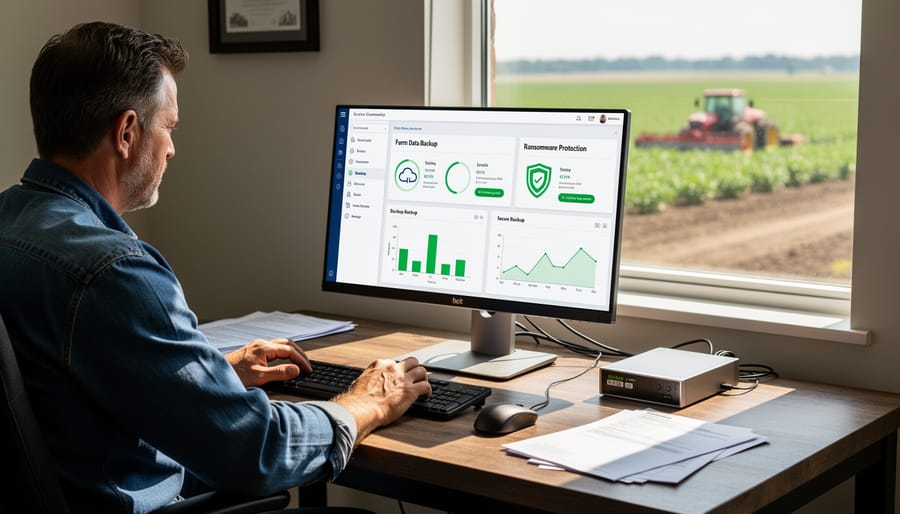
Backup hard drives and storage devices on farm office desk with laptop and paperwork
Regular backups of critical farm data ensure business continuity and protect against ransomware attacks or system failures.

Software Development Security: Choosing and Using Farm Software Safely

Choosing the right farm software is like selecting seeds for your garden—quality matters from the start. When evaluating CSA management software, prioritize vendors who take security seriously.

Ask potential software providers key questions: Do they encrypt your data? How often do they release security updates? Where are your farm records stored, and who has access? Can you export your data if you switch systems? Reputable vendors will answer these confidently and provide documentation about their security practices.

Before adopting any third-party app or tool, research the company’s reputation. Read reviews from other farmers, check how long they’ve been in business, and verify they comply with privacy regulations. Avoid downloading apps from unofficial sources.

Keep all software updated regularly. Those update notifications aren’t just annoying—they often patch security vulnerabilities that hackers exploit. Enable automatic updates when possible.

Success story: Green Valley Farm switched to a vendor-supported platform after their homemade spreadsheet system became unwieldy. The farm manager now spends less time troubleshooting and more time connecting with members, knowing their customer data is professionally protected.

Remember, free software isn’t always the best deal if it compromises your farm’s security. Investing in reliable, secure tools protects both your business and your members’ trust.

Building Your Farm’s Cybersecurity Action Plan

Ready to strengthen your farm’s digital defenses? Start small and build momentum. First, assess where you are today by making a simple checklist of your current digital assets—from your customer database to your website login credentials. This inventory helps you prioritize what needs protection most urgently.

For small CSA operations, begin with quick wins that deliver immediate protection. Change default passwords on all devices, enable two-factor authentication on email accounts, and set up automatic backups for your customer database. These foundational steps cost nothing but time and dramatically reduce your vulnerability to common attacks.

Medium-sized farms might invest in password management software like Bitwarden (free version available) and create a basic incident response plan—essentially a one-page document outlining who to call if something goes wrong. The Cybersecurity and Infrastructure Security Agency offers free resources specifically designed for small businesses, including downloadable guides and security assessments.

Think of cybersecurity as similar to sustainable farming practices—both require ongoing attention, seasonal reviews, and continuous learning. Just as you wouldn’t skip soil testing or crop rotation, don’t skip monthly password updates or quarterly security reviews.

Connect with other CSA farmers through agricultural networks to share experiences and solutions. Many have faced similar challenges and discovered affordable tools that work for farm-scale operations. Consider scheduling a “digital health day” each season to review your security practices, update software, and train any team members on new protocols.

Remember, protecting your farm’s digital infrastructure protects your customers’ trust and your community’s food security. Start today, even if it’s just one small step forward.

Protecting your farm’s digital infrastructure isn’t just about technology—it’s about safeguarding the relationships and trust you’ve built with your community. As more CSA operations embrace digital local food systems, cybersecurity becomes an essential part of farm resilience, right alongside soil health and crop rotation.

The good news? You don’t need to tackle all eight domains at once. Start with the basics: create strong passwords, back up your member data regularly, and have honest conversations with your team about online safety. These small steps create a foundation that protects not just your business information, but also the personal details your members trust you with every season.

Consider the story of Green Valley Farm, which started by simply implementing two-factor authentication and regular software updates. Within six months, they’d prevented a phishing attack that could have compromised hundreds of member email addresses. Their commitment to digital security strengthened member confidence and became part of their farm’s reputation for reliability.

Remember, sustainable agriculture extends beyond organic practices and regenerative farming—it includes building systems that can withstand modern challenges. By taking practical steps to secure your digital operations, you’re investing in your farm’s future, protecting your community’s privacy, and contributing to a more resilient local food movement. Start small, stay consistent, and watch your digital security grow alongside your crops.

How Smart Technology Transforms Your Urban CSA Garden into a Thriving Food System

Posted by darrell on
0
Technology and Innovation
How Smart Technology Transforms Your Urban CSA Garden into a Thriving Food System

Map your growing space by measuring every sunny spot—balconies, windowsills, rooftops, and shared yards—then calculate hours of direct sunlight each location receives daily. This data-driven approach helps you match crops to microclimates, ensuring tomatoes claim your south-facing balcony while shade-tolerant lettuce thrives under partial cover.

Design vertical growing systems using wall-mounted planters, trellises, and tiered shelving to multiply your productive area without expanding your footprint. A 4×8 foot balcony can yield over 100 pounds of produce annually when you grow upward rather than outward, stacking herbs, greens, and vining crops in carefully planned layers.

Schedule succession plantings every two weeks using a simple calendar system that tracks planting dates, expected harvest windows, and crop rotation patterns. This planning method prevents feast-or-famine cycles and keeps fresh vegetables flowing from spring through fall, maximizing every container’s productivity throughout the growing season.

Connect with urban Community Supported Agriculture programs that provide proven growing blueprints and seasonal crop plans tailored to city conditions. These partnerships offer structured guidance for beginners while creating food security through coordinated neighborhood efforts. Urban farmers who adopt integrated planning methods report harvesting 3-5 times more produce than those using random, unplanned approaches.

Transform scattered containers into productive mini-farms by treating your urban space as a complete agricultural system where every element—from water collection to companion planting—works together intentionally.

What Integrated Urban Planning Means for Your Garden

The CSA Connection: From Farm to Urban Plot

Traditional Community Supported Agriculture models are experiencing an exciting urban evolution. Instead of simply delivering produce from distant farms, modern CSA programs are embracing integrated urban planning to create interconnected food networks right in the heart of cities. This transformation turns urban members from passive consumers into active participants in local food production.

Urban CSA farms now work closely with city planners to establish micro-farms on vacant lots, rooftop gardens, and underutilized green spaces. These small-scale operations serve as demonstration sites and educational hubs, showing residents how professional farming techniques can scale down for home gardens. Members learn directly from farmers during work shares, then apply those same principles to their backyard plots or balcony containers.

The real magic happens when home gardens become recognized extensions of the larger CSA system. Some programs now offer seed sharing initiatives, where members receive the same heirloom varieties grown at the main farm. Others coordinate neighborhood growing clusters, where several households focus on different crops and share their harvests, mimicking the diversity of a traditional CSA box.

Sarah Martinez, a CSA member in Portland, transformed her 400-square-foot backyard into a productive plot after working weekend shifts at her local urban farm. “I grew enough tomatoes and herbs last season to supply three neighboring families,” she shares. “We’re essentially creating our own micro-CSA network, and it started with what I learned through the main farm’s integrated planning workshops.”

This model proves that urban agriculture isn’t just about individual gardens but rather coordinated systems that strengthen community food security together.

Why Your Backyard Matters to City Food Security

Your backyard might seem like just a small patch of green space, but when connected through smart planning systems, it becomes part of something much bigger. Individual urban gardens collectively create a network of local food production that strengthens community resilience during supply chain disruptions and reduces reliance on distant food sources.

Think of integrated planning as connecting the dots between your tomato plants and your neighbor’s herb garden, then linking those to community plots and local CSA farms. When cities implement coordinated urban agriculture solutions, they create systems where resources like compost, seeds, and knowledge flow efficiently between growers.

The impact is real. In Detroit, networked urban gardens now produce over 400,000 pounds of food annually, demonstrating how individual efforts add up. Your backyard contributions matter because they diversify what your neighborhood grows, reduce food miles, and create living examples that inspire others to start growing.

Smart planning systems help track what each garden produces, identify gaps in local food availability, and coordinate seasonal growing schedules. This transforms scattered individual efforts into a cohesive food security strategy that benefits everyone in your community.

Technology That Makes Urban Growing Smarter, Not Harder

Aerial view of urban rooftop garden with raised beds and soil moisture sensors
Smart sensors integrated into urban rooftop gardens help maximize yields in limited city spaces while optimizing water and resource use.

Sensors and Automation: Your Garden’s Digital Assistant

Urban gardening doesn’t require constant vigilance when you have the right digital tools working alongside you. Modern sensors and automation systems act as your garden’s tireless assistant, monitoring conditions and responding to your plants’ needs even when you’re at work or away.

Soil moisture sensors are the perfect entry point for beginners. These affordable devices measure water levels in your soil and send alerts to your phone when plants need watering. Basic models start around $20-30, while smart sensors with Bluetooth connectivity range from $50-100. They eliminate guesswork and prevent both overwatering and drought stress, crucial for apartment balconies where you can’t easily check soil daily.

Compact weather stations designed for urban settings track temperature, humidity, rainfall, and sunlight. These mini stations help you understand your microclimate—essential information since rooftop conditions differ dramatically from ground-level patios. Expect to invest $75-150 for reliable models that sync with smartphone apps.

Automated watering systems transform how city dwellers maintain gardens. Simple drip irrigation kits with timers cost $30-60 and work perfectly for balcony container gardens. More sophisticated systems ($150-300) integrate with moisture sensors and weather data, adjusting watering schedules automatically. This technology proves invaluable during summer vacations or busy work weeks.

Maria, a Toronto CSA member, installed a basic moisture sensor system in her vertical garden last spring. “I was drowning my tomatoes and under-watering my peppers,” she shares. “Now my phone tells me exactly what each section needs. My harvest doubled, and I’m spending less time worrying.”

The beauty of these systems is scalability. Start with one moisture sensor, then expand as you gain confidence. As IoT technology transforms commercial farming, similar tools become increasingly accessible and affordable for home gardeners seeking efficiency in limited urban spaces.

Apps That Connect Growers and Build Community

Technology is bringing urban growers together in exciting new ways, making it easier than ever to share knowledge, coordinate harvests, and build thriving digital communities around local food production.

Apps like Crop Swap and ShareHarvest connect neighbors who want to exchange surplus produce, seeds, and gardening supplies. These platforms help reduce food waste while strengthening community bonds. Simply post what you have available, browse nearby offerings, and arrange pickups with fellow growers in your area.

For CSA members, coordination apps like Harvie and Local Line streamline communication between farms and shareholders. Members can customize their weekly shares, swap items they don’t want, and even pick up extra produce when available. The real-time updates keep everyone informed about harvest schedules and farm happenings.

Knowledge-sharing platforms such as GrowIt! and PlantSnap function as social networks specifically for gardeners. Upload photos of your urban garden, identify unfamiliar plants, troubleshoot pest problems, and get advice from experienced growers worldwide. These apps create supportive spaces where beginners feel comfortable asking questions and experts enjoy sharing their wisdom.

Many urban farms now use apps like Growing Gardens to manage volunteer schedules, workshop registrations, and community events. Members receive notifications about planting days, harvest festivals, and educational sessions, making participation effortless.

These digital tools transform isolated backyard efforts into collaborative movements, proving that even in dense cities, growers can cultivate both vegetables and meaningful connections with their neighbors.

Person checking garden monitoring app on smartphone next to vertical hydroponic growing system
Mobile apps connect urban growers to real-time garden data and community networks, making high-tech food production accessible to apartment dwellers.

Vertical and Indoor Systems: Growing Beyond Ground Level

When ground space is scarce, thinking vertically transforms your urban growing potential. Hydroponic tower systems stack growing pockets upward, allowing you to cultivate dozens of plants in the footprint of a single houseplant. These innovative structures use nutrient-rich water instead of soil, making them perfect for balconies and patios where weight matters.

Indoor growing has evolved dramatically with LED grow light technology. These energy-efficient lights mimic natural sunlight, enabling year-round harvests regardless of weather or season. Modern LED systems use specific light spectrums to boost plant growth while consuming 40-60% less energy than traditional grow lights. You can now grow fresh lettuce, herbs, and even tomatoes right in your kitchen or spare bedroom.

Smart indoor systems take the guesswork out of urban farming. Automated controllers monitor moisture levels, adjust lighting schedules, and alert you when plants need attention. Some systems connect to smartphone apps, letting you tend your garden remotely during busy workdays.

Take Maria from Chicago, who transformed her studio apartment’s unused corner into a thriving vertical garden. Using a simple tower system and LED lights, she grows enough salad greens and herbs to supply her weekly meals and share with neighbors. She reports saving over $50 monthly on produce while enjoying fresher, pesticide-free food.

Starting small is key. Begin with a countertop herb garden to learn the basics, then expand as your confidence grows. The beauty of vertical and indoor systems is their scalability—you control exactly how much space and effort you invest.

Group of urban gardeners working together and sharing harvest in city backyard garden
Urban CSA members collaborate in shared growing spaces, combining traditional community-supported agriculture with modern city gardening techniques.

Real Success: Urban Growers Making It Work

The best proof that integrated urban planning works? Real people growing real food in real cities. Let’s meet some urban growers who’ve cracked the code.

Sarah Chen transformed her Brooklyn apartment building’s rooftop into a thriving CSA that now feeds 25 neighborhood families. She started with just three raised beds and a simple drip irrigation system controlled by her smartphone. By mapping sun exposure throughout the day and using vertical growing structures, Sarah maximized every square foot. Her secret weapon? A combination of automated watering scheduled around weather forecasts and a detailed planting calendar that ensures continuous harvests from April through November. What began as a personal experiment now generates enough produce to supply weekly shares while building community among her neighbors.

In Detroit, Marcus Williams turned his backyard and two vacant side lots into an urban farm that supplies three local restaurants. His integrated approach combines solar-powered irrigation, companion planting strategies, and a simple spreadsheet system that tracks what to plant when. Marcus emphasizes that you don’t need expensive technology to succeed. His planning notebook and basic weather app help him stay ahead of planting deadlines and pest problems. The key, he says, is consistency and observation.

Even balcony gardeners are seeing remarkable results. Lima Rodriguez feeds her family of four with vegetables grown entirely on her Chicago apartment balcony. She uses container gardens with self-watering systems and follows a succession planting schedule she learned from online gardening communities. By growing vertically and choosing high-yield varieties like cherry tomatoes, peppers, and leafy greens, Lima harvests something fresh almost daily during the growing season.

These growers share common threads: they all started small, learned from mistakes, and used simple planning tools to track what worked. They prove that integrated urban planning isn’t about having the perfect setup or expensive equipment. It’s about understanding your space, using available resources wisely, and staying committed to the process. Whether you have a rooftop, backyard, or just a sunny balcony, their stories show that thoughtful planning makes urban food production not just possible, but genuinely rewarding.

Getting Started: Your First Steps Toward an Integrated Garden

Assess Your Space and Resources

Before diving into urban agriculture, take time to understand what you’re working with. Start by observing your available space throughout the day. Which areas receive at least six hours of direct sunlight? These prime spots are perfect for fruiting plants like tomatoes and peppers, while shadier corners work well for leafy greens.

Next, evaluate your water situation. Is there easy access to a hose or outdoor faucet? Consider installing rain barrels to harvest free water while reducing your environmental footprint. One urban farmer in Chicago saved 40% on her water bill by collecting rainwater from her roof.

Measure your actual growing space, whether it’s a balcony, rooftop, or small yard. Don’t let limited square footage discourage you. Vertical gardens, container systems, and intensive planting methods can transform even tiny areas into productive gardens.

Finally, establish a realistic budget. Factor in initial setup costs for containers, soil, seeds, and any technology like drip irrigation systems or grow lights. Remember that many investments, like quality containers and automated watering systems, pay dividends through years of use. Start small if needed—you can always expand as you gain experience and confidence in your urban growing journey.

Start Small, Scale Smart

You don’t need to transform your entire urban garden overnight. The most successful city growers start with one or two simple technologies and expand as they learn what works in their specific environment. Begin by choosing a single system that addresses your biggest challenge. If watering is your struggle, try a basic drip irrigation timer before investing in a smart controller. If space is tight, test one vertical growing structure before covering every wall.

Consider running small experiments. Set up moisture sensors in half your containers while watering the others manually, then compare plant health and water usage over a month. This hands-on approach teaches you what your plants actually need rather than guessing. Maria, a Brooklyn balcony gardener, started with just three self-watering containers. After seeing her tomato yields double, she gradually expanded to 15 containers with a rainwater collection system.

Track what you observe in a simple notebook or phone app. Note which plants thrive, when pests appear, and how much you harvest. These insights become invaluable when deciding where to invest time and resources next. Remember, urban farming is about progress, not perfection. Each growing season offers new lessons that help you refine your approach and scale thoughtfully.

Overcoming Common Urban Growing Challenges

Urban gardening comes with its fair share of hurdles, but integrated planning paired with smart technology turns these obstacles into opportunities. Let’s explore how modern solutions tackle the common urban farming challenges that city growers face.

Limited space ranks as the biggest concern for urban farmers. Vertical growing systems, including tower gardens and wall-mounted planters, maximize every square foot available. Many urban CSAs now use tiered shelving with grow lights to transform small warehouses into productive farms. By mapping your space digitally using garden planning apps, you can optimize layouts and calculate exactly how many plants fit in your area.

Contaminated soil presents another significant barrier in cities where industrial history left behind harmful residues. Raised beds with purchased organic soil provide a clean growing medium, while container gardening eliminates ground contact entirely. Some urban farmers use soil testing kits to assess contamination levels before planting, then choose appropriate growing methods based on results.

Unpredictable microclimates make urban growing tricky. Tall buildings create wind tunnels and shade patterns that shift throughout the day. Temperature variations between sunny pavement and shaded areas can differ by 15 degrees. Weather monitoring stations and smartphone apps help you track these variations, allowing you to position heat-loving tomatoes in warm spots while placing leafy greens in cooler zones.

Water management also challenges city growers. Integrated drip irrigation systems with timers ensure consistent moisture without waste, while rainwater collection barrels turn rooftops into water sources. These technologies, combined with moisture sensors that alert you via smartphone, prevent both drought stress and overwatering, helping your urban garden thrive despite city conditions.

The beauty of integrated urban planning is that it transforms what seems impossible into something genuinely achievable. By combining thoughtful space design with accessible technology like soil sensors, vertical growing systems, and simple planning apps, city dwellers can create thriving food gardens right where they live. You don’t need a sprawling farm or expensive equipment to participate in CSA programs or grow your own fresh produce.

The success stories we’ve explored prove that anyone can start small and scale up gradually. Whether you’re joining a community garden with shared technology resources or setting up a modest balcony garden with a few smart tools, taking that first step matters most. Connect with your local CSA programs to learn what’s possible in your neighborhood and discover what resources already exist in your community.

Technology has democratized urban agriculture, making it accessible to beginners and experienced gardeners alike. Start by assessing your available space, research one or two tech tools that match your budget, and begin growing something simple. Your urban garden journey doesn’t have to be perfect from day one. The important thing is to begin, learn as you grow, and enjoy the fresh, organic produce you’ve cultivated yourself while contributing to a more sustainable food system in your city.

Personalized Farewell Ceremonies Using Poems and Tree Burial Pods

Posted by darrell on
0
Categories
Personalized Farewell Ceremonies Using Poems and Tree Burial Pods

Modern funeral practices are shifting toward ceremonies that reflect individual lives rather than following rigid traditions. Families increasingly seek alternatives that blend emotional expression with environmental consciousness, turning to elements like meaningful poetry recitations and biodegradable burial methods. Short poems for scattering ashes offer structured moments of reflection, while tree burial pods transform grief into growth. These personalized approaches raise important questions about how memorial choices can honor both the deceased and the values they held throughout their lives.

Why Personalization Matters in Modern Farewell Ceremonies

The evolution of funeral services reflects a broader cultural shift away from standardized rituals toward ceremonies that honor individual lives authentically.

Modern families increasingly reject one-size-fits-all approaches, seeking instead to celebrate what made their loved ones unique. Personalization transforms funerals from generic observances into meaningful tributes that capture specific personalities, passions, and values.

This customization extends beyond memorial service elements to final disposition choices. Traditional burials and cremations no longer satisfy everyone’s wishes for how they return to nature or leave their mark.

Incorporating personal poetry readings or choosing eco-conscious options like tree burial pods demonstrates how individualization now permeates every aspect of farewell planning. These personalized elements provide genuine comfort to grieving families, creating memories that reflect their loved one’s authentic spirit rather than conforming to impersonal conventions.

Using Short Poems for Scattering Ashes to Express Love and Remembrance

Among the most intimate personalization choices families make, selecting words to accompany ash scattering ceremonies carries profound emotional weight. Short poems provide structured yet meaningful expressions when emotions overwhelm spontaneous speech.

These verses capture relationships, memories, and final wishes in condensed form, making them ideal for outdoor settings where brevity suits the moment. Families often choose poems reflecting the deceased’s connection to nature, favorite locations, or personal philosophies. Maritime verses accompany ocean scatterings, while woodland imagery complements forest releases.

Some select classical poetry; others commission custom pieces incorporating specific details about their loved one. The recitation itself creates ceremonial structure, marking the shift from physical presence to memory.

Words spoken aloud unite mourners in shared remembrance, transforming ash scattering from solitary act into communal tribute honoring the departed.

Selecting Words and Readings That Reflect a Life Well Lived

When families gather to celebrate a life’s journey, the readings they select serve as verbal portraits capturing essential truths about the person who has died. These carefully chosen words should mirror individual passions, values, and character traits that defined their existence.

A nature enthusiast might be honored through passages describing forests, oceans, or wildlife. Someone devoted to service could be remembered with humanitarian writings. Literary lovers deserve excerpts from beloved authors, while spiritual individuals benefit from sacred texts reflecting their faith traditions.

Personal writings, journal entries, letters, or original poetry, offer intimate glimpses into authentic perspectives. Combining professional literature with the deceased’s own words creates powerful tributes.

Selections need not be somber. Humorous anecdotes, adventure stories, or uplifting verses celebrating joy align perfectly with vibrant personalities, ensuring ceremonies genuinely represent lives fully lived.

How a Tree Burial Pod Supports Symbolic and Nature-Based Memorials

Tree burial pods transform death into regeneration by encasing remains within biodegradable vessels designed to nourish saplings planted above them. This method creates living memorials that grow stronger over time, replacing traditional stone markers with forests that breathe and evolve.

Families select tree species meaningful to the deceased, perhaps an oak symbolizing strength or a cherry representing beauty and impermanence. The pod’s organic materials gradually decompose, releasing nutrients that sustain root development and growth cycles.

These nature-based memorials align with ecological values while offering tangible connection points for mourners. Visiting a thriving tree provides comfort through visible transformation, demonstrating how endings feed new beginnings.

The practice reduces environmental impact compared to conventional burials, eliminating embalming chemicals and non-biodegradable materials while contributing to reforestation efforts and carbon sequestration.

Planning a Meaningful Ceremony That Honors Personal Values

How does one design a farewell ceremony that authentically reflects a person’s beliefs, passions, and lived experiences? The process begins with gathering insights from loved ones about what mattered most to the deceased.

Consider their relationship with nature, spiritual beliefs, favorite places, and cherished activities. Incorporate meaningful elements that represent their values. An environmentalist might prefer a tree burial pod ceremony in a forest setting. A poet’s service could feature readings of their work or beloved verses. Musicians may want instrumental performances rather than traditional hymns.

Select a location that held significance, a garden they tended, a hiking trail they loved, or a quiet woodland grove. Invite participants who shared meaningful connections. Choose rituals that feel genuine rather than obligatory, creating an authentic tribute to their unique life.

Involving Family and Friends in the Farewell Process

Active participation transforms a farewell ceremony from a passive observance into a shared act of remembrance and healing. Family members can read selected poems that reflect the deceased’s personality, values, or favorite literary works. Friends might share personal stories that illuminate cherished memories and character traits.

Practical involvement deepens connection to the ceremony. Participants can help plant the tree burial pod together, symbolizing collective nurturing of new life. Others may create visual tributes, compile photo displays, or contribute written reflections to a memorial book.

Assigning specific roles guarantees everyone feels included. Children can draw pictures or select flowers. Musicians may perform meaningful songs.

This collaborative approach acknowledges grief as a communal experience while honoring individual relationships with the deceased.

Creating a Lasting Legacy Through Thoughtful Memorial Choices

Beyond the ceremony itself, memorial choices shape how a person’s memory endures for generations. Tree burial pods offer an environmentally conscious alternative that transforms remains into nourishment for living trees, creating tangible symbols of life’s continuity.

These biodegradable vessels allow families to visit meaningful spaces where nature flourishes rather than static gravesites.

Selecting memorial poems adds intellectual and emotional depth to legacies. Verses chosen for headstones, plaques, or digital memorials communicate values and philosophies that defined the deceased.

Whether classical literature or contemporary works, these words provide comfort and connection for future generations seeking understanding of their ancestors.

Combining ecological burial methods with carefully curated poetry creates multidimensional tributes. Physical trees represent growth and renewal while selected verses preserve wisdom and personality, ensuring memories remain vibrant and accessible.

Smart Livestock Feeding: How to Optimize Livestock Nutrition With Online Feed Sources and Calculators

Posted by darrell on
0
Categories
Smart Livestock Feeding: How to Optimize Livestock Nutrition With Online Feed Sources and Calculators

Modern livestock producers face mounting pressure to maximize efficiency while maintaining animal health and profitability. Traditional feeding methods, reliant on guesswork and generalized rations, often result in nutrient imbalances, excessive waste, and suboptimal performance. The agriculture industry now stands at a critical juncture where digital tools can transform nutritional management entirely. Online feed sources and precision calculators offer producers unprecedented access to data-driven insights that align feed composition with specific herd requirements, fundamentally changing how nutrition strategies are developed and implemented.

The Shift Toward Smarter Livestock Nutrition Planning

Modern livestock operations face mounting pressure to balance animal health, production efficiency, and economic viability while reducing environmental impact. Traditional feeding approaches relied heavily on standardized ration formulations and generalized nutritional guidelines that often resulted in overfeeding or nutrient imbalances.

Digital transformation has introduced sophisticated tools that enable precision nutrition management. Online feed databases provide real-time nutritional composition data, while advanced calculators account for variables including animal weight, production stage, breed characteristics, and environmental conditions.

These technologies allow farmers to formulate customized rations that match specific herd requirements. The shift toward data-driven nutrition planning reduces feed waste, lowers costs, and minimizes nutrient excretion into the environment.

Producers can now make informed decisions based on accurate nutritional analysis rather than approximations, resulting in improved animal performance and profitability.

How Livestock Food Online Expands Access to Quality Feed Options

Online marketplaces have fundamentally altered how farmers source feed materials and supplements. Digital platforms now connect producers directly with specialized feed suppliers, eliminating geographical barriers that previously limited access to premium ingredients. Buying goat food online is not a burden in 2026 and beyond

Farmers in remote areas can order nutritional concentrates, mineral supplements, and specialized grains previously unavailable through local distributors.These platforms provide detailed product specifications, nutritional analyses, and ingredient transparency that traditional supply chains often lack. Producers can compare formulations, verify certifications, and read verified reviews before purchasing. Bulk ordering options and subscription services reduce costs while ensuring consistent supply.

The competitive marketplace drives suppliers to maintain higher quality standards and offer innovative products. Real-time inventory systems prevent shortages, while direct shipping reduces handling and preserves feed freshness, ultimately supporting more precise nutritional management.

Using a Feed Calculator to Match Nutrition With Animal Age and Purpose

Precision feeding requires matching nutritional inputs to specific physiological demands, which vary dramatically across growth stages, production purposes, and species.

Feed calculators enable producers to input variables like animal weight, age, breed, and intended outcome, whether for meat production, dairy, breeding, or maintenance, to generate tailored ration recommendations. These digital tools account for metabolic differences between young, growing animals requiring higher protein ratios and mature livestock needing maintenance-level nutrition.

Dairy cattle demand calcium and energy-dense formulations, while beef cattle finishing operations prioritize energy concentration for weight gain. Layer hens require distinct nutritional profiles compared to broilers. Horse feed calculators are often present in websites selling horse food.

Modern calculators integrate scientific feeding standards with real-time ingredient analysis, preventing both nutritional deficiencies and costly overfeeding. This data-driven approach maximizes feed conversion efficiency, optimizes growth rates, and reduces waste.

Balancing Protein, Energy, and Minerals for Optimal Animal Health

Why do nutritional imbalances remain a primary cause of production losses and health complications in livestock operations? The answer lies in the complex interplay between protein, energy, and minerals that must align with specific production stages.

Protein deficiencies reduce growth rates and milk production, while excess protein burdens kidney function and increases nitrogen waste. Energy imbalances directly affect body condition, insufficient energy mobilizes body reserves, whereas surplus energy leads to obesity and metabolic disorders. Mineral deficiencies create cascading health issues. Calcium and phosphorus imbalances cause skeletal problems and milk fever. Selenium deficiency triggers white muscle disease, while copper deficiency impairs immune function.

Online calculators help producers identify ideal ratios for their specific animals. These tools account for breed, age, weight, and production purpose, preventing costly nutritional errors that compromise profitability and animal welfare.

Reducing Feed Waste and Costs Through Data-Driven Feeding Decisions

Feed costs represent 50-70% of total livestock production expenses, making waste reduction an immediate opportunity for improved profitability.

Data-driven feeding systems enable producers to calculate precise ration quantities based on animal weight, production stage, and nutritional requirements, eliminating guesswork and overfeeding. Digital feed calculators analyze feed composition, nutrient availability, and animal performance metrics to optimize ingredient combinations. This targeted approach prevents nutrient excesses that animals cannot utilize, reducing both waste and environmental nitrogen output.

Real-time monitoring of feed conversion ratios identifies inefficiencies quickly, allowing immediate corrective action. Tracking feeding patterns through software reveals seasonal trends and helps predict future feed needs accurately. Producers can purchase ingredients strategically when prices are favorable, avoiding emergency purchases at premium costs.

Documentation also supports compliance with regulatory requirements while improving overall herd management decisions.

Seasonal and Production-Based Adjustments in Feeding Strategies

Livestock nutritional requirements fluctuate considerably throughout the year and across different production phases, demanding flexible feeding protocols rather than static rations.

Winter months typically necessitate increased energy supplementation to maintain body temperature, while summer heat may require dietary adjustments to compensate for reduced feed intake. Pregnant and lactating animals demand elevated protein and mineral levels compared to maintenance requirements.

Online feed calculators enable producers to modify rations efficiently based on these variables. Inputting seasonal temperatures, production stage, and current body condition scores generates precise nutritional recommendations.

Shifting cattle from backgrounding to finishing phases, for example, requires progressive grain increases while reducing forage percentages. Similarly, ewes approaching lambing need concentrated energy sources.

Digital tools eliminate guesswork, ensuring animals receive appropriate nutrients precisely when physiological demands change, optimizing both performance and feed efficiency.

Building Long-Term Herd Performance With Digital Nutrition Tools

Consistent application of digital nutrition tools creates extensive datasets that reveal patterns invisible through traditional record-keeping methods.

These accumulated records enable producers to identify which feeding strategies consistently yield superior results across different conditions and animal groups. Data-driven insights help optimize replacement heifer development, ensuring future productivity while controlling costs. Digital platforms track individual animal performance metrics, allowing early detection of nutrition-related issues before they impact herd health or production levels.

Long-term analysis reveals correlations between specific feed formulations and outcomes like reproductive efficiency, milk quality, or growth rates. This evidence-based approach eliminates guesswork from nutritional management decisions. Producers can benchmark their operations against historical performance and industry standards, identifying improvement opportunities.

Integration of multiple data sources creates predictive models that forecast nutritional needs and economic returns with increasing accuracy over time.

How AI Loan Matching Is Saving Small CSA Farms From Financial Collapse

Posted by darrell on
0
Categories
How AI Loan Matching Is Saving Small CSA Farms From Financial Collapse

Match your farm’s financial needs with the right lender using AI-powered platforms that analyze your CSA operation’s unique characteristics—from subscriber numbers to crop diversity—and connect you with specialized agricultural lenders in minutes rather than months. Upload your farm’s financial documents, revenue projections, and business plan to these intelligent systems that compare hundreds of online loans without credit check simultaneously, identifying products that evaluate alternative data points like customer retention rates and seasonal cash flow patterns, including options you might never find through traditional banking channels.

Community Supported Agriculture faces distinct financing challenges that conventional loan officers rarely understand. Your CSA’s subscription-based model, seasonal revenue cycles, and customer prepayments create financial patterns that traditional underwriting algorithms flag as risky. AI loan matching technology recognizes these patterns as strengths, not weaknesses.

Take Sarah Chen, who runs Green Valley Farm in Vermont. After two years of rejected bank applications, she used an AI matching platform that connected her with an agriculture-focused credit union within 48 hours. The system highlighted her 92% subscriber renewal rate and waitlist of 30 families—data points traditional lenders had overlooked—securing her a $75,000 equipment loan that transformed her operation.

These platforms democratize access to capital by removing geographic barriers and human bias from initial screenings. Whether you’re launching your first CSA or expanding from 50 to 200 shares, AI matching helps you find lenders who genuinely understand regenerative agriculture’s financial model and long-term value.

Why Traditional Lending Fails CSA Farmers

For Sarah Chen, a third-generation farmer launching her CSA operation in Vermont, the bank meeting felt like speaking different languages. Despite her detailed business plan and waiting list of eager subscribers, the loan officer seemed puzzled by her model. “But when do customers actually pay you?” he asked, flipping through projections that showed concentrated income during spring sign-ups and harvest season.

This scenario plays out repeatedly across North America. Traditional lenders struggle to understand the CSA model’s unique rhythm, creating frustrating barriers for farmers seeking growth capital.

The seasonal cash flow pattern inherent to CSA operations immediately raises red flags in conventional lending systems. While subscription payments often arrive upfront in late winter or early spring, significant expenses—equipment repairs, seed purchases, greenhouse maintenance—hit during the same period. Then comes the “hungry gap” of early season when cash reserves dwindle before harvest begins. This doesn’t indicate poor CSA farm profitability, but standard underwriting algorithms interpret these fluctuations as instability.

Collateral presents another stumbling block. Many CSA farmers operate on leased land or own property with conservation easements that limit its value as security. Their assets—hoop houses, washing stations, walk-in coolers—don’t translate easily into resale values that banks recognize.

Credit history compounds these challenges. Farmers transitioning from other careers or young growers establishing their first operations often lack extensive business credit. Their subscriber relationships, community reputation, and farming expertise carry tremendous real-world value but don’t appear on credit reports.

Perhaps most frustrating is the knowledge gap. Loan officers unfamiliar with agricultural nuances miss the strength signals inherent to successful CSA operations: high renewal rates, diversified crop plans, established distribution networks, and strong community ties. These indicators of stability and success simply don’t fit traditional lending frameworks, leaving viable farm businesses without access to capital that could fuel expansion, improve infrastructure, and strengthen local food systems.

Small organic CSA farm with diverse vegetable rows and rustic distribution building
Small CSA farms face unique financial challenges that traditional lenders often fail to understand, making capital access difficult.

What AI Loan Matching Actually Does for Your Farm

Smart Analysis of Your Farm’s Financial Story

Traditional lenders often overlook what makes CSA farms truly valuable. When you apply for conventional financing, banks focus heavily on credit scores and standard financial statements—metrics that don’t capture the unique strengths of your subscription-based farming operation.

AI-powered loan matching changes this game entirely. These intelligent systems dig deeper into what really matters for CSA success. They analyze your member retention rates, showing lenders that your 85% renewal rate demonstrates customer loyalty and predictable revenue. The technology recognizes seasonal cash flow patterns inherent to farming, understanding that February looks different from July—and that’s perfectly normal.

Your subscription growth trends tell a compelling story that AI can translate for lenders. If you’ve steadily increased from 50 to 120 member shares over three years, that progression matters more than a single quarter’s snapshot. The system also evaluates delivery consistency, member satisfaction indicators, and even your waiting list size as positive financial markers.

This smart analysis means you’re not competing against traditional businesses with different models. Instead, you’re matched with lenders who understand and value the community-supported agriculture approach, increasing your chances of securing fair financing terms.

Farmer using tablet technology in vegetable field with harvest crates nearby
AI-powered platforms analyze CSA-specific metrics like member retention and seasonal patterns to match farmers with appropriate lenders.

Finding Lenders Who Actually Understand Agriculture

One of the biggest frustrations CSA farmers face is sitting across from loan officers who simply don’t understand the seasonal nature of agriculture or the value of community-supported farming models. Traditional banks often view CSA operations as risky because they lack familiarity with this subscription-based approach to farming.

This is where AI loan matching becomes transformative. These platforms analyze your farm’s specific profile—including your CSA membership base, crop diversity, and sustainable practices—then connect you with lenders who actually specialize in agricultural financing. Instead of casting a wide net and hoping for the best, you’re instantly matched with credit unions, farm-focused lenders, and alternative financing sources that recognize the stability and community value your CSA provides.

Many of these agricultural lenders appreciate metrics that traditional banks overlook, like your customer retention rate, pre-season subscription sales, and commitment to regenerative practices. Some even offer favorable terms specifically for organic and sustainable operations.

Take Sarah Chen’s story: after being rejected by three conventional banks, an AI matching platform connected her with a regional agricultural credit union within 48 hours. They understood her CSA model immediately and approved her greenhouse expansion loan within two weeks. “They asked about my crop rotation plans and member satisfaction rates,” Sarah recalls. “Finally, someone who spoke my language.”

The technology eliminates the exhausting process of researching dozens of lenders individually, saving you valuable time you’d rather spend in the field.

Real CSA Farmers Who Found Funding Through AI Matching

Sarah Martinez discovered AI loan matching at a pivotal moment for her 15-acre CSA operation in Oregon’s Willamette Valley. After three years of managing her farm with borrowed equipment, she needed $45,000 to purchase a walk-in cooler and washing station. Traditional banks had turned her down twice, citing limited collateral and her farm’s short operating history.

“I spent maybe twenty minutes entering my farm’s information into an AI matching platform,” Sarah recalls. “Within 48 hours, I had responses from four different lenders who actually understood agriculture.” She secured a loan through a regional farm credit union that the algorithm identified based on her crop mix, customer retention rate, and commitment to organic practices. The new infrastructure allowed her to extend her growing season and increase her member base from 85 to 140 families within eighteen months.

Marcus and Jennifer Thompson faced a different challenge at their Iowa CSA farm. They wanted to expand from five to twelve acres but needed $120,000 for land purchase and soil amendments to transition the new acreage to organic certification. Their AI matching experience connected them with an agricultural-focused CDFI that specialized in organic transition financing.

“The platform highlighted our three-year waitlist and strong community connections from economic impact studies we’d participated in,” Marcus explains. “Those weren’t things our local bank even asked about.” The couple received favorable terms with deferred payments during the three-year organic transition period. Today, they supply 200 member families and employ four seasonal workers.

Even smaller investments can transform operations. Devon Chen used AI matching to secure a $15,000 microloan for high tunnel construction at his urban CSA farm outside Seattle. The algorithm connected him with a nonprofit lender focused on new farmers of color and sustainable agriculture initiatives.

“I didn’t know that lender existed,” Devon says. “The AI found them based on my demographics, farm size, and business model.” The high tunnels extended his growing season by two months, allowing him to offer winter shares for the first time and boost annual revenue by 35%.

These farmers share a common thread: AI matching didn’t just find them money—it found them the *right* partners who understood their unique business models and long-term sustainability goals.

CSA farmer standing with new commercial cooling and washing equipment funded through alternative lending
Successful CSA farmers have used AI loan matching to secure funding for critical infrastructure like cooling equipment and processing facilities.

Getting Started: What You Need to Apply

Before diving into AI loan matching platforms, gathering the right documentation will streamline your application and improve your chances of securing favorable terms. Think of this preparation as creating a comprehensive snapshot of your farm’s health and potential.

Start with your **financial fundamentals**. You’ll need at least two years of tax returns, profit and loss statements, and balance sheets. Don’t worry if your early years show modest profits—lenders understand that building a CSA takes time. Include bank statements from the past 3-6 months and a list of current debts with payment schedules.

Your **farm metrics** tell the story behind the numbers. Document your current acreage, crop varieties, growing seasons, and production volumes. Include your CSA membership numbers (current and historical), average share prices, and retention rates. These details demonstrate market demand and business stability.

A solid **business plan** is essential, but keep it practical. Outline your 3-5 year growth projections, expansion plans, and how loan funds will be used specifically. Will you purchase equipment, expand greenhouse capacity, or increase distribution? Be concrete. Many successful farmers also include their approach to sustainable farming practices, which resonates with mission-driven lenders.

**CSA-specific documentation** strengthens your application significantly. Share member testimonials, renewal rates, and waiting list numbers if applicable. Include photos of your operation, harvest records, and evidence of community engagement like farmers market participation or farm-to-table partnerships.

Finally, prepare **certification documents** such as organic certification, Good Agricultural Practices (GAP) certification, or food safety plans. These demonstrate professionalism and can unlock better loan terms.

Remember Sarah from Vermont, who secured funding by showcasing her 85% member retention rate alongside traditional financials? Her thorough preparation impressed lenders and resulted in a competitive interest rate. Taking time to organize these materials upfront means less back-and-forth later and positions you as a serious, organized business owner ready for growth.

Top AI Loan Matching Platforms for Agricultural Borrowers

Several AI-powered lending platforms have emerged to specifically serve small-scale farmers, making the loan matching process surprisingly straightforward for CSA operations.

**Steward** stands out for agricultural borrowers, offering free loan matching services that connect farmers with mission-aligned lenders who understand seasonal cash flow challenges. Their AI analyzes your farm’s unique financial patterns and matches you with lenders offering terms from $10,000 to $600,000. What makes them special? They don’t charge farmers any fees—lenders pay for the service instead.

**FarmRaise** combines AI loan matching with grant-finding tools, perfect for CSA farmers pursuing organic certification or infrastructure improvements. Their platform is free to use and includes personalized recommendations based on your farm size, crops, and sustainability practices. The AI learns from successful applications, helping you craft stronger proposals.

**AgCountry Farm Credit Services** uses sophisticated algorithms to pre-qualify farmers within minutes, specializing in operations under 100 acres. Their platform understands the value of agricultural partnerships and community-supported models, often viewing CSA membership lists as positive indicators of stable revenue.

**Whole Farm Co-op Lending** offers AI-assisted matching specifically for organic operations. While they charge a small application fee ($50-100), their technology excels at finding creative financing solutions including equipment leasing and working capital lines that sync with harvest schedules.

When choosing a platform, prioritize those with transparent fee structures and proven track records with small organic farms. Look for success stories from operations similar to yours—many platforms showcase farmer testimonials demonstrating how AI matching helped secure funding that traditional banks initially rejected.

What to Watch Out For: Protecting Your Farm’s Interests

While AI loan matching opens exciting doors for CSA farmers, it’s essential to approach these tools with informed confidence. Think of the AI as a helpful guide, not a decision-maker—the final choice always rests with you.

First, carefully review interest rates and repayment terms. AI platforms may suggest multiple lenders, but the lowest rate isn’t always the best fit. Consider the full picture: Are there prepayment penalties? What happens during a challenging growing season? Look for agricultural-friendly terms that understand the seasonal nature of farming income.

Watch out for fees that can quietly add up. Some platforms charge subscription fees, while lenders may include origination fees, application fees, or service charges. Calculate the true cost of borrowing before committing.

Be cautious about sharing sensitive farm data. Reputable AI platforms use secure encryption, but always read privacy policies. Your financial information and farm metrics are valuable—ensure they’re protected and won’t be sold to third parties.

Here’s an empowering tip from successful CSA farmer Maria Rodriguez: “I always run AI recommendations past my farm mentor and accountant. The technology found options I’d never discovered alone, but having trusted advisors review the terms gave me peace of mind.” This balanced approach—embracing innovation while maintaining careful oversight—helps you leverage AI’s power while protecting your farm’s future. Remember, you’re building a sustainable operation, and the right financing should support that long-term vision.

AI loan matching is breaking down financial barriers that have long kept sustainable farming out of reach for many passionate growers. By connecting CSA farmers with lenders who understand and value organic agriculture, these tools are creating real pathways to expand operations, invest in infrastructure, and build thriving local food systems. Whether you’re just starting your farming journey or looking to scale your existing CSA, exploring AI-powered loan platforms could be the key to unlocking your next chapter.

Take the first step today: research platforms that specialize in agricultural financing, gather your farm’s financial documentation, and prepare a clear vision for how funding will support your sustainable mission. Remember, securing capital isn’t just about growing your business—it’s about nourishing your community with nutrient-dense, locally grown food for years to come.

How CSA Farms Can Actually Win Customers Through Digital Marketing

Posted by darrell on
0
Technology and Innovation
How CSA Farms Can Actually Win Customers Through Digital Marketing

Audit your current digital efforts by listing every platform where your CSA farm appears online, from your website and email list to Facebook and Instagram accounts. Evaluate which channels actually bring new members versus those consuming your time without results. Many CSA farmers discover they’re spreading themselves too thin across platforms their customers don’t even use.

Define your ideal member profile before investing another dollar in digital marketing. Ask yourself who shops at your farm stand, who stays subscribed year after year, and what problems your CSA solves for them. This clarity transforms generic social media posts into targeted messages that resonate with families seeking convenient access to organic vegetables or professionals wanting to support local agriculture.

Measure what matters by tracking specific numbers like email open rates, website farm tour requests, and social media inquiries that convert to memberships. Stop obsessing over vanity metrics like follower counts that don’t pay the bills. Set quarterly benchmarks for lead generation and member retention so you know whether your digital marketing actually strengthens your farm’s financial sustainability.

Prioritize one platform where your target audience actively engages rather than maintaining a weak presence everywhere. Focus your limited time on mastering that single channel with consistent, valuable content about seasonal harvests, sustainable farming practices, and member success stories before expanding elsewhere.

Why Most CSA Farms Get Digital Marketing Wrong

Many CSA farms dive into digital marketing with the best intentions but quickly find themselves spinning their wheels. The most common mistake? Treating all digital marketing tactics as equal priorities. Farmers often scatter their energy across Facebook, Instagram, email newsletters, blog posts, and website updates without a clear strategy connecting these efforts to actual member sign-ups.

Sarah Chen, who runs Riverside Community Farm in Ontario, learned this lesson the hard way. “I spent my first year posting beautiful photos daily on three different platforms,” she shares. “I was exhausted, and we only added twelve new members. When I finally sat down and asked myself which activities actually converted followers into paying members, I realized email was doing all the heavy work while social media just fed my ego with likes.”

Another trap is assuming you need to be everywhere at once. The truth is, successful CSA farms focus on mastering one or two channels that align with their target audience rather than maintaining a mediocre presence across every platform. This scattered approach wastes precious time that could be spent tending crops or connecting with members in person.

CSA farms also frequently confuse activity with effectiveness. Posting content regularly feels productive, but without tracking which digital marketing strategies drive membership inquiries, you’re essentially gardening in the dark. The solution starts with asking better questions about what you’re doing, why you’re doing it, and how you’ll measure success. Strategic questioning transforms random digital activities into intentional marketing that grows your farm community sustainably.

Community members shopping for fresh vegetables at local farmers market
Understanding your ideal CSA members means knowing their values, habits, and what draws them to local food communities.

Questions About Your Target Audience and Community

Who Are Your Ideal CSA Members?

Before crafting any digital marketing message, you need to understand who you’re talking to. Start by asking yourself: What age groups and family structures are most interested in my farm? Are they young families seeking healthy options for their children, or retirees passionate about supporting local agriculture? Consider their location too—are they urban dwellers craving a connection to the countryside, or nearby neighbors who want to reduce their carbon footprint?

Next, dig deeper into their values and motivations. Understanding what motivates CSA members helps you create content that resonates. Do they prioritize organic certification, sustainability practices, or simply knowing their farmer? Are they experienced cooks comfortable with unusual vegetables, or beginners who need recipe inspiration?

Finally, examine their behaviors and preferences. How do they prefer to communicate—through email newsletters, social media, or text updates? What times of day are they most active online? Do they respond better to beautiful farm photos, educational content about growing practices, or practical cooking tips? When Sarah from Riverbend Farm surveyed her members, she discovered most were working parents who checked Instagram during their morning commute, completely transforming her posting strategy and doubling her engagement within months.

Where Does Your Community Gather Online?

Understanding where your local community spends time online is essential for connecting with potential CSA members effectively. Start by asking yourself: Which social media platforms do my target customers actually use? While Facebook remains popular among families and older demographics interested in local food systems, Instagram attracts younger audiences who love beautiful farm photos and behind-the-scenes stories. Don’t assume you need to be everywhere at once.

Consider conducting an informal survey of your current members or engaging in conversations at farmers markets. Ask questions like: Do you prefer receiving farm updates through email newsletters, social media posts, or text messages? Where do you go online when researching local farms or organic produce? These insights help you focus your energy where it matters most.

Think about local online groups too. Many communities have Facebook groups dedicated to sustainable living, local food movements, or buy-and-trade networks where environmentally conscious consumers gather. Participating authentically in these spaces can build trust and awareness for your farm.

Pay attention to platform-specific behaviors as well. Are your potential members watching cooking videos on YouTube? Do they engage with farming content on TikTok? One successful CSA farmer discovered that her community loved Instagram Stories showing daily harvest activities, which required minimal editing but generated strong member engagement.

Remember, quality trumps quantity. It’s better to maintain a consistent, genuine presence on one or two platforms where your community actively gathers than spreading yourself thin across every social network available.

Questions About Your Digital Presence and Website

Is Your Website Working or Just Existing?

Your website is often the first impression potential CSA members have of your farm, so it needs to work hard for you. Start by asking yourself these honest questions: Can visitors find your CSA sign-up page within three clicks? When Sarah from Green Valley Farm redesigned her site with a prominent “Join Our CSA” button on the homepage, her membership inquiries doubled within a month.

Test your website on your smartphone right now. Does everything load quickly? Can you easily read the text without zooming? With over 60% of users browsing on mobile devices, a clunky mobile experience means lost memberships. Your navigation should be simple and intuitive—think “About,” “CSA Membership,” “What’s Growing,” and “Contact” rather than complicated menus.

Ask yourself what happens after someone expresses interest. Is there a clear path from curiosity to commitment? Your conversion path might include a simple contact form, an informative welcome email, and easy payment options. Consider whether your site answers the questions new members typically ask: What’s included? How much does it cost? Where do I pick up my produce?

Finally, examine your site loading speed using free tools like Google PageSpeed Insights. A slow website frustrates visitors and hurts your search rankings. Sometimes simple fixes like compressing images of your beautiful harvest photos can make a significant difference. Your website should be your hardest-working farmhand, cultivating relationships even while you’re tending crops.

What Content Actually Helps People Decide?

Before investing time and money into digital marketing, ask yourself what kind of content genuinely helps potential members overcome their hesitations about joining a CSA. The most effective content addresses real concerns that keep people from committing.

Start by asking: What questions do newcomers ask most frequently? Common concerns include meal planning with unfamiliar vegetables, storage tips, recipe ideas, and understanding what comes in the weekly share. Creating content that answers these questions positions your farm as helpful rather than just promotional.

Consider whether your digital marketing demonstrates transparency about your farming practices. Share behind-the-scenes glimpses of your growing methods, pest management approaches, and how you handle challenging weather conditions. This openness builds trust with environmentally conscious consumers who want to know exactly where their food comes from.

Ask if your content educates rather than simply sells. Brief growing tips, seasonal eating guides, and simple preservation techniques add value beyond asking people to sign up. When someone discovers your helpful article about storing root vegetables through winter, they remember your farm when CSA sign-up season arrives.

Think about whether you’re sharing authentic farmer success stories and challenges. People connect with real experiences more than polished marketing messages. A short post about successfully transitioning to no-till methods or introducing a new crop variety shows your commitment to continuous improvement and sustainable practices.

Finally, evaluate if your content timing aligns with decision-making cycles. Educational content works best several months before your sign-up period, giving potential members time to learn about CSAs and feel comfortable with the concept before committing.

Smartphone showing farm social media content on rustic farm table with vegetables
Strategic social media use helps CSA farms connect authentically with their community without overwhelming limited time resources.

Questions About Social Media Strategy

Which Platforms Deserve Your Limited Time?

Not every social media platform deserves your precious farming hours. Before spreading yourself too thin, ask yourself some key questions about choosing the right channels for your farm.

Where does your target audience actually spend time? If your CSA members are primarily busy families, Facebook and email might be your sweet spot. Younger, urban customers? Instagram could be worth the investment. Survey your members or observe where they engage most with your content.

How much time can you realistically dedicate each week? Start with one or two platforms you can maintain consistently rather than creating abandoned accounts everywhere. A thriving Facebook page beats a neglected presence on five platforms.

What content can you create effortlessly? If you love taking photos of your harvest, Instagram is natural. Prefer quick updates and community conversations? Facebook groups work beautifully. Play to your strengths.

Which platform shows actual results? Track where your sign-ups originate. One farmer discovered that her simple weekly email newsletter converted better than all her social media combined, saving her hours of posting time while growing her membership effectively.

What Stories Connect People to Your Farm?

Authentic storytelling is the heartbeat of successful farm marketing. Ask yourself: What daily moments capture the essence of our farm? Think beyond perfect produce photos—your members want to see the muddy boots, early morning harvests, and even the challenges you overcome. These genuine glimpses build emotional connections that turn customers into loyal community members.

Consider which stories resonate most with your audience. Do your members love learning about soil health improvements? Are they curious about how you decide what to plant each season? Understanding these preferences helps you create content that genuinely engages rather than just fills your social media calendar.

Video content offers powerful storytelling opportunities, even with just a smartphone. Ask yourself: Can we show a quick tour of the greenhouse? Could we explain our composting process in 60 seconds? Short, authentic videos often outperform polished professional content because they feel real and accessible.

Think about seasonal narratives too. How can you build anticipation for strawberry season or explain why certain crops struggled during drought? Sharing both triumphs and setbacks demonstrates transparency and educates your members about the realities of farming.

Finally, consider featuring your team and their individual stories. Who picks your tomatoes? What inspired your farm manager to pursue agriculture? These personal connections transform your CSA from a produce service into a community of real people working toward shared values of sustainability and local food systems.

Questions About Email Marketing and Member Communication

How Are You Growing Your Email List?

Your email list is one of your most valuable assets as a CSA farmer. Start by asking: What compelling incentives am I offering to encourage sign-ups? Successful farms often provide downloadable seasonal recipe guides, early access to share sign-ups, or exclusive growing tips in exchange for email addresses. Consider whether you’re placing sign-up forms strategically on your website, at farmers market booths, and during farm events.

Ask yourself if you’re making the sign-up process simple and mobile-friendly, since many potential members will subscribe from their phones. Are you clearly communicating what subscribers will receive and how often? Mystery Hill Farm in Vermont grew their list by 300% by offering a free “Guide to Storing Your CSA Harvest” at checkout.

Don’t overlook offline opportunities either. Are you collecting emails at farm tours, workshops, and community events? A simple clipboard with a clear value proposition works wonders. Finally, consider whether you’re segmenting your list to send targeted content to prospects versus current members. Personalization helps convert interested subscribers into committed CSA shareholders who stay engaged season after season.

What Makes Members Open and Read Your Emails?

Email marketing remains one of the most powerful tools for CSA farms to stay connected with members, but it only works if people actually open and read your messages. Start by asking yourself: Are we providing genuine value in every email, or just filling inboxes? Your members need useful content like seasonal recipes, harvest schedules, storage tips, and farm updates that make them feel connected to where their food comes from.

Consider your frequency carefully. Are you emailing too often and overwhelming busy families, or so infrequently that members forget about you? Most successful CSA farms find a sweet spot with weekly or bi-weekly newsletters during peak season.

Think about engagement tactics that spark action. Do your subject lines create curiosity without being clickbait? Are you including compelling photos of fresh harvests or behind-the-scenes moments that bring your farm to life? Does each email have a clear purpose, whether that’s announcing pickup changes, sharing a farmer success story, or highlighting what’s growing this week?

Test your timing too. Are members more likely to open emails on Tuesday mornings versus Friday afternoons? Pay attention to your open rates and adjust accordingly. Remember, quality always trumps quantity when building trust with your community.

Questions About Measuring Success and ROI

Understanding whether your digital marketing efforts are actually bringing in CSA members is crucial for making smart decisions about where to invest your time and limited resources. Start by asking yourself: How am I currently tracking where my new members find out about my farm? Many successful CSA farmers use simple tracking methods, like asking a quick question during sign-up—”How did you hear about us?” This basic data can reveal whether your Instagram posts, farmers market conversations, or email newsletters are doing the heavy lifting.

Next, consider what metrics matter most for your farm’s goals. Rather than obsessing over follower counts or website visits alone, focus on conversions. Are people actually signing up for shares after engaging with your content? One organic farm in Vermont discovered that their blog posts about seasonal recipes generated three times more sign-ups than generic promotional posts, allowing them to shift their content strategy accordingly.

Ask yourself these practical questions: Which social media platforms bring actual member inquiries versus just likes? Are people who attend your farm tours more likely to join your CSA? Does your email newsletter lead to renewals? Understanding these connections helps you prioritize efforts that truly work.

Consider using free tools like Google Analytics to track website behavior or creating unique promo codes for different marketing channels. This approach lets you see exactly which Facebook ad or newsletter campaign prompted someone to take action. Even a simple spreadsheet tracking monthly sign-ups alongside your marketing activities can reveal valuable patterns over time, helping you make confident, data-informed decisions about where to focus your energy next season.

Farmer reviewing marketing data on tablet while standing in crop field at sunset
Measuring digital marketing success helps CSA farms make informed decisions about where to invest their limited time and resources.

Questions About Time and Resource Investment

Before diving into any digital marketing strategy, take an honest look at your available time and energy. Ask yourself: How many hours per week can I realistically dedicate to creating content and engaging online? Many farmers discover that maintaining an active social media presence requires 5-10 hours weekly, a significant commitment during peak growing season.

Consider whether your current marketing efforts feel sustainable long-term. If you’re already feeling overwhelmed by daily posts or responding to messages at 10 PM, it’s time to reassess. One successful organic farmer in Vermont shared how she nearly burned out trying to post daily on three platforms until she simplified to just Facebook twice weekly, which actually improved her engagement.

Think about your strengths and weaknesses honestly. Are you comfortable writing blog posts, or would creating short videos feel more natural? Playing to your strengths makes marketing less draining and more authentic.

The DIY-versus-help question deserves careful consideration. While budget constraints are real, sometimes investing in a social media scheduler, hiring a part-time assistant, or trading services with another farmer can free you to focus on growing quality produce. Ask yourself: What would happen if I spent those marketing hours in the field instead?

Remember, consistency matters more than perfection. A simple, maintainable approach beats an ambitious plan that leads to burnout. Start small, establish routines during slower winter months, and adjust as you learn what works for your farm’s rhythm.

Asking the right questions about digital marketing isn’t a one-time exercise. The most successful CSA farms revisit these questions seasonally, treating them as essential check-ins that keep marketing efforts aligned with farm goals. By regularly evaluating what’s working, what needs adjustment, and where opportunities lie, you’ll stay strategic rather than reactive in your approach.

Don’t feel pressured to tackle everything at once. Start with the questions that address your most pressing challenges. If retention is your biggest concern, focus there first. If you’re struggling to reach new members, prioritize those discovery-related questions. Building a strong digital presence happens gradually, much like nurturing soil health.

Remember, you’re not alone in this journey. The community support for local farms continues to grow as consumers increasingly value transparency, sustainability, and connection to their food sources. Every question you ask and answer brings you closer to meaningful conversations with people who genuinely care about supporting your work. Your commitment to feeding your community deserves marketing that reflects that dedication and reaches those who share your values.

Inside the Smart Farm: The Technology Connecting Satellites, Sensors, and AI

Posted by darrell on
0
Technology and Innovation
Inside the Smart Farm: The Technology Connecting Satellites, Sensors, and AI

Farming has undergone massive changes over the last few decades. Earlier, farming activity was mainly based on experience and intuition without any chance to prognose or plan yields and incomes. But what has changed? Modern growers utilize satellite imagery, IoT sensors, and AI analytics to monitor their fields in real-time, even without on-site inspections.

All this data is presented in a clear and understandable format in a crop tracking platform, allowing farmers to view everything in one place: soil conditions, crop health, weather patterns, and growth progress. The result? Smarter farming, better yields, and more sustainable use of every resource.

What Is a Crop Tracking Platform?

A crop tracking platform is a central command center, where a farmer can access data from multiple resources about crop conditions, soil moisture, weather predictions, and more. As a result, growers receive a comprehensive, real-time view of the crop lifecycle through satellite imagery, on-the-ground sensors, and analytical tools. Here, how it works:

  1. Satellites like Sentinel and Landsat capture images of fields in various spectral bands (visible, NIR, and others, depending on the purpose).
  2. Together with satellites, IoT sensors in soil measure moisture, temperature, and other vital indicators. Then this data is sent wirelessly to the farmer’s device.
  3. Real-time information on weather patterns, humidity, and wind is also sent to the platform via an API.
  4. According to gathered data, tractors and harvesters, equipped with GPS on their boards, can synchronise together to adjust irrigation and fertilisation, and report on their general performance.
  5. All data collected and generated are stored in the platform’s cloud and are available from anywhere in the world, ensuring clarity and standardization for every authorized person.

Turning Satellite Light into Insight: How Vegetation Indices Help Farmers Act Early

Sentinel and Landsat satellites are the main sources of imagery in various spectral bands – visible, near-infrared (NIR), and shortwave-infrared (SWIR) wavelengths. Based on this information and vegetation indices, an application builds a map for growers who can improve the planting process before the consequences affect yields and profits. A wide variety of indices serve farmers:

  • NDVI (Normalized Difference Vegetation Index): Measures plant “health” and photosynthetic activity. If NDVI values are low, it means that the plant is experiencing drought stress, pest damage, or nutrient deficiency.
  • EVI (Enhanced Vegetation Index): This index is similar to NDVI, but it is less sensitive to atmospheric conditions and canopy density, making it suitable for areas with dense vegetation.
  • NDWI (Normalized Difference Water Index): This index helps farmers to assess water content on the fields and figure out over- or under-irrigated zones.

The Role of IoT in Smart Farming

The Internet of Things brings a little magic to what is happening on the ground. It combines all the small sensors on the fields and in machinery, creating a comprehensive nervous system for a farm. As a result, all possible data, such as moisture levels, irrigation schedules, temperature, and many other factors, are synchronized in real-time and submitted to a single platform in a clear and understandable format. Therefore, there will be no guesswork for a farmer on what to do next. Generally, the processes can be automated without the need to participate in the core farming activities:

  • Smart Irrigation: Sensors detect the moisture level and give this data to irrigation systems. Then they are adjusted automatically, providing the perfect amount of water for plants and precisely at the times when they need it.
  • Precision Farming: Field borders are synchronised with data from satellites, and tractors are guided with centimeter-level accuracy to avoid waste.
  • Targeted Pest Control: Using data from space and onsite sensors, AI-powered traps enable farmers to spray only where necessary, rather than the entire field.
  • Healthy Equipment: Sensors act like a fitness tracker for tractors and predict if they need maintenance before a breakdown happens. They say it is cheaper and easier to prevent than to cure.

The result is bigger harvests and less wasted water. In fact, the UN’s Food and Agriculture Organization found this tech can boost farm efficiency by up to 25%.

The Future of Smart Farming

Traditional methods for managing crops are no longer effective in modern realities. Supply chains must be stable due to the growing population and climate change. Today, we must precisely predict what plants will need next and identify the factors that can negatively impact them. Here come all the technologies that may not have been developed for farming, but are nevertheless used in it.

Drones will act as tireless scouts, scanning vast kilometers of fields without needing to be charged. AI will continue to advance, automating processes and learning from new circumstances in real-time. Meanwhile, blockchain will create a “digital passport” for all the yields and products from fields. As a result, the logistics will be clear and transparent, and you will have a precise understanding of what is on your shelf and where each food item was produced. This will build a more trusted and safe supply chain. This is how we’ll build a brighter, greener future for farming that boosts profits and strengthens our global food security.